中文    English

Journal of library and information science in agriculture


A Comparative Study of Large Model-Driven AI Retrieval and Traditional Information Retrieval: A Case Study of DeepSeek

XIE Pengfei1, LI Baiyang2   

  1. 1. School of Frontier Sciences, Nanjing University, Suzhou 215163
    2. Research Center for Data Management Innovation, Nanjing University, Suzhou 215163
  • Received:2026-05-13 Online:2026-06-10

Abstract:

[Purpose/Significance] With the rapid development of large language models and web-connected search functions, AI retrieval has become an important new form of information access and is reshaping the technical logic, interaction mode, and service structure of traditional information retrieval. Taking DeepSeek as a representative case, this study compares large model-driven AI retrieval with traditional information retrieval from the perspective of information resource management. The purpose of this paper is not merely to discuss whether AI retrieval will replace traditional retrieval, but to clarify the functional boundaries, structural differences, complementary roles, and possible integration paths between the two. Compared with previous discussions that mainly focus on technical performance or application experience, this study emphasizes the transformation of information retrieval from document location to semantic understanding, evidence organization, reasoning support, and knowledge generation. It therefore provides a useful reference for understanding the evolution of retrieval services in the intelligent information environment. [Method/Process] Based on a review of the historical development of information retrieval, this paper conducts a systematic comparative analysis of traditional information retrieval and AI retrieval from several dimensions, including technical principles, information demand expression, retrieval mechanisms, result organization, application scenarios, advantages, limitations, and governance risks. Traditional information retrieval is examined through its core processes of keyword matching, controlled vocabulary, Boolean logic, index construction, relevance ranking, and document return. These mechanisms reflect a relatively mature retrieval paradigm centered on resource organization, document positioning, and source traceability. In contrast, AI retrieval is analyzed as a compound process that integrates natural language understanding, query rewriting, task decomposition, multi-source recall, semantic matching, evidence filtering, contextual integration, reasoning, and generative output. DeepSeek's "deep thinking" and web search functions are used to illustrate the typical features of web-connected reasoning-based AI retrieval. In this process, web search provides external evidence, while deep thinking supports question decomposition, evidence selection, reasoning organization, and answer generation. This case-based comparison helps reveal that AI retrieval is not a simple extension of search engines, but a new retrieval form that combines retrieval, reasoning, and generation. [Results/Conclusions] The study found that traditional information retrieval still has irreplaceable advantages in precise search, authoritative verification, academic citation, legal and policy inquiry, and other scenarios requiring clear evidence chains and source traceability. Its strengths lie in certainty, interpretability, stable system performance, low operating cost, and direct access to original documents. However, traditional retrieval usually returns document lists, abstracts, or information fragments, which means that users still need to complete further reading, screening, comparison, and knowledge integration. AI retrieval, by contrast, shows stronger advantages in complex question answering, exploratory learning, interdisciplinary inquiry, research assistance, and knowledge consultation. Supported by semantic understanding, natural language interaction, and generative integration, it can reduce users' cognitive burden and transform scattered information into more structured and usable knowledge. Nevertheless, AI retrieval also brings new risks, including hallucination, inaccurate citation, source confusion, over-generalization, privacy leakage, model bias, and user over-reliance. Therefore, the future development of information retrieval should not be understood as a simple replacement of traditional retrieval by AI retrieval. A more reasonable direction is to construct a collaborative retrieval framework in which traditional retrieval provides reliable evidence anchors and AI retrieval undertakes semantic translation, knowledge organization, interactive explanation, and preliminary synthesis. To improve the credibility and applicability of AI retrieval, future systems should strengthen source citation, evidence verification, uncertainty indication, human review in high-risk scenarios, and user information literacy education. Future research may further conduct user experiments, system evaluation, and scenario-based empirical studies to examine the effectiveness, reliability, and governance mechanisms of AI retrieval in different information service contexts.

Key words: information retrieval, AI retrieval, artificial intelligence, large language model, DeepSeek

CLC Number: 

  • G252.7

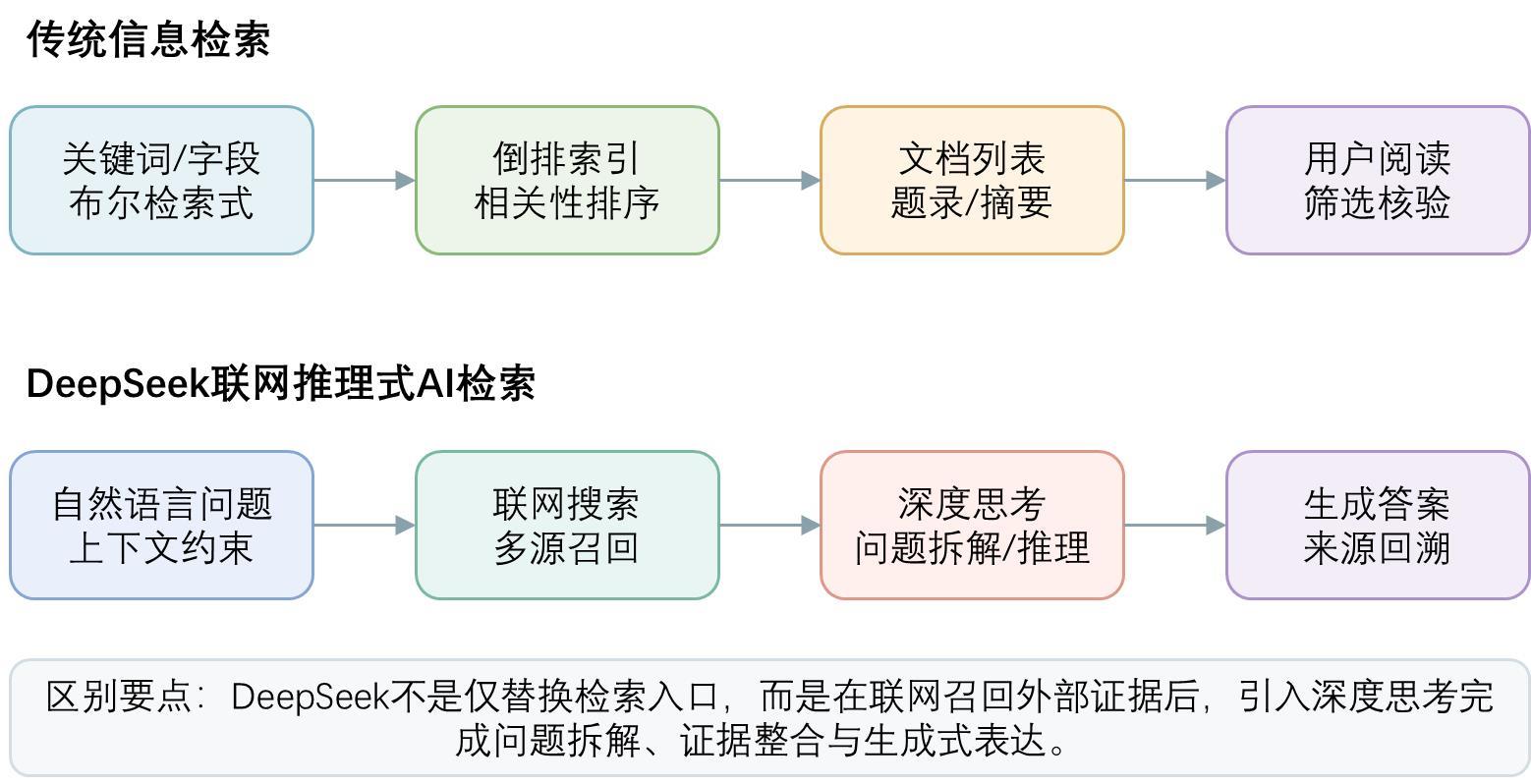
Fig. 1

Comparison of traditional information retrieval and DeepSeek web-connected reasoning AI retrieval workflows"

[1]
DeepSeek V 2系列收官, 联网搜索上线官网|DeepSeek API docs[EB/OL]. [2026-03-29].
[2]
DeepSeek-R1发布, 性能对标OpenAI o 1正式版|DeepSeek API docs[EB/OL]. [2026-03-29].
[3]
隆重推出ChatGPT搜索功能[EB/OL]. (2024-07-25)[2026-03-29].
[4]
AI in search: Going beyond information to intelligence[EB/OL]. (2025-05-20)[2026-03-29].
[5]
金家琴, 刘炜, 赵宇翔, 等. AI时代生成式搜索对情报检索范式的影响与对策[J]. 现代情报, 2026, 46(5): 16-27.
Jin Jiaqin, Liu Wei, Zhao Yuxiang, et al. Research on the impact of generative search on intelligence retrieval paradigms in AI era[J]. Journal of Modern Information, 2026, 46(5): 16-27.
[6]
欧运波. 大语言模型赋能信息检索与知识发现的框架、评测与实践路径[J]. 情报理论与实践, 2025, 48(S1): 103-110.
Ou Yunbo. Framework, evaluation and practical path of large language model-enabled information retrieval and knowledge discovery[J]. Information Studies: Theory & Application, 2025, 48(S1): 103-110.
[7]
郭鹏睿, 文庭孝. 大语言模型对信息检索系统与用户检索行为影响研究[J]. 农业图书情报学报, 2023, 35(11): 13-22.
Guo Pengrui, Wen Tingxiao. Research of the impact of LLMs on information retrieval systems and users' information retrieval behavior[J]. Journal of Library and Information Science in Agriculture, 2023, 35(11): 13-22.
[8]
张勇. 基于RAG的智慧图书馆信息检索系统构建探讨[J]. 河南图书馆学刊, 2025, 45(9): 123-125, 140.
Zhang Yong. Discussion on the construction of information retrieval system of smart library based on RAG[J]. The Library Journal of Henan, 2025, 45(9): 123-125, 140.
[9]
赵瑞雪, 黄永文, 马玮璐, 等. ChatGPT对图书馆智能知识服务的启示与思考[J]. 农业图书情报学报, 2023, 35(1): 29-38.
Zhao Ruixue, Huang Yongwen, Ma Weilu, et al. Insights and reflections of the impact of ChatGPT on intelligent knowledge services in libraries[J]. Journal of Library and Information Science in Agriculture, 2023, 35(1): 29-38.
[10]
贺聪, 杨静, 肖雄, 等. AI时代背景下高校图书馆资源建设效能评估体系构建——北京理工大学图书馆的实践探索[J]. 农业图书情报学报, 2025, 37(10): 96-111.
He Cong, Yang Jing, Xiao Xiong, et al. Construction of efficiency evaluation system for university library resource construction under the background of AI era: Practical exploration of Beijing institute of technology library[J]. Journal of Library and Information Science in Agriculture, 2025, 37(10): 96-111
[11]
张智雄, 曾建勋, 夏翠娟, 等. 回应AIGC的信息资源管理学人思考[J]. 农业图书情报学报, 2023, 35(1): 4-28.
Zhang Zhixiong, Zeng Jianxun, Xia Cuijuan, et al. Information resource management researchers' thinking about the opportunities and challenges of AIGC[J]. Journal of Library and Information Science in Agriculture, 2023, 35(1): 4-28.
[12]
裘江南, 高双燕, 黄榕江, 等. AIGC背景下人智认知导向的信息检索范式——基于世界3理论的探究[J]. 中国图书馆学报, 2025, 51(1): 34-48.
Qiu Jiangnan, Gao Shuangyan, Huang Rongjiang, et al. A human-intelligence cognitive-oriented information retrieval paradigm in the context of AIGC-An exploration based on the three worlds theory[J]. Journal of Library Science in China, 2025, 51(1): 34-48.
[13]
曾建勋. DeepSeek开源的力量[J]. 农业图书情报学报, 2025, 37(2): 100-101.
Zeng Jianxun. The power of DeepSeek open source[J]. Journal of Library and Information Science in Agriculture, 2025, 37(2): 100-101.
[14]
张兴旺, 李洁, 李思凡, 等. DeepSeek赋能图书馆知识服务的理论模型、模式创新与重要启示[J]. 农业图书情报学报, 2025, 37(1): 4-16.
Zhang Xingwang, Li Jie, Li Sifan, et al. Theoretical model, model innovation, and important implications of DeepSeek empowering library knowledge services[J]. Journal of Library and Information Science in Agriculture, 2025, 37(1): 4-16.
[15]
王伟康, 褚浩衍, 朱庆华. 基于任务驱动的信息检索人智交互体验研究——以对话式搜索引擎为例[J]. 情报理论与实践, 2025, 48(6): 132-141.
Wang Weikang, Chu Haoyan, Zhu Qinghua. Research on task-driven human-AI interaction experience in information retrieval: A case study of conversational search engine[J]. Information Studies (Theory & Application), 2025, 48(6): 132-141.
[16]
郭利敏, 刘悦如, 付雅明. 面向生成式智能体的图书馆系统架构与转型研究[J]. 农业图书情报学报, 2025, 37(12): 36-47.
Guo Limin, Liu Yueru, Fu Yaming. Design and transformation pathways of library systems driven by generative agents[J]. Journal of Library and Information Science in Agriculture, 2025, 37(12): 36-47.
[17]
王旦, 王佑镁, 王海洁, 等. “生成式”还是“传统式”?——人工智能时代研究生信息检索行为的实证研究[J]. 图书馆学研究, 2025(7): 79-91, 114.
Wang Dan, Wang Youmei, Wang Haijie, et al. Generative or traditional? - An empirical research on the information retrieval behavior of postgraduates in the age of artificial intelligence[J]. Research on Library Science, 2025(7): 79-91, 114.
[18]
郑丽平, 张垒. DeepSeek赋能高校图书馆信息素养教育: 逻辑与策略[J]. 黑龙江教师发展学院学报, 2026, 45(1): 151-154.
Zheng Liping, Zhang Lei. DeepSeek empowers information literacy education in university libraries: Logic and strategy[J]. Journal of Heilongjiang Institute of Teacher Development, 2026, 45(1): 151-154.
[19]
江京泽, 周天旻, 李妹, 等. 高校图书馆智能化转型中的复合型AI馆员核心能力模型的探索与研究[J]. 农业图书情报学报, 2025, 37(9): 97-109.
Jiang Jingze, Zhou Tianmin, Li Mei, et al. A study of the core competence model of compound AI librarians in the intelligent transformation of university libraries[J]. Journal of Library and Information Science in Agriculture, 2025, 37(9): 97-109.
[1] WU Dan, XU Hao. From Human-Computer Interaction to Human-AI Collaboration: A Frontier Perspective on Constructing an Independent Knowledge System for Information Resource Management in China [J]. Journal of library and information science in agriculture, 2026, 38(5): 55-64.
[2] LYU Lucheng, ZHOU Jian, SUN Wenjun, ZHAO Yajuan, HAN Tao. Performance of Fine-Tuned Large Language Models in Patent Text Mining [J]. Journal of library and information science in agriculture, 2026, 38(4): 36-46.
[3] AN Lin. Governance of Personal Information Security in the Iteration of Generative AI: From the Perspective of the Technological Evolution of Large Models [J]. Journal of library and information science in agriculture, 2026, 38(4): 61-70.
[4] LI Baiyang, REN Shangsheng. Technical Evolution and Application Scenarios of Open-Source Agents:A Case Study of "OpenClaw" [J]. Journal of library and information science in agriculture, 2026, 38(4): 23-35.
[5] QIAN Li, YANG Yanxi, ZHANG Yuanzhe, HU Maodi, CHANG Zhijun. The Impacts and Implications of OpenClaw for Scientific and Technical Literature Intelligence Work [J]. Journal of library and information science in agriculture, 2026, 38(4): 4-12.
[6] DENG Qiping, KE Jiaxiu, GAN Peng, ZHOU Song. Construction of an Intelligent Agent for Academic Output Data Analysis Oriented to Academic Evaluation [J]. Journal of library and information science in agriculture, 2026, 38(3): 76-87.
[7] HU Anqi. Construction of an Artificial Intelligence Literacy Ability Framework and Training System for College Students [J]. Journal of library and information science in agriculture, 2026, 38(2): 42-55.
[8] HUANG Xiaotang, YAO Qibin. Collaborative Development Path of GLAM Institutions Based on AIGC Technology Application [J]. Journal of library and information science in agriculture, 2026, 38(2): 66-78.
[9] YI Chenhe, ZHANG Yuting. Risk Assessment and Early Warning of Generative Artificial Intelligence Impact on Network Public Opinion Based on Optimized BP Neural Network [J]. Journal of library and information science in agriculture, 2026, 38(2): 30-41.
[10] GUO Hailing, ZENG Meiyun, FENG Yuxi. Model Construction and Strategies for AI-enabled University Library Services to Facilitate Scientific and Technological Achievement Transformation [J]. Journal of library and information science in agriculture, 2026, 38(2): 56-65.
[11] ZHANG Ling. Integrating Digital Humanities and Agricultural Knowledge Services A Simulation Modeling Perspectives [J]. Journal of library and information science in agriculture, 2026, 38(2): 79-89.
[12] WU Yuhao, LIU Yihao, LI Qingjun, HU Xu. Open Sharing of Library Data Based on Large Language Models: Logic, Path and Strategy [J]. Journal of library and information science in agriculture, 2026, 38(1): 28-43.
[13] JIANG Jingze, ZHOU Tianmin, LI Mei, CHENG Cheng, CHEN Haiyan. A study of the Core Competence Model of Compound AI Librarians in the Intelligent Transformation of University Libraries [J]. Journal of library and information science in agriculture, 2025, 37(9): 97-109.
[14] WANG Xiaoyu, HU Jingyuan, WU Ruoyu, WANG Shu, ZHAI Yujia. An LLM-based Data Augmentation Method for Constructing Science & Technology Topic Linkages: Taking the Energy Conservation Field as an Example [J]. Journal of library and information science in agriculture, 2025, 37(9): 63-81.
[15] SHEN Hongjie, SHEN Hongwei, WANG Junli. Generative AI Empowering Information Literacy Education in Digital Libraries: Path Exploration, Challenge Analysis, and Response Strategies [J]. Journal of library and information science in agriculture, 2025, 37(7): 50-60.
Viewed
Full text


Abstract

Cited

  Shared   
  Discussed   
No Suggested Reading articles found!