中文    English

Journal of library and information science in agriculture


Risk Assessment and Early Warning of Generative Artificial Intelligence Impact on Network Public Opinion Based on Optimized BP Neural Network

YI Chenhe, ZHANG Yuting   

  1. School of Public Administration, Xiangtan University, Xiangtan 411105
  • Received:2025-09-12 Online:2025-12-31

Abstract:

[Purpose/Significance] Generative Artificial Intelligence (GAI) has rapidly reshaped the landscape of social information dissemination, bringing unprecedented network public opinion risks-such as large-scale disinformation spread, algorithmic bias-induced social inequality, extreme emotional polarization, and model hallucinations leading to cognitive deviations-that significantly amplify the complexity, suddenness, and cross-domain spillover effects of public opinion evolution. These risks not only undermine the authenticity and order of information ecosystems but also pose severe challenges to social governance, public trust, and policy-making efficiency, making accurate identification, quantitative assessment, and early warning an urgent academic and practical task. Existing research has obvious limitations: single-dimensional assessment frameworks fail to capture GAI's multi-faceted and interrelated risks, such as the concealment of generated content, algorithmic recommendation amplification and cross-platform diffusion; traditional models such as basic BP neural networks suffer from susceptibility to local optima and poor generalization, inadequately adapting to the non-linear, dynamic, and high-dimensional attributes of GAI-generated content. To address these gaps, this study constructed a 4-dimensional risk assessment index system (content, dissemination, sentiment, and user) and proposed a GA-optimized BP neural network model, which will enrich public opinion management theories in the AI era and provide practical, efficient tools for precise risk control. It will contribute to the construction of a safe, orderly, and trustworthy online space. [Method/Process] A mixed research method with solid theoretical foundations (information communication theory and intelligent optimization algorithms) and empirical support was adopted: Ten typical GAI-induced public opinion events were selected from Sina Weibo (selection criteria: views ≥1 million, original posts ≥60, covering technology, society, public affairs, and consumption fields). Following a four-stage evolutionary model (formation, outbreak, mitigation, and recovery) and four early warning levels (Level I-IV, corresponding to binary outputs 1000, 0100, 0010, 0001) as specified in national emergency management standards, samples were systematically categorized into four evolutionary stages and corresponding risk grades. A 12-indicator system covering content (authenticity, misleadingness, and professionalism), dissemination (speed, scope, and diffusion path), sentiment (intensity, polarization degree, and negative ratio), and user (influencing impact, participant activity, and interaction stickiness) dimensions was constructed. The weights of each indicator were determined to ensure objectivity, and data preprocessing was performed via min-max normalization to eliminate dimensional differences. A 4-layer BP neural network (12 input neurons, 2 hidden layers with 15 and 10 neurons respectively, and 4 output neurons) was built, with initial weights, thresholds, and hyperparameters (learning rate and iteration times) optimized by genetic algorithm (GA). A traditional BP model served as the control group, with 70% of data as the training set and 30% as the test set, and model performance was evaluated based on prediction accuracy. [Results/Conclusions] Experimental results confirm the significant superiority of the GA-BP model: its prediction accuracy reached 91.67%, 8.34 percentage points higher than the traditional BP model (83.33%). This verifies that GA optimization effectively improved model performance, enabling better capture of complex non-linear relationships among GAI-induced risk factors. The multi-dimensional index system successfully extracted core risk characteristics, realizing comprehensive identification and traceability of GAI-related public opinion risks. Limitations of this study include sample concentration on Chinese social platforms, limited case quantity, and narrow time span. Future research will expand cross-border, multi-language samples (e.g., Twitter, Facebook), enrich technical indicators (e.g., GAI content identifiability, algorithmic intervention intensity), and explore integration with deep learning models (e.g., LSTM, Transformer) to further enhance the generalizability, real-time performance, and intelligent decision-making support capabilities of the risk assessment system.

Key words: genetic algorithm, backpropagation neural network, generative artificial intelligence, public opinion risk early warning

CLC Number: 

  • G206

Table 1

Preliminary index system for public opinion risk assessment of generative artificial intelligence"

指标体系一级指标二级指标性质向性
生成式人工智能舆情风险评估初级指标体系U内容维度U1信息真实性U11定量正向
内容直观度U12定量负向
焦点偏离度U13定量负向
传播维度U2扩散加速度U21定量负向
跨平台扩散率U22定量负向
传播持续性U23定量负向
情感维度U3情感极化烈度U31定量负向
情感传染强度U32定量负向
价值观扭曲度U33定量负向
用户维度U4交互活跃度U41定量负向
用户画像风险U42定量负向
行动转化率U43定量负向

Table 2

Public opinion topics related to generative artificial intelligence"

案例话题名称话题详情/条阶段样本
A1#地震被压废墟下戴帽小孩是AI生成的#

7 597.4万阅读量

2 670原创量

形成阶段1
爆发阶段2
缓解阶段3
平复阶段4
A2#大学生要警惕被AI控制#

2 000.3万阅读量

680原创量

形成阶段5
爆发阶段6
缓解阶段7
平复阶段8
A3#央视揭AI假女友诈骗#

1 438万阅读量

560原创量

形成阶段9
爆发阶段10
缓解阶段11
平复阶段12
A4#AI造谣顶流明星在澳门输10亿#

431.8万阅读量

129原创量

形成阶段13
爆发阶段14
缓解阶段15
平复阶段16
A5#荐股群所谓内幕或是AI生成#

680万阅读量

420原创量

形成阶段17
爆发阶段18
缓解阶段19
平复阶段20
A6#央视报告AI假冒名人明星#

3 211.8万阅读量

788原创量

形成阶段21
爆发阶段22
缓解阶段23
平复阶段24
A7#AI复活名人玩梗要有尺度#

350.1万阅读量

153原创量

形成阶段25
爆发阶段26
缓解阶段27
平复阶段28
A8#大学生滥用AI发上千条骚扰短信#

181.6万阅读量

74原创量

形成阶段29
爆发阶段30
缓解阶段31
平复阶段32
A9#短剧疑似AI换脸迪丽热巴#

1亿阅读量

5 289原创量

形成阶段33
爆发阶段34
缓解阶段35
平复阶段36
A10#账号教用AI一键去衣被查#

416.8万阅读量

169原创量

形成阶段37
爆发阶段38
缓解阶段39
平复阶段40

Table 3

Normalized sample data"

样本U11U12U13U21U22U23U31U32U33U41U42U43
10.201 70.308 60.258 40.327 90.242 90.221 60.375 30.340 90.357 20.142 90.272 50.279 1
20.000 30.957 10.873 21.000 00.855 10.892 91.000 01.000 00.721 40.860 11.000 00.860 7
30.261 70.670 40.622 90.576 50.428 60.402 50.493 60.657 30.507 10.428 30.508 20.632 2
40.675 90.142 90.224 70.340 30.167 90.267 00.220 80.114 30.201 10.213 30.139 10.201 3
50.469 30.285 70.007 90.155 60.013 90.180 60.000 00.142 90.002 30.284 90.023 60.189 7
60.104 30.714 30.430 90.763 20.574 30.705 80.033 10.571 40.483 30.703 40.527 50.557 6
70.523 30.621 70.175 00.540 90.431 80.469 40.013 70.428 60.290 70.642 90.308 20.330 4
80.673 80.012 90.000 00.012 00.009 10.102 50.001 20.000 00.012 40.000 00.113 60.020 8
90.452 10.370 40.175 00.334 20.160 90.230 20.240 50.357 10.000 70.283 70.137 50.302 6
100.121 00.857 10.642 10.872 50.658 20.722 90.562 00.714 30.470 10.857 00.590 60.691 1
110.375 30.571 40.525 30.580 30.570 60.480 30.375 20.571 40.393 10.560 20.375 20.301 2
120.798 10.142 90.005 50.320 90.042 90.035 20.223 60.285 70.011 40.130 80.127 10.016 6
130.125 00.328 00.263 00.257 80.439 60.263 50.325 10.571 40.372 20.341 60.257 30.307 2
140.007 90.857 10.672 10.503 11.000 00.772 81.000 00.978 41.000 00.779 20.737 80.548 0
150.536 10.571 40.532 20.224 50.714 30.635 00.557 40.857 10.470 80.502 30.472 50.341 2
160.696 20.142 90.150 40.134 90.285 70.180 40.312 60.428 60.220 30.286 20.212 50.205 1
170.225 10.051 40.243 70.217 40.065 20.290 70.137 20.357 10.116 70.229 80.159 10.170 1
180.032 50.683 10.860 10.774 50.557 10.670 10.562 90.714 30.490 10.680 10.597 50.502 4
190.561 70.571 40.629 10.569 00.431 40.332 90.330 50.571 40.258 20.552 40.362 10.328 9
200.775 00.285 70.126 50.145 20.043 70.198 30.012 70.428 60.191 40.285 50.038 90.002 7
210.211 60.460 10.077 40.112 70.185 10.280 50.467 20.357 10.190 30.428 60.137 50.370 1
220.042 30.857 10.826 70.790 80.690 10.876 90.886 20.714 30.314 40.866 10.608 61.000 0
230.625 10.631 40.623 10.653 30.579 20.356 20.479 10.571 40.280 90.523 10.530 80.572 4
241.000 00.285 70.107 90.008 50.131 60.119 30.392 50.128 60.121 60.290 60.112 50.225 1
250.425 00.314 30.490 30.037 60.103 30.343 60.000 00.285 70.103 20.019 20.125 30.023 7
260.231 70.769 10.762 50.750 60.760 20.780 20.374 20.571 40.391 30.520 10.518 80.390 8
270.625 80.714 30.601 20.572 20.443 50.634 70.253 30.428 60.274 10.311 80.123 70.203 5
280.768 30.328 60.250 30.002 40.028 60.000 00.004 30.142 90.110 60.102 30.000 00.000 0
290.349 70.285 70.125 70.008 70.002 10.113 20.251 10.042 90.112 50.000 00.342 10.312 3
300.215 20.471 40.532 80.547 90.390 20.429 70.570 20.357 10.590 20.408 20.550 30.970 4
310.596 00.028 60.375 20.112 40.293 60.308 90.370 80.285 70.311 90.317 10.367 50.776 8
321.000 00.000 00.140 90.000 00.000 00.000 00.102 30.000 00.200 10.110 50.000 00.201 5
330.115 60.857 10.425 90.437 50.430 80.537 20.534 10.582 30.000 00.430 80.238 10.382 4
340.000 01.000 01.000 00.997 51.000 01.000 01.000 00.714 30.342 11.000 00.630 91.000 0
350.341 70.714 30.753 30.629 00.702 30.792 80.409 30.571 40.210 80.857 10.412 50.490 5
360.241 60.498 60.375 80.212 50.410 90.520 60.237 50.428 60.102 20.491 30.112 90.281 1
370.264 90.214 30.317 50.370 70.080 60.170 40.162 50.285 70.015 50.114 50.289 70.155 6
380.172 20.328 70.570 20.590 80.421 50.690 30.330 90.484 30.367 30.590 70.632 40.492 0
390.375 60.474 30.379 80.447 50.320 10.408 20.217 50.320 90.228 90.488 50.410 50.277 1
400.667 30.085 70.107 50.09250.025 30.066 70.137 50.042 90.021 50.128 60.109 20.166 7

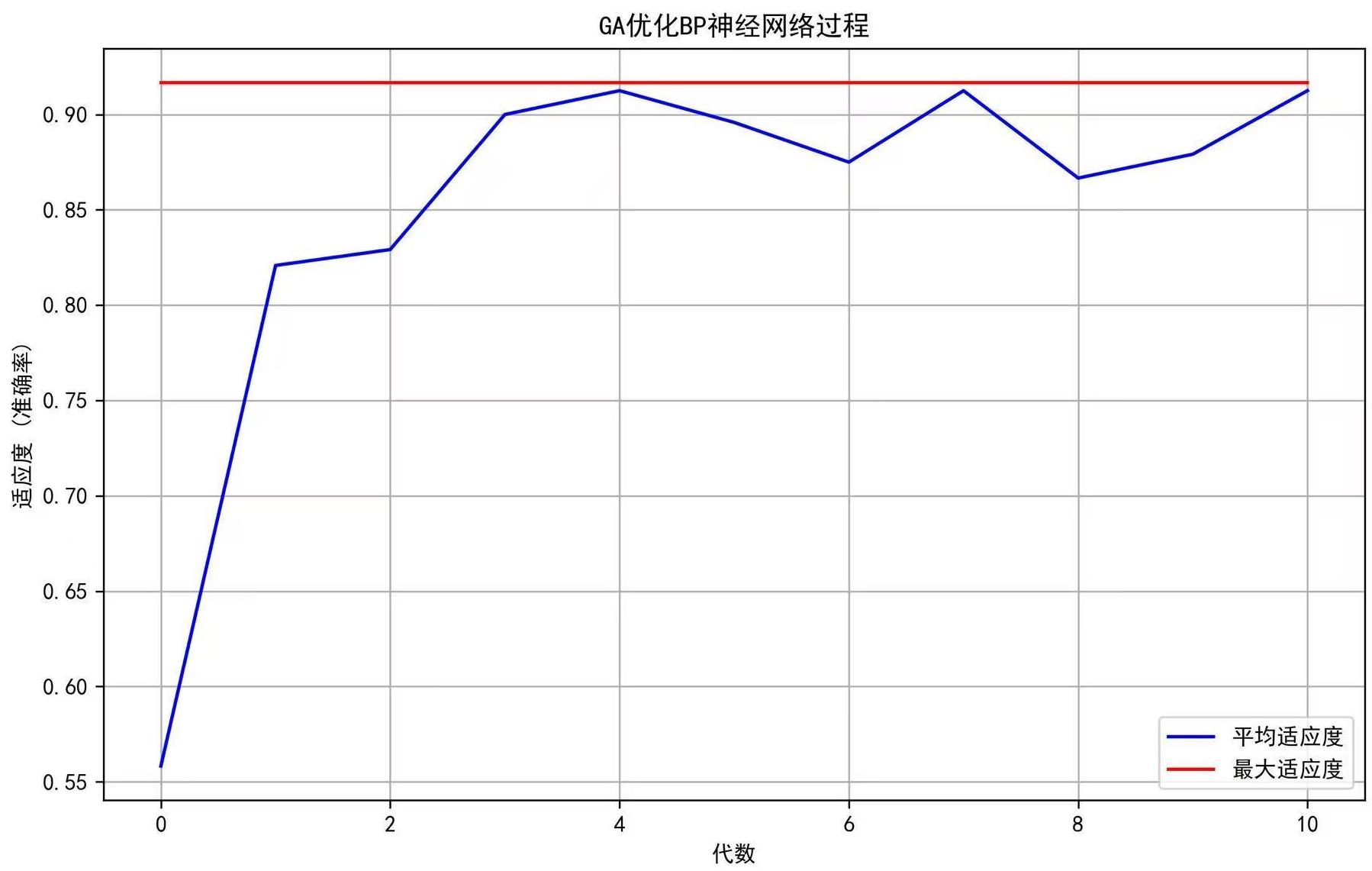
Fig.1

Optimization process of GA-BP neural network model"

Table 4

Comparison of experimental results"

样本期望输出标准BP神经网络输出GA-BP神经网络输出
50001

0

0.000

0

0.000

0

0.000

1

0.999

0

0.000

0

0.000

0

0.000

1

0.999

70010

0

0.018

0

0.054

0

0.066

1

0.909

0

0.007

0

0.005

0

0.003

1

0.986

101000

1

0.921

0

0.076

0

0.000

0

0.002

1

0.889

0

0.116

0

0.000

0

0.000

130010

0

0.000

0

0.000

1

0.936

0

0.063

0

0.000

0

0.008

1

0.981

0

0.009

160010

0

0.000

0

0.000

1

0.969

0

0.030

0

0.000

0

0.001

1

0.978

0

0.020

170010

0

0.000

0

0.000

1

0.990

0

0.010

0

0.000

0

0.000

1

0.973

0

0.026

200001

0

0.000

0

0.000

0

0.129

1

0.987

0

0.000

0

0.000

0

0.199

1

0.799

260100

0

0.108

1

0.883

0

0.001

0

0.008

0

0.169

1

0.829

0

0.000

0

0.001

270100

0

0.002

0

0.004

0

0.308

1

0.686

0

0.008

1

0.820

0

0.123

0

0.051

280001

0

0.000

0

0.000

0

0.000

1

0.999

0

0.000

0

0.000

0

0.000

1

0.999

380100

0

0.455

1

0.941

0

0.002

0

0.010

0

0.106

1

0.884

0

0.002

0

0.007

400001

0

0.000

0

0.000

0

0.000

1

0.999

0

0.000

0

0.000

0

0.000

1

0.999

[1] 詹希旎, 李白杨, 张心源, 等. 人工智能生成内容(AIGC)的监管与合规治理研究: 基于多源流耦合分析[J/OL]. 图书情报知识, 2025: 1-12. .
ZHAN X N, LI B Y, ZHANG X Y, et al. The regulatory and compliance governance of artificial intelligence generated content: A multi-source flow coupling analysis[J/OL]. Documentation, information & knowledge, 2025: 1-12. .
[2] ROSELLI D, MATTHEWS J, TALAGALA N. Managing bias in AI[C]//Companion Proceedings of the 2019 World Wide Web Conference. San Francisco USA: ACM, 2019: 539-544.
[3] 张文祥. 生成式人工智能虚假信息的舆论生态挑战与治理进路[J]. 山东大学学报(哲学社会科学版), 2025(1): 155-164.
ZHANG W X. Governance approaches of public opinion: Ecosystems and challenges from generative AI disinformation[J]. Journal of Shandong University (philosophy and social sciences), 2025(1): 155-164.
[4] 谢耘耕, 张秀丽. 人工智能生成内容对舆论生态的介入、挑战及治理[J]. 新媒体与社会, 2024(1): 30-42, 390, 391.
XIE Y G, ZHANG X L. The intervention, challenges and governance of AI generated content in the public opinion ecology[J]. New media and society, 2024(1): 30-42, 390, 391.
[5] 黄日涵, 姚浩龙. “再塑造”与“高风险”: 生成式人工智能对舆论安全的影响[J]. 情报杂志, 2024, 43(4): 121-127.
HUANG R H, YAO H L. "Reshaping" and "high risk": The impact of generative artificial intelligence on public opinion security[J]. Journal of intelligence, 2024, 43(4): 121-127.
[6] 张爱军, 贾璐. 类ChatGPT人工智能语境下网络舆情安全的风险样态及其规制[J]. 情报杂志, 2023, 42(12): 180-187.
ZHANG A J, JIA L. Risk patterns and regulations of online public opinion security in the context of ChatGPT[J]. Journal of intelligence, 2023, 42(12): 180-187.
[7] PENG L J, SHAO X G, HUANG W M. Research on the early-warning model of network public opinion of major emergencies[J]. IEEE access, 2021, 9: 44162-44172.
[8] WITBOOI P J. Stability of an SEIR epidemic model with independent stochastic perturbations[J]. Physica A: Statistical mechanics and its applications, 2013, 392(20): 4928-4936.
[9] 黄炜, 吴昀璟, 余辉, 等. 生成式人工智能引发的网络舆情风险预警研究: 基于引爆点理论分析[J]. 情报杂志, 2025, 44(3): 98-106.
HUANG W, WU Y J, YU H, et al. Research on early warning of network public opinion risks triggered by generative artificial intelligence: An analysis based on tipping point theory[J]. Journal of intelligence, 2025, 44(3): 98-106.
[10] 李思佳, 郑德铭, 孙正义. 微博中基于用户特征的突发事件信息传播分析[J]. 农业图书情报学报, 2023, 35(11): 86-97.
LI SJ, ZHENG D M, SUN Z Y. Analysis of information dissemination of emergencies based on weibo user characteristics[J]. Journal of library and information science in agriculture, 2023, 35(11): 86-97.
[11] 顾海硕, 贾楠, 孟子淳, 等. 基于SEIR-SPN的突发事件网络舆情演化及预警机制[J]. 情报杂志, 2024, 43(4): 146-155.
GU H S, JIA N, MENG Z C, et al. Research on the evolution and early warning mechanism of network public opinion for emergencies based on SEIR-SPN[J]. Journal of intelligence, 2024, 43(4): 146-155.
[12] 李启月, 杨晓枭, 黄兴, 等. 基于系统安全降维理论的网络舆情危机预警方法研究[J]. 情报杂志, 2021, 40(9): 88-94.
LI Q Y, YANG X X, HUANG X, et al. Research on early warning methods of network public opinion crisis based on system security and dimensionality reduction theory[J]. Journal of intelligence, 2021, 40(9): 88-94.
[13] 杨柳, 徐宇昭, 邓春林. 高校网络舆情风险评估及预警研究[J]. 情报科学, 2022, 40(5): 65-72, 83.
YANG L, XU Y Z, DENG C L. Risk assessment and early warning of university network public opinion[J]. Information science, 2022, 40(5): 65-72, 83.
[14] 章留斌, 彭程, 钱浩然. 基于社会安全阀的地方政务发布舆情预警模型研究[J]. 情报科学, 2020, 38(4): 101-107.
ZHANG L B, PENG C, QIAN H R. Public opinion early warning model of local government weibo based on social safety valve[J]. Information science, 2020, 38(4): 101-107.
[15] 袁媛. 面向公共安全风险防控的疫情网络舆情预警研究: 以刚果埃博拉病毒为例[J]. 情报科学, 2022, 40(1): 44-50.
YUAN Y. The Internet public opinion early warning of epidemics for public security risk prevention and control: Taking Congo Ebola as an example[J]. Information science, 2022, 40(1): 44-50.
[16] 孙玲芳, 周加波, 林伟健, 等. 基于BP神经网络和遗传算法的网络舆情危机预警研究[J]. 情报杂志, 2014, 33(11): 18-24.
SUN L F, ZHOU J B, LIN W J, et al. On network public opinion crisis early warning based on the BP neural network and genetic algorithm[J]. Journal of intelligence, 2014, 33(11): 18-24.
[17] 游丹丹, 陈福集. 基于改进粒子群和BP神经网络的网络舆情预测研究[J]. 情报杂志, 2016, 35(8): 156-161.
YOU D D, CHEN F J. Research on the prediction of network public opinion based on improved PSO and BP neural network[J]. Journal of intelligence, 2016, 35(8): 156-161.
[18] 黄亚驹, 陈福集, 游丹丹. 基于混合算法和BP神经网络的网络舆情预测研究[J]. 情报科学, 2018, 36(2): 24-29.
HUANG Y J, CHEN F J, YOU D D. Research on the prediction of network public opinion based on hybrid algorithm and BP neural network[J]. Information science, 2018, 36(2): 24-29.
[19] 陈福集, 肖鸿雁. 基于改进ABC-BP模型的网络舆情热度预测研究[J]. 图书馆学研究, 2018(9): 84-89, 101.
CHEN F J, XIAO H Y. Research on the heat prediction of network public opinion based on improved ABC-BP model[J]. Research on library science, 2018(9): 84-89, 101.
[20] 林育曼, 文海宁, 饶浩. 基于ARIMA-BP神经网络模型的微信舆情热度预测[J]. 统计与决策, 2019, 35(14): 71-74.
LIN Y M, WEN H N, RAO H. Prediction of WeChat public opinion based on ARIMA-BP neural network model[J]. Statistics & decision, 2019, 35(14): 71-74.
[21] 程铁军, 王曼, 黄宝凤, 等. 基于CEEMDAN-BP模型的突发事件网络舆情预测研究[J]. 数据分析与知识发现, 2021, 5(11): 59-67.
CHENG T J, WANG M, HUANG B F, et al. Predicting online public opinion in emergencies based on CEEMDAN-BP[J]. Data analysis and knowledge discovery, 2021, 5(11): 59-67.
[22] 张鹏, 李昊青, 兰月新, 等. 基于BP神经网络的突发事件网络谣言危机预警[J]. 电子政务, 2016(11): 40-47.
ZHANG P, LI H Q, LAN Y X, et al. Early warning of network rumor crisis of emergencies based on BP neural network[J]. E-Government, 2016(11): 40-47. 40-47.
[23] 张鑫, 田雪灿, 刘鑫雅. 反复性视角下网络舆情风险评估指标体系研究[J]. 图书与情报, 2020(6): 123-135.
ZHANG X, TIAN X C, LIU X Y. Research on the risk assessment index system of Internet public opinion from the perspective of recurrence[J]. Library & information, 2020(6): 123-135.
[24] 李玥琪, 王晰巍, 王楠阿雪, 等. 突发事件下社交媒体网络舆情风险识别及预警模型研究[J]. 情报学报, 2022, 41(10): 1085-1099.
LI Y Q, WANG X W, WANG N, et al. Risk identification and early warning model of social media network public opinion in emergencies[J]. Journal of the China society for scientific and technical information, 2022, 41(10): 1085-1099.
[25] 金燕, 朱家伟, 朱一梅, 等. 社交媒体中生成式AI的舆论操纵特征识别及应对策略研究[J]. 情报理论与实践, 2025, 48(9): 109-119.
JIN Y, ZHU J W, ZHU Y M, et al. Identifying characteristics of public opinion manipulation and response strategies by generative AI in social media[J]. Information studies: Theory & application, 2025, 48(9): 109-119.
[26] HE J M, TIAN D M, LIU Y Z. The measure method of complaint theme influence in view of netizens' emotional resonance[J]. Journal of systems science and information, 2017, 5(4): 310-327.
[27] 曾润喜, 王晨曦, 陈强. 网络舆情传播阶段与模型比较研究[J]. 情报杂志, 2014, 33(5): 119-124.
ZENG R X, WANG C X, CHEN Q. Comparative study on transmission phase and model of Internet public opinion[J]. Journal of intelligence, 2014, 33(5): 119-124.
[1] ZHAI Jun, MENG Zihan, LI Fangsu, SHEN Lixin. AI Guides in Research Libraries of North America under the AI4S Context: Based on the Survey of 125 ARL Libraries [J]. Journal of library and information science in agriculture, 2025, 37(7): 35-49.
[2] SHEN Hongjie, SHEN Hongwei, WANG Junli. Generative AI Empowering Information Literacy Education in Digital Libraries: Path Exploration, Challenge Analysis, and Response Strategies [J]. Journal of library and information science in agriculture, 2025, 37(7): 50-60.
[3] ZHANG Li, WANG Bo, JING Shui. Generative AI-Driven Resource Discovery in Public Libraries: Service Optimization Based on a Dynamic Evaluation Model [J]. Journal of library and information science in agriculture, 2025, 37(5): 58-71.
[4] SHI Xujie, YUAN Fan, LI Jia. Searching as Learning in the Context of Generative Artificial Intelligence: Technological Pathways, Behavioral Evolution, and Ethical Challenges [J]. Journal of library and information science in agriculture, 2025, 37(5): 40-57.
[5] GOU Ruike, LUO Wei. Influencing Factors of Continuous Use Intention of "Generation Z" Users of an AIGC Platform [J]. Journal of library and information science in agriculture, 2025, 37(3): 66-80.
[6] QIAO Jinhua, MA Xueyun. Risks and Regulations for Application of the LLaMA Model in University Future Learning Centers [J]. Journal of library and information science in agriculture, 2025, 37(2): 37-48.
[7] LUO Guofeng, YI Tong, YAN Zhouzhou. Critical Information Literacy Education in University Libraries from the Perspective of AIGC Application [J]. Journal of library and information science in agriculture, 2025, 37(1): 47-58.
[8] SUN Lijuan. Exploring the Transition of Public Librarians to "Prompt Librarians" from the Perspective of New Quality Productive Forces [J]. Journal of library and information science in agriculture, 2025, 37(1): 17-32.
[9] Baiyang LI, Rong SUN. Construction of an AI Literacy General Education Curriculum Based on "Knowledge-Skills" Navigation [J]. Journal of library and information science in agriculture, 2024, 36(8): 34-42.
[10] Huaming LI. Opportunities and Challenges: The Use of ChatGPT in Enabling Library Knowledge Services [J]. Journal of library and information science in agriculture, 2024, 36(8): 96-105.
[11] Jia LIU. Innovation and Risk Avoidance of Smart Library Services Based on Generative Artificial Intelligence [J]. Journal of library and information science in agriculture, 2024, 36(7): 63-75.
[12] Mo LI, Bin YANG. From Generative Artificial Intelligence to Artificial General Intelligence: Enabling Innovation Models in Library Knowledge Services [J]. Journal of library and information science in agriculture, 2024, 36(6): 50-61.
[13] WANG Weizheng, QIAO Hong, LI Xiaojun, WANG Jingjing. User Willingness to Use Generative Artificial Intelligence Based on AIDUA Framework [J]. Journal of library and information science in agriculture, 2024, 36(2): 36-50.
[14] MA Lecun, ZHAN Xini, ZHU Qiyu, SUN Rong, LI Baiyang. Digital Intelligence Integration Innovation Development of GLAM Driven by AIGC [J]. Journal of library and information science in agriculture, 2023, 35(5): 4-15.
Viewed
Full text


Abstract

Cited

  Shared   
  Discussed   
No Suggested Reading articles found!