中文    English

Journal of library and information science in agriculture


Model Construction and Strategies for AI-enabled University Library Services to Facilitate Scientific and Technological Achievement Transformation

GUO Hailing1,2, ZENG Meiyun1, FENG Yuxi1   

  1. 1. School of Management, Hebei University, Baoding 071002
    2. Research Institute for Digital Governance and Collaborative Governance of Hebei Province, Baoding 071002
  • Received:2025-10-24 Online:2026-01-22

Abstract:

[Purpose/Significance] Against the backdrop of national innovation-driven development strategies and the pressing need to enhance the efficiency with which scientific and technological achievements are transformed within universities, university libraries are undergoing a critical transition. They are shifting from being traditional, passive information providers to becoming proactive, embedded partners in the research and innovation value chain. However, this transition is often hampered by inherent limitations in traditional service models. This study, therefore, posits artificial intelligence (AI) as a pivotal enabler and investigates the specific mechanisms through which AI technologies can empower university libraries to achieve deep, systemic integration into the entire lifecycle of technology transfer. The research aims to provide a comprehensive theoretical framework for understanding this transformation and offer actionable, evidence-based practical pathways for academic libraries to redefine their functional boundaries and substantially strengthen the institutional support ecosystem for university technology transfer. [Method/Process] This research employs a qualitative multi-case study design, underpinned by an analytical framework constructed around the four critical, sequential stages of the technology transfer lifecycle: 1) research topic selection and project initiation, 2) research and development, 3) project conclusion and evaluation, and 4) marketization and industrialization of outcomes. Case selection followed purposive sampling criteria to ensure representation across diverse contexts, including domestic and international universities, as well as varied library types. The primary data comprised detailed case descriptions from published academic literature, institutional reports, and official service platforms. Within this staged framework, the analysis focuses on two intertwined dimensions at each phase: the evolution of the library's core service functions and the transformative impact of AI empowerment. Through a comparative cross-case analysis, this study examines how specific AI technologies augment traditional services, fundamentally changing the role and value proposition of libraries. [Results/Conclusions] The results show that through intelligent information analysis, knowledge association, data mining, and precise matching, AI can promote university libraries to shift from resource supply-oriented support to collaborative services that run through the entire lifecycle of technology transfer. This transformation manifests across the four-stage lifecycle as a shift: from providing literature to forecasting opportunities at the initiation phase; from offering patent data to navigating R&D pathways and risks during development; from archiving outputs to assessing value and potential at conclusion; and from disseminating information to intelligently brokering industry partnerships at the commercialization phase. Synthesizing these stage-specific transformations, this study constructs a novel, integrated service framework. This framework explicitly links specific AI capabilities with the redefined core functions of the library at each stage, illustrating the transition from a linear support model to a dynamic, AI-augmented ecosystem wherein the library serves as a central intelligence node. Meanwhile, this study reveals practical challenges in current practices, including ambiguous organizational boundaries, insufficient professional capabilities, and imperfect evaluation mechanisms oriented toward technology transfer. Correspondingly, it proposes strategies such as clarifying collaborative positioning, strengthening the construction of AI-empowered service capabilities, and improving technology transfer-oriented evaluation mechanisms to promote the sustainable development of AI-empowered research services in university libraries.

Key words: artificial intelligence, university libraries, technology transfer, full-lifecycle services, case study

CLC Number: 

  • G258.6

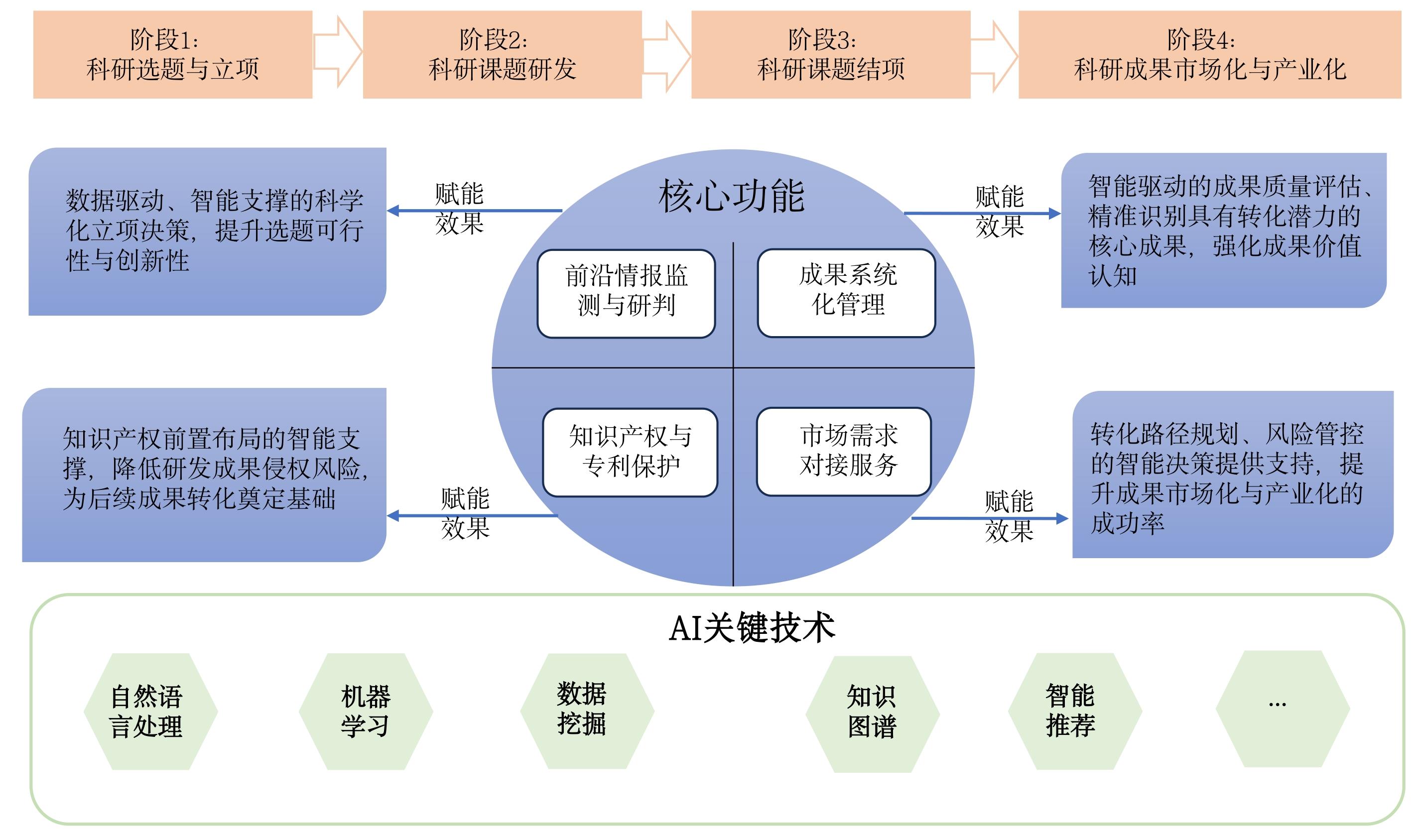
Fig.1

AI-empowered service model for scientific and technological achievement transformation in university libraries"

[1]
国务院关于促进科技成果转化工作情况的报告_中国人大网[EB/OL]. [2025-12-29].
[2]
中华人民共和国促进科技成果转化法[EB/OL]. [2015-08-30].
[3]
张鹏, 周恩毅, 刘启雷. 创新生态系统视角下科技成果转化的高校图书馆服务创新研究[J]. 新世纪图书馆, 2020(3): 40-44.
Zhang Peng, Zhou Enyi, Liu Qilei. Research on the innovation of university library service under the perspective of innovation ecological system[J]. New Century Library, 2020(3): 40-44.
[4]
李琪, 叶继元. 人工智能驱动科学(AI4S)赋能高校图书馆学科情报服务的场景、模式和策略探索[J/OL].图书馆, 1-11[2025-10-08].
Li Qi, Ye Jiyuan. AI for Science(AI4S) empowers the exploration of scenarios, models and strategies for subject intelligence services in university library[J/OL]. Library, 1-11[2025-10-08].
[5]
许强. 分阶段体系化概念验证是科技成果转化的“牛鼻子”[J]. 中国软科学, 2024(3): 174-178.
Xu Qiang. Phased and systematized concept verification is the key to the transformation of scientific and technological achievements[J]. China Soft Science, 2024(3): 174-178.
[6]
闫雨薇, 王海川, 杨曙红. 高校图书馆助力科技成果转化研究[J]. 国际公关, 2022(6): 100-102.
Yan Yuwei, Wang Haichuan, Yang Shuhong. Research on university library's contribution to the transformation of scientific and technological achievements[J]. PR Magazine, 2022(6): 100-102.
[7]
高彦静, 刘晶晶, 张杰. 论高校图书馆开展知识产权信息服务职能定位[J]. 图书馆建设, 2019(S1): 20-24.
Gao Yanjing, Liu Jingjing, Zhang Jie. On the functional orientation of intellectual property information service in university libraries[J]. Library Development, 2019(S1): 20-24.
[8]
苑亚坤, 吴昊. 研究型图书馆服务科研院所科技成果转化的模式与策略研究[J]. 图书情报工作, 2023, 67(10): 47-55.
Yuan Yakun, Wu Hao. Research on the service mode and strategy of research libraries for the transformation of scientific and technological achievements of research institutes[J]. Library and Information Service, 2023, 67(10): 47-55.
[9]
范琴. 基于知识转移的高校图书馆知识产权信息服务策略研究——以南京农业大学为例[J]. 图书馆界, 2023(3): 61-69.
Fan Qin. Research on intellectual property information service strategy of university library based on knowledge transfer - Taking Nanjing agricultural university as an example[J]. Library World, 2023(3): 61-69.
[10]
夏燕. 面向科技成果转化的高校图书馆信息服务策略研究[J]. 河北科技图苑, 2019, 32(1): 55-59.
Xia Yan. Study on information service strategies of university library oriented to transformation of sci-tech achievements[J]. Hebei Sci-Tech Library Journal, 2019, 32(1): 55-59.
[11]
Dewland J, Elliott C M. Embedding libraries in the university commercialization process[M]. Lanham: Rowman & Littlefield Publishers, 2015: 41-50.
[12]
Dewland J, Jackson J. Technology transfer and libraries: Embedding the library in the technology transfer process[J]. Qualitative and Quantitative Methods in Libraries, 2016, 5(2): 409-416.
[13]
魏东原, 祝林, 陈嘉琪. 专业图书馆为实体经济服务的思索与实践[J]. 图书情报工作, 2019, 63(1): 111-117.
Wei Dongyuan, Zhu Lin, Chen Jiaqi. The discussion and implementation of how to make the professional libraries serve the real economy development[J]. Library and Information Service, 2019, 63(1): 111-117.
[14]
廖兰辉. 图书馆参与科技成果转化的制约因素与策略[J]. 图书馆学刊, 2019, 41(2): 91-94.
Liao Lanhui. Restrictive factors and strategies of library's participation in the transformation of scientific and technological achievements[J]. Journal of Library Science, 2019, 41(2): 91-94.
[15]
潘卫, 董珏, 王钧钰, 等. 高校图书馆情报服务智库化探索与发展思考——以上海交通大学图书馆为例[J]. 大学图书馆学报, 2025, 43(3): 5-14.
Pan Wei, Dong Jue, Wang Junyu, et al. Think tank-oriented development of intelligence services in university libraries[J]. Journal of Academic Libraries, 2025, 43(3): 5-14.
[16]
张更平, 陈欣. 用户导向的知识产权信息服务探索——基于同济大学图书馆的实践与思考[J]. 大学图书馆学报, 2025, 43(3): 43-49.
Zhang Gengping, Chen Xin. Exploring user-oriented intellectual property information services - Insights from the practice of Tongji University library[J]. Journal of Academic Libraries, 2025, 43(3): 43-49.
[17]
Kulkanjanapiban P, Silwattananusarn T, Lambovska M. Research on AI-driven innovations and services in academic libraries: A bibliometric and systematic literature review[J]. Journal of Data and Information Science, 2025, 10(4): 146-196.
[18]
张若楠, 刘琪, 李鑫鑫. 生成式人工智能赋能高校图书馆文献资源建设路径探析[J]. 图书馆理论与实践, 2025(5): 66-75, 105.
Zhang Ruonan, Liu Qi, Li Xinxin. Exploring pathways for generative artificial intelligence to empower the construction of university library literature resources[J]. Library Theory and Practice, 2025(5): 66-75, 105.
[19]
傅平, 邹小筑, 吴丹, 等. 回顾与展望: 人工智能在图书馆的应用[J]. 图书情报知识, 2018, 35(2): 50-60.
Fu Ping, Zou Xiaozhu, Wu Dan, et al. Retrospective analysis and prediction: Artificial intelligence and its applications in libraries[J]. Document, Information & Knowledge, 2018, 35(2): 50-60.
[20]
刘淑华, 侯西龙, 张洪孟. 生成式人工智能背景下高校图书馆新型数字学术服务内容与工具调查分析[J]. 图书馆工作与研究, 2025(1): 62-71, 112.
Liu Shuhua, Hou Xilong, Zhang Hongmeng. Investigation and analysis of new digital scholarship service content and tools in university libraries in the background of generative artificial intelligence[J]. Library Work and Study, 2025(1): 62-71, 112.
[21]
邵敏. 清华大学图书馆学科服务架构与学科馆员队伍建设[J]. 图书情报工作, 2008, 52(2): 11-14.
Shao Min. Subject service framework and subject librarian team construction in Tsinghua university library[J]. library and Information Service, 2008, 52(2): 11-14.
[22]
宋西贵, 王平利, 万益嘉, 等. AI时代高校图书馆开放创新生态构建: 美国国会图书馆Innovator in Residence项目的启示[J]. 大学图书馆学报, 2025, 43(6): 82-92.
Song Xigui, Wang Pingli, Wan Yijia, et al. Building an open innovation ecosystem for university libraries in the age of AI: Enlightenment from the innovator in residence project of the library of congress[J]. Journal of Academic Libraries, 2025, 43(6): 82-92.
[23]
同济大学图书馆. 同济大学图书馆AI智能助手“智小图”上线试运行[EB/OL]. (2025-01-19) [2025-10-10].
[24]
华南理工大学图书馆. 首批高校国家知识产权信息服务中心评估结果出炉 华南理工获评“优秀”[EB/OL]. (2024-08-21)[2025-10-10].
[25]
西北农林科技大学图书馆. 知识产权信息服务[EB/OL]. (2023-05-18)[2025-10-10].
[26]
北京大学图书馆. 让知识传播的纽带在夏日里飞扬-北京大学图书馆交流学习有感[EB/OL]. (2019-03-14)[2025-10-10].
[27]
厦门大学图书馆. 厦门市与厦门大学签署合作协议: 共建世界知识产权组织在华技术与创新支持中心(TISC)[EB/OL]. (2023-05-06)[2025-10-10].
[1] JIANG Jingze, ZHOU Tianmin, LI Mei, CHENG Cheng, CHEN Haiyan. A study of the Core Competence Model of Compound AI Librarians in the Intelligent Transformation of University Libraries [J]. Journal of library and information science in agriculture, 2025, 37(9): 97-109.
[2] SHEN Hongjie, SHEN Hongwei, WANG Junli. Generative AI Empowering Information Literacy Education in Digital Libraries: Path Exploration, Challenge Analysis, and Response Strategies [J]. Journal of library and information science in agriculture, 2025, 37(7): 50-60.
[3] DONG Ke, SONG Yuchen, WU Jiachun. Layout and Characteristics of European AI Data Governance Policy [J]. Journal of library and information science in agriculture, 2025, 37(7): 4-18.
[4] ZHAI Jun, MENG Zihan, LI Fangsu, SHEN Lixin. AI Guides in Research Libraries of North America under the AI4S Context: Based on the Survey of 125 ARL Libraries [J]. Journal of library and information science in agriculture, 2025, 37(7): 35-49.
[5] SHI Xujie, YUAN Fan, LI Jia. Searching as Learning in the Context of Generative Artificial Intelligence: Technological Pathways, Behavioral Evolution, and Ethical Challenges [J]. Journal of library and information science in agriculture, 2025, 37(5): 40-57.
[6] CHEN Jiayong, GONG Jiaoteng, WANG Yuyi. Research of Interdisciplinary Comparison and Collaborative Paradigm on the Concept of Agent in Library Science [J]. Journal of library and information science in agriculture, 2025, 37(5): 27-39.
[7] ZHANG Li, WANG Bo, JING Shui. Generative AI-Driven Resource Discovery in Public Libraries: Service Optimization Based on a Dynamic Evaluation Model [J]. Journal of library and information science in agriculture, 2025, 37(5): 58-71.
[8] GOU Ruike, LUO Wei. Influencing Factors of Continuous Use Intention of "Generation Z" Users of an AIGC Platform [J]. Journal of library and information science in agriculture, 2025, 37(3): 66-80.
[9] QIAO Jinhua, MA Xueyun. Risks and Regulations for Application of the LLaMA Model in University Future Learning Centers [J]. Journal of library and information science in agriculture, 2025, 37(2): 37-48.
[10] GUO Wenli. The Five Laws of Library Science in the AIGC Era: Contextual Integration and Boundary Expansion [J]. Journal of library and information science in agriculture, 2025, 37(10): 22-36.
[11] HE Cong, YANG Jing, XIAO Xiong, SUN Wenwen, LI Chenggang. Construction of Efficiency Evaluation System for University Library Resource Construction under the Background of AI Era: Practical Exploration of Beijing Institute of Technology Library [J]. Journal of library and information science in agriculture, 2025, 37(10): 96-111.
[12] SUN Lijuan. Exploring the Transition of Public Librarians to "Prompt Librarians" from the Perspective of New Quality Productive Forces [J]. Journal of library and information science in agriculture, 2025, 37(1): 17-32.
[13] LUO Guofeng, YI Tong, YAN Zhouzhou. Critical Information Literacy Education in University Libraries from the Perspective of AIGC Application [J]. Journal of library and information science in agriculture, 2025, 37(1): 47-58.
[14] Hecan ZHANG, Chengqi YI, Peng GUO, Qianqian HUANG, Xiaokun JIN. Copyright Data Dilemma of Building High-Quality Data System for AI: Present Situation, Coping Strategies, and Implementation Path [J]. Journal of library and information science in agriculture, 2024, 36(9): 32-43.
[15] Xuemei LUO, Yuzhe LIN. Graduate Student Digital Literacy Promotion Pathway Driven by AIGC [J]. Journal of library and information science in agriculture, 2024, 36(9): 70-77.
Viewed
Full text


Abstract

Cited

  Shared   
  Discussed   
No Suggested Reading articles found!