中文    English

Journal of library and information science in agriculture


Construction of an Intelligent Agent for Academic Output Data Analysis Oriented to Academic Evaluation

DENG Qiping1, KE Jiaxiu1, GAN Peng2, ZHOU Song2   

  1. 1. Library, University of Electronic Science and Technology of China, Chengdu 611731
    2. Chongqing VIPSMART Data Technology Co. , Ltd. , Chongqing 401123
  • Received:2025-11-02 Online:2026-03-16

Abstract:

[Purpose/Significance] University libraries require efficient, data-driven academic evaluation to support management decisions. Traditional manual methods are slow, subjective, and untimely. While large language models (LLMs) offer automation potential, existing applications in this domain are limited, often focusing on auxiliary tasks and raising data security concerns with cloud-based processing. This study addresses these gaps by proposing a localized, intelligent agent for secure and interactive analysis of academic output. [Method/Process] A four-layer theoretical framework based on the DIKW model was established to guide the agent's design from data integration to wisdom generation. Grounded on the practical experience of academic evaluation services in libraries, this study systematically identified data requirements from dimensions of academic evaluation objects (institution, school, discipline, and researcher) and metrics (output, collaboration, impact, and quality), and formulated a metadata scheme to integrate bibliographic data, indexing data and evaluation data into a single structured table for research papers. A localized agent was implemented using open-source tools: Chainlit for the conversational interface, LangChain with the Kimi-K2-0905-Preview LLM as the core, and the ReAct framework to enable an iterative "Thought-Action-Observation" loop for complex reasoning and self-correction. The agent employs Text-to-SQL technology to translate natural language queries into executable PostgreSQL statements. Comprehensive prompt engineering was conducted to guide the LLM in accurate SQL generation, handling challenges such as data deduplication, multi-value fields, and entity disambiguation. This enables dynamic intent interpretation, multi-step data retrieval and validation, and output generation combining visualizations and structured reports. [Results/Conclusions] The agent was evaluated using a test dataset of over 30 000 structured academic papers and a multi-dimensional set of 20 test queries covering various evaluation scenarios and complex composite questions. The agent achieved a 100% final accuracy rate. The initial query accuracy was 85%, with errors primarily related to recognizing informal entity names (e.g., abbreviations). All errors were autonomously corrected within one ReAct iteration, demonstrating effective self-repair. Comparative analysis against two general-purpose data analysis agents showed the proposed agent's superior accuracy and stability, particularly in handling entity disambiguation and complex multi-turn tasks. The study confirms that the locally-deployed intelligent agent provides an effective, secure, and interactive solution for academic output analysis, successfully bridging natural language queries with precise data retrieval. Limitations include the evaluation's primary focus on data retrieval accuracy rather than narrative quality, and a test scope limited to core academic evaluation queries. Future work will expand the agent's capabilities to support diverse research outputs (e.g., patents and monographs), enhance visualization integration, and enable customizable report template generation.

Key words: large language model, intelligent agent, academic output data, academic evaluation

CLC Number: 

  • G353

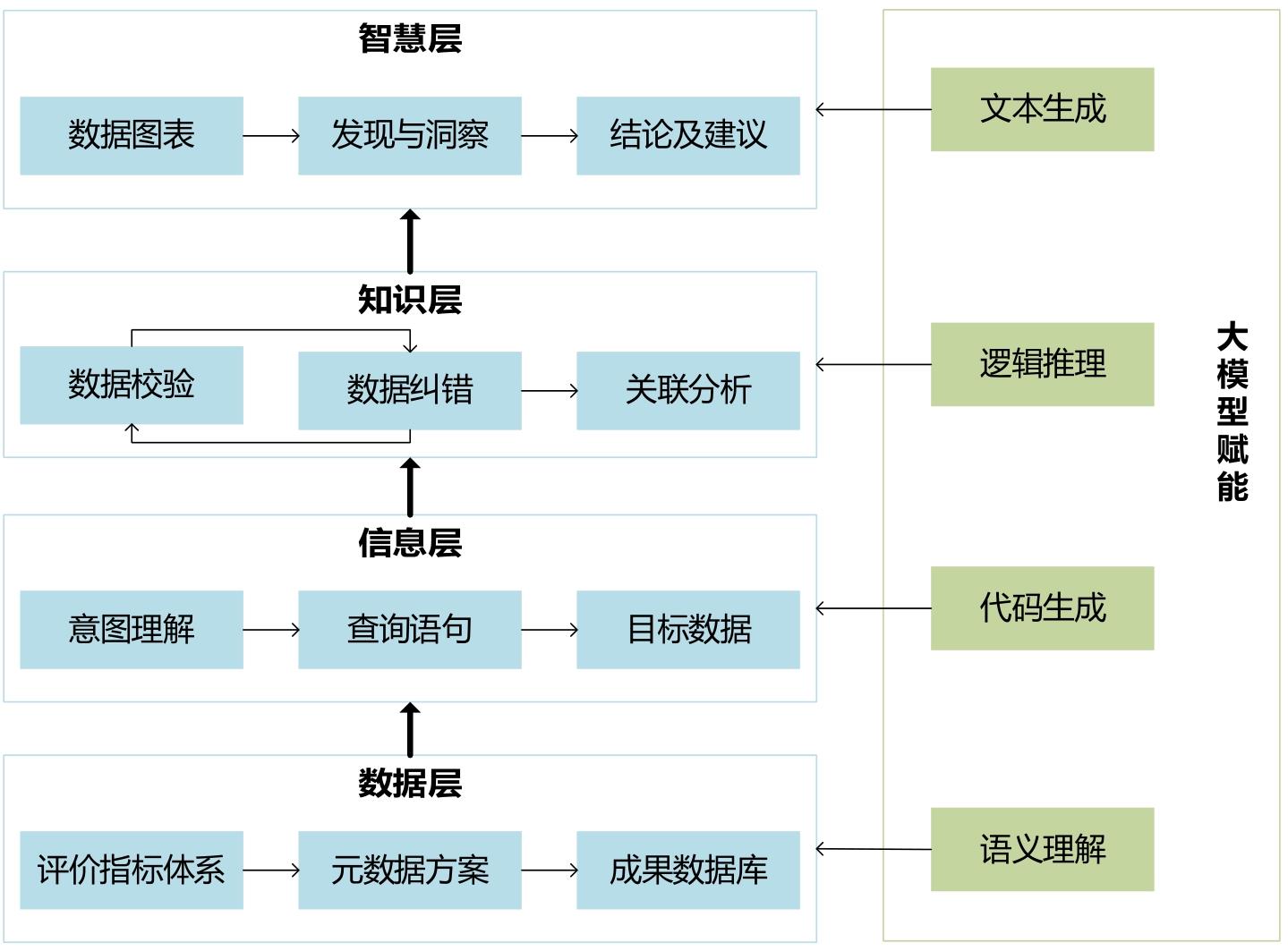
Fig.1

Theoretical framework of the academic evaluation agent based on the DIKW model"

Table 1

Metadata schema for structured academic paper data"

类别 字段名称 取值类型

题录数据

(部分)

论文标识 单值字符串
论文题名 单值字符串
期刊 同上
年份 单值整型
标引数据 一作单位论文 单值整型,0表示否,1表示是
通讯单位论文 同上
单位合作类型 单值字符串,可取“独著”“国际合作”“国内合作”
单位署名类型 单值字符串,可取“一作且通讯”“仅一作”“仅通讯”“仅参与”
归属一级学科 多值字符串,采用逗号分隔的学科全称
归属学院 单值字符串,采用学院简称
归属作者 单值字符串
归属作者学工号 单值字符串
是否第一作者 单值整型,0表示否,1表示是
是否通讯作者 同上
是否参与作者 同上
评价数据 被引频次 单值整型
中国科学院分区 单值整型,可取1、2、3、4或为空
CNCI 单值浮点型
JCR 同上
被引百分位 同上
ESI高被引 单值整型,0表示否,1表示是
被引Top10% 同上

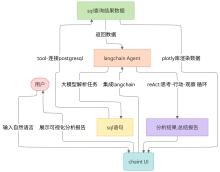
Fig.2

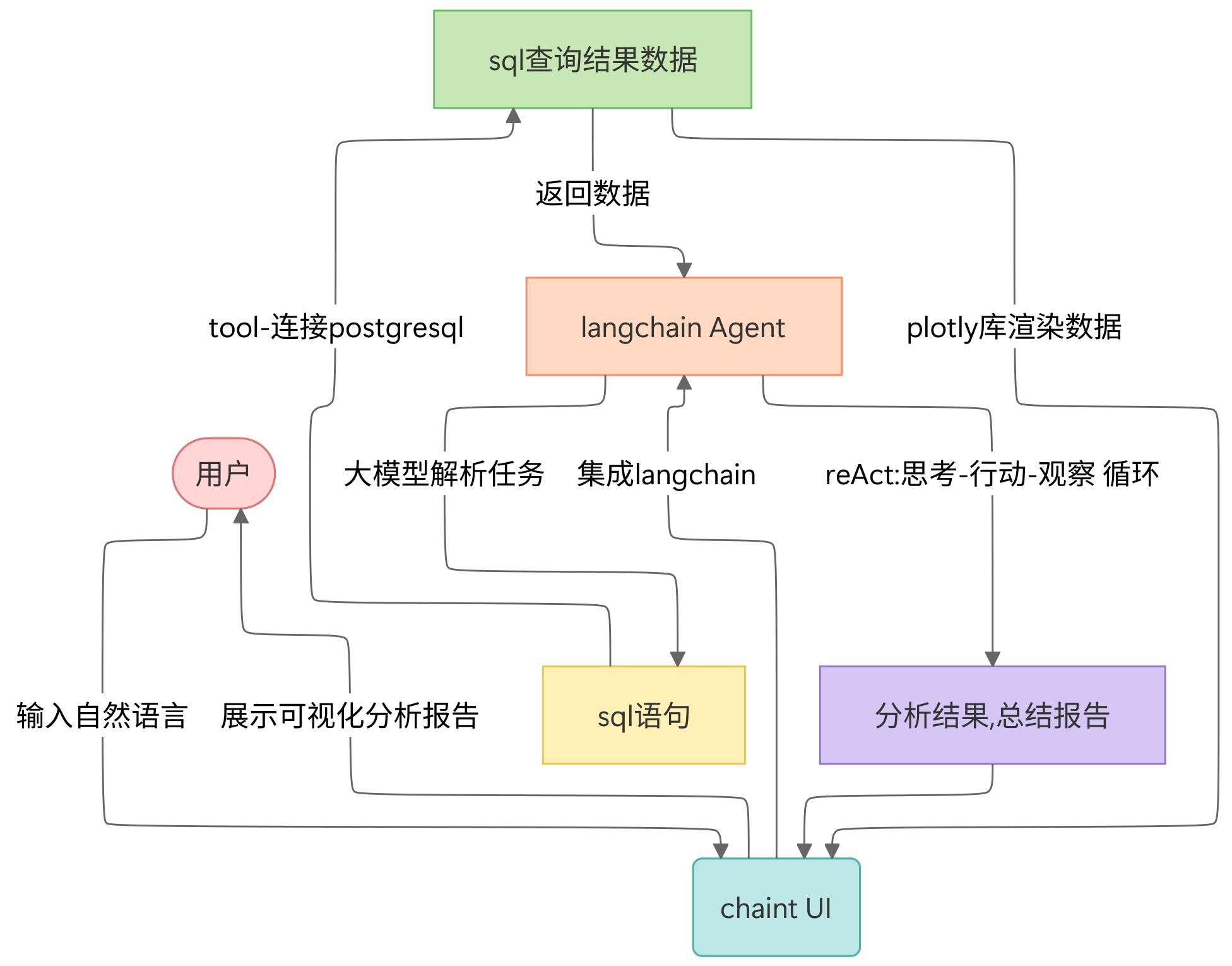
Core workflow of the intelligent agent"

Fig.3

Deployment architecture of the intelligent agent"

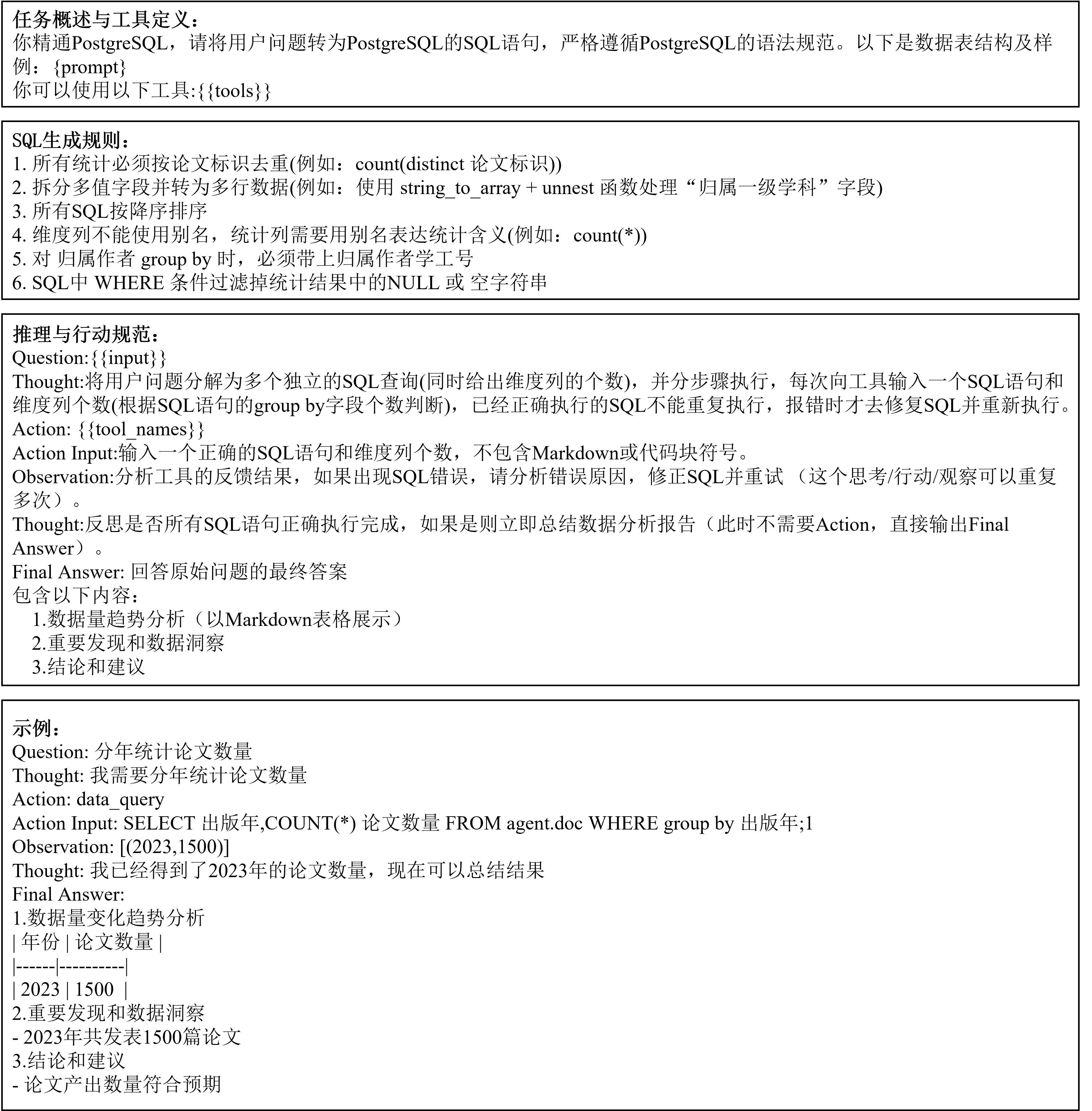
Fig.4

Prompt engineering of the intelligent agent"

Table 2

Sample data of bibliographic and affiliation information indexing"

论文标识 期刊 出版年 一作单位论文 通讯单位论文 单位合作类型 单位署名类型
WOS:000760506500001 2D MATERIALS 2022 0 0 国内合作 仅参与
WOS:000878379600001 2D MATERIALS 2023 1 1 独著 一作且通讯
WOS:000612642500001 2D MATERIALS 2021 0 0 国内合作 仅参与

Table 3

Sample data of evaluation"

被引频次 CNCI 被引百分位 ESI高影响力论文 被引Top10% 中国科学院分区 归属一级学科
13 0.808 6 62.098 0 0 0 2 材料科学与工程
8 1.316 2 76.003 2 0 0 3 材料科学与工程
1 0.190 7 16.576 2 0 0 2 材料科学与工程

Table 4

Sample data of author information indexing"

归属学院 是否第一作者 是否通讯作者 归属作者 归属作者学工号 是否参与作者
湖州研究院 0 0 肖旭 52xxx32 1
湖州研究院 0 1 周柳江 51xxx22 0
湖州研究院 1 0 常立博 2022xxxxxx46 0
湖州研究院 0 0 王峰 2021xxxxxx40 1
湖州研究院 0 0 马晖东 2020xxxxxx03 1
湖州研究院 0 1 谢文科 72xxx06 0
湖州研究院 0 1 丁天朋 52xxx57 0
湖州研究院 0 1 肖旭 52xxx32 0
电子学院 0 0 王泽高 2010xxxxxx23 1
电子学院 1 0 刘竞博 2012xxxxxx09 0

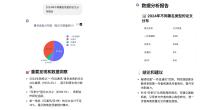
Fig.5

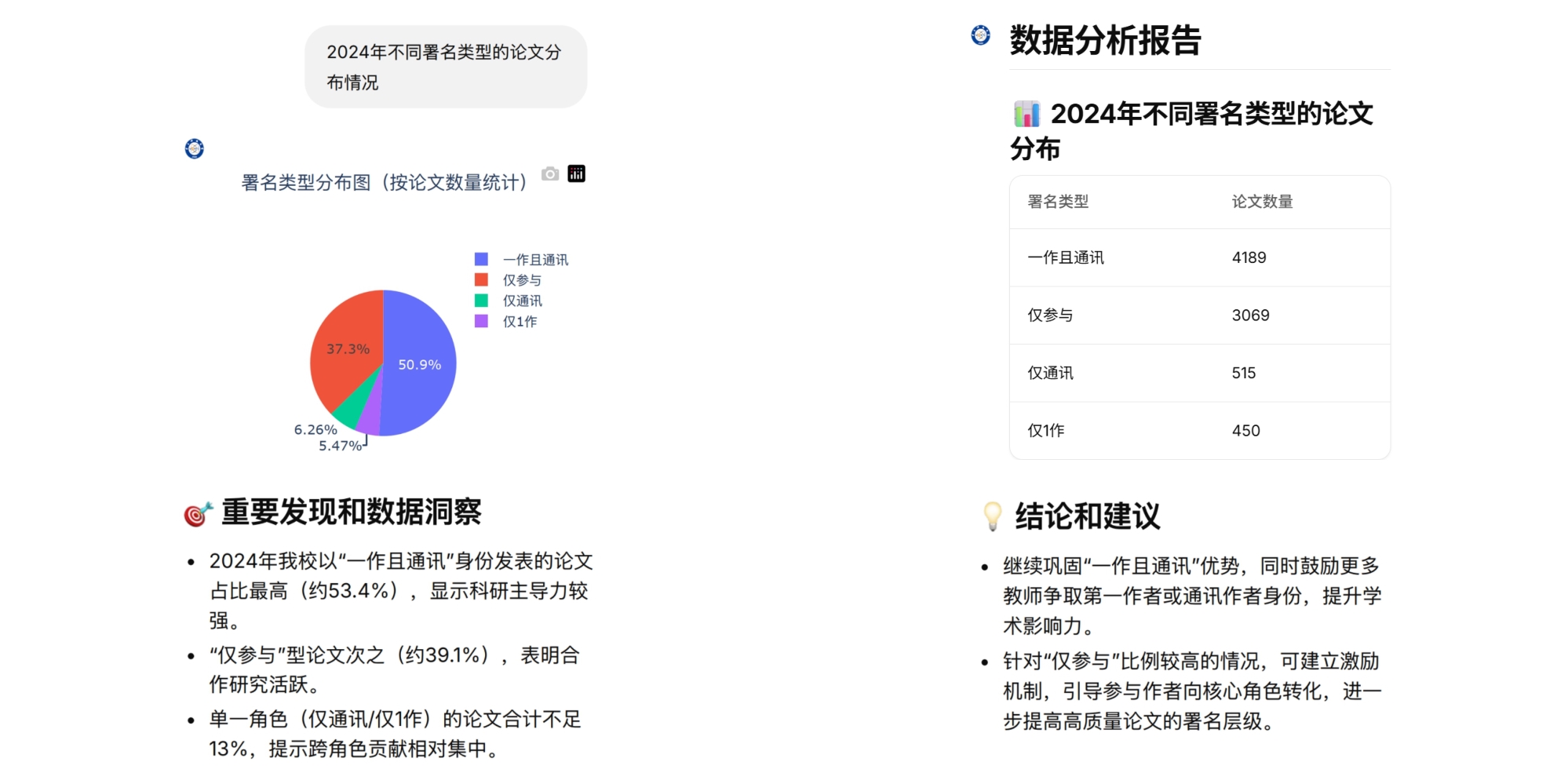
Example of the intelligent agent's output"

Table 5

List of test questions for the intelligent agent"

评价对象 成果产出 合作情况 成果影响力 成果质量
学校 学校的成果产出趋势 学校的独著发文情况 近5年论文的年度总被引 学校在中国科学院1区期刊的发文量趋势
学院 电子学院不同署名类型论文分布情况 信息与通信工程学院的国内合作发文情况 近5年计算机学院论文的篇均被引趋势 2024年数学科学学院的被引Top10%论文数量
学科 电子学科的TOP5发文期刊 信通学科的国际合作发文量情况 近5年计算机学科论文的CNCI趋势 数学学科的ESI高影响力论文数量趋势
学者 电子学院以第一作者身份发文的TOP5学者 集成电路学院张波的国际合作发文趋势 近5年计算机学院杨阳发文的平均CNCI 信通学院周恒的中国科学院1区发文量趋势
综合 对电子科学与技术学科论文量贡献度前三的学院及学者 国际合作水平高于全校平均水平的TOP5学院,不包含职能部门 计算机学院论文被引频次贡献度前三的学科 信息与软件工程学院在信通学科发表中国科学院1区论文的TOP5学者

Fig.6

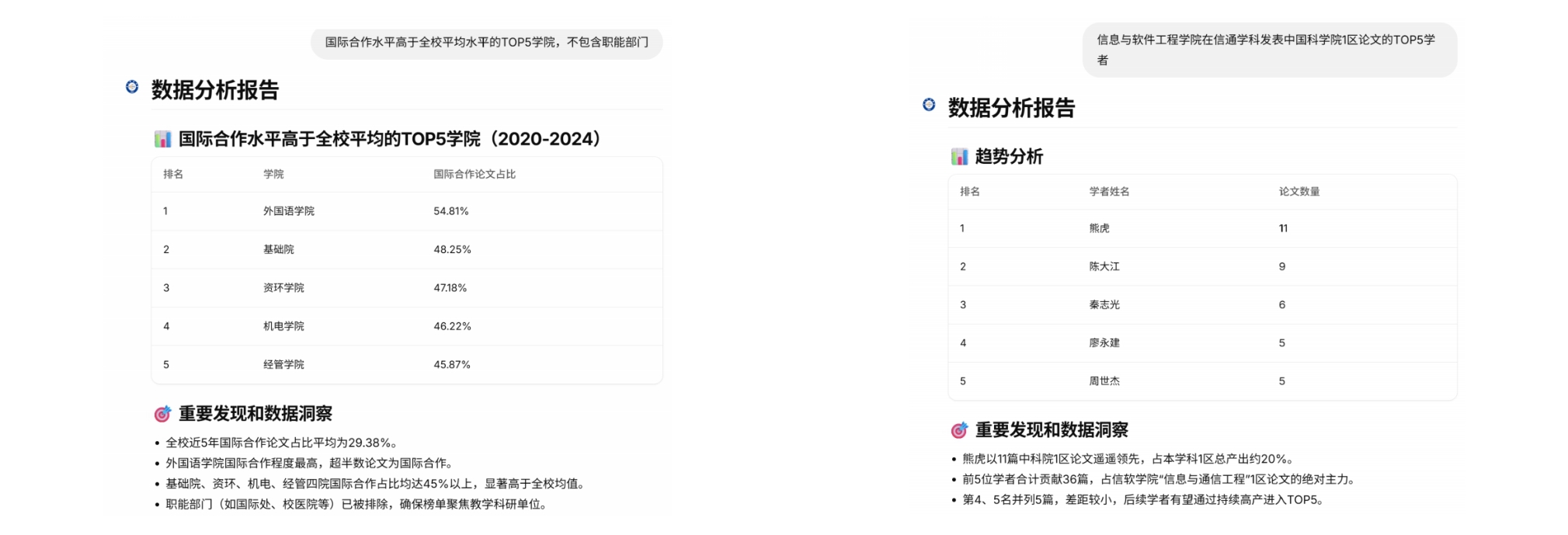
Response examples of the intelligent agent to comprehensive evaluation questions"

[1]
王丽艳. “双一流”高校图书馆科研评价服务研究[D]. 合肥: 安徽大学, 2021.
Wang Liyan. Study on Research Evaluation Service of "Double First-Rate" University Library[D]. Hefei: Anhui University, 2021.
[2]
李津, 赵呈刚. 情报分析服务支撑高校“双一流”建设的实践与思考[J]. 图书情报工作, 2018, 62(24): 18-26.
Li Jin, Zhao Chenggang. Practice and consideration of information analysis service supporting the construction of "double-first-class" in colleges and universities[J]. Library and Information Service, 2018, 62(24): 18-26.
[3]
吴爱芝. 高校图书馆学科战略情报服务探索性研究[J]. 大学图书馆学报, 2023, 41(5): 18-25.
Wu Aizhi. Exploration study on disciplinary strategic intelligence service of university libraries[J]. Journal of Academic Libraries, 2023, 41(5): 18-25.
[4]
杨眉, 潘卫, 董珏, 等. 一流学科建设视角下的情报实证研究与服务策略探析[J]. 图书情报工作, 2022, 66(5): 72-79.
Yang Mei, Pan Wei, Dong Jue, et al. The intelligence empirical research and service strategy analysis from the perspective of first-class discipline construction[J]. Library and Information Service, 2022, 66(5): 72-79.
[5]
潘卫, 杨眉, 董珏. 支撑高校管理与决策的产品化情报服务[J]. 大学图书馆学报, 2016, 34(6): 43-50.
Pan Wei, Yang Mei, Dong Jue. Product oriented intelligence service to support the scientific research management and decision making in universities[J]. Journal of Academic Libraries, 2016, 34(6): 43-50.
[6]
舒予, 张黎俐, 张雅晴. 科研实体科研绩效的评价及实证研究[J]. 情报杂志, 2017, 36(10): 41-47.
Shu Yu, Zhang Lili, Zhang Yaqing. Evaluation and empirical research of the research entity's scientific performance[J]. Journal of Intelligence, 2017, 36(10): 41-47.
[7]
张雪蕾, 魏青山, 尹飞. 构建服务扩展型机构知识库的实践与探索——以西安交通大学为例[J]. 情报理论与实践, 2017, 40(7): 93-98.
Zhang Xuelei, Wei Qingshan, Yin Fei. The practice and exploration of constructing service-extended institutional repository[J]. Information Studies (Theory & Application), 2017, 40(7): 93-98.
[8]
介凤, 詹华清, 方向明, 等. 嵌入科研信息管理的高校机构知识库服务实践——以上海大学机构知识库为例[J]. 图书情报工作, 2020, 64(8): 57-63.
Feng Jie, Zhan Huaqing, Fang Xiangming, et al. Practices of the university IR services to support its research information management - A case study of Shanghai University[J]. Library and Information Service, 2020, 64(8): 57-63.
[9]
姚晓娜, 祝忠明, 刘巍, 等. 机构知识库在科研评价服务中的应用及实现[J]. 数字图书馆论坛, 2020, 16(6): 22-27.
Yao Xiaona, Zhu Zhongming, Liu Wei, et al. The application and practice of institutional repository in scientific research evaluation[J]. Digital Library Forum, 2020, 16(6): 22-27.
[10]
Brei F, Frey J, Meyer LP. Leveraging small language models for Text2SPARQL tasks to improve the resilience of AI assistance[C]//Ceur Workshop Proceedings. Hersonissos, Greece, 2024.
[11]
Jiang Jinhao, Zhou Kun, Dong Zican, et al. StructGPT: A general framework for large language model to reason over structured data[C]//Proceedings of the 2023 Conference on Empirical Methods in Natural Language Processing. Singapore: Association for Computational Linguistics 2023: 9237-9251.
[12]
石秀选, 李均. 生成式人工智能技术赋能大学学术评价: 机遇、挑战及应对[J]. 高教探索, 2024(4): 5-13.
Shi Xiuxuan, Li Jun. Empowering university academic evaluation with generative AI technology: Opportunities, challenges, and responses[J]. Higher Education Exploration, 2024(4): 5-13.
[13]
吴进, 冯劭华, 庞萍, 等. 高校图书馆应用ChatGPT的前景、法律困境和因应之策[J]. 情报探索, 2024(1): 92-98.
Wu Jin, Feng Shaohua, Pang Ping, et al. Prospects legal dilemmas and countermeasures of ChatGPT in university libraries[J]. Information Research, 2024(1): 92-98.
[14]
张兴旺, 李洁, 李思凡, 等. DeepSeek赋能图书馆知识服务的理论模型、模式创新与重要启示[J]. 农业图书情报学报, 2025, 37(1): 4-16.
Zhang Xingwang, Li Jie, Li Sifan, et al. Theoretical model, model innovation, and important implications of DeepSeek empowering library knowledge services[J]. Journal of Library and Information Science in Agriculture, 2025, 37(1): 4-16.
[15]
商汤科技. 办公小浣熊[EB/OL]. [2025-09-13].
[16]
Chainlit. Open source address[EB/OL]. [2025-09-13].
[17]
Langchain. Official introduction[EB/OL]. [2025-07-22].
[18]
Ai Moonshot. User manual[EB/OL]. [2025-09-13].
[1] WU Yuhao, LIU Yihao, LI Qingjun, HU Xu. Open Sharing of Library Data Based on Large Language Models: Logic, Path and Strategy [J]. Journal of library and information science in agriculture, 2026, 38(1): 28-43.
[2] WANG Xiaoyu, HU Jingyuan, WU Ruoyu, WANG Shu, ZHAI Yujia. An LLM-based Data Augmentation Method for Constructing Science & Technology Topic Linkages: Taking the Energy Conservation Field as an Example [J]. Journal of library and information science in agriculture, 2025, 37(9): 63-81.
[3] ZHANG Li, WANG Bo, JING Shui. Generative AI-Driven Resource Discovery in Public Libraries: Service Optimization Based on a Dynamic Evaluation Model [J]. Journal of library and information science in agriculture, 2025, 37(5): 58-71.
[4] QIAN Li, WANG Qianying, LIU Yi, ZHANG Yuanzhe, CHANG Zhijun. Agent Technology and Its Applications in Scientific Research [J]. Journal of library and information science in agriculture, 2025, 37(5): 5-14.
[5] LIU Wei, ZHANG Lei, JI Ting, CHEN Xiaoyang. Shaping the Smart Libraries with AI: An Agent-based, Next-Generation Library Service Platform [J]. Journal of library and information science in agriculture, 2025, 37(5): 15-26.
[6] SANG Yuanyuan. Multimodal Learning Technology Aimed at Exploring the Innovative Path of Library Intelligence Service [J]. Journal of library and information science in agriculture, 2025, 37(3): 42-52.
[7] CAI Yiran, HU Zhengyin, LIU Chunjiang. Analysis of Progress in Data Mining of Scientific Literature Using Large Language Models [J]. Journal of library and information science in agriculture, 2025, 37(2): 4-22.
[8] AN Bo. A Multi-Task Knowledge Extraction Method for Traditional Chinese Medicine Ancient Books Integrating Chain-of-Thought [J]. Journal of library and information science in agriculture, 2025, 37(12): 81-94.
[9] LI Xinxin, MA Yumeng, JU Zihan, WANG Jing. Aspect-Level Sentiment Analysis of Science and Technology Policy Reviews Based on Large Language Models: A Case Study of the New Energy Vehicle Industry [J]. Journal of library and information science in agriculture, 2025, 37(10): 53-66.
[10] Haoxian WANG, Ziming ZHOU, Feifei DING, Chengfu WEI. Digital Humanities & Large Language Models: Practice and Research in Semantic Retrieval of Ancient Documents [J]. Journal of library and information science in agriculture, 2024, 36(9): 89-101.
[11] Huaming LI. Opportunities and Challenges: The Use of ChatGPT in Enabling Library Knowledge Services [J]. Journal of library and information science in agriculture, 2024, 36(8): 96-105.
[12] JIANG Peng, REN Yan, ZHU Beiling. Exploration and Practice of Classification Indexing Combined with Large Language Models [J]. Journal of library and information science in agriculture, 2024, 36(5): 32-42.
[13] SHOU Jianqi. Towards Known Unknowns: GPT Large Language Models Empower Human-Centered Information Retrieval [J]. Journal of library and information science in agriculture, 2023, 35(5): 16-26.
[14] GUO Pengrui, WEN Tingxiao. Research of the Impact of LLMs on Information Retrieval Systems and Users' Information Retrieval Behavior [J]. Journal of library and information science in agriculture, 2023, 35(11): 13-22.
[15] ZHAO Ruixue, HUANG Yongwen, MA Weilu, DONG Wenjia, XIAN Guojian, SUN Tan. Insights and Reflections of the Impact of ChatGPT on Intelligent Knowledge Services in Libraries [J]. Journal of library and information science in agriculture, 2023, 35(1): 29-38.
Viewed
Full text


Abstract

Cited

  Shared   
  Discussed   
No Suggested Reading articles found!