中文    English

Journal of library and information science in agriculture


Data Collaborative Governance Mechanism of Smart Libraries Driven by Application Scenarios

WU Yuhao, ZHOU Zhigang, LIU Wei()   

  1. School of Economics and Management, Weifang University, Weifang 261061
  • Received:2026-01-12 Online:2026-04-16
  • Contact: LIU Wei E-mail:Liuwei@wfu.edu.cn

Abstract:

[Purpose/Significance] In response to the urgent need for deep digital transformation and the release of data value in smart libraries, this study is based on the research perspective of integrated application scenarios and data collaborative governance. It targets commonly encountered in smart libraries, such as fragmented data governance, insufficient collaboration among entities, weak scene adaptation, and the disconnection between theory and practice. This study breaks through the limitation of existing research that only regards scenarios as external application conditions. Taking scenario demands as the core driving force and internal logic for constructing governance mechanisms, it systematically explores the internal mechanisms and implementation paths of application scenarios that drive data collaborative governance. It further improves the theoretical system of smart library data governance and fills the academic gap in the research on integrating scenario-driven and collaborative governance. It also provides innovative ideas and theoretical support for enhancing the efficiency of allocating data resources, strengthening the enabling effect of smart services, and supporting the high-quality development of public cultural services. [Method/Process] With scenario theory and collaborative governance theory as the core theoretical basis, and by comprehensively applying methods such as theoretical deduction, framework construction, case empirical research, and normative research, this study analyzed the connotation and operational characteristics of application scenarios that drive data collaborative governance. It scientifically classified smart library applications into three types: core basic, value-added innovative, and emergency response. It also constructed a governance mechanism with five interlinked and differentiated subjects, objects, platforms, technologies, and systems adapted to different scenarios. It selected the Jiaxing City Library as an example to empirically verify, extracting and forming operational, replicable, and promotional governance strategies and implementation paths. [Results/Conclusions] The research indicates that there is a significant dynamic coupling, bidirectional iteration, and closed-loop evolution relationship between application scenarios, data collaborative governance mechanisms, and the development vision of smart libraries. The targeted allocation of governance elements is driven by scenario demands, and the iterative upgrade of scenarios is driven by governance effectiveness feedback. Efficient implementation is achieved through scenario design optimization, element resource allocation, data integration applications, and effectiveness evaluation feedback. The research verifies the scientific basis and practical feasibility of the theoretical framework. It can alaso provide valuable insights for enhancing the efficiency of smart library data governance and maximizing data value. This study is limited because as it only uses single-case empirical research. Further research can be carried out in the future in areas such as multi-case comparisons, cross-regional library collaborations, the deep integration of digital and intelligent technologies, and long-term governance mechanisms.

Key words: application scenarios, smart library, data collaborative governance, data elements, data value

CLC Number: 

  • G250.7

Table 1

Comparison of differences in application scenarios of libraries"

维度特征传统图书馆应用场景智慧图书馆应用场景
空间属性以物理空间为核心,服务场景固定,无虚拟场景延伸虚实融合,物理场景智能化升级+虚拟场景拓展(线上学科服务、沉浸式阅读等)
服务驱动资源驱动,围绕文献资源整理、借阅开展服务,场景功能单一数据驱动,依托多源数据挖掘用户需求,场景功能随数据反馈动态迭代
数据需求数据类型单一,无实时性、关联性要求,数据利用程度低数据类型多元异构,按场景有差异化时效、质量和关联要求,数据为场景核心要素
服务主体图书馆内部工作人员为单一服务主体,用户被动接受服务多元主体协同,图书馆、技术方、合作机构、用户共同参与场景服务与运营
服务边界单馆服务,场景辐射范围有限,无跨馆、跨域场景联动跨域服务,支持馆际、区域、跨机构场景联动
功能价值以文献存取为核心,满足用户基础阅读需求,无增值服务基础服务与增值服务双重价值,兼具文献存取、个性化推荐、科研赋能、公共文化服务等多重功能

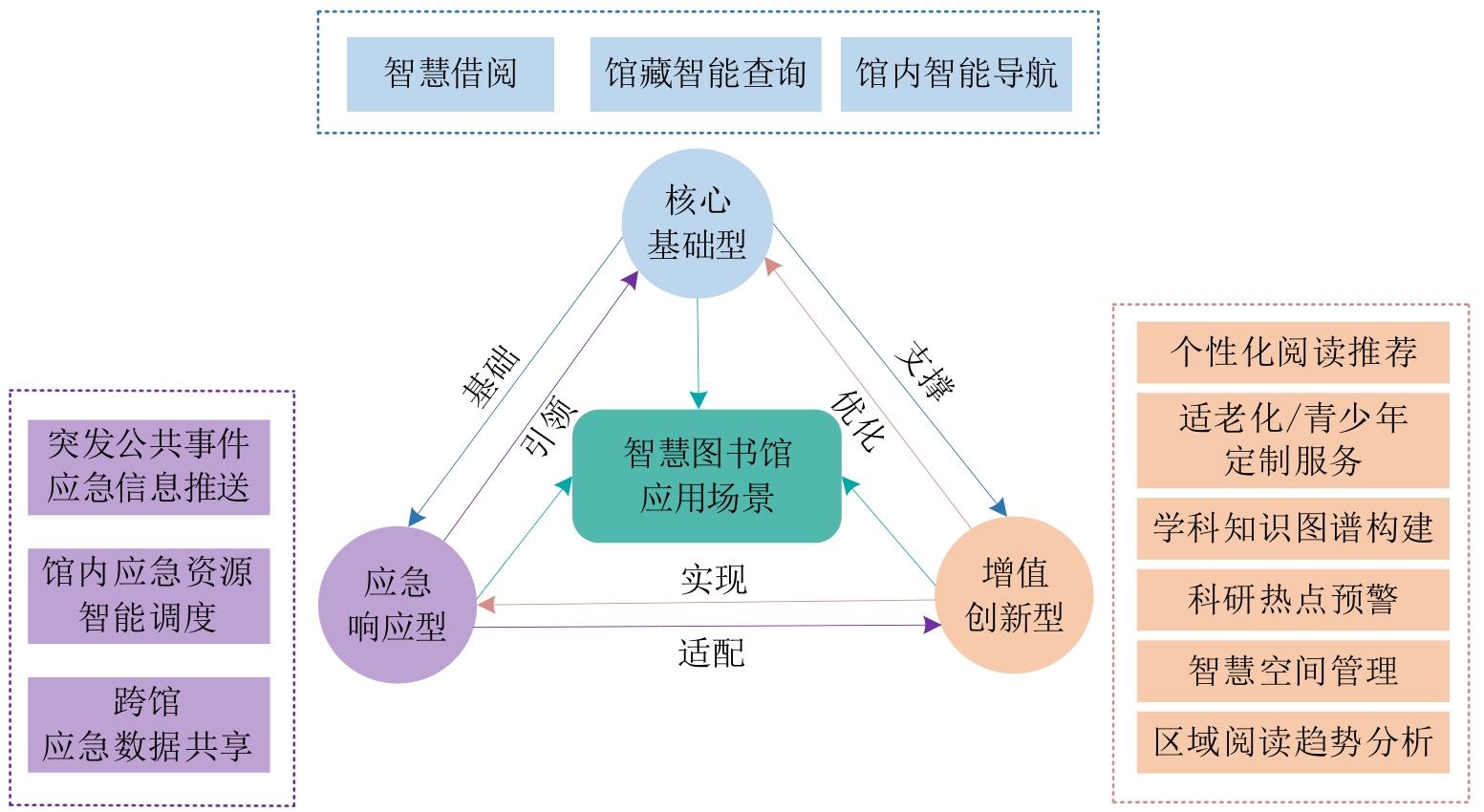
Fig.1

Composition of smart library application scenarios"

Table 2

Comparison of the old and new paradigms of library data governance"

维度特征图书馆常规数据治理智慧图书馆数据协同治理
治理目标实现馆藏、借阅等结构化数据的规范存储与简单管理,保障基础数据可用实现多源异构数据的融合流通、跨界复用与场景化增值,赋能智慧图书馆全场景服务与高质量发展
治理主体图书馆内部技术和馆藏部门为单一治理主体,权责集中,无外部主体参与多元主体协同治理,涵盖图书馆内部多部门、用户群体、外部合作机构、监管方,各主体权责清晰、利益协调
治理对象馆藏数据、借阅数据等单一类型的结构化数据,数据规模小、无跨域数据多源异构数据,包括结构化馆藏、借阅数据,非结构化用户行为、评论文本数据,半结构化文献元数据,实时感知数据及外部关联数据,数据规模大、跨域特征显著
治理模式分散式、静态化治理,各部门独立管理数据,无统一治理标准,数据孤岛现象突出一体化、动态化治理,以应用场景需求为牵引,建立统一治理框架,实现治理要素的动态适配与跨域协同
治理技术基础数据存储与管理技术,无复杂数据处理、融合、安全技术应用多元技术组合适配,融合大数据、人工智能、区块链、联邦学习等技术,按场景需求提供定制化技术支撑
治理与场景的联系治理与服务场景脱节,数据治理无场景导向,仅为管理而治理治理与应用场景深度融合,场景需求牵引治理实践、治理效能反哺场景升级,形成双向联动闭环

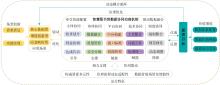
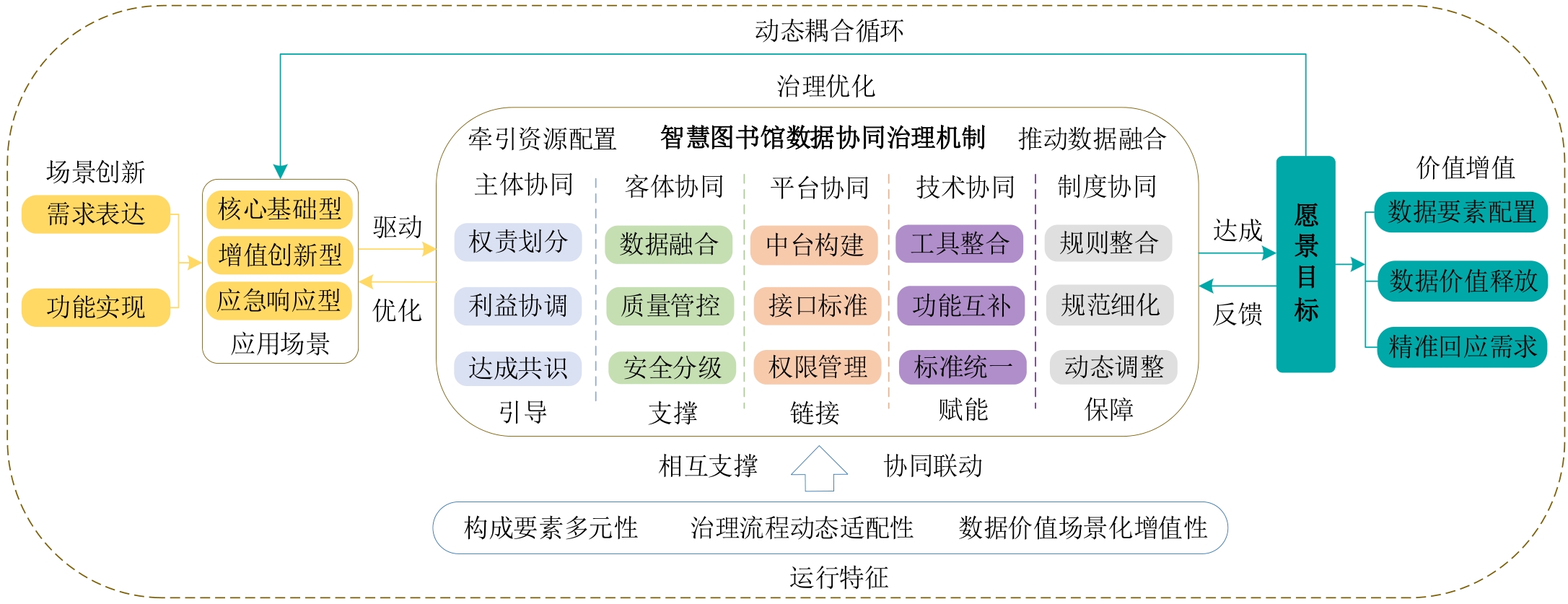
Fig.2

Framework for the collaborative governance mechanism of smart library data driven by application scenarios"

[1] 霍瑞娟. 图书馆智慧化转型中数据治理体系建设路径探究[J]. 图书情报工作, 2024, 68(22): 37-44.
Huo Ruijuan. Exploration of data governance system construction for intelligent transformation of libraries[J]. Library and Information Service, 2024, 68(22): 37-44.
[2] 吴玉浩, 周志红, 刘伟, 等. 价值链协同视角下智慧图书馆可信数据空间体系研究[J]. 农业图书情报学报, 2025, 37(11): 30-46.
Wu Yuhao, Zhou Zhihong, Liu Wei, et al. Trusted data space system of smart libraries from the perspective of value chain synergy[J]. Journal of Library and Information Science in Agriculture, 2025, 37(11): 30-46.
[3] 杨晓菲, 孔悦凡, 孙继莆. 智慧图书馆区块链安全框架模型设计与分析[J]. 农业图书情报学报, 2023, 35(4): 79-89.
Yang Xiaofei, Kong Yuefan, Sun Jipu. Design and analysis of a blockchain security framework model for smart libraries[J]. Journal of Library and Information Science in Agriculture, 2023, 35(4): 79-89.
[4] 邢文明, 刘我. 高校图书馆推进FAIR数据管理原则实施的服务调研[J]. 农业图书情报学报, 2022, 34(7): 65-75.
Xing Wenming, Liu Wo. An investigation on university libraries' service in promoting the implementation of FAIR data management principles[J]. Journal of Library and Information Science in Agriculture, 2022, 34(7): 65-75.
[5] 吴丹, 郭清玥, 杨馨梅, 等. 智慧图书馆场景下数据与知识双驱动方法创新研究[J]. 中国图书馆学报, 2025, 51(5): 37-53.
Wu Dan, Guo Qingyue, Yang Xinmei, et al. Methodological innovation on dual data-and knowledge-driven approach for smart library scenarios[J]. Journal of Library Science in China, 2025, 51(5): 37-53.
[6] 朱红艳, 王静. 数字孪生图书馆理论模型、服务场景及未来展望[J]. 图书馆, 2023(11): 18-23, 31.
Zhu Hongyan, Wang Jing. Theoretical model, service scenario and future prospect of digital twin library[J]. Library, 2023(11): 18-23, 31.
[7] 孙建军, 马亚雪. 面向多元场景的数据治理: 进展与思考[J]. 图书与情报, 2023(4): 1-11.
Sun Jianjun, Ma Yaxue. Data governance for diverse scenarios: Progress and reflection[J]. Library and Information, 2023(4): 1-11.
[8] 周毅, 韩诗雨. 应用场景驱动的数据要素流通生态体系建设研究[J]. 电子政务, 2024(11): 2-14.
Zhou Yi, Han Shiyu. Research on the construction of data element circulation ecosystem driven by application scenarios[J]. E-Government, 2024(11): 2-14.
[9] 白芳睿, 梁少博, 吴丹, 等. 数字孪生生态中的人智协作: 价值定位、关键技术与实践进路[J]. 农业图书情报学报, 2024, 36(7): 4-18.
Bai Fangrui, Liang Shaobo, Wu Dan, et al. Human-intelligent information system collaboration in digital twin environment: Value proposition, key technologies, and practical approaches[J]. Journal of Library and Information Science in Agriculture, 2024, 36(7): 4-18.
[10] 常志军, 许丽媛, 于倩倩, 等. 基于生命周期模型的科技文献数据管理体系研究[J]. 农业图书情报学报, 2022, 34(6): 36-49.
Chang Zhijun, Xu Liyuan, Yu Qianqian, et al. Scientific and technical literature data management system based on life cycle model[J]. Journal of Library and Information Science in Agriculture, 2022, 34(6): 36-49.
[11] 周霞, 谷莹, 陈为东, 等. 政府数据协同治理影响因素及其驱动—依赖机制研究[J]. 情报科学, 2025, 43(2): 67-75, 148.
Zhou Xia, Gu Ying, Chen Weidong, et al. The factors influencing collaborative governance of government data and their driving force-dependence mechanism[J]. Information Science, 2025, 43(2): 67-75, 148.
[12] 马乐存, 裴雷, 李白杨. 数据要素流通安全治理: 体系架构与实践进路[J]. 农业图书情报学报, 2024, 36(3): 46-58.
Ma Lecun, Pei Lei, Li Baiyang. Security governance of data element circulation: System architecture and practical approach[J]. Journal of Library and Information Science in Agriculture, 2024, 36(3): 46-58.
[13] Han Shuangshuang, Bai Yongqiang, Zhang Tianrui, et al. Parallel management of IoV information enabled by blockchain and decentralized autonomous organizations[J]. IEEE Transactions on Intelligent Vehicles, 2024, 9(4): 4759-4768.
[14] Zhao Shoucai, Cao Lifeng, Li Jinhui, et al. Cross-domain data traceability mechanism based on blockchain[J]. Computers, Materials & Continua, 2023, 76(2): 2531-2549.
[15] Hu Fang, Qiu Siyi, Yang Xiaolian, et al. Privacy-preserving healthcare and medical data collaboration service system based on blockchain and federated learning[J]. Computers, Materials & Continua, 2024, 80(2): 2897-2915.
[16] Brandell E E, Storm D J, Van Deelen T R, et al. A call to action: Standardizing white-tailed deer harvest data in the Midwestern United States and implications for quantitative analysis and disease management[J]. Frontiers in Ecology and Evolution, 2022, 10: 943411.
[17] 李丽辉, 杨林珂. 政府数据协同治理研究现状和趋势[J]. 西安财经大学学报, 2025, 38(3): 90-104.
Li Lihui, Yang Linke. The current situation and trends of government data collaborative governance[J]. Journal of Xi'an University of Finance and Economics, 2025, 38(3): 90-104.
[18] 于兴尚, 刘月, 谭洪, 等. 数智驱动下智慧图书馆的场景应用与模型体系建构[J]. 图书与情报, 2023(2): 95-102.
Yu Xingshang, Liu Yue, Tan Hong, et al. Scenario application and model system construction of smart libraries driven by digital intelligence[J]. Library & Information, 2023(2): 95-102.
[19] 董同强, 丁世强. “数智”融合驱动下智慧图书馆服务场景与体系设计[J]. 图书馆学研究, 2022(1): 2-8.
Dong Tongqiang, Ding Shiqiang. Service scenario and system design of smart library driven by digital intelligencef[J]. Research on Library Science, 2022(1): 2-8.
[20] 刘炜, 张磊, 嵇婷, 等. 以AI塑形智慧图书馆: 基于智能体的下一代图书馆服务平台[J]. 农业图书情报学报, 2025, 37(5): 15-26.
Liu Wei, Zhang Lei, Ji Ting, et al. Shaping the smart libraries with AI: An agent-based, next-generation library service platform[J]. Journal of Library and Information Science in Agriculture, 2025, 37(5): 15-26.
[21] 蔡畯, 陈艳, 黄佩芳. 新场景驱动下智慧阅读服务的模式、框架和实施路径[J]. 图书情报工作, 2025, 69(11): 16-25.
Cai Jun, Chen Yan, Huang Peifang. Model, framework, and pathways of intelligent reading services driven by new scenarios[J]. Library and Information Service, 2025, 69(11): 16-25.
[22] 王东波. 图书馆场景服务的要素分析与内容实现[J]. 图书馆学研究, 2017(1): 60-64.
Wang Dongbo. Element analysis and content realization of the library scene service[J]. Research on Library Science, 2017(1): 60-64.
[23] Lloyd R, Clark T N. The city as an entertainment machine[M]//Critical Perspectives on Urban Redevelopment. Bingley: Emerald (MCB UP), 2004: 357-378.
[24] 齐骥, 亓冉, 特里·N.克拉克. 场景的“蜂鸣生产力”[J]. 山东大学学报(哲学社会科学版), 2022(4): 24-39.
Qi Ji, Qi Ran, Terry N C. The buzz power of scenes[J]. Journal of Shandong University (Philosophy and Social Sciences), 2022(4): 24-39.
[25] 秦春秀, 马茜茜, 马续补, 等. 信息资源管理视角下的场景概念及场景分析模型[J]. 图书情报工作, 2024, 68(13): 78-86.
Qin Chunxiu, Ma Qianqian, Ma Xubu, et al. Context concept and context analysis model from the perspective of information resource management[J]. Library and Information Service, 2024, 68(13): 78-86.
[26] 徐延章. 场景理论视域下公共文化数字化服务的创新维度[J]. 图书馆学研究, 2023(11): 25-32.
Xu Yanzhang. Innovative dimensions of public digital cultural services from the perspective of scene theory[J]. Research on Library Science, 2023(11): 25-32.
[27] 钱力, 王茜颖, 刘熠, 等. 科研场景下的智能体技术与应用研究[J]. 农业图书情报学报, 2025, 37(5): 5-14.
Qian Li, Wang Qianying, Liu Yi, et al. Agent technology and its applications in scientific research[J]. Journal of Library and Information Science in Agriculture, 2025, 37(5): 5-14.
[28] 张艳丰,何婉婷.AIGC赋能智慧图书馆场景化服务模式及其应用路径研究[J/OL].图书情报工作, 1-11[2026-01-05]. .
Zhang Yanfeng, He Wanting. Research on the scenario-based service model and application path of smart library enabled by AIGC[J/OL]. Library and Information Service, 1-11[2026-01-05]. .
[29] Mcginnis M D. Polycentricity and local public economies: Readings from the workshop in political theory and policy analysis[M]. Washtenaw County: The University of Michigan Press, 1999: 52-74.
[30] Stoker G. Governance as theory: Five propositions[J]. International Social Science Journal, 1998, 50(155): 17-28.
[31] 孙大鹏. 协同治理的理论框架及案例考察[J]. 财经问题研究, 2022(8): 113-121.
Sun Dapeng. The theoretical framework and case study of collaborative governance[J]. Research on Financial and Economic Issues, 2022(8): 113-121.
[32] Ansell C, Gash A. Collaborative governance in theory and practice[J]. Journal of Public Administration Research and Theory: J-PART, 2008, 18(4): 543-571.
[33] Emerson K, Nabatchi T, Balogh S. An integrative framework for collaborative governance[J]. Journal of Public Administration Research and Theory: J-PART, 2012, 22(1): 1-29.
[34] 韦景竹, 王政. 公共文化数据协同治理研究: 内涵、范畴与理论框架[J]. 图书情报知识, 2022, 39(6): 67-77, 157.
Wei Jingzhu, Wang Zheng. Collaborative governance of public cultural data: Connotation, category and theoretical framework[J]. Document, Information & Knowledge, 2022, 39(6): 67-77, 157.
[1] LI Baiyang, REN Shangsheng. Technical Evolution and Application Scenarios of Open-Source Agents:A Case Study of "OpenClaw" [J]. Journal of library and information science in agriculture, 2026, 38(4): 23-35.
[2] GAO Dan, CUI Bin. Value Co-Creation Mechanism of Cultural Heritage Data Resources: An Analysis Based on the “Stage-Subject-Scenario” Framework [J]. Journal of library and information science in agriculture, 2025, 37(7): 61-72.
[3] LIU Wei, ZHANG Lei, JI Ting, CHEN Xiaoyang. Shaping the Smart Libraries with AI: An Agent-based, Next-Generation Library Service Platform [J]. Journal of library and information science in agriculture, 2025, 37(5): 15-26.
[4] ZHANG Li, WANG Bo, JING Shui. Generative AI-Driven Resource Discovery in Public Libraries: Service Optimization Based on a Dynamic Evaluation Model [J]. Journal of library and information science in agriculture, 2025, 37(5): 58-71.
[5] CHEN Nan. Strategies for Smart Library Services in Public Libraries during the Digitally-Intelligence Era under the 15th Five-Year Plan [J]. Journal of library and information science in agriculture, 2025, 37(12): 64-80.
[6] TANG Feng, FANG Xiangming, WANG Yixin. On the Practical Needs, Theoretical Framework, and Implementation Strategies for Constructing a Trusted Data Space for Library Digital Special Collections [J]. Journal of library and information science in agriculture, 2025, 37(11): 47-61.
[7] WU Yuhao, ZHOU Zhihong, LIU Wei, XU Bangdong. Trusted Data Space System of Smart Libraries from the Perspective of Value Chain Synergy [J]. Journal of library and information science in agriculture, 2025, 37(11): 30-46.
[8] Hecan ZHANG, Chengqi YI, Peng GUO, Qianqian HUANG, Xiaokun JIN. Copyright Data Dilemma of Building High-Quality Data System for AI: Present Situation, Coping Strategies, and Implementation Path [J]. Journal of library and information science in agriculture, 2024, 36(9): 32-43.
[9] Jia LIU. Innovation and Risk Avoidance of Smart Library Services Based on Generative Artificial Intelligence [J]. Journal of library and information science in agriculture, 2024, 36(7): 63-75.
[10] MA Lecun, PEI Lei, LI Baiyang. Security Governance of Data Element Circulation: System Architecture and Practical Approach [J]. Journal of library and information science in agriculture, 2024, 36(3): 46-58.
[11] YANG Xinya, RAN Weiran, LI Li. Key Points of the 15th Five-Year Plan for University Libraries to Support the Construction of a Powerful Country in the Education Sector [J]. Journal of library and information science in agriculture, 2024, 36(12): 35-44.
[12] XIA Yikun, JIANG Jie, ZHANG Xiaheng, WANG Jiandong, ZHOU Wenjie, YANG Xinya, LI Yang. Developing the New Quality Productivity: Responses and Reflections on the Discipline of Information Resource Management [J]. Journal of library and information science in agriculture, 2024, 36(1): 4-32.
[13] SUN Lili, WANG WeiJie, SHENG Jiefei. Influencing Factors of Scientific Data Value Increment Based on System Dynamics [J]. Journal of library and information science in agriculture, 2023, 35(9): 28-42.
[14] FU Rongxin, YANG Xiaohua. Analysis of AIGC Language Models and Application Scenarios in University Libraries [J]. Journal of library and information science in agriculture, 2023, 35(7): 27-38.
[15] Guo Limin. The Practice and Enlightment of Cloud Collaboration in Libraries: A Case Study of the Mobile Library App of Shanghai Library [J]. Journal of library and information science in agriculture, 2023, 35(6): 93-102.
Viewed
Full text


Abstract

Cited

  Shared   
  Discussed   
No Suggested Reading articles found!