中文    English

Journal of library and information science in agriculture


Key Factors and Transmission Paths of Willingness to Share Social Media Health Science Information

ZHANG Keyong1, WU Shuang2   

  1. 1. School of Medical Information and Engineering, Bengbu Medical University, Bengbu 233030
    2. School of Business, Changzhou University, Changzhou 213159
  • Received:2025-12-05 Online:2026-02-12

Abstract:

[Purpose/Significance] Against the backdrop of the digital wave and the Healthy China initiative, efforts to enhance national health information literacy face challenges, including an insufficient supply of high-quality popular science content and low public enthusiasm for its dissemination. This study aims to explore the internal driving forces, core influencing factors, and transmission paths of the willingness to share online health popular science information. It further intends to provide theoretical support for regulatory authorities and popular science platforms in formulating incentive policies and safeguard mechanisms, thereby promoting the participation of social entities in popular science dissemination, increasing the supply of high-quality popular science resources, and enhancing the health information literacy of the general public. [Method/Process] A three-stage research design of "Grounded Theory - Fuzzy DEMATEL - ISM" was adopted. Firstly, interview data from diverse groups were collected through semi-structured interviews. Grounded Theory was then applied to coding to extract initial influencing factors and construct a multi-dimensional driving force system. Secondly, Fuzzy DEMATEL was used to calculate the centrality and causality degrees, so as to identify key factors. Finally, the interpretive structural modeling (ISM) method was employed to integrate the influencing factors, establish a hierarchical structure, and clarify the transmission logic and action mechanism. This method not only enables the acquisition of the most original influencing factor system from interview materials but also reveals the interaction relationships among these factors, which is in line with the research requirements and trends in the field of information science. [Results/Conclusions] The results of Grounded Theory analysis identified 13 influencing factors, which are categorized into four dimensions. The personal dimension includes four factors: interpersonal interaction traits, perceived utility, health information literacy, and self-efficacy. The information dimension consists of four factors: information quality, information source credibility, information richness, and information clarity. The platform dimension comprises two factors: interaction promotion mechanism and platform technology. The social dimension contains three factors: social economy, social public events, and the clustering effect. Fuzzy DEMATEL analysis indicated that perceived utility, health information literacy, information clarity, and social economy are the key factors. ISM analysis revealed a 4-layer hierarchical structure of influencing factors from the superficial to the deep, with the social economy being the deepest-layer factor. Additionally, four key transmission paths were sorted out. Based on the research conclusions, four suggestions are proposed: Firstly, from the personal dimension, efforts should be made to mobilize the subjective role of users. Secondly, from the information dimension, the information quality and clarity for content creators and sharers should be improved. Thirdly, from the platform dimension, active cooperation with content sharers should be pursued and the interaction mechanism should be optimized. Finally, from the social dimension, the government should promote the development of the health popular science industry. In subsequent studies, empirical tests (such as structural equation modeling and fsQCA) can be incorporated to ensure the reliability and validity of the theory.

Key words: social media, health science information, key influencing factors, transmission path, DEMATEL, ISM, health informatics

CLC Number: 

  • G206

Table 1

Statistical description of respondents' basic information"

统计维度 具体分类 样本数/个
性别 8
10
年龄 18~25岁 7
26~35岁 6
36岁以上 5
学历 大专 3
本科 7
硕士 5
博士 3
分析频率 每周6次或更多 5
每周4~5次 6
每周2~3次 4
每周1次或更少 3
职业 学生 8
高校教师 3
企业职工 3
医护人员 3
自由职业者 1

Table 2

Open coding results (partial)"

初始范畴 初始概念 代表性语句
社交倾向性 转发;小广播 看到正确刷牙方法的科普视频就转发到朋友圈,感觉自己像小广播
亲和力 关心他人 朋友爱吃油腻的外卖,我会告诉他吃太多油腻的东西对肝脏、肠胃不好
认知开放性 接受科普信息;健康误区纠正 看了科普视频才发现肉汤里脂肪含量高。喝醋能软化血管是个误区,应分享正确的知识
个人效用感知 商业价值;自我满足感 分享养生的科普知识,帮助他人会让我觉得很开心,也可以增加流量、提高知名度
社会效用感知 有用;控制病情;减轻医疗负担 健康科普知识太有用了。健康科普能帮糖尿病患者控糖,减少就医压力
健康知识水平 专业知识 分享者需具备扎实的专业知识,避免传播健康谣言
信息甄别能力 谣言识别;信息甄别 营销号为博人眼球传播谣言,分享者应能识别,甄别信息真伪
过往分享经验 发布时间;平台规则;经验摸索 晚上七八点发的时候,看的人多。每个平台规则不一样,有的对标题长度有要求。这些经验都是一次次摸索出来的
未来分享意向 继续分享;帮助他人 分享健康科普信息是一件有意义的事,能让更多人了解健康知识。以后会继续分享,希望能帮到更多人
信息趣味性 科普动画;有趣 有个关于肠道菌群的科普动画,它把肠道菌群比作是我们身体里的一个“小王国”,双歧杆菌是“善良的居民”,这样的动画很有意思
信息准确性 信息科学性;符合逻辑 我重视信息的科学性,朋友圈里经常转“吃这个能抗癌”之类的文章,真可能会误导大家
信源权威性 专业知识;临床经验 一些医生或专家分享的信息往往是经过科学研究和临床验证的。他们分享的高血压患者饮食注意事项的科普,我们看了就会觉得很靠谱
信源影响力 资深博主;流量 我做健康科普多年,随着粉丝增多,流量也逐渐增加。疫情期间是视频播放量最高的时候
表达多样性 图文并茂;互动形式 形式丰富、图文并茂会增强分享意愿。有些博主做可互动答题的科普文章,提升了参与感
内容深度 内容系统;内容全面 很多信息以偏概全,比如“每天吃点B族维生素让眼睛年轻十岁!”但后来我才发现维生素摄入要均衡,过度摄入反而会导致健康问题。我现在只会转发一些讲解比较系统的内容
信息可理解性 大众化语言;易于理解 有的健康科普文章有很多专业术语,看不懂,看两行就看不下去了,我自然也不会转发
信息精炼度 文字简洁;短小精悍 平时比较忙,不想看长篇大论,简单明了的信息能吸引我,更愿意去阅读、分享
发布促进机制 创作工具;激励政策 抖音、B站等平台提供了简单易用的创作工具,今日头条会根据文章的阅读量、点赞数、评论数给创作者发放稿费或流量扶持
分享促进机制 互动反馈;成就感 别人觉得我分享的内容有用,会让我有成就感。平台提供多种分享方式,方便粉丝在不同的平台阅读,扩大了信息的传播范围
共创促进机制 创作者合作;平台支持 在知乎上可以和答主围绕健康话题交流讨论;在B站上,我会收到平台邀请,和一些医学专业的博主一起合作。平台也会在合作过程中提供技术指导、资源对接等
用户界面友好性 易操作;分类清晰;搜索 操作界面简单易懂很重要。平台的分类和搜索功能也很重要,当我想找一些特定的信息时,容易找到
技术先进性 智能推送;多媒体支持;数据分析 平台智能推送功能很实用。各大平台都具有强大的多媒体支持性,允许用各种形式来分享信息。数据分析功能也挺有用,能告诉我用户的阅读访问量和兴趣点
宏观经济状况 经济发展 现在社会经济发展越来越好,大家对健康的关注度也越来越高,开始注重养生、预防疾病
经济前景预期 经济形势 预期经济形势好,我分享的动力会更强。经济形势不好,我可能侧重去赚钱来维持生活
公共卫生政策 政策支持;政府监管 如果政府出台鼓励政策,给予一定的奖励或荣誉,那分享的意愿会提高。如果监管过严,可能会让我感到束缚
健康社会事件 新冠疫情;争议事件 疫情期间分享健康信息的意愿特别高,因为大家都特别关心个人健康。对于争议性事件,比如转基因食品到底健不健康,我就不愿意分享
社会认同效应 正面反馈;专业人士认可 如果我分享的健康科普信息收到很多网友的点赞、评论,或者有专业的医生或健康领域的专家认可我的分享,那我分享的意愿也会大增
行为示范效应 亲朋支持;榜样激励 如果我的家人和朋友按照我分享的内容去做,会让我很有成就感。看到他人得到了很好的社会反响,也会激励我

Table 3

Spindle encoding results (partial)"

维度 主范畴 初始范畴 范畴内涵

A

个人维度

A1

人际交往特质

社交倾向性 个人善于社交的程度
亲和力 个人乐于助人的程度
认知开放性 个人对新知识的接受程度

A2

效用感知

个人效用感知 分享健康科普信息对个人的价值感知
社会效用感知 分享健康科普信息对社会的价值感知

A3

健康信息素养

健康知识水平 个人对健康知识的积累程度
信息甄别能力 个人对健康谣言的鉴别能力

A4

自我效能

过往分享经验 过往分享健康科普信息的经历及获得的经验
未来分享意向 未来继续分享网络健康科普信息的意愿

B

信息维度

B1

信息质量

信息趣味性 健康科普信息是否有趣
信息准确性 健康科普信息是否有科学依据、符合逻辑

B2

信源可信度

信源权威性 健康科普信息发布者是否权威
信源影响力 健康科普信息发布者在公众间的关注度

B3

信息丰富度

表达多样性 健康科普信息组织形式的多样化程度
内容深度 健康科普信息内容的系统全面程度

B4

信息清晰度

信息可理解性 健康科普信息是否易于公众理解
信息精炼度 健康科普信息内容是否简洁、精炼

C

平台维度

C1

互动促进机制

发布促进机制 平台给予的支撑条件和激励措施
分享促进机制 平台为健康科普信息分享者提供的支撑条件
共创促进机制 平台为健康科普信息发布者营造的共创环境

C2

平台技术

用户界面友好性 平台操作界面是否美观、易用、交互性好
技术先进性 平台是否拥有完善、先进的支撑技术

D

社会维度

D1

社会经济

宏观经济情况 当前的宏观经济水平
经济前景预期 对未来经济发展趋势的预估

D2

社会公共事件

公共卫生政策 政府对健康科普信息管理的支持或监管政策
健康社会事件 突发公共事件或热点争议话题

D3

群聚效应

社会认同效应 健康科普信息分享行为受他人的认可程度
行为示范效应 亲朋、榜样的分享行为对个人的激励效果

Table 4

Correspondence table of impact values and triangular fuzzy numbers"

影响程度 影响数值 对应的三角模糊数
不影响 0 (0,0,0.25)
较小影响 1 (0,0.25,0.5)
中等影响 2 (0.25,0.5,0.75)
较大影响 3 (0.5,0.75,1)
很大影响 4 (0.75,1,1)

Table 5

Direct influence matrix Z"

因素 A1 A2 A3 A4 B1 B2 B3 B4 C1 C2 D1 D2 D3
A1 0.00 0.81 0.73 0.73 0.17 0.33 0.24 0.24 0.18 0.01 0.02 0.24 0.49
A2 0.33 0.00 0.50 0.73 0.41 0.41 0.26 0.26 0.01 0.01 0.18 0.49 0.57
A3 0.42 0.58 0.00 0.73 0.41 0.41 0.49 0.49 0.49 0.49 0.17 0.18 0.33
A4 0.18 0.42 0.34 0.00 0.18 0.49 0.41 0.41 0.41 0.33 0.18 0.17 0.49
B1 0.17 0.81 0.42 0.19 0.00 0.26 0.50 0.73 0.17 0.01 0.02 0.41 0.81
B2 0.24 0.66 0.34 0.42 0.66 0.00 0.42 0.42 0.02 0.01 0.02 0.41 0.73
B3 0.24 0.58 0.03 0.58 0.58 0.18 0.00 0.50 0.34 0.34 0.01 0.26 0.66
B4 0.24 0.66 0.34 0.42 0.66 0.34 0.50 0.00 0.34 0.34 0.01 0.26 0.66
C1 0.24 0.49 0.34 0.42 0.66 0.19 0.58 0.58 0.00 0.02 0.17 0.49 0.57
C2 0.01 0.02 0.02 0.19 0.50 0.02 0.73 0.42 0.81 0.00 0.01 0.41 0.50
D1 0.58 0.58 0.42 0.42 0.19 0.19 0.33 0.18 0.42 0.50 0.00 0.42 0.73
D2 0.26 0.50 0.58 0.26 0.02 0.18 0.26 0.26 0.17 0.02 0.73 0.00 0.89
D3 0.50 0.66 0.27 0.73 0.01 0.17 0.02 0.18 0.18 0.26 0.41 0.26 0.00

Table 6

Comprehensive influence matrix T"

因素 A1 A2 A3 A4 B1 B2 B3 B4 C1 C2 D1 D2 D3
A1 0.30 0.67 0.54 0.64 0.39 0.37 0.43 0.43 0.34 0.27 0.25 0.38 0.64
A2 0.36 0.56 0.52 0.64 0.44 0.39 0.45 0.46 0.33 0.28 0.28 0.43 0.67
A3 0.43 0.74 0.49 0.73 0.51 0.44 0.55 0.55 0.44 0.38 0.29 0.45 0.74
A4 0.33 0.61 0.47 0.50 0.41 0.38 0.45 0.46 0.37 0.30 0.26 0.37 0.63
B1 0.37 0.75 0.55 0.64 0.41 0.40 0.53 0.56 0.37 0.30 0.29 0.46 0.77
B2 0.38 0.73 0.54 0.67 0.53 0.35 0.52 0.53 0.37 0.30 0.29 0.47 0.76
B3 0.37 0.71 0.50 0.66 0.50 0.39 0.44 0.54 0.41 0.35 0.27 0.45 0.74
B4 0.39 0.74 0.55 0.68 0.54 0.43 0.55 0.47 0.42 0.36 0.28 0.46 0.77
C1 0.38 0.71 0.54 0.67 0.53 0.41 0.54 0.55 0.35 0.32 0.29 0.48 0.74
C2 0.31 0.58 0.44 0.57 0.46 0.34 0.52 0.49 0.44 0.26 0.24 0.42 0.67
D1 0.46 0.76 0.59 0.72 0.51 0.44 0.54 0.53 0.46 0.41 0.28 0.51 0.81
D2 0.38 0.68 0.54 0.61 0.42 0.38 0.47 0.47 0.36 0.31 0.37 0.37 0.75
D3 0.36 0.62 0.46 0.61 0.36 0.32 0.40 0.41 0.33 0.30 0.28 0.38 0.53

Table 7

Influencing factors: degree of influence, degree of being influenced, centrality, and causality"

因素 影响度 被影响度 中心度 原因度
A1 5.66 4.84 10.51 0.82
A2 5.79 8.88 14.67 -3.09
A3 6.74 6.75 13.49 -0.01
A4 5.54 8.33 13.87 -2.79
B1 6.39 6.01 12.39 0.38
B2 6.47 5.04 11.51 1.42
B3 6.33 6.40 12.72 -0.07
B4 6.65 6.45 13.10 0.20
C1 6.51 4.99 11.50 1.52
C2 5.74 4.14 9.88 1.60
D1 7.01 3.67 10.68 3.34
D2 6.12 5.61 11.73 0.51
D3 5.36 9.20 14.56 -3.84

Table 8

Key influencing factors identification table"

影响度分析 被影响度分析 原因度分析 中心度分析 关键影响因素识别
因素 排名 因素 排名 因素 排名 因素 排名 因素 综合得分 是否关键
D1 1 D3 1 D1 1 A2 1 A3 4.75
A3 2 A2 2 C2 2 D3 2 B4 5.25
B4 3 A4 3 C1 3 A4 3 A2 6
C1 4 A3 4 B2 4 A3 4 D1 6.5
B2 5 B4 5 A1 5 B4 5 B1 6.75
B1 6 B3 6 D2 6 B3 6 B2 6.75
B3 7 B1 7 B1 7 B1 7 C1 6.75
D2 8 D2 8 B4 8 D2 8 B3 7
A2 9 B2 9 A3 9 B2 9 A4 7.25
C2 10 C1 10 B3 10 C1 10 D3 7.25
A1 11 A1 11 A4 11 D1 11 D2 7.5
A4 12 C2 12 A2 12 A1 12 C2 9.25
D3 13 D1 13 D3 13 C2 13 A1 9.75

Table 9

Reachability matrix W"

因素 A1 A2 A3 A4 B1 B2 B3 B4 C1 C2 D1 D2 D3
A1 1 1 1 1 0 0 0 0 0 0 0 0 1
A2 0 1 1 1 0 0 0 0 0 0 0 0 1
A3 0 1 1 1 1 0 1 1 0 0 0 0 1
A4 0 1 0 1 0 0 0 0 0 0 0 0 1
B1 0 1 1 1 1 0 1 1 0 0 0 0 1
B2 0 1 1 1 1 1 1 1 0 0 0 0 1
B3 0 1 1 1 1 0 1 1 0 0 0 0 1
B4 0 1 1 1 1 0 1 1 0 0 0 0 1
C1 0 1 1 1 1 0 1 1 1 0 0 0 1
C2 0 1 0 1 0 0 1 1 0 1 0 0 1
D1 0 1 1 1 1 0 1 1 0 0 1 1 1
D2 0 1 1 1 0 0 0 0 0 0 0 1 1
D3 0 1 0 1 0 0 0 0 0 0 0 0 1

Table 10

Hierarchical table of influencing factors"

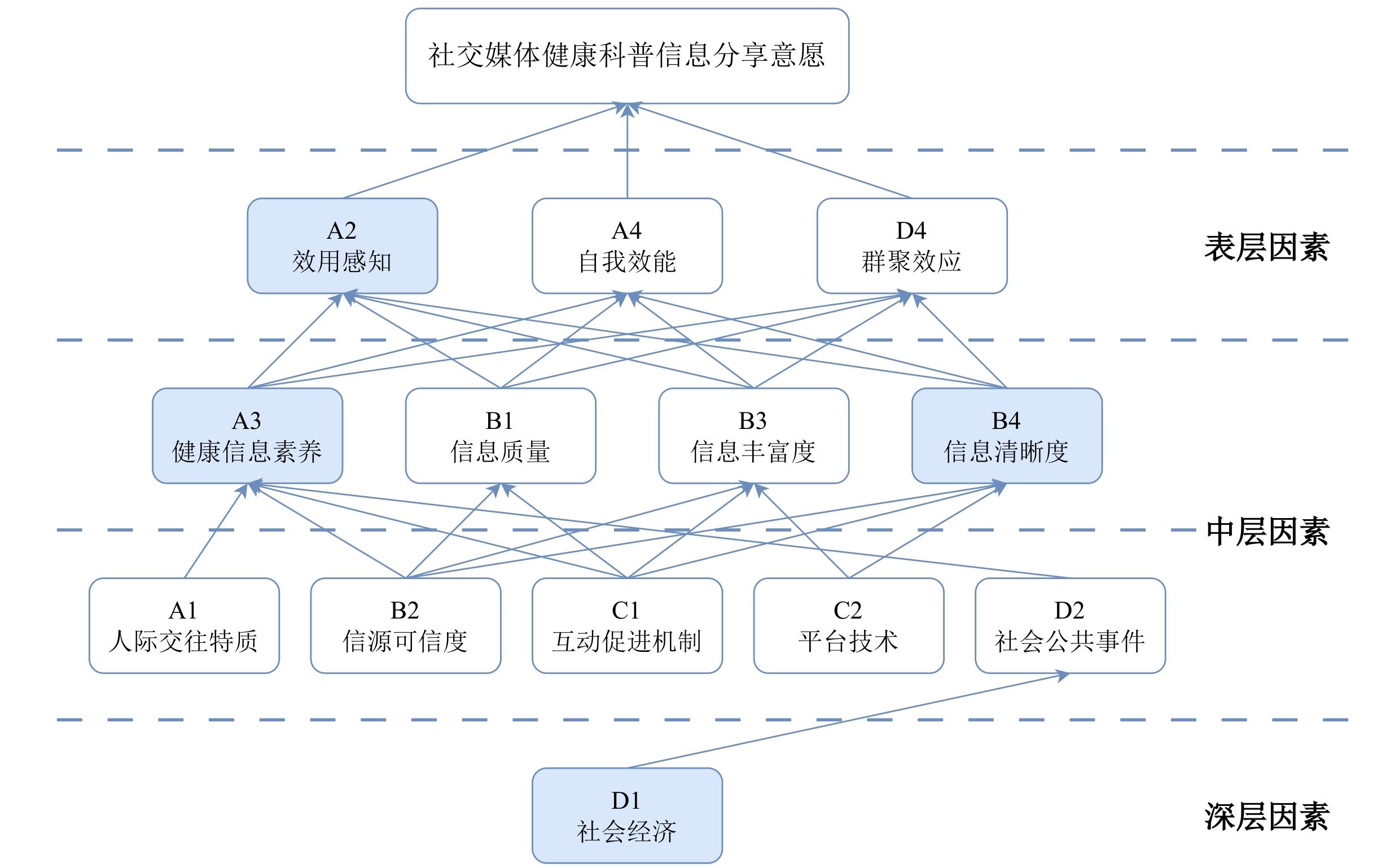
层级 影响因素
L1(表层因素) A2、A4、D3
L2(中层因素) A3、B1、B3、B4
L3(中层因素) A1、B2、C1、C2、D2
L4(深层因素) D1

Fig.1

Hierarchical structural model of influencing factors"

[1]
中共中央, 国务院. “健康中国2030”规划纲要[EB/OL]. [2024-12-05].
[2]
中共中央, 国务院. 关于实施健康中国行动的意见[EB/OL]. [2024-12-05].
[3]
中华人民共和国国家卫生健康委员会. 关于建立健全全媒体健康科普知识发布和传播机制的指导意见[EB/OL]. [2024-12-05].
[4]
乔昆, 韩晔, 洪玮, 等. 医疗机构新媒体健康科普信息发布评价指标探索与构建[J]. 中国健康教育, 2023, 39(6): 488-492, 522.
Qiao Kun, Han Ye, Hong Wei, et al. Development of indexes for new media health popularization information dissemination in medical institutions[J]. Chinese Journal of Health Education, 2023, 39(6): 488-492, 522.
[5]
徐基田. 图书馆科普服务发展历程探究[J]. 数字与缩微影像, 2021(4): 18-20.
Xu Jitian. An exploration of the development history of library science popularization services[J]. Digital & Micrographic Imaging, 2021(4): 18-20.
[6]
徐基田. 图书馆科普服务路径选择研究[J]. 河南图书馆学刊, 2021, 41(7): 113-115.
Xu Jitian. Research on the path selection of library science popularization service[J]. The Library Journal of Henan, 2021, 41(7): 113-115.
[7]
周谦豪, 姚占雷, 许鑫. 图书馆健康信息素养教育的调研与分析[J]. 图书馆学研究, 2020(10): 77-86.
Zhou Qianhao, Yao Zhanlei, Xu Xin. Investigation and analysis of library education of health information literacy[J]. Research on Library Science, 2020(10): 77-86.
[8]
田崑, 宣雯霞, 魏文静, 等. 基于C-A-C理论的健康科普视频对用户持续使用意愿的影响研究[J]. 包装工程, 2023, 44(18): 293-302.
Tian Kun, Xuan Wenxia, Wei Wenjing, et al. Impact of health science video on users' intention to continue usage: An investigation from the perspective of the C-A-C theory[J]. Packaging Engineering, 2023, 44(18): 293-302.
[9]
武晓立. 微信用户健康信息分享行为的影响因素研究[J]. 国际新闻界, 2022, 44(10): 96-118.
Wu Xiaoli. Influence factors of users' health information sharing behavior on WeChat platform[J]. Journal of International Communication, 2022, 44(10): 96-118.
[10]
魏华, 高劲松, 代芳. 虚拟健康社区社会支持对用户知识分享意愿的影响: 一个有调节的链式中介模型[J]. 情报科学, 2021, 39(12): 146-154, 173.
Wei Hua, Gao Jinsong, Dai Fang. Impact of social support on users' knowledge sharing intention in virtual health community: A moderated chain mediation model[J]. Information Science, 2021, 39(12): 146-154, 173.
[11]
尤剑, 李新月, 朱庆华, 等. 基于内容分析法的社交媒体健康信息分享行为研究综述[J]. 现代情报, 2023, 43(6): 67-77, 107.
You Jian, Li Xinyue, Zhu Qinghua, et al. Health information sharing behavior of social media based on content analysis: A review[J]. Journal of Modern Information, 2023, 43(6): 67-77, 107.
[12]
田梅, 韩月茹, 刘菡. 社交媒体用户健康信息行为研究元人种志分析[J]. 情报杂志, 2023, 42(8): 177-184.
Tian Mei, Han Yueru, Liu Han. A meta-ethnographic analysis of social media users health information behavior research[J]. Journal of Intelligence, 2023, 42(8): 177-184.
[13]
张坤, 查先进, 严亚兰. 从众健康信息转发行为影响因素的扎根探测——以新浪微博为例[J]. 图书与情报, 2022(2): 10-18.
Zhang Kun, Zha Xianjin, Yan Yalan. Grounded detection on influencing factors for herd forwarding behavior of health information: The case of sina weibo[J]. Library and Information, 2022(2): 10-18.
[14]
Vardell E, Wang Ting. The information behaviour of individuals changing health insurance plans and an exploration of health insurance priorities[J]. Journal of Information Science, 2024, 50(3): 751-765.
[15]
韩玺, 蒋佩瑶, 陈思然, 等. 评论特征对用户采纳在线医评信息意愿的影响机制——基于ELM模型和信任转移理论[J]. 现代情报, 2023, 43(9): 36-50.
Han Xi, Jiang Peiyao, Chen Siran, et al. The influence mechanism of review features on users' willingness to adopt online physician review information - Based on ELM model and trust transfer theory[J]. Journal of Modern Information, 2023, 43(9): 36-50.
[16]
刘玮, 陈锦博. 搜索即学习视角下知识捕获与学习效果的影响因素研究——以健康信息学习型搜索为例[J]. 信息资源管理学报, 2023, 13(6): 133-143, 155.
Liu Wei, Chen Jinbo. Identifying the influencial factors of knowledge capture and learning performance in learning-related search: A perspective of SAL[J]. Journal of Information Resources Management, 2023, 13(6): 133-143, 155.
[17]
王素芳, 周禹涵. 老年人社交媒体健康信息甄别能力及其提升影响因素研究[J]. 图书情报工作, 2022, 66(24): 14-29.
Wang Sufang, Zhou Yuhan. Influencing factors of social media health information screening ability and its improving of the elderly[J]. Library and Information Service, 2022, 66(24): 14-29.
[18]
陈旖旎, 周晓英, 岳丽欣, 等. 健康焦虑人群信息行为的类型、特征及影响因素[J]. 图书情报知识, 2024, 41(5): 89-102.
Chen Yini, Zhou Xiaoying, Yue Lixin, et al. The types, characteristics and influencing factors of information behavior in people with health anxiety[J]. Document, Informaiton & Knowledge, 2024, 41(5): 89-102.
[19]
Vaghefi M S, Beheshti N, Jain H. Dissemination of health messages in online social network: A study of healthcare providers'content generation and dissemination on Twitter[J]. Information & Management, 2024, 61(2): 103925.
[20]
段尧清, 郑卓闻, 汪银霞, 等. 基于DEMATEL的数据要素属性结构关系分析[J]. 情报理论与实践, 2022, 45(7): 124-131, 123.
Duan Yaoqing, Zheng Zhuowen, Wang Yinxia, et al. Attributes structural relationship analysis of data as a factor of production based on DEMATEL[J]. Information Studies (Theory & Application), 2022, 45(7): 124-131, 123.
[21]
陈琦, 熊回香, 肖兵, 等. 高校学生在线健康信息搜寻行为影响因素研究: 全貌、关键及层级路径[J]. 图书情报工作, 2023, 67(23): 69-88.
Chen Qi, Xiong Huixiang, Xiao Bing, et al. A study on the influencing factors of college students' online health information seeking behavior: Panorama, key factors and hierarchical paths[J]. Library and Information Service, 2023, 67(23): 69-88.
[22]
李建玲. 基于DEMATEL的数字档案馆建设影响因素研究[D]. 武汉: 华中师范大学, 2021.
Li Jianling. Research on Influencing Factors of Digital Archives Construction Based on DEMATEL[D]. Wuhan: Central China Normal University, 2021.
[23]
袁红, 王焘. 政府数据开放可持续发展关键影响因素识别与作用机理分析[J]. 图书情报工作, 2022, 66(9): 53-65.
Yuan Hong, Wang Tao. Critical influencing factors identification and action mechanism analysis of the sustainable development of government data openness[J]. Library and Information Service, 2022, 66(9): 53-65.
[24]
付少雄, 邓胜利, 陈晓宇. 国外健康信息素养研究现状与发展动态述评[J]. 信息资源管理学报, 2016, 6(3): 5-14, 33.
Fu Shaoxiong, Deng Shengli, Chen Xiaoyu. Review on the foreign research status and development trend of health information literacy[J]. Journal of Information Resources Management, 2016, 6(3): 5-14, 33.
[25]
姚丽琴, 杨光, 任雁洲. 我国公共图书馆健康信息服务研究[J]. 图书馆工作与研究, 2024(8): 83-91.
Yao Liqin, Yang Guang, Ren Yanzhou. Research on health information services in public libraries in China[J]. Library Work and Study, 2024(8): 83-91.
[1] SONG Yaping, LIAN Kangping. Pathways for Public Library Study Tour Services in the Context of Cultural and Tourism Integration [J]. Journal of library and information science in agriculture, 2025, 37(8): 92-103.
[2] SHEN Mengcheng, CHEN Xiuping. Analysis of the Evaluation and Development Pathways for Rural Cultural-Tourism Integration Based on Online Text Data: A Case Study of 26 Mountainous Counties in Zhejiang Province [J]. Journal of library and information science in agriculture, 2025, 37(4): 66-82.
[3] SHI Qin, XIE Jing, WU Shang. Influencing Factors and Correlations of User Satisfaction with Mobile Health Applications [J]. Journal of library and information science in agriculture, 2025, 37(1): 33-46.
[4] YOU Ge, LI Jielin, ZHANG Fangshun. Generating Mechanism of Online Public Opinion Heat in Public Emergencies from the Perspective of Information Ecology: Fuzzy Set Qualitative Comparative Analysis Based on 50 Cases [J]. Journal of library and information science in agriculture, 2025, 37(1): 86-99.
[5] ZHOU Xin. Machine Functionalism and the Digital-Intelligence Divide: Evolutionary Pathways, Generative Logic and Regulatory Strategies [J]. Journal of library and information science in agriculture, 2024, 36(3): 59-71.
[6] ZHAO Ruixue, LI Tian, GUAN Zhihao, XIAN Guojian, KOU Yuantao, SUN Tan. Bidirectional Empowerment Between Knowledge Service and New Quality Productive Forces Theoretical Interpretation and Practical Path [J]. Journal of library and information science in agriculture, 2024, 36(2): 4-14.
[7] HAN Xi, LIAO Ke. Factors Influencing Misinformation Propagation: A Systemic Review [J]. Journal of library and information science in agriculture, 2024, 36(12): 45-63.
[8] Yan MOU. Social Media Users' Expression, Formation Mechanism, and Coping Strategies for Algorithm Aversion [J]. Journal of library and information science in agriculture, 2024, 36(10): 86-94.
[9] Fengwei JIANG, Qing WANG, Zhuqi LI. Practice and Development Strategy of Culture and Tourism Integration Services for Children in Public Libraries [J]. Journal of library and information science in agriculture, 2024, 36(10): 95-105.
[10] LI Tian, ZHAO Ruixue, XIAN Guojian, KOU Yuantao. Agricultural Intelligent Knowledge Services to Enable Rural Revitalization: Internal Mechanism and Dilemma Relief [J]. Journal of library and information science in agriculture, 2023, 35(8): 43-54.
[11] XIE Yanjie. Review of Public Library Services to the Elderly in China [J]. Journal of library and information science in agriculture, 2023, 35(7): 18-26.
[12] LI Jing. Causes of Intergenerational Conflict Heath Information Behavior and Its Mechanism in Social Control in the Context of Public Health Emergencies [J]. Journal of library and information science in agriculture, 2023, 35(5): 74-88.
[13] MA Weilu, XIAN Guojian, ZHAO Ruixue, LI Jiao, HUANG Yongwen, SUN Tan. Comparative Study and Optimization Strategies of Knowledge Graph Construction Management Systems [J]. Journal of library and information science in agriculture, 2023, 35(4): 19-31.
[14] YING Ke, HONG Yilin, ZHANG Yan, LU Xiaomei. Path Selection of IP Empowerment in the Integrated Development of Culture and Tourism in Libraries [J]. Journal of library and information science in agriculture, 2023, 35(3): 81-89.
[15] XU Zhao, PENG Juyuan, DUAN Juanjuan. Model of Cooperation between University Libraries and Social Organizations for the Integration of Culture and Tourism Development [J]. Journal of library and information science in agriculture, 2023, 35(12): 71-83.
Viewed
Full text


Abstract

Cited

  Shared   
  Discussed   
No Suggested Reading articles found!