中文    English

Journal of library and information science in agriculture


Connotations and Innovative Path of Data Element Discipline Construction under the Background of New Liberal Arts

FAN Zhenjia1,2, ZHANG Yunong3, LIU Tingxiao3, JI Xiangfei3   

  1. 1. School of Information and Communication, Nankai University, Tianjin 300071
    2. Institute of Advanced Interdisciplinary Studies, Nankai University, Tianjin 300071
    3. Business School, Nankai University, Tianjin 300071
  • Received:2026-05-22

Abstract:

[Purpose/Significance] In the context of the development of the New Liberal Arts and the Digital China strategy, the construction of data element-related disciplines and professional programs has become an important response to the growing demand for highly skilled digital talent. As data are increasingly recognized as a key production factor, talent cultivation must go beyond technical training and address the full process through which data are organized, governed, developed, circulated, and transformed into value. This paper focuses on the connotations and innovative pathways of data element-related program construction. It highlights the supporting role of Information Resources Management, a discipline that has long focused on the organization, retrieval, preservation, governance, service, and utilization of information resources. The study contributes to current discussions by linking data element talent cultivation with disciplinary transformation, curriculum reconstruction, practice-based education, and the development of China's independent knowledge system in philosophy and social sciences. [Method/Process] This paper adopts an interpretive analytical approach based on policy texts, disciplinary evolution, and professional construction practices. First, it analyzes the strategic background of Digital China, the digital economy, data element marketization, and New Liberal Arts development, and clarifies the new requirements these contexts place on talent cultivation. Second, it examines the transformation from Library, Information and Archives Management to Information Resources Management (IRM), emphasizing the expansion of disciplinary objects from documents, archives, and information services to data resources, digital knowledge, data governance, intelligent information services, and value realization. Third, it reviews the knowledge foundations of IRM, including information organization, knowledge organization, metadata, information retrieval, digital preservation, information behavior, knowledge services, information policy, public data opening, data quality, data ethics, and intelligence analysis. Finally, it draws on the construction of the Data Resources and Data Intelligence program as an illustrative practice to discuss possible pathways for curriculum design, practical teaching, digital-intelligent empowerment, multi-actor collaboration, and international cooperation. [Results/Conclusions] The study found that data element-related disciplinary and professional program construction should be organized around the full lifecycle governance and value realization of data resources. This lifecycle includes the processes of data resource management, assetization, and capitalization, covering data collection, storage, description, organization, quality control, rights confirmation, valuation, product development, circulation, application, and security governance. This perspective helps integrate fragmented knowledge modules and connects data management education with the practical process of data value creation. IRM provides a distinctive disciplinary foundation for this task. Compared with fields that focus mainly on algorithms, systems, or market allocation, IRM emphasizes the relationship between data, users, organizations, institutions, scenarios, and public value. It can therefore support the cultivation of compound, governance-oriented, and scenario-oriented digital talent. Such talent should possess foundational knowledge of data resources, methods of digital and intelligent technologies, an understanding of governance institutions, capabilities for industry and scenario application, and international communication competence. The paper further proposes that data element-related program construction can proceed through several connected pathways. Teaching content should cover the full process of data value realization and integrate data organization, data governance, data intelligence, data ethics, data asset management, and scenario-based data application. Practical teaching should be strengthened through real projects, industry scenarios, government departments, enterprises, data circulation institutions, and research organizations. Digital and intelligent technologies should be deeply embedded in professional training, while data security, ethical awareness, and responsible innovation should remain central. International cooperation should also be expanded to enhance students' global competence and awareness of cross-border data governance. Overall, data element-related program construction provides an important opportunity for IRM to reorganize its knowledge system, renew its educational model, and better serve Digital China, the data element market, and global data governance.

Key words: data elements, information resource management, data resources and data intelligence, digital talent, discipline construction

CLC Number: 

  • G25

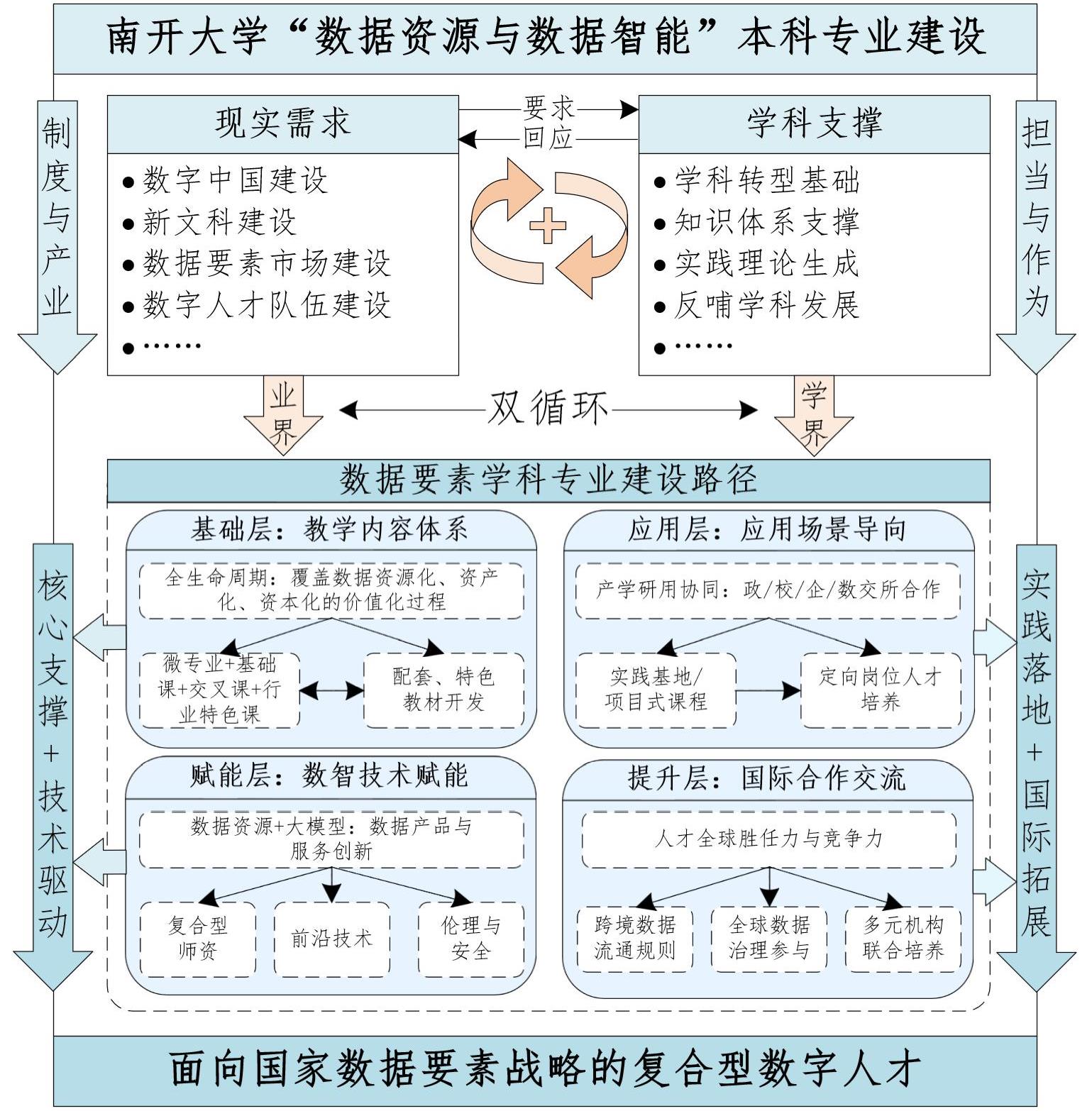
Fig.1

Construction path for data resources and data intelligence program"

[1]
新华社. 中国共产党第二十届中央委员会第四次全体会议公报__中国政府网[EB/OL]. [2026-05-07].
[2]
中共中央关于制定国民经济和社会发展第十五个五年规划的建议[EB/OL]. [2026-05-10].
[3]
李海涛, 王春蕾. 场景驱动数据要素价值化的作用机制分析[J/OL]. 图书情报知识, 1-11[2026-05-11].
Li Haitao, Wang Chunlei. Analysis of mechanism of scenario-driven valorization of data elements[J/OL]. Documentation,Information & Knowledge, 1-11[2026-05-11].
[4]
国家数据局等部门关于培育数据流通服务机构 加快推进数据要素市场化价值化的意见-国家数据局[EB/OL]. [2026-05-06].
[5]
国家统计局. 2024年全国数字经济核心产业增加值占GDP比重为10.5%__中国政府网[EB/OL]. [2026-05-08].
[6]
新华社. 我国建成高质量数据集超10万个, 规模超890PB__中国政府网[EB/OL]. [2026-05-07].
[7]
人民日报. 我国日均词元(Token)调用量突破140万亿[EB/OL]. [2026-05-07].
[8]
艾瑞咨询. 2025年中国数据要素行业发展研究报告|界面财经号[EB/OL]. [2026-05-09].
[9]
新华社. 多部门部署加强数据要素学科专业建设和数字人才队伍建设_部门动态_中国政府网[EB/OL]. [2026-05-06].
[10]
李月琳. 专家解读|高起点建设数据要素学科专业 培养服务国家重大战略的数字人才[EB/OL]. [2026-05-06].
[11]
张向宏, 涂群. 专家解读|创新数字人才培养模式 奠定数字中国建设坚实基础-国家数据局[EB/OL]. [2026-05-13].
[12]
孙建军, 裴雷, 柯青, 等. 新文科背景下“信息资源管理”课程教学创新思考[J]. 图书与情报, 2020(6): 19-25.
Sun Jianjun, Pei Lei, Ke Qing, et al. Considerations on teaching innovation of course “information resource management” in the context of new liberal arts[J]. Library and Information, 2020(6): 19-25.
[13]
梁心怡, 甘佩玄, 陈雅. 新文科建设背景下中国特色信息资源管理学科体系构建研究[J]. 图书馆, 2023(10): 22-28, 36.
Liang Xinyi, Gan Peixuan, Chen Ya. The construction of discipline system of information resource management with Chinese characteristics in the context of new liberal arts construction[J]. Library, 2023(10): 22-28, 36.
[14]
孙建军, 裴雷, 付少雄. 兼收并蓄: 信息资源管理学科建设背景下的数据管理[J]. 信息资源管理学报, 2023, 13(1): 9-17.
Sun Jianjun, Pei Lei, Fu Shaoxiong. To be eclectic: Discussion on the data management in the context of the discipline construction of information resource management[J]. Journal of Information Resources Management, 2023, 13(1): 9-17.
[15]
孙建军, 吴丹, 孙昕玦, 等. 信息资源管理学科专家谈《教育强国建设规划纲要(2024-2035)》(一): 人才培养与数字素养教育[J]. 信息资源管理学报, 2025, 15(2): 4-12.
Sun Jianjun, Wu Dan, Sun Xinjue, et al. Experts in information resource management discipline discussing "the 2024-2035 Master Plan on Building China into a Leading Country in Education" (part 1): Talent cultivation and digital literacy education[J]. Journal of Information Resources Management, 2025, 15(2): 4-12.
[16]
周毅, 白文琳, 李洁. 项目化学习: 新文科背景下信息资源管理类专业教学模式的深化实践[J]. 情报理论与实践, 2022, 45(4): 1-7.
Zhou Yi, Bai Wenlin, Li Jie. Project-based learning: The deepening practice of the teaching mode of information resources management program in the background of new liberal arts[J]. Information Studies (Theory & Application), 2022, 45(4): 1-7.
[17]
吴丹, 白芳睿. 数智赋能信息资源管理学科“双核四驱”教学模式优化研究——以信息描述课程为例[J]. 图书馆学研究, 2025(2): 35-43.
Wu Dan, Bai Fangrui. Research on optimization of "dual-core, four-wheel drive" teaching mode in information resource management empowered by AI: A case study of the course “information description”[J]. Research on Library Science, 2025(2): 35-43.
[18]
潘禹辰, 呼玮, 杨建梁, 等. 新文科背景下信息资源管理院系本科专业大数据类课程体系设计[J]. 图书情报工作, 2025, 69(13): 71-82.
Pan Yuchen, Hu Wei, Yang Jianliang, et al. Design of big data curriculum for undergraduate in information resources management major under the background of new liberal arts[J]. Library and Information Service, 2025, 69(13): 71-82.
[19]
潘禹辰, 呼玮, 杨建梁, 等. 新文科下的信息资源管理专业人工智能课程体系设计[J]. 图书情报知识, 2023, 40(6): 42-51, 67.
Pan Yuchen, Hu Wei, Yang Jianliang, et al. The design of artificial intelligence curriculum for information resources management under the background of new liberal arts[J]. Document, Informaiton & Knowledge, 2023, 40(6): 42-51, 67.
[20]
柯平, 杜艳爱. 信息资源管理一级学科发展的里程碑——从“图书情报与档案管理”到“信息资源管理”的百年历史启示[J]. 情报理论与实践, 2024, 47(9): 1-8.
Ke Ping, Du Yan'ai. Milestones in the development of information resource management as a first level discipline: A centennial historical enlightenment from library, information and archive management to information resource management[J]. Information Studies (Theory & Application), 2024, 47(9): 1-8.
[21]
闫慧. 论信息资源管理的知识体系、基本定律与学科结构[J]. 图书馆理论与实践, 2024(3): 4-11.
Yan Hui. On the knowledge system, fundamental laws, and disciplinary structure of information resource management[J]. Library Theory and Practice, 2024(3): 4-11.
[22]
马费成, 陈帅朴, 陈景龙. 中国信息资源管理学科自主知识体系构建[J]. 图书情报知识, 2025, 42(2): 6-21.
Ma Feicheng, Chen Shuaipu, Chen Jinglong. The construction of an independent knowledge system for information resources management discipline in China[J]. Documentation, Information & Knowledge, 2025, 42(2): 6-21.
[23]
冯惠玲. 学科探路时代——从未知中探索未来[J]. 信息资源管理学报, 2020, 10(3): 4-10.
Feng Huiling. A path-finding era of discipline: Exploring the future from the unknown[J]. Journal of Information Resources Management, 2020, 10(3): 4-10.
[24]
杨思洛, 吴丽娟. 中国信息资源管理学科自主知识体系建构[J]. 图书馆论坛, 2024, 44(10): 1-9.
Yang Siluo, Wu Lijuan. Developing an independent knowledge system for information resource management science in China[J]. Library Tribune, 2024, 44(10): 1-9.
[25]
初景利. 一级学科更名后信息资源管理学科建设新挑战[J]. 文献与数据学报, 2022, 4(4): 7-10.
Chu Jingli. New challenges to the construction of information resources management after the discipline renaming[J]. Journal of Library and Data, 2022, 4(4): 7-10.
[26]
冯惠玲. 以信息资源管理的名义再绘学科蓝图[J]. 信息资源管理学报, 2022, 12(6): 4-10.
Feng Huiling. Redrawing the disciplinary blueprint in the name of information resources management[J]. Journal of Information Resources Management, 2022, 12(6): 4-10.
[27]
朝乐门. 信息资源管理理论的继承与创新: 大数据与数据科学视角[J]. 中国图书馆学报, 2019, 45(2): 26-42.
Chao Lemen. Developing information resources management studies: Big data and data science perspectives[J]. Journal of Library Science in China, 2019, 45(2): 26-42.
[28]
马费成, 李志元. 中国当代情报学的起源及发展[J]. 情报学报, 2021, 40(5): 547-554.
Ma Feicheng, Li Zhiyuan. The origin and development of information science in China[J]. Journal of the China Society for Scientific and Technical Information, 2021, 40(5): 547-554.
[29]
孙建军. 学科建设应主动服务数据要素市场培育的改革实践[J]. 图书与情报, 2020(3): 5-6.
Sun Jianjun. Discipline construction should actively serve the reform practice of data element market cultivation[J]. Library & Information, 2020(3): 5-6.
[30]
孙建军, 李阳. 信息资源管理学科视角下的数据要素研究[J]. 图书情报知识, 2024, 41(2): 6-12.
Sun Jianjun, Li Yang. Research on data elements from the perspective of the discipline of information resources management[J]. Document, Informaiton & Knowledge, 2024, 41(2): 6-12.
[31]
夏立新, 郭致怡. 推动信息资源管理学科高质量发展的思考[J]. 图书情报工作, 2023, 67(1): 9-15.
Xia Lixin, Guo Zhiyi. Reflections on promoting high-quality development of information resources management discipline[J]. Library and Information Service, 2023, 67(1): 9-15.
[32]
石庆功, 肖希明. 中国特色图书馆学话语体系构建的理与路[J/OL]. 中国图书馆学报, 1-20[2026-03-19].
Shi Qinggong, Xiao Ximing. The construction of library science discourse system with Chinese characteristics[J/OL]. Journal of Library Science in China, 1-20[2026-03-19].
[33]
苏新宁. 中国特色情报学学科体系、学术体系、话语体系论纲[J]. 中国图书馆学报, 2021, 47(4): 16-27.
Su Xinning. The discipline system, academic system and discourse system of intelligence studies with Chinese characteristics[J]. Journal of Library Science in China, 2021, 47(4): 16-27.
[34]
张斌, 尹鑫, 杨文. 中国档案学学科体系建设回顾与展望[J]. 中国图书馆学报, 2024, 50(2): 87-99.
Zhang Bin, Yin Xin, Yang Wen. Retrospect and prospect of the construction of the discipline system of archival science in China[J]. Journal of Library Science in China, 2024, 50(2): 87-99.
[35]
孙建军, 付少雄. “十五五”时期我国信息资源管理学科创新发展的思考[J]. 情报学报, 2025, 44(11): 1359-1369.
Sun Jianjun, Fu Shaoxiong. Reflections on innovative development of information resource management discipline in China during the 15th Five-Year Plan period[J]. Journal of the China Society for Scientific and Technical Information, 2025, 44(11): 1359-1369.
[36]
张斌, 张旭, 杨文. 国家数据战略下建构中国自主的档案学知识体系的使命、基础与路径[J]. 档案学通讯, 2024(4): 4-12.
Zhang Bin, Zhang Xu, Yang Wen. The mission, foundation and path of constructing China's autonomous archival science knowledge system under the national data strategy[J]. Archives Science Bulletin, 2024(4): 4-12.
[37]
闫慧, 贾诗威, 吴兆桐, 等. 2022-2023年情报学前沿进展综述[J]. 情报学进展, 2024, 15(0): 420-477.
Yan Hui, Jia Shiwei, Wu Zhaotong, et al. Review of frontier progress in information science from 2022 to 2023[J]. Advances in Information Science, 2024, 15(0): 420-477.
[38]
王芳, 张超, 黄梅银, 等. 数智赋能政府治理的理论与实践进展: 一个跨学科学术会议综述[J]. 图书与情报, 2023(3): 126-135.
Wang Fang, Zhang Chao, Huang Meiyin, et al. Theoretical and practical progress in empowering government with digital intelligence: A review of an interdisciplinary academic conference[J]. Library and Information, 2023(3): 126-135.
[39]
安小米, 加小双, 王彦妍. 信息资源管理学科标准化人才培养模式研究——以“N+2+3”培养模式为例[J]. 中国标准化, 2024(1): 78-84, 106.
An Xiaomi, Jia Xiaoshuang, Wang Yanyan. Study on the talent cultivation mode of the information resource management standardization discipline-taking the example of the "N+2+3" cultivation mode[J]. China Standardization, 2024(1): 78-84, 106.
[40]
张洋, 吴婷婷, 李晶. 交叉学科视角下的信息资源管理创新人才培养[J]. 信息资源管理学报, 2024, 14(3): 21-29, 55.
Zhang Yang, Wu Tingting, Li Jing. Cultivation of innovative talents in information resource management under in-terdisciplinary perspective[J]. Journal of Information Resources Management, 2024, 14(3): 21-29, 55.
[41]
柯平, 张瑜祯. 中国图书馆学自主知识体系构建的逻辑起点、理论探索与发展路径[J]. 中国图书馆学报, 2026, 52(1): 4-20.
Ke Ping, Zhang Yuzhen. The logical starting point, theoretical exploration, and development approach of the construction of the autonomous knowledge system of Chinese library science[J]. Journal of Library Science in China, 2026, 52(1): 4-20.
[42]
徐拥军, 闫静. 中国特色档案学的基本范畴与核心命题[J]. 中国图书馆学报, 2024, 50(3): 30-46.
Xu Yongjun, Yan Jing. The basic categories and core propositions of archival science with Chinese characteristics[J]. Journal of Library Science in China, 2024, 50(3): 30-46.
[43]
安小米, 龙志奇. “人工智能+政府”场景下的数智治理: 内涵、挑战与对策[J/OL]. 图书馆建设, 1-16[2026-05-08].
An Xiaomi, Long Zhiqi. Digital-intelligence governance in the "AI + government" scenario: Essence, challenges, and strategies[J/OL]. Library Development, 1-16[2026-05-08].
[44]
Liu Hui, Zhou Qingshan, Liang Shuang. Digital inclusion in public services for vulnerable groups: A systematic review for research themes and goal-action framework from the lens of public service ecosystem theory[J]. Government Information Quarterly, 2025, 42(2): 102019.
[45]
王协舟, 李奕扉. 网络信息内容生态治理科研主题识别及网民需求协同研究[J]. 情报科学, 2025, 43(8): 68-77.
Wang Xiezhou, Li Yifei. Identification of research themes for ecological governance of online information content and synergistic research on needs of netizen[J]. Information Science, 2025, 43(8): 68-77.
[46]
求是网. 怎样推进新文科建设[EB/OL]. (2026-03-13)[2026-05-08].
[47]
新华网. 南开大学: 以新文科建设擘画“公能日新”新篇章-新华网[EB/OL]. (2025-10-24)[2026-05-08].
[48]
冯惠玲. 新版学科专业目录下的档案学科建设思考[J]. 档案学通讯, 2022(6): 103-105.
Feng Huiling. Reflections on the construction of archival discipline under the new catalogue of disciplines and specialties[J]. Archives Science Bulletin, 2022(6): 103-105.
[49]
洪秋兰, 李芩. 信息生命周期视角下信息资源管理学科知识体系重构研究[J]. 图书馆理论与实践, 2025(5): 47-56.
Hong Qiulan, Li Qin. Research on the reconstruction of the knowledge system of information resources management from the perspective of information life cycle[J]. Library Theory and Practice, 2025(5): 47-56.
[50]
李海舰, 黄朝椿. 数据要素价值化研究[J]. 贵州社会科学, 2026(1): 4-17.
Li Haijian, Huang Chaochun. Research on the valorization of data factors[J]. Guizhou Social Sciences, 2026(1): 4-17.
[51]
中国信通院-科研能力-权威发布-专题报告[EB/OL]. [2026-05-11].
[52]
樊振佳, 姬祥飞, 赵需要, 等. 政企数据融合开放协同治理的逻辑内涵、要素识别与框架构建[J]. 情报理论与实践, 2026, 49(3): 1-10.
Fan Zhenjia, Ji Xiangfei, Zhao Xuyao, et al. Logical connotation, element identification and framework construction of collaborative governance of public-enterprise data integration and opening[J]. Information Studies (Theory & Application), 2026, 49(3): 1-10.
[53]
赵需要, 姬祥飞, 侯晓丽, 等. 分工理论视域下数据要素流通的生发逻辑、内涵意蕴、市场路径及现实困境[J]. 情报理论与实践, 2023, 46(9): 37-46.
Zhao Xuyao, Ji Xiangfei, Hou Xiaoli, et al. The germinal logic, connotation, market path and practical dilemma of data element circulation from the perspective of division of labor theory[J]. Information Studies (Theory & Application), 2023, 46(9): 37-46.
[54]
孙建军, 巴志超, 夏义堃. 数据要素市场体系建构与价值实现路径探索[J]. 情报学报, 2024, 43(1): 1-9.
Sun Jianjun, Ba Zhichao, Xia Yikun. System construction and value realization paths of data factor markets[J]. Journal of the China Society for Scientific and Technical Information, 2024, 43(1): 1-9.
[55]
赵需要, 姬祥飞, 樊振佳. 供需匹配视角下公共开放数据价值共创机制研究[J]. 图书情报工作, 2025, 69(5): 3-12.
Zhao Xuyao, Ji Xiangfei, Fan Zhenjia. Study on value co-creation mechanism of open public data from the perspective of supply and demand matching[J]. Library and Information Service, 2025, 69(5): 3-12.
[56]
樊振佳, 姬祥飞. 世界数据组织赋能数据要素价值化的逻辑、样态与路径[J/OL]. 情报理论与实践, 1-10[2026-05-19].
Fan Zhenjia, Ji Xiangfei. Logic, patterns and pathways of the World Data Organization enabling the valorization of data elements[J/OL]. Information Studies: Theory & Application, 1-10[2026-05-19].
[1] WU Dan, XU Hao. From Human-Computer Interaction to Human-AI Collaboration: A Frontier Perspective on Constructing an Independent Knowledge System for Information Resource Management in China [J]. Journal of library and information science in agriculture, 2026, 38(5): 55-64.
[2] ZHOU Wenjie. On the Theoretical Field of Information Resource Management in the Context of Autonomous Knowledge System Construction: A Systematic Inquiry into Indigenous Chinese Academic Discourse [J]. Journal of library and information science in agriculture, 2026, 38(5): 65-81.
[3] NIU Chunhua, WANG Yaqi, SHA Yongzhong. Scenario-Adaptive Intelligent Knowledge Services in the Construction of China's Independent Knowledge System: Supporting Capabilities and Talent Cultivation in the Discipline of Information Resource Management [J]. Journal of library and information science in agriculture, 2026, 38(5): 82-93.
[4] GAO Dan, CUI Bin. Value Co-Creation Mechanism of Cultural Heritage Data Resources: An Analysis Based on the “Stage-Subject-Scenario” Framework [J]. Journal of library and information science in agriculture, 2025, 37(7): 61-72.
[5] TANG Feng, FANG Xiangming, WANG Yixin. On the Practical Needs, Theoretical Framework, and Implementation Strategies for Constructing a Trusted Data Space for Library Digital Special Collections [J]. Journal of library and information science in agriculture, 2025, 37(11): 47-61.
[6] Hecan ZHANG, Chengqi YI, Peng GUO, Qianqian HUANG, Xiaokun JIN. Copyright Data Dilemma of Building High-Quality Data System for AI: Present Situation, Coping Strategies, and Implementation Path [J]. Journal of library and information science in agriculture, 2024, 36(9): 32-43.
[7] MA Lecun, PEI Lei, LI Baiyang. Security Governance of Data Element Circulation: System Architecture and Practical Approach [J]. Journal of library and information science in agriculture, 2024, 36(3): 46-58.
[8] XIA Yikun, JIANG Jie, ZHANG Xiaheng, WANG Jiandong, ZHOU Wenjie, YANG Xinya, LI Yang. Developing the New Quality Productivity: Responses and Reflections on the Discipline of Information Resource Management [J]. Journal of library and information science in agriculture, 2024, 36(1): 4-32.
[9] SUN Lili, WANG WeiJie, SHENG Jiefei. Influencing Factors of Scientific Data Value Increment Based on System Dynamics [J]. Journal of library and information science in agriculture, 2023, 35(9): 28-42.
[10] ZHANG Faliang, LIU Junjie. Visual Analysis on Research Status and Themes Evolution of Discipline Construction Research in China [J]. Journal of library and information science in agriculture, 2019, 31(6): 31-39.
[11] WANG Wenting. Research Status and Hotspot Analysis of China's Information Policy [J]. Journal of library and information science in agriculture, 2018, 30(9): 75-80.
[12] ZHANG Chuanzhen, WANG Huanjing. Research on Domestic Information Resource Management Based on Co-word Cluster Analysis [J]. Journal of library and information science in agriculture, 2018, 30(3): 48-52.
[13] WANG Qiang, DING Enjun, WU Xinyu. The Research Situation and Countermeasures of Biology in Southwestern University ——Based on the Perspective of Bibliometrics [J]. Journal of library and information science in agriculture, 2018, 30(11): 77-81.
[14] YAO Dan. Discussion on the Information Resource Construction of University Library with Discipline Construction Oriented——Taking Library of Fuzhou University as an Example [J]. Journal of library and information science in agriculture, 2017, 29(5): 43-46.
[15] ZHAO Ying-chun. Application of Grey Relational Analysis Method in the College Libraries’ Books Acquisition [J]. Journal of library and information science in agriculture, 2016, 28(9): 114-118.
Viewed
Full text


Abstract

Cited

  Shared   
  Discussed   
No Suggested Reading articles found!