中文    English

Journal of library and information science in agriculture


Factors Influencing AI Adoption Intention among Chinese Academic Librarians: An Empirical Analysis Based on the Integrated TAM-TOE Framework

LIANG Meiling1, WU Hongmei2   

  1. 1.School of Foreign Languages and International Trade, Guangdong Polytechnic of Science and Trade, Guangzhou 510430
    2.Library, Guangzhou International Economics College, Guangzhou 510540
  • Received:2025-12-25

Abstract:

[Purpose/Significance] Artificial intelligence is profoundly transforming library services worldwide, making it essential to understand the factors influencing librarians' AI adoption intentions for promoting smart library development. Unlike previous studies that primarily focused on general technology adoption in commercial settings, this research specifically targets academic librarians in Chinese universities who face unique professional challenges and institutional constraints in the digital transformation era. This study aims to identify key determinants of AI adoption intention among academic librarians, providing theoretical foundations and practical guidance for optimizing library AI service systems. The research contributes to the existing literature by constructing an integrated framework that combines individual-level perceptions with organizational and environmental factors to explain technology adoption behavior in the academic library context. [Method/Process] Drawing upon the Technology Acceptance Model (TAM) and Technology-Organization-Environment (TOE) framework, this study constructs an integrated theoretical model encompassing three dimensions: individual perceptions (perceived usefulness and perceived ease of use), organizational factors (organizational readiness and management support), and environmental factors (external environment). Six research hypotheses were proposed based on the theoretical framework. A questionnaire survey was conducted among academic librarians from various types of higher education institutions across 12 provinces in China during November 2025. A total of 177 valid responses were collected from research universities, teaching-oriented universities, and vocational colleges, with an effective response rate of 84.7%. The measurement items were adapted from validated scales and underwent rigorous translation and back-translation procedures. Partial Least Squares Structural Equation Modeling (PLS-SEM) was employed for measurement model assessment, structural model evaluation, hypothesis testing, and mediation effect analysis. [Results/Conclusions] The findings reveal that perceived usefulness exerts the strongest influence on AI adoption intention (β=0.447, p<0.001), followed by the external environment (β=0.354, p<0.001) and perceived ease of use (β=0.234, p<0.001). Contrary to theoretical expectations, organizational readiness (β=-0.099, p=0.075) and management support (β=0.034, p=0.593) showed no significant effects on adoption intention. The mediation analysis demonstrates that perceived ease of use influences adoption intention both directly (β=0.234) and indirectly through perceived usefulness (β=0.205, t=5.450, p<0.001), with the indirect effect accounting for 46.7% of the total effect. The integrated model explains 62.6% of variance in adoption intention, demonstrating substantial explanatory power. These findings suggest that during the early stage of AI technology adoption in Chinese academic libraries, individual-level perceptions and external competitive pressures predominate over organizational factors. This pattern may be attributed to the fact that librarians currently access AI technologies primarily through personal exploration using publicly available tools rather than through organizational deployment. The study provides differentiated practical recommendations for universities at different development stages and suggests future research directions including longitudinal designs and cross-cultural comparisons.

Key words: artificial intelligence, technology adoption, academic libraries, technology acceptance model, TOE framework

CLC Number: 

  • G252

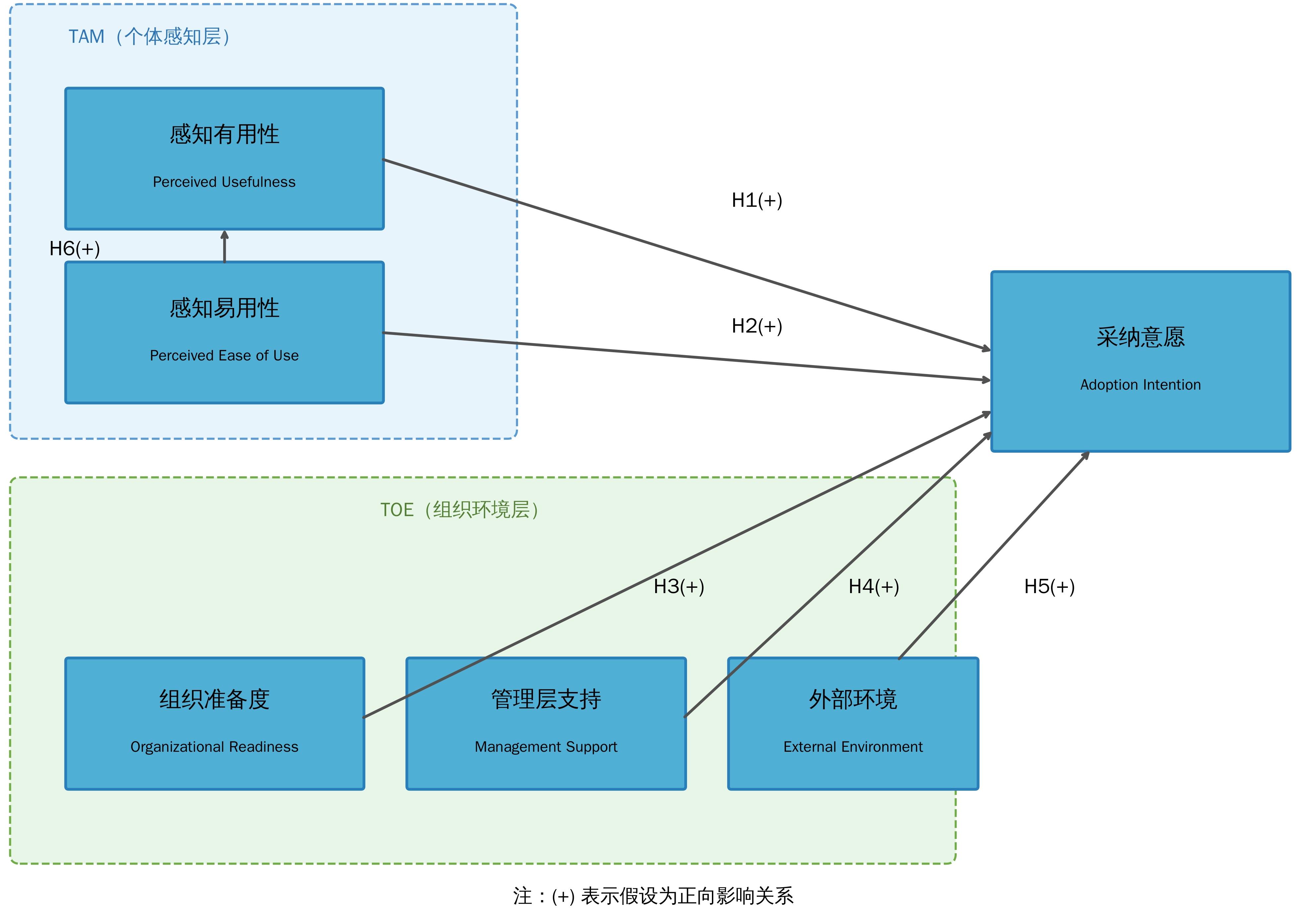
Fig.1

Research model and hypotheses of AI adoption intention among academic librarians"

Table 1

Measurement items"

潜在变量问项数/个问项内容参考来源
感知有用性(PU)4PU1:使用AI技术能帮助我更好地完成工作任务DAVIS[6]
PU2:使用AI技术能提高我的工作效率
PU3:使用AI技术能提升服务质量
PU4:总体而言,我认为AI技术对我的工作有用
感知易用性(PEOU)4PEOU1:学习使用AI技术对我来说是容易的
PEOU2:我认为AI技术容易理解和掌握
PEOU3:使用AI技术对我来说是轻松的
PEOU4:总体而言,我认为AI技术是易于使用的
组织准备度(OR)4OR1:我们图书馆有足够的财务资源支持AI技术的采纳IACOVOU等[16]、ZHU等[20]
OR2:我们图书馆有足够的技术基础设施支持AI应用
OR3:我们图书馆有充足的人力资源投入AI项目
OR4:我们图书馆有能力维持AI技术的长期发展
管理层支持(MS)4MS1:图书馆领导积极推动AI技术的应用PREMKUMAR等[17]
MS2:图书馆领导愿意为AI项目提供必要的支持
MS3:图书馆已将AI技术纳入战略规划
MS4:图书馆领导认为AI技术对图书馆发展很重要
外部环境(EE)3EE1:为了保持竞争力,我们需要采纳AI技术BAKER[19]、OLIVEIRA等[10]
EE2:图书馆用户期待我们提供AI驱动的服务
EE3:满足用户需求是我们考虑采纳AI的重要原因
采纳意愿(BI)4BI1:我打算在工作中使用AI工具VENKATESH等[21]
BI2:我会向同事推荐使用AI技术
BI3:我支持图书馆采用AI技术
BI4:未来我计划更多地使用AI技术

Table 2

Sample characteristics (N=177)"

变量类别频数/人百分比/%
性别5028.2
12771.8
年龄≤30岁3720.9
31~40岁3218.1
41~50岁6637.3
≥51岁4223.7
学历本科及以下10358.2
硕士7240.7
博士21.1
职位一线馆员10659.9
中层管理2916.4
高层管理4223.7
院校类型双一流高校63.4
普通本科5028.2
高职院校11263.3
其他95.1

Table 3

Reliability and convergent validity"

变量问项数/个载荷范围αCRAVE
采纳意愿(BI)40.874~0.8930.9060.9340.780
感知有用性(PU)40.864~0.9230.9180.9420.801
感知易用性(PEOU)40.868~0.9030.9110.9380.790
组织准备度(OR)40.845~0.9360.9230.9430.806
管理层支持(MS)40.823~0.8790.8830.9150.729
外部环境(EE)30.672~0.8190.6710.8150.597

Table 4

Discriminant validity (HTMT)"

变量BIEEMSORPEOUPU
BI
EE0.714
MS0.3410.647
OR0.1790.4020.462
PEOU0.5600.3430.2820.412
PU0.7430.4720.2430.1440.496

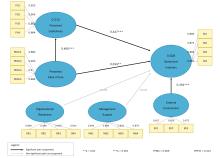
Fig.2

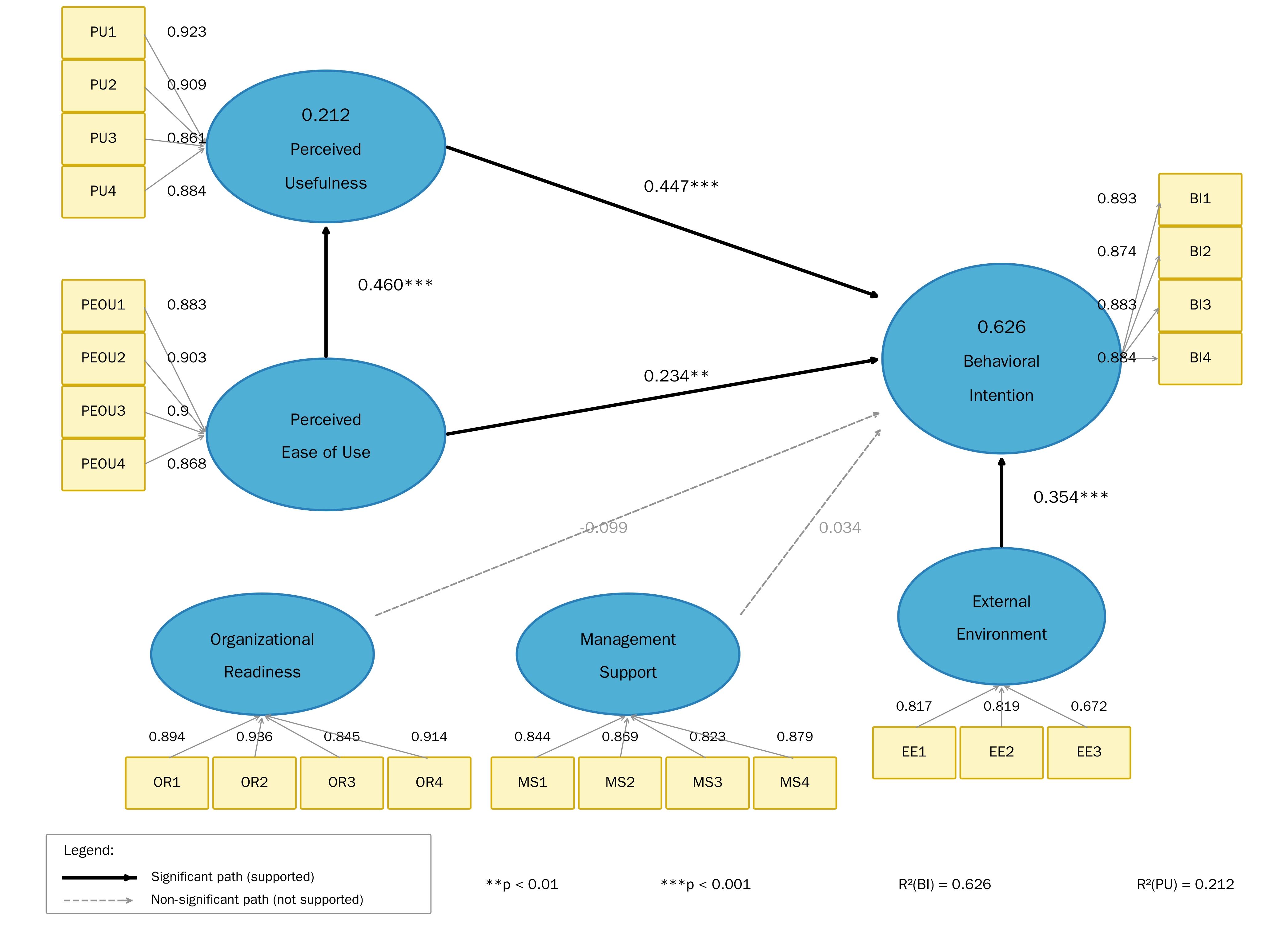
Results of structural equation modeling analysis"

Table 5

Hypothesis of testing results"

假设路径βSEtpf ²结论
H1PU→BI0.4470.0567.923<0.0010.373支持
H2PEOU→BI0.2340.0723.2560.0010.100支持
H3OR→BI-0.0990.0551.7830.0750.019不支持
H4MS→BI0.0340.0630.5340.5930.002不支持
H5EE→BI0.3540.0695.156<0.0010.220支持
H6PEOU→PU0.4600.0696.700<0.0010.268支持
[1] 傅平, 邹小筑, 吴丹, 等. 回顾与展望: 人工智能在图书馆的应用[J]. 图书情报知识, 2018, 35(2): 50-60.
Fu Ping, Zou Xiaozhu, Wu Dan, et al. Retrospective analysis and prediction: Artificial intelligence and its applications in libraries[J]. Documentation, Information & Knowledge, 2018, 35(2): 50-60.
[2] Cox A M, Pinfield S, Rutter S. The intelligent library: Thought leaders' views on the likely impact of artificial intelligence on academic libraries[J]. Library Hi Tech, 2019, 37(3): 418-435.
[3] Adetayo A J. ChatGPT and librarians for reference consultations[J]. Internet Reference Services Quarterly, 2023, 27(3): 131-147.
[4] 王曦. 人工智能赋能智慧图书馆发展的作用机制[J]. 图书情报知识, 2024, 41(6): 94-101, 165.
Wang Xi. The mechanism of artificial intelligence enabling the development of smart libraries[J]. Documentation, Information & Knowledge, 2024, 41(6): 94-101, 165.
[5] 邹娅一. ChatGPT赋能图书馆智慧服务: 机遇、挑战与发展策略[J]. 农业图书情报学报, 2024, 36(2): 71-80.
Zou Yayi. ChatGPT strengthens library intelligence services: Opportunities, challenges and development strategies[J]. Journal of Library and Information Science in Agriculture, 2024, 36(2): 71-80.
[6] Davis F D. Perceived usefulness, perceived ease of use, and user acceptance of information technology[J]. MIS Quarterly, 1989, 13(3): 319-340.
[7] 鲁耀斌, 徐红梅. 技术接受模型的实证研究综述[J]. 研究与发展管理, 2006, 18(3): 93-99.
Lu Yaobin, Xu Hongmei. An empirical research on technology acceptance model[J]. R & D management, 2006, 18(3): 93-99.
[8] 张楠, 郭迅华, 陈国青. 行为建模角度信息技术采纳研究综述[J]. 科学管理研究, 2009, 27(4): 13-19.
Zhang Nan, Guo Xunhua, Chen Guoqing. A critical review of IT adoption research on the perspective behavioral modeling[J]. Scientific Management Research, 2009, 27(4): 13-19.
[9] Tornatzky L G, Fleischer M, Chakrabarti A K, et al. The processes of technological innovation[M]. Lexington, Mass.: Lexington Books, 1990.
[10] Oliveira T, Martins M F. Literature review of information technology adoption models at firm level[J]. Electronic Journal of Information Systems Evaluation, 2011, 14(1): 110-121.
[11] Andrews J E, Ward H, Yoon J. UTAUT as a model for understanding intention to adopt AI and related technologies among librarians[J]. The Journal of Academic Librarianship, 2021, 47(6): 102437.
[12] Lund B, Omame I, Tijani S, et al. Perceptions toward artificial intelligence among academic library employees and alignment with the diffusion of innovations' adopter categories[J]. College & Research Libraries, 2020, 81(5): 865-882.
[13] Gangwar H, Hema Date, Ramaswamy R. Understanding determinants of cloud computing adoption using an integrated TAM-TOE model[J]. Journal of Enterprise Information Management, 2015, 28(1): 107-130.
[14] Rafique H, Almagrabi A O, Shamim A, et al. Investigating the acceptance of mobile library applications with an extended technology acceptance model (TAM)[J]. Computers & Education, 2020, 145: 103732.
[15] Kelly S, Kaye S A, Oviedo-Trespalacios O. What factors contribute to the acceptance of artificial intelligence? A systematic review[J]. Telematics and Informatics, 2023, 77: 101925.
[16] Iacovou C L, Benbasat I, Dexter A S. Electronic data interchange and small organizations: Adoption and impact of technology[J]. MIS Quarterly, 1995, 19(4): 465-485.
[17] Premkumar G, Roberts M. Adoption of new information technologies in rural small businesses[J]. Omega, 1999, 27(4): 467-484.
[18] Venkatesh V. Determinants of perceived ease of use: Integrating control, intrinsic motivation, and emotion into the technology acceptance model[J]. Information Systems Research, 2000, 11(4): 342-365.
[19] Baker J. The technology-organization-environment framework[M]//Dwivedi Y K, Wade M R, Schneberger S L. Information Systems Theory. New York, NY: Springer New York, 2011: 231-245.
[20] Zhu K, Kraemer K L, Xu Sean. The process of innovation assimilation by firms in different countries: A technology diffusion perspective on E-business[J]. Management Science, 2006, 52(10): 1557-1576.
[21] Venkatesh V, Morris M G, Davis G B, et al. User acceptance of information technology: Toward a unified view[J]. MIS Quarterly, 2003, 27(3): 425-478.
[22] Hair J F, Risher J J, Sarstedt M, et al. When to use and how to report the results of PLS-SEM[J]. European Business Review, 2019, 31(1): 2-24.
[23] 黄荣怀. 人工智能正加速教育变革: 现实挑战与应对举措[J]. 中国教育学刊, 2023(6): 26-33.
Huang Ronghuai. Artificial intelligence is accelerating educational reform: Realistic challenges and countermeasures[J]. Journal of the Chinese Society of Education, 2023(6): 26-33.
[24] 周琼, 徐亚苹, 蔡迎春. 高校学生人工智能素养能力现状及影响因素多维分析[J]. 图书情报知识, 2024, 41(3): 38-48.
Zhou Qiong, Xu Yaping, Cai Yingchun. An examination of AI literacy among university students: Current status and multifaceted influencing factors[J]. Documentation, Information & Knowledge, 2024, 41(3): 38-48.
[25] Lee S G, Trimi S, Kim C. The impact of cultural differences on technology adoption[J]. Journal of World Business, 2013, 48(1): 20-29.
[1] JIANG Jingze, ZHOU Tianmin, LI Mei, CHENG Cheng, CHEN Haiyan. A study of the Core Competence Model of Compound AI Librarians in the Intelligent Transformation of University Libraries [J]. Journal of library and information science in agriculture, 2025, 37(9): 97-109.
[2] SHEN Hongjie, SHEN Hongwei, WANG Junli. Generative AI Empowering Information Literacy Education in Digital Libraries: Path Exploration, Challenge Analysis, and Response Strategies [J]. Journal of library and information science in agriculture, 2025, 37(7): 50-60.
[3] DONG Ke, SONG Yuchen, WU Jiachun. Layout and Characteristics of European AI Data Governance Policy [J]. Journal of library and information science in agriculture, 2025, 37(7): 4-18.
[4] ZHAI Jun, MENG Zihan, LI Fangsu, SHEN Lixin. AI Guides in Research Libraries of North America under the AI4S Context: Based on the Survey of 125 ARL Libraries [J]. Journal of library and information science in agriculture, 2025, 37(7): 35-49.
[5] SHI Xujie, YUAN Fan, LI Jia. Searching as Learning in the Context of Generative Artificial Intelligence: Technological Pathways, Behavioral Evolution, and Ethical Challenges [J]. Journal of library and information science in agriculture, 2025, 37(5): 40-57.
[6] ZHANG Weichong, XU Chen, ZHU Yiran. Cultivation Path of AI Literacy for Grassroots Civil Servants Based on the Integrated TAM-IDT Model [J]. Journal of library and information science in agriculture, 2025, 37(5): 72-85.
[7] CHEN Jiayong, GONG Jiaoteng, WANG Yuyi. Research of Interdisciplinary Comparison and Collaborative Paradigm on the Concept of Agent in Library Science [J]. Journal of library and information science in agriculture, 2025, 37(5): 27-39.
[8] ZHANG Li, WANG Bo, JING Shui. Generative AI-Driven Resource Discovery in Public Libraries: Service Optimization Based on a Dynamic Evaluation Model [J]. Journal of library and information science in agriculture, 2025, 37(5): 58-71.
[9] GOU Ruike, LUO Wei. Influencing Factors of Continuous Use Intention of "Generation Z" Users of an AIGC Platform [J]. Journal of library and information science in agriculture, 2025, 37(3): 66-80.
[10] QIAO Jinhua, MA Xueyun. Risks and Regulations for Application of the LLaMA Model in University Future Learning Centers [J]. Journal of library and information science in agriculture, 2025, 37(2): 37-48.
[11] GUO Wenli. The Five Laws of Library Science in the AIGC Era: Contextual Integration and Boundary Expansion [J]. Journal of library and information science in agriculture, 2025, 37(10): 22-36.
[12] HE Cong, YANG Jing, XIAO Xiong, SUN Wenwen, LI Chenggang. Construction of Efficiency Evaluation System for University Library Resource Construction under the Background of AI Era: Practical Exploration of Beijing Institute of Technology Library [J]. Journal of library and information science in agriculture, 2025, 37(10): 96-111.
[13] SUN Lijuan. Exploring the Transition of Public Librarians to "Prompt Librarians" from the Perspective of New Quality Productive Forces [J]. Journal of library and information science in agriculture, 2025, 37(1): 17-32.
[14] LUO Guofeng, YI Tong, YAN Zhouzhou. Critical Information Literacy Education in University Libraries from the Perspective of AIGC Application [J]. Journal of library and information science in agriculture, 2025, 37(1): 47-58.
[15] Hecan ZHANG, Chengqi YI, Peng GUO, Qianqian HUANG, Xiaokun JIN. Copyright Data Dilemma of Building High-Quality Data System for AI: Present Situation, Coping Strategies, and Implementation Path [J]. Journal of library and information science in agriculture, 2024, 36(9): 32-43.
Viewed
Full text


Abstract

Cited

  Shared   
  Discussed   
No Suggested Reading articles found!