中文    English

Journal of library and information science in agriculture


Construction Path of China's Independent Knowledge System for Academic Evaluation

YANG Siluo1,2, DU Jiayu1,2   

  1. 1.School of Information Management, Wuhan University, Wuhan 430072
    2.Research Center for Chinese Science Evaluation, Wuhan University, Wuhan 430072
  • Received:2026-05-07 Online:2026-05-09

Abstract:

[Purpose/Significance] The development of an independent knowledge system has become an important issue in the advancement of philosophy and the social sciences in China. As an essential component of knowledge production and academic governance, the academic evaluation system directly influences research orientation, resource allocation, disciplinary development, and the formation of academic discourse. In recent years, although China has made continuous progress in academic evaluation reform, the current evaluation system still exhibits structural problems such as excessive dependence on external standards, overreliance on quantitative indicators, and insufficient support for original and long-term research. These issues not only weaken the guiding function of academic evaluation, but also restrict the development of an independent knowledge system with Chinese characteristics. Against this background, this study systematically explores the construction path of China's independent knowledge system for academic evaluation. Different from existing studies that mainly focus on specific evaluation tools or policy reforms, this study attempts to establish an integrated analytical framework combining evaluation paradigms, evaluation mechanisms, and supporting systems, thereby providing a systematic perspective for understanding the transformation of academic evaluation in China. [Method/Process] This study first examines the practical foundation of the development of academic evaluation in China from the perspectives of theoretical exploration, practical reform, technological empowerment, and policy support. On this basis, the study analyzes the structural problems of the current academic evaluation system from three dimensions: evaluation criteria, evaluation methods, and evaluation orientation. Specifically, the study argues that standardized and externally oriented evaluation criteria have constrained the expression of local academic characteristics; quantitatively dominated evaluation methods have limited the identification of originality, long-term contributions, and social value; and result-oriented evaluation mechanisms have weakened the guiding role of academic evaluation in promoting independent innovation. To address these issues, this paper constructs a three-level framework for the independent knowledge system of academic evaluation. At the paradigm level, the study proposes a transition from single-dimensional and result-oriented evaluation toward classified, multidimensional, transparent, and developmental evaluation paradigms. At the mechanism level, the study emphasizes the importance of peer review, classified evaluation, representative work systems, and the integration of quantitative and qualitative approaches in building collaborative and diversified evaluation mechanisms. At the structural level, the paper further discusses the roles of disciplinary systems, academic systems, and discourse systems in providing long-term support for the sustainable development of academic evaluation. In addition, this study takes the reform of applied journal evaluation in China as a practical case to examine how classification-based evaluation, multidimensional indicators, and digital technologies can promote the transformation of academic evaluation from external dependence toward independent development. [Results/Conclusions] The study found that the construction of an independent knowledge system for academic evaluation is not merely a technical adjustment of evaluation methods, but a systematic transformation involving value orientation, institutional operation, and structural support. Evaluation paradigm reconstruction provides the fundamental value orientation for academic evaluation reform; mechanism optimization serves as the operational bridge connecting evaluation concepts and evaluation practices; and disciplinary systems, academic systems, and discourse systems constitute the long-term structural foundation for the sustainable operation of the evaluation system. The case of applied journal evaluation demonstrates that classified evaluation, representative work systems, multidimensional indicators, and digital technologies can effectively enhance the adaptability and explanatory capacity of academic evaluation, thereby contributing to the establishment of a more autonomous and diversified evaluation system. However, the current construction of China's independent knowledge system for academic evaluation still faces challenges in terms of international dialogue, methodological innovation, evaluation transparency, and long-term dynamic assessment. Future studies should further explore the integration of digital technologies with evaluation theory, strengthen the international interpretability of China's academic evaluation discourse, and promote the formation of a more open, diversified, and sustainable academic evaluation system.

Key words: academic evaluation, independent knowledge system, construction pathway, philosophy and social sciences

CLC Number: 

  • G353.1

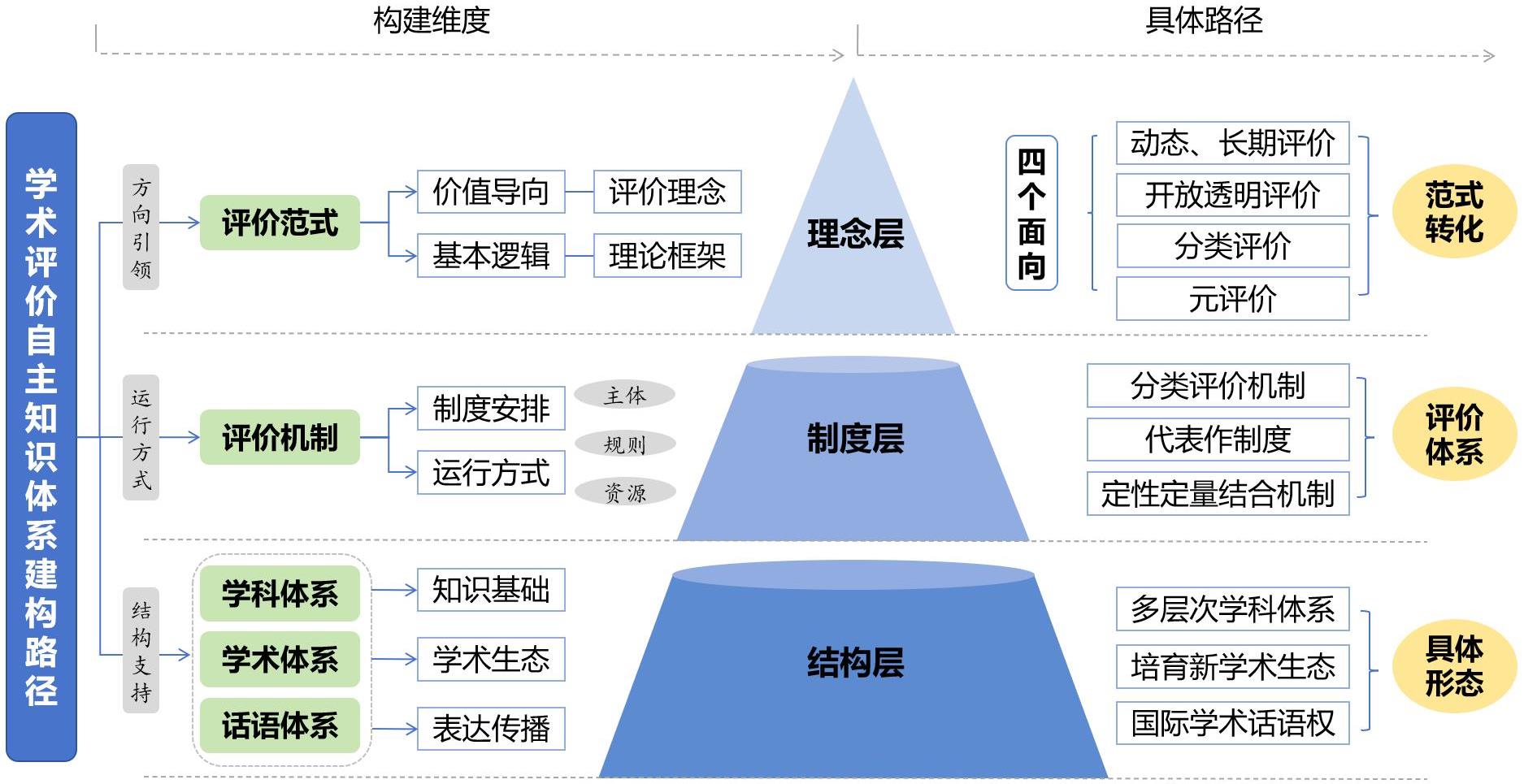
Fig.1

Logical framework for the implementation pathways of an independent knowledge system for academic evaluation"

[1] 杨佳乐, 胡乐明. 知识生产过程、学术评价变革与自主知识体系构建[J]. 学习与探索, 2024(11): 41-50.
Yang Jiale, Hu Leming. Knowledge production process, academic evaluation reform and the construction of independent knowledge system[J]. Study & Exploration, 2024(11): 41-50.
[2] 伍宸. 价值驱动学术评价的理论框架与中国道路[J]. 江苏高教, 2025(5): 12-21.
Wu Chen. The theoretical framework of value-driven academic evaluation and the Chinese path[J]. Jiangsu Higher Education, 2025(5): 12-21.
[3] 王旭, 戴春燕, 翟洵涧, 等. 自主知识体系建构视域下中国人文社会科学学术论文原创力评价研究[J/OL]. 重庆大学学报(社会科学版), 1-20[2026-04-30]. .
Wang Xu, Dai Chunyan, Zhai Xunjian, et al. Research on the originality evaluation of academic papers in Chinese humanities and social sciences from the perspective of independent knowledge system construction[J/OL]. Journal of Chongqing University (Social Science Edition), 1-20[2026-04-30]. .
[4] 蒋玲. 构建中国自主的学术评价知识体系[EB/OL]. (2025-12-26)[2026-04-30]. .
[5] 邱均平, 文庭孝, 等. 评价学: 理论·方法·实践[M]. 北京: 科学出版社, 2010.
[6] 邱均平, 张蕊, 文庭孝, 等. 评价科学: 理论·方法·应用[M]. 北京: 科学出版社, 2021.
[7] 索传军. 学术评价论[M]. 北京: 科学技术文献出版社, 2020.
[8] 叶继元. 学术“全评价”体系论[M]. 北京: 社会科学文献出版社, 2021.
[9] 毛婧. 基于扎根理论的高校科研评价制度改革[J]. 高教发展与评估, 2025, 41(5): 10-21, 129-130.
Mao Jing. Reform of university research evaluation system based on grounded theory[J]. Higher Education Development and Evaluation, 2025, 41(5): 10-21, 129-130.
[10] 周春雷, 姚周远伊, 汪巧红, 等. 学术期刊赋能自主知识体系建构的角色定位、现实困境与发展路径[J]. 中国科技期刊研究, 2025, 36(6): 729-736.
Zhou Chunlei, Yao Zhouyuanyi, Wang Qiaohong, et al. Role positioning, practical challenges, and development paths of academic journals in empowering the construction of an independent knowledge system[J]. Chinese Journal of Scientific and Technical Periodicals, 2025, 36(6): 729-736.
[11] 江波, 王伯扬. AI辅助学术期刊同行评议: 必要、可行与可为[J]. 中国编辑, 2025(11): 26-33.
Jiang Bo, Wang Boyang. AI-assisted peer review of academic journals: Necessity, feasibility and feasibility[J]. Chinese Editors Journal, 2025(11): 26-33.
[12] 卢思佳. 基于学术共同体构建的哲学社会科学学术评价生态治理[J/OL]. 情报理论与实践, 1-11[2026-04-30]. .
Lu Sijia. Ecological governance of academic evaluation in philosophy and social sciences based on the construction of academic community[J/OL]. Information Studies: Theory & Application, 1-11[2026-04-30]. .
[13] 夏倩芳. 建构一种积极的学术自主性——兼论学术自主性与知识体系自主性的关系[J]. 开放时代, 2025(2): 25-40, 6.
Xia Qianfang. Constructing pro-active academic autonomy: On the relationship between academic autonomy and knowledge system autonomy[J]. Open Times, 2025(2): 25-40, 6.
[14] 王伟光. 加快构建中国特色哲学社会科学“三大体系”推动中国自主知识体系建构与发展[J]. 人民论坛·学术前沿, 2025(19): 13-21.
Wang Weiguang. Accelerate the development of the "three major systems" of philosophy and social sciences with Chinese characteristics promote the construction and development of China's independent knowledge system[J]. Frontiers, 2025(19): 13-21.
[15] 徐拥军. 哲学社会科学学术评价的范式转型: 从绩效观到生态观[J]. 北京大学学报(哲学社会科学版), 2024, 61(6): 160-170.
Xu Yongjun. Paradigm transformation of academic evaluation in philosophy and social sciences: From the performance view to the ecological view[J]. Journal of Peking University (Philosophy and Social Sciences), 2024, 61(6): 160-170.
[16] 杨思洛. 数智技术赋能科学计量评价[N]. 中国社会科学报, 2024-10-22(8).
[17] 杨思洛, 韩瑞珍. 构筑“四位一体”的科研评价体系[N]. 中国社会科学报, 2022-02-15(8).
[18] 王旭. 面向自主知识体系建构的中国社会科学国际学术话语权评价与提升研究[J]. 情报科学, 2025, 43(7): 115-123.
Wang Xu. Analysis on the evaluation and enhancement of China’s international academic discourse power in social sciences oriented to the construction of independent knowledge system[J]. Information Science, 2025, 43(7): 115-123.
[19] 王廷国. 学术期刊助力中国自主知识体系构建的理与路[J]. 科技与出版, 2024(12): 15-22.
Wang Tingguo. The theory and way for academic journals to help the construction of independent knowledge system in China[J]. Science-Technology & Publication, 2024(12): 15-22.
[20] 杨思洛, 白立华, 王新波, 等. 中国应用型期刊评价研究报告(2025版)[M]. 天津: 天津科学技术出版社, 2026.
[1] DENG Qiping, KE Jiaxiu, GAN Peng, ZHOU Song. Construction of an Intelligent Agent for Academic Output Data Analysis Oriented to Academic Evaluation [J]. Journal of library and information science in agriculture, 2026, 38(3): 76-87.
[2] ZHANG Wenjun. Conception of Academic Coin Circulation System Based on Blockchain [J]. Journal of library and information science in agriculture, 2022, 34(8): 42-51.
[3] ZHOU Wenjie, YANG Kehu. An Overview of the Evidence-based Digital Humanity Paradigm with Chinese Characteristics from the Perspective of the Construction of Independent Knowledge System [J]. Journal of library and information science in agriculture, 2022, 34(11): 5-13.
[4] TANG Bqiun, WANG Lingfeng. Improvement of PACT Rules for International Academic Conferences Ranking [J]. Journal of library and information science in agriculture, 2018, 30(7): 10-13.
[5] ZHANG YaNan, ZHANG Ling. Research on the Same Disciplinary Field's Academic Evaluation System in the Views of Scientometrics [J]. Journal of library and information science in agriculture, 2018, 30(11): 57-60.
[6] ZHAO Jie. Investigation and Analysis on Academic Journal Citation utility [J]. Journal of library and information science in agriculture, 2014, 26(12): 154-156.
Viewed
Full text


Abstract

Cited

  Shared   
  Discussed   
No Suggested Reading articles found!