中文    English

Journal of library and information science in agriculture ›› 2024, Vol. 36 ›› Issue (8): 34-42.doi: 10.13998/j.cnki.issn1002-1248.24-0670

;

Previous Articles     Next Articles

Construction of an AI Literacy General Education Curriculum Based on "Knowledge-Skills" Navigation

Baiyang LI, Rong SUN   

  1. Research Institute for Data Management Innovation, Nanjing University, Suzhou 215163
  • Received:2024-07-15 Online:2024-08-05 Published:2024-12-13

Abstract:

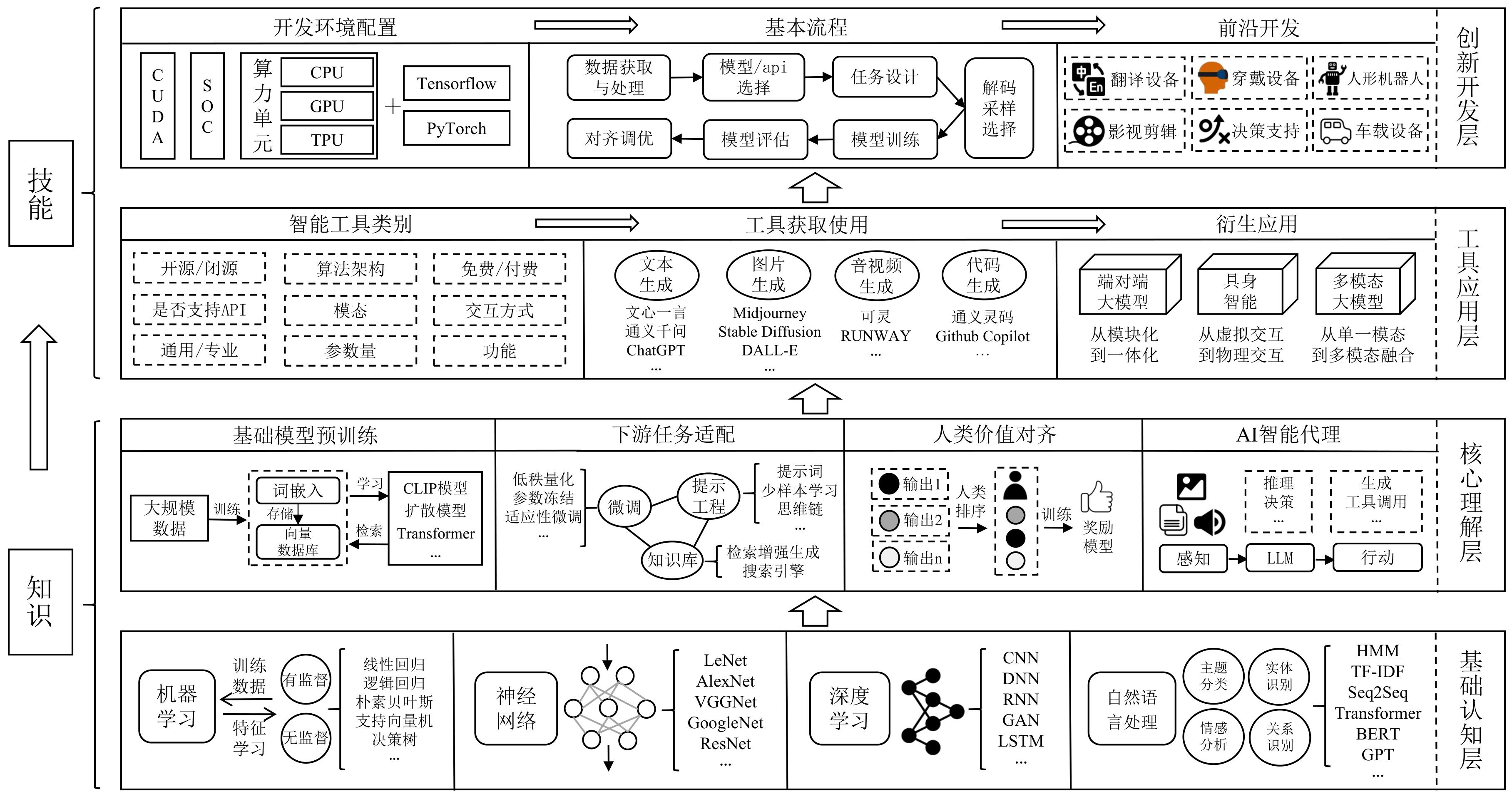
[Purpose/Significance] The rapid development of generative artificial intelligence (GenAI) has led to a growing demand for AI literacy in various fields. However, current AI literacy courses often fail to adequately address the diverse needs of students with different academic backgrounds, expertise, and learning levels. This research aims to design an AI literacy curriculum that balances knowledge dissemination with skill development, ensuring that students can not only understand basic concepts but also apply them in practice. [Method/Process] This study is based on the design of Nanjing University's "Exploration of Frontier Applications of Generative Artificial Intelligence" course, which adopts the "knowledge-skills" navigation framework. The course is divided into four progressively advanced levels: foundational cognition, core understanding, tool application, and innovative development. The foundational cognition level systematically organizes the four key knowledge modules involved in generative artificial intelligence: Machine Learning, Neural Networks, Deep Learning, and Natural Language Processing, helping students to build an initial cognitive framework for GenAI. The core understanding level explores advanced topics in GenAI, covering four main modules: basic model pre-training, downstream task adaptation, human-AI value alignment, and AI agents. This aims to enhance students' comprehensive understanding of the technical principles, application methods, and ethical considerations, providing the necessary technical support and conceptual tools for real-world applications. The tool application level consists of three modules: classification of intelligent tools, tool acquisition and use, and derived applications. It gradually guides students from analyzing the characteristics of tools and their use to exploring state-of-the-art applications in multi-modal, multi-scenario, and integrated contexts. Finally, the innovative development level is the final practical stage of the GenAI learning system and includes environment configuration, basic processes, and frontier development. This includes configuration of hardware and software environments, basic steps for development tasks, and advanced practices for complex functions, forming a complete chain from basic support to high-end applications. Following the "knowledge-skills" navigation, the course will also include teaching designs such as concept cognition modules, multi-modal generation and application skill modules, advanced generative AI knowledge and skill modules, and generative AI governance modules, along with the development of corresponding online open courses, open educational resources, and experimental equipment resources. [Results/Conclusions] The "knowledge-skills" navigation framework effectively enhances students' AI literacy by successfully bridging the gap between theoretical knowledge and practical application. The modular structure of the course, combined with multi-modal learning and hands-on practice, effectively meets the diverse learning needs of students. The course allows students to gradually build a knowledge system from basic concepts to advanced skills, fostering a comprehensive understanding of AI technologies.

Key words: generative artificial intelligence, AI literacy, general education, curriculum design, digital literacy education

CLC Number: 

  • G252.7

Fig.1

"Knowledge-skills" navigation"

1
OECD. Emerging Trends in AI skill demand across 14 OECD countries[EB/OL]. [2024-07-13].
2
UNESCO. Beijing consensus on artificial intelligence and education[EB/OL]. [2024-07-13].
3
UNESCO. AI competency framework for teachers[EB/OL]. [2024-07-13].
4
Commission European. White paper on artificial intelligence: A European approach toexcellence and trust[EB/OL]. [2024-06-20].
5
中华人民共和国教育部. 关于“双一流”建设高校促进学科融合加快人工智能领域研究生培养的若干意见[EB/OL]. [2024-06-20].
6
中华人民共和国中央人民政府. 习近平在全国教育大会上强调: 紧紧围绕立德树人根本任务 朝着建成教育强国战略目标扎实迈进[EB/OL]. [2024-06-20].
7
National Institute of Science and Technology Policy. 科学技术指标2024[EB/OL]. [2024-06-20].
8
UNESCO. AI: UNESCO mobilizes education ministers from around the world for a co-ordinated response to ChatGPT[EB/OL]. [2024-07-13].
9
UNESCO. AI competency framework for students[EB/OL]. [2024-07-13].
10
OECD. OECD digital education outlook 2023: Towards an effective education ecosystem[EB/OL]. [2024-07-13].
11
OECD. PISA 2025 learning in the digital world[EB/OL]. [2024-07-13].
12
IFLA. IFLA statement on libraries and artificial intelligence[EB/OL]. [2024-07-13].
13
IFLA. Artificial Intelligence Special Interest Group[EB/OL]. [2024-07-13].
14
Computing Community Consortium & Association for the Advancement of Articial Intelligence. A 20 -year community roadmap for artificial intelligence research in the US[EB /OL]. [2024-06-16].
15
The White House. National artificial intelligence research and development strategicplan 2023 update[EB/OL]. [2024-06-16].
16
National Security Commission on Artificial Intelligence(NSCAI). The final report[EB/OL]. [2024-06-16].
17
Teach AI[EB/OL]. [2024-06-16].
18
United Kingdom Government. National AI strategy[EB/OL]. [2024-06-16].
19
Deep Knowledge Analytics. Artificial intelligence industry in the UK: Landscape overview 2021[EB/OL]. [2024-06-16].
20
沈苑, 胡梦圆, 范逸洲, 等. 可信赖人工智能教育应用的建设路径与现实启示——以英国典型举措为例[J]. 现代远程教育研究, 2023, 35(4): 65-74.
SHEN Y, HU M Y, FAN Y Z, et al. Path and enlightenment of trustworthy artificial intelligence in education: A case study of typical initiatives in the United Kingdom[J]. Modern distance education research, 2023, 35(4): 65-74.
21
中华人民共和国中央人民政府. 国务院关于印发新一代人工智能发展规划的通知[EB/OL]. [2024-06-16].
22
中华人民共和国教育部. 教育部关于印发《高等学校人工智能创新行动计划》的通知[EB/OL]. [2024-06-16].
23
中华人民共和国中央人民政府. 中央网信办等四部门印发《2024年提升全民数字素养与技能工作要点》[EB/OL]. [2024-06-16].
24
中华人民共和国教育部. 教育部发布4项行动助推人工智能赋能教育[EB/OL]. [2024-06-16].
[1] AN Lin. Governance of Personal Information Security in the Iteration of Generative AI: From the Perspective of the Technological Evolution of Large Models [J]. Journal of library and information science in agriculture, 2026, 38(4): 61-70.
[2] LI Baiyang, REN Shangsheng. Technical Evolution and Application Scenarios of Open-Source Agents:A Case Study of "OpenClaw" [J]. Journal of library and information science in agriculture, 2026, 38(4): 23-35.
[3] YI Chenhe, ZHANG Yuting. Risk Assessment and Early Warning of Generative Artificial Intelligence Impact on Network Public Opinion Based on Optimized BP Neural Network [J]. Journal of library and information science in agriculture, 2026, 38(2): 30-41.
[4] ZHANG Ling. Integrating Digital Humanities and Agricultural Knowledge Services A Simulation Modeling Perspectives [J]. Journal of library and information science in agriculture, 2026, 38(2): 79-89.
[5] JIANG Jingze, ZHOU Tianmin, LI Mei, CHENG Cheng, CHEN Haiyan. A study of the Core Competence Model of Compound AI Librarians in the Intelligent Transformation of University Libraries [J]. Journal of library and information science in agriculture, 2025, 37(9): 97-109.
[6] SHEN Hongjie, SHEN Hongwei, WANG Junli. Generative AI Empowering Information Literacy Education in Digital Libraries: Path Exploration, Challenge Analysis, and Response Strategies [J]. Journal of library and information science in agriculture, 2025, 37(7): 50-60.
[7] ZHANG Tao, WU Sihang. How Achievement Goal Orientation Influences College Students' Usage Behaviors of AI Tutoring Tools: An Empirical Study Based on Dual Mediation [J]. Journal of library and information science in agriculture, 2025, 37(7): 91-105.
[8] JIANG Yumeng. An Investigation and Enlightenment on the Current Status of AI Literacy Education in Nordic University Libraries [J]. Journal of library and information science in agriculture, 2025, 37(7): 19-34.
[9] ZHAI Jun, MENG Zihan, LI Fangsu, SHEN Lixin. AI Guides in Research Libraries of North America under the AI4S Context: Based on the Survey of 125 ARL Libraries [J]. Journal of library and information science in agriculture, 2025, 37(7): 35-49.
[10] DAI Xinwei, LI Feng. Enlightenment of AI Literacy Educational Designs and Practices at Japanese MDASH Literacy-level Approved Universities [J]. Journal of library and information science in agriculture, 2025, 37(5): 86-101.
[11] SHI Xujie, YUAN Fan, LI Jia. Searching as Learning in the Context of Generative Artificial Intelligence: Technological Pathways, Behavioral Evolution, and Ethical Challenges [J]. Journal of library and information science in agriculture, 2025, 37(5): 40-57.
[12] ZHANG Weichong, XU Chen, ZHU Yiran. Cultivation Path of AI Literacy for Grassroots Civil Servants Based on the Integrated TAM-IDT Model [J]. Journal of library and information science in agriculture, 2025, 37(5): 72-85.
[13] ZHANG Li, WANG Bo, JING Shui. Generative AI-Driven Resource Discovery in Public Libraries: Service Optimization Based on a Dynamic Evaluation Model [J]. Journal of library and information science in agriculture, 2025, 37(5): 58-71.
[14] GOU Ruike, LUO Wei. Influencing Factors of Continuous Use Intention of "Generation Z" Users of an AIGC Platform [J]. Journal of library and information science in agriculture, 2025, 37(3): 66-80.
[15] SUN Zhimei, LIU Yan, LIU Wenyun, LI Ruiqin. Perception and Utilization of Digital Literacy Knowledge by University Library Users from Representational Pers Perspective [J]. Journal of library and information science in agriculture, 2025, 37(2): 23-36.
Viewed
Full text


Abstract

Cited

  Shared   
  Discussed   
No Suggested Reading articles found!