中文    English

Journal of library and information science in agriculture


Construction of the Library's Personalized Intelligent Service Model Driven by Artificial Intelligence: an Integrated Theoretical Framework Based on Multiple Cases at Home and Abroad

YANG Shanxi   

  1. Party School of Guangxi Zhuang Autonomous Region Committee of CPC, Nanning 530021
  • Received:2026-04-07 Online:2026-06-10

Abstract:

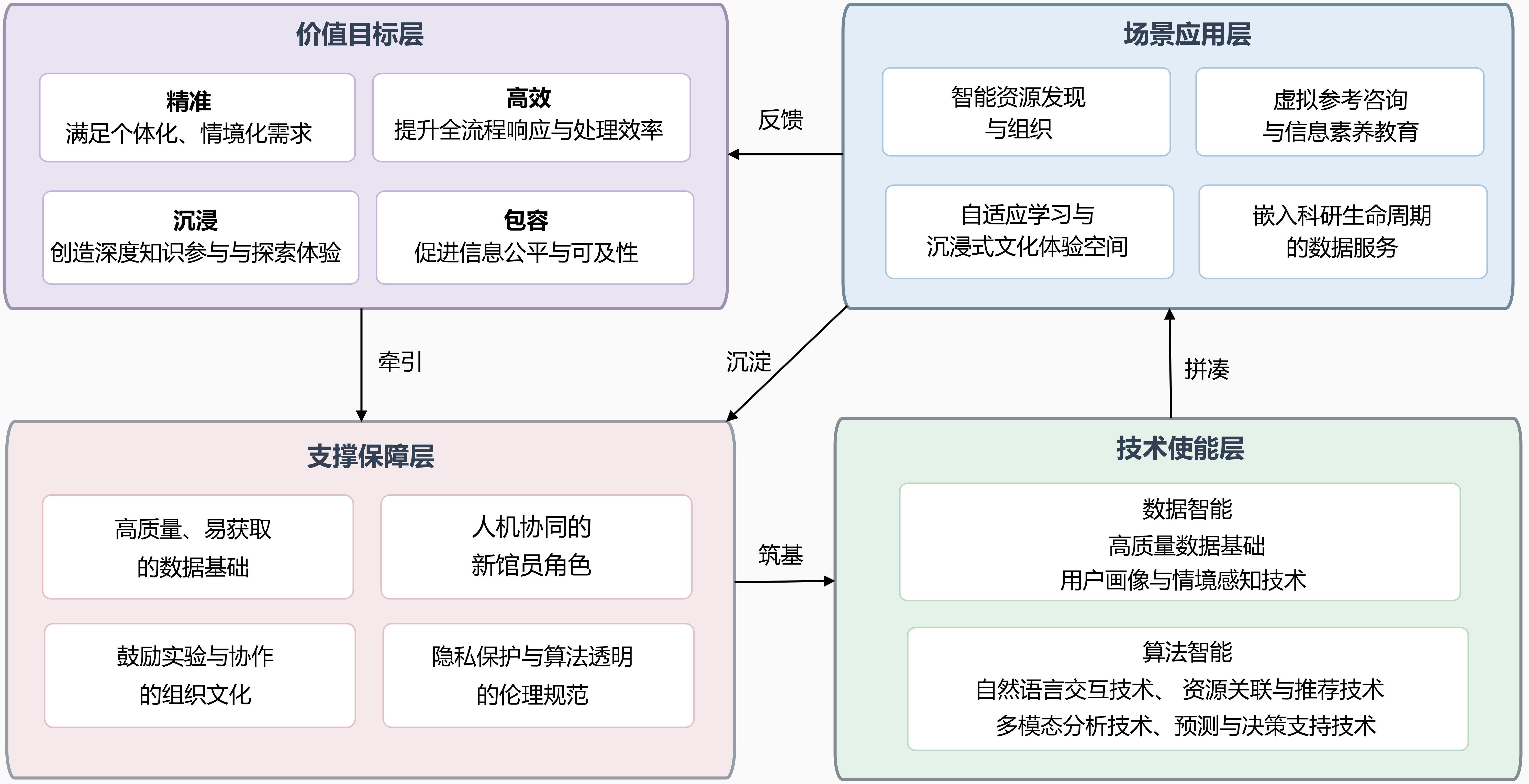
[Purpose/Significance] The existing AI library research is mostly limited to isolated technologies such as recommendation algorithms and chatbots, and lacks a systematic explanation of the overall mechanism of the service model. From the perspective of resource bricolage theory, based on the realistic constraints of capital, technology, and talents, this study constructed an integrated theoretical framework and revealed the elements, hierarchical relationships, and dynamic evolution logic of the library's personalized intelligent service. On this basis, the core issue of "how to realize artificial intelligence-driven innovation in libraries with limited resources" is analyzed to make up for the shortcomings of existing research in applying bricolage theory to the field of personalized intelligent services. [Method/Process] This study adopted a combination of multiple-case study and grounded theory. According to the principle of maximum difference, seven cases were selected: the National Library of Singapore, the National Library of Australia, Stanford University Library, Helsinki Central Library in Finland, an Ethiopian university library, the Library of Congress of Chile, and the Digital Library of Jao College of India, covering three types (public, university, and professional libraries) and spanning six continents (Asia, Oceania, North America, Europe, Africa, and South America). Materials were sourced from policy documents, academic papers, research reports, and news reports. Non-Chinese materials were subjected to two-way back translation to ensure semantic consistency. NVivo 15 software was used for three-level coding: in the open coding stage, initial concepts were extracted sentence by sentence, yielding 128 initial concepts, which were merged into 37 initial categories; in the axial coding stage, the 37 categories were summarized into 12 subcategories, which were further refined into four main categories: value goals, technology empowerment, scenario application, and support and guarantee; in the selective coding stage, the two-way interactive logic of "target traction-foundational support" among the four layers was established, and seven types of resource bricolage were identified: experience-driven, institution-driven, capability-driven, and organization-driven, demand-oriented, technology-deep integration, and agile tool-based. Two articles were reserved for theoretical saturation testing, confirming that the core categories reached saturation. [Results/Conclusions] We have constructed a "four-layer dynamic model driven by resource bricolage," and support the bottom-up support layer (data governance, librarian ability, organizational culture, and ethical norms) as a bricolage resource library; the technical enabling layer (data intelligence and algorithm intelligence) realizes the creative reconstruction of resources; the scene application layer (resource discovery, virtual consulting, scientific research service, and adaptive experience) is the value transformation interface; the value target layer (precise, efficient, immersive, and inclusive) provides direction traction. The four layers constitute a recursive cycle consisting of target traction, resource activation, organizational improvisation, resource reconstruction, scenario realization, and capability precipitation, thereby promoting the spiral upward development of service capability. We define the three-stage path: basic construction (resources will be available, suitable for grassroots libraries), in-depth integration (resource reconstruction, suitable for pilot libraries), and ecological innovation (system bricolage, suitable for leading libraries). This paper contributes by introducing bricolage theory, constructing the structure-process integration framework, and proposing a three-stage implementation roadmap. Its limitations are that it relies on second-hand information and lacks first-hand interviews, as well as universality for an empirical test. In the future, a quantitative evaluation of librarian AI ability modeling and deep impact research on generative AI can be conducted.

Key words: artificial intelligence, resource bricolage, smart personalized service, smart library, personalized service, service model, multi-case study

CLC Number: 

  • G252

Table 1

Feature matrix of key cases for constructing personalized intelligent service models in libraries"

序号 案例名称 核心特征与代表性 对模式构建研究的主要价值 资料类型
1 新加坡国家图书馆管理局(亚洲) 借助生成式人工智能技术,开发出ChatBook、Playbrary、StoryGen三款服务原型。其中,ChatBook实现用户与馆藏内容的对话式互动,Playbrary将经典文学作品转化为互动游戏化阅读形式,StoryGen则可完成文本到视觉内容的转换,核心实践重点是通过生成式AI创新用户交互模式[16,17] 该案例为生成式人工智能在图书馆用户交互、阅读推广服务中的创新应用提供了真实实践参考,能够帮助研究者分析技术对用户与馆藏内容连接方式的改变,进而构建基于新型交互界面的个性化智慧服务路径[16,17] 新闻报道
2 澳大利亚国家图书馆(大洋洲) 该馆发布的人工智能框架提出在遵守法律法规、保护知识产权、保障隐私安全的前提下负责任地应用人工智能的原则[18]。在实践中,图书馆利用人工智能进行口述历史转录、图像识别以解锁馆藏,并探索语义搜索,以实现Trove平台数据分类与信息获取效率的提升[19] 该案例为考察图书馆在法律与伦理约束下如何制定人工智能应用的系统性框架提供了经验材料。通过分析该案例,可以探究机构层面协调技术创新与风险管理的具体机制,并在此基础上进一步讨论负责任的个性化智慧服务治理模式的构建路径[18,19] 政策文件、学术论文
3 斯坦福大学图书馆(北美洲) 构建了以资源数字化、专业化团队和智能化平台为支撑的“全要素整合”数据服务体系[20]。实践包括利用FOLIO开源平台进行资源管理,引入Jupyter系列工具为研究人员提供数据分析服务,并在AI工具链中集成Scite等模块以辅助可信度评估,支持数据密集型科研工作[21] 该案例为探讨图书馆从文献服务者向科研赋能者转型的路径提供了实证基础,有助于分析图书馆如何通过整合资源、技术与专业能力,构建嵌入科研工作流的智慧数据与计算服务模式[20,21] 学术论文
4 芬兰赫尔辛基中央图书馆(欧洲) 利用人工智能技术优化实体空间与物理馆藏的运营管理[22,23]。实践包括引入对话机器人提供主题阅读推荐与导航服务,部署智能物流与馆藏管理系统实现自动化图书分拣、运输与定位,利用数据分析优化馆藏在全市范围内的流通与配置[24] 该案例为研究人工智能如何与图书馆物理空间、实体资源深度融合以提升运营效率与用户体验提供了典型范例,有助于构建线上线下融合的个性化智慧服务运营模式[22-24] 学术论文、新闻报道
5 埃塞俄比亚高校图书馆(非洲) 基于实证数据考察资源受限情境下学生对AI聊天机器人的使用模式与满意度[25]。结果显示,学生主要将AI工具用于考试准备、作业辅助与研究协助。技术可及性、隐私安全与本地化支持是用户体验层面的主要关注点。受访学生普遍期望AI工具能够适应当地语言与文化语境 该案例从用户视角为检验个性化智慧服务模式在欠发达地区的适用性与包容性提供了实证依据。相关数据有助于揭示技术接入不平等与数字素养差异条件下服务模式本地化适配的具体策略[25] 学术论文
6 智利国会图书馆(南美洲) 利用多种人工智能技术对立法核心业务流程进行深度改造[26]。实践中,采用语义网技术将立法数据发布为关联开放数据,利用自然语言处理对历史立法文档进行自动标注以构建法律史系统,并基于机器学习模型结合政治背景数据预测法案通过概率,准确率约86%[26] 该案例为研究人工智能如何深度嵌入专业领域核心业务流程、实现知识服务精细化与决策支持智能化提供了完整的技术实现路径,有助于分析AI在驱动特定领域服务升级中的应用潜力与整合方式[26] 学术论文
7 印度贾奥学院数字图书馆(亚洲) 利用商用AI工具(ChatGPT)和轻量化开源平台(Google Sheets、Google Apps Script)快速构建了一个面向学生就业需求的自动化新闻推送系统[27]。该系统能够每日定时抓取、去重、组织并推送287家目标公司的新闻,且具有良好的可扩展性[27] 该案例为研究在技术资源有限的情况下,图书馆如何利用易获取的AI工具进行敏捷开发以快速响应特定用户需求提供了实践参考,有助于分析技术简化为馆员赋能、实现个性化智慧服务模式快速创新的可行路径[27] 学术论文

Table 2

Partial open coding process"

序号 初始范畴 原始资料 编码说明
1 个性化匹配 智能聊天机器人“奥博蒂”(Obotti)根据用户的兴趣、资源利用记录、主动反馈等信息,为用户推荐要借阅的书籍或要参加的活动等[22] 依据用户兴趣、行为与反馈,动态匹配资源,实现个性化适配
2 智能问答嵌入

一项根据已出版的书籍等内容而生成的服务名为“ChatBook”,让读者通过聊天的方式了解书中内容

(A Generative AI chat service that enables conversations with books. This service, named "ChatBook," allows readers to understand book content through conversation[16]

将静态阅读转为问答交互,AI对话能力嵌入内容获取流程
3 知识探索

利用语义网技术将立法内容作为关联开放数据发布,实现机器可读性与高标准互操作性的结合

(Publishing legislation as linked open data with Semantic Web technologies, combining machine-readable comprehension with high standards of interoperability[26]

依托开放数据与语义网,构建可互操作的结构化知识网络
4 语义检索 通过提高关键词搜索能力优化搜索引擎,强化语义关联与文本挖掘、更新文献资源网站布局[19] 基于语义理解优化检索,实现深层内容关联与挖掘
5 活动情景适配 Oodi充分利用AI提升用户的参与度并分析用户对学习服务的需求[22] AI分析用户需求,适配学习场景,提升参与效能
6 体验创造 公众可通过语音和文字方式与聊天书互动,探索相关的书面资料、口述历史记录和照片等[17] 多模态交互驱动沉浸式内容体验生成
7 深度参与

玩家可以扮演夏洛克·福尔摩斯的角色,并在约翰·华生医生的帮助下一起做出选择,以解决一个神秘的案件

(Players can assume the role of Sherlock Holmes and make choices together with the help of Dr. John Watson to solve a mystery case[16]

角色扮演与自主选择推动叙事,实现主动式深度参与
8 算法透明可解释

73%的受访者对人工智能聊天机器人在教育领域的透明度持正面看法,表明他们信任其算法和决策过程

(Seventy-three percent of the respondents held a positive opinion of AI chatbots' transparency in education, indicating trust in their algorithms and decision-making processes[25]

算法可解释性增强用户信任,保障服务可信度
9 隐私保护机制

外部服务处理的数据只保留在事务的持续时间中,而不被这些服务存储

(Data processed by external services is retained only for the transaction's duration and is not stored by those services[25]

数据短时处理、不持久化,构建隐私防护机制

Table 3

Category structure from axial coding"

编码 主范畴 编码 副范畴 对应初始范畴
V 价值目标层 V1 智慧服务愿景 公平可及、体验创造、深度参与
V2 知识组织与创新探索 知识图谱构建
V3 人文与伦理关怀 文化保护、专业判断价值
T 技术使能层 T1 智能感知与交互 空间状态感知、计算机视觉、自然语言处理
T2 资源组织与处理 多源数据整合、资源自动标引、资源动态调度、语义检索
T3 技术与系统能力 多语言支持、响应速度、流程自动化
S 场景应用层 S1 科研支持场景 科研平台支撑、学科数据分析、研究技能培训、人机协作咨询
S2 学习与知识服务 知识探索、个性化匹配、智能问答嵌入
S3 预测模型、活动情景适配 预测模型、活动情景适配
G 支撑保障层 G1 组织与人力资源 AI馆员培训、跨部门协作、人力成本降低、组织自我管理
G2 数据与算法治理 数据质量治理、隐私保护机制、算法透明可解释、偏见审计
G3 制度与文化环境 实验试错文化、数字鸿沟、技术采纳意愿

Table 4

Cross-case analysis of resource bricolage logic"

案例 现有资源识别 资源将就的立即行动 资源重构的创造性组合 拼凑类型
新加坡国家图书馆 已出版的经典文学著作、馆藏历史资料(照片、口述史) 利用生成式AI(ChatGPT)快速开发服务原型(ChatBook, Playbrary),无需等待复杂的系统开发 将文本内容与游戏化交互、多媒介体验进行创造性重组,将静态馆藏转化为动态体验 体验驱动型拼凑
澳大利亚国家图书馆 已有的文化藏品、Trove数字平台、既有的政策框架 在政府AI政策指引尚不完备的情况下,率先发布机构AI框架,将风险防范与创新探索同步推进 将文化保护协议(ICIP)与AI伦理原则、技术标准进行制度性整合 制度驱动型拼凑
斯坦福大学图书馆 数百万的数字化馆藏、元数据团队、跨学科研究中心、FOLIO开源平台 不追求“大而全”的单一系统,而是将Jupyter Notebook、Scite等成熟工具链式集成入现有工作流 将技术工具、专业馆员、科研流程、元数据标准进行深度融合,构建“全要素整合”的科研支持体系 能力驱动型拼凑
芬兰赫尔辛基中央图书馆 全市36家图书馆的实体馆藏、现有馆员团队、城市数字化项目(Nuuka) 引入IMMS混沌仓储系统,打破“书归原处”的传统思维,采用“就地流转”的策略 将智能物流技术、浮动馆藏理念、青色组织管理模式与物理空间进行系统性整合,重塑服务流程与组织文化 流程与组织驱动型拼凑
埃塞俄比亚高校图书馆 学生用户对本地语言和文化的隐性需求 在学生调研基础上,快速提出对AI工具进行本地化适配的需求,虽未形成系统性解决方案,但明确了拼凑方向 研究者初步构想了将本地语言、文化敏感性与技术可及性进行组合的适配框架 需求导向型拼凑
智利国会图书馆 历史立法文档、已有的立法数据库、政治背景数据 不满足于文档数字化,而是立即采用语义网和NLP技术对文档进行深度标注和关联化处理 将关联数据、NLP自动标注、机器学习预测模型进行技术栈的深度整合,重构立法信息服务范式 技术深度整合型拼凑
印度贾奥学院数字图书馆 可以获取的免费技术工具,包括Google News、Sheets、Apps Script及ChatGPT;馆员具备基础编程能力与探索意愿 面对学生获取招聘公司新闻的迫切需求,馆员基于现有条件启动原型构建,未等待项目立项或专项经费批复 通过脚本将RSS订阅、表格自动化功能与内容管理系统LibGuides加以整合,以较低成本实现自动化新闻推送服务 敏捷工具型拼凑

Fig.1

Four-layer dynamic model driven by resource bricolage"

[1]
中华人民共和国国民经济和社会发展第十五个五年规划纲要[EB/OL]. (2026-03-13)[2026-05-17].
[2]
中华人民共和国文化和旅游部. “十四五”公共文化服务体系建设规划[EB/OL]. (2021-06-10)[2026-05-17].
[3]
国务院. 关于深入实施“人工智能+”行动的意见. 国发〔2025〕11号[EB/OL]. (2025-08-21)[2026-05-17].
[4]
郭亚军, 郭一若, 李帅, 等. ChatGPT赋能图书馆智慧服务: 特征、场景与路径[J]. 图书馆建设, 2023(2): 30-39, 78.
Guo Yajun, Guo Yiruo, Li Shuai, et al. ChatGPT empowers library smart service: Characteristics, scenarios and realization paths[J]. Library Development, 2023(2): 30-39, 78.
[5]
蔡子凡, 蔚海燕. 人工智能生成内容(AIGC)的演进历程及其图书馆智慧服务应用场景[J]. 图书馆杂志, 2023, 42(4): 34-43.
Cai Zifan, Wei Haiyan. Evolution of artificial intelligence generated content(AIGC)and its application scenario of library intelligent service[J]. Library Journal, 2023, 42(4): 34-43.
[6]
陈媛媛, 符彬, 高源, 等. 融合BERTopic与IWOA-BiLSTM模型的新兴技术主题识别与趋势预测方法研究[J]. 农业图书情报学报, 2025, 37(6): 55-69.
Chen Yuanyuan, Fu Bin, Gao Yuan, et al. Identification of emerging technology topics and prediction of trends using a method integrating BERTopic and IWOA-BiLSTM models[J]. Journal of Library and Information Science in Agriculture, 2025, 37(6): 55-69.
[7]
杨新涯, 杨俊利, 涂佳琪, 等. 智慧图书馆“十四五”反思与“十五五”规划研究[J/OL]. 图书馆杂志, 1-9[2026-02-18].
Yang Xinya, Yang Junli, Tu Jiaqi, et al. Research on smart libraries: Retrospection of the 14th Five-Year Plan and strategic planning for the 15th Five-Year Plan period[J/OL]. Library Journal, 1-9[2026-02-18].
[8]
张铭洁, 赵瑞雪. ChatGPT驱动的智慧图书馆情感感知与服务优化[J]. 农业图书情报学报, 2024, 36(12): 74-88.
Zhang Mingjie, Zhao Ruixue. Emotion perception and service optimization in ChatGPT-driven smart libraries emotion libraries[J]. Journal of Library and Information Science in Agriculture, 2024, 36(12): 74-88.
[9]
陈楠. “十五五”规划下数智时代公共图书馆智慧服务策略[J]. 农业图书情报学报, 2025, 37(12): 64-80.
Chen Nan. Strategies for smart library services in public libraries during the digitally-intelligence era under the 15th Five-Year Planth plan[J]. Journal of Library and Information Science in Agriculture, 2025, 37(12): 64-80.
[10]
初景利, 段美珍. 智慧图书馆与智慧服务[J]. 图书馆建设, 2018(4): 85-90, 95.
Chu Jingli, Duan Meizhen. Smart library and smart services[J]. Library Development, 2018(4): 85-90, 95.
[11]
宋剑锋, 王笛, 孙秀梅. 跨界搜寻、资源拼凑对持续性竞争优势的影响: 基于资源编排理论[J]. 科技管理研究, 2023, 43(13): 179-191.
Song Jianfeng, Wang Di, Sun Xiumei. The impact of boundary-spanning and resource bricolage on the sustainable competitive advantage based on resource arrangement theory[J]. Science and Technology Management Research, 2023, 43(13): 179-191.
[12]
刘海龙, 许文. 组织即兴和资源拼凑的内涵及关系研究述评[J]. 管理评论, 2022, 34(7): 115-128.
Liu Hailong, Xu Wen. The connotation and relationship between organizational improvisation and bricolage: An integrative literature review[J]. Management Review, 2022, 34(7): 115-128.
[13]
刘志迎, 龚秀媛, 张孟夏. Yin、Eisenhardt和Pan的案例研究方法比较研究——基于方法论视角[J]. 管理案例研究与评论, 2018, 11(1): 104-115.
Liu Zhiying, Gong Xiuyuan, Zhang Mengxia. A comparative study on the case study methods of Yin, Eisenhardt and Pan: From the methodological perspective[J]. Journal of Management Case Studies, 2018, 11(1): 104-115.
[14]
介凤, 盛兴军. 数字学术中心: 图书馆服务转型与空间变革——以北美地区大学图书馆为例[J]. 图书情报工作, 2016, 60(13): 64-70.
Feng Jie, Sheng Xingjun. The center for digital scholarship: Service transformation and space change in libraries: A case study of the CDS of academic libraries in North America[J]. Library and Information Service, 2016, 60(13): 64-70.
[15]
涂志芳, 刘细文. 数字学术服务的内容与形式: 一项系统综述和比较研究[J]. 图书情报工作, 2023, 67(8): 104-114.
Tu Zhifang, Liu Xiwen. The contents and forms of digital scholarship services: A systematic review and comparative study[J]. Library and Information Service, 2023, 67(8): 104-114.
[16]
National Library Board Singapore. Discover new gen AI-enabled reading adventures based on literary classics[EB/OL]. [2023-04-02].
[17]
联合早报. 新加坡国家图书馆首推AI“聊天书”介绍建国元勋拉惹勒南生平[N/OL]. [2024-07-29].
[18]
National Library of Australia. Artificial intelligence framework[EB/OL]. [2025-03-20].
[19]
柯平, 李筱颖, 孙宣, 等. 中国图书馆“十五五”规划编制——基于环境扫描与需求分析的战略目标体系构建[J]. 农业图书情报学报, 2024, 36(12): 4-19.
Ke Ping, Li Xiaoying, Sun Xuan, et al. Drafting the "15th Five-Year Plan" of Chinese librariesth libraries: Constructing the strategic goals and systems based on environmental scanning and demand AnalysisGoals analysis[J]. Journal of Library and Information Science in Agriculture, 2024, 36(12): 4-19.
[20]
宋娟. 斯坦福大学图书馆数据服务模式研究: 基于全要素整合的案例研究[J]. 图书馆, 2026(1): 24-31.
Song Juan. Research on the data service model of stanford university library: A case study based on all elements integration[J]. Library, 2026(1): 24-31.
[21]
翟军, 孟子涵, 李方苏, 等. AI4S背景下北美研究型图书馆AI指南研究——基于对125所ARL图书馆的调研[J]. 农业图书情报学报, 2025, 37(7): 35-49.
Zhai Jun, Meng Zihan, Li Fangsu, et al. AI guides in research libraries of North America under the AIAI AI44S ContextS context: Based on the survey of 125125 ARL libraries[J]. Journal of Library and Information Science in Agriculture, 2025, 37(7): 35-49.
[22]
郑燕林, 罗宇晨. AI重塑芬兰公共图书馆服务赋能全民教育的实践进向[J]. 外国教育研究, 2024, 51(3): 33-45.
Zheng Yanlin, Luo Yuchen. Practice path of reshaping public library services to promote education for all by utilizing artificial intelligence in Finland[J]. Studies in Foreign Education, 2024, 51(3): 33-45.
[23]
王碧. 芬兰赫尔辛基颂歌中央图书馆智慧图书馆建设实践及启示[J]. 河北科技图苑, 2022, 35(6): 3-9.
Wang Bi. Practice and enlightenment of smart library development of Finland Helsinki central library oodi[J]. Hebei Journal of Library and Information Science, 2022, 35(6): 3-9.
[24]
李玉海. 塑造数字时代的公共文化空间——芬兰赫尔辛基中央图书馆的知识共享[N]. 学习时报, 2025-12-22(07).
[25]
Subaveerapandiyan A, Radhakrishnan S, Tiwary N, et al. Student satisfaction with artificial intelligence chatbots in Ethiopian academia[J]. IFLA Journal, 2025, 51(3): 600-614.
[26]
Cifuentes-Silva F, Astudillo H, Gayo J E L. Transforming parliamentary libraries: Enhancing processes delivering new services with artificial intelligence[J]. IFLA Journal, 2025, 51(3): 814-835.
[27]
Jhan P J, Sreekumar M G, Kuriakose R. Enhancing library services with artificial intelligence: A framework for an automated news delivery system[J]. IFLA Journal, 2025, 51(3): 836-848.
[28]
Brislin R W. Back-translation for cross-cultural research[J]. Journal of Cross-Cultural Psychology, 1970, 1(3): 185-216.
[29]
周纲, 朱雯晶, 张磊. 开放、合作、智慧的图书馆未来——2024年世界开放图书馆基金会会议(WOLFcon)综述[J]. 图书馆杂志, 2024, 43(12): 77-88.
Zhou Gang, Zhu Wenjing, Zhang Lei. Open, collaborative, and intelligent: The future of libraries: A summary of the 2024 world open library foundation conference[J]. Library Journal, 2024, 43(12): 77-88.
[30]
Martínez-Camacho H, Saavedra-Alamillas C, Pacheco-Mendoza J, et al. Generative artificial intelligence and university libraries in Latin America[J]. IFLA Journal, 2025, 51(3): 647-659.
[31]
吴玉浩, 刘艺浩, 李庆军, 等. 基于大语言模型的图书馆数据开放共享: 逻辑、路径与策略[J]. 农业图书情报学报, 2026, 38(1): 28-43.
Wu Yuhao, Liu Yihao, Li Qingjun, et al. Open sharing of library data based on large language models: Logic, path and strategy[J]. Journal of Library and Information Science in Agriculture, 2026, 38(1): 28-43.
[32]
江皓轩. 广东首个! 广州南沙上线地方文献AI大模型[EB/OL]. (2025-08-28)[2026-04-23].
[33]
重庆大学智慧图书馆. 图书馆AI版门户上线试运行, 一站解锁智能学术新体验![EB/OL]. (2026-12-30)[2026-04-23].
[34]
首都图书馆. 一元肇始 汇智启新——北京城市图书馆开馆一周年[EB/OL]. (2024-12-31)[2026-04-23].
[35]
孙杰. AI“超级馆员”丰台区图书馆上岗[N]. 丰台时报, 2025-11-28(001).
[1] WU Dan, XU Hao. From Human-Computer Interaction to Human-AI Collaboration: A Frontier Perspective on Constructing an Independent Knowledge System for Information Resource Management in China [J]. Journal of library and information science in agriculture, 2026, 38(5): 55-64.
[2] AN Lin. Governance of Personal Information Security in the Iteration of Generative AI: From the Perspective of the Technological Evolution of Large Models [J]. Journal of library and information science in agriculture, 2026, 38(4): 61-70.
[3] LI Baiyang, REN Shangsheng. Technical Evolution and Application Scenarios of Open-Source Agents:A Case Study of "OpenClaw" [J]. Journal of library and information science in agriculture, 2026, 38(4): 23-35.
[4] HU Anqi. Construction of an Artificial Intelligence Literacy Ability Framework and Training System for College Students [J]. Journal of library and information science in agriculture, 2026, 38(2): 42-55.
[5] HUANG Xiaotang, YAO Qibin. Collaborative Development Path of GLAM Institutions Based on AIGC Technology Application [J]. Journal of library and information science in agriculture, 2026, 38(2): 66-78.
[6] YI Chenhe, ZHANG Yuting. Risk Assessment and Early Warning of Generative Artificial Intelligence Impact on Network Public Opinion Based on Optimized BP Neural Network [J]. Journal of library and information science in agriculture, 2026, 38(2): 30-41.
[7] GUO Hailing, ZENG Meiyun, FENG Yuxi. Model Construction and Strategies for AI-enabled University Library Services to Facilitate Scientific and Technological Achievement Transformation [J]. Journal of library and information science in agriculture, 2026, 38(2): 56-65.
[8] ZHANG Ling. Integrating Digital Humanities and Agricultural Knowledge Services A Simulation Modeling Perspectives [J]. Journal of library and information science in agriculture, 2026, 38(2): 79-89.
[9] JIANG Jingze, ZHOU Tianmin, LI Mei, CHENG Cheng, CHEN Haiyan. A study of the Core Competence Model of Compound AI Librarians in the Intelligent Transformation of University Libraries [J]. Journal of library and information science in agriculture, 2025, 37(9): 97-109.
[10] SHEN Hongjie, SHEN Hongwei, WANG Junli. Generative AI Empowering Information Literacy Education in Digital Libraries: Path Exploration, Challenge Analysis, and Response Strategies [J]. Journal of library and information science in agriculture, 2025, 37(7): 50-60.
[11] DONG Ke, SONG Yuchen, WU Jiachun. Layout and Characteristics of European AI Data Governance Policy [J]. Journal of library and information science in agriculture, 2025, 37(7): 4-18.
[12] ZHAI Jun, MENG Zihan, LI Fangsu, SHEN Lixin. AI Guides in Research Libraries of North America under the AI4S Context: Based on the Survey of 125 ARL Libraries [J]. Journal of library and information science in agriculture, 2025, 37(7): 35-49.
[13] LIU Wei, ZHANG Lei, JI Ting, CHEN Xiaoyang. Shaping the Smart Libraries with AI: An Agent-based, Next-Generation Library Service Platform [J]. Journal of library and information science in agriculture, 2025, 37(5): 15-26.
[14] SHI Xujie, YUAN Fan, LI Jia. Searching as Learning in the Context of Generative Artificial Intelligence: Technological Pathways, Behavioral Evolution, and Ethical Challenges [J]. Journal of library and information science in agriculture, 2025, 37(5): 40-57.
[15] CHEN Jiayong, GONG Jiaoteng, WANG Yuyi. Research of Interdisciplinary Comparison and Collaborative Paradigm on the Concept of Agent in Library Science [J]. Journal of library and information science in agriculture, 2025, 37(5): 27-39.
Viewed
Full text


Abstract

Cited

  Shared   
  Discussed   
No Suggested Reading articles found!