中文    English

Journal of library and information science in agriculture


Element Coupling of Smart Services in University Libraries and Its Scenario-based Applications from the Perspective of Smart Ecosystem

FU Guorui, HAN Dingdong(), WANG Hongye   

  1. Shandong University Library, Jinan 250100
  • Received:2026-04-02 Online:2026-06-10
  • Contact: HAN Dingdong

Abstract:

[Purpose/Significance] Because of the rapid digitalization and intelligentization during China's 15th Five-Year Plan period, university libraries are undergoing a profound transformation from traditional resource-oriented service institutions to integrated smart service systems. Although considerable progress has been made in the development of smart libraries, the existing studies are mainly concerned with specific technologies, functional modules, or localized service innovations. Therefore, insufficient attention is given to the internal structure of smart service systems and to the mechanisms through which different service elements interact to generate service value. As a consequence, the practical applications often suffer from fragmented element configurations and inadequate integration between service design and application scenario. To address these issues, this study introduces the perspective of smart ecosystem for exploring the basic composition and operational logic of smart services in university libraries. By constructing an analytical framework of element coupling and its scenario-based applications, this study seeks to surpass the technology-centered and function-centered approaches so as to provide a systematic explanation for the design, operation, and evolution of smart service systems. This framework is expected to deepen the theoretical understanding of smart library services and offer practical inspirations for university libraries in building sustainable and adaptive service ecosystems. [Method/Process] In this study, smart library services were regarded as a dynamic process consisting of demand generation, information representation, technological processing, service delivery, and feedback optimization. On this basis, smart services were broken down into four main categories: users, data, technology, and services. Then, the analysis was conducted in their interaction, coupling relationship, and dynamic reconfiguration mechanism. Instead of regarding smart services as a simple aggregation of technologies or service functions, this study emphasizes the networked relationships among the four categories. It identifies several basic coupling modes, including user-data coupling, data-technology coupling, technology-service coupling, and user-service coupling, and further extends them into a multi-element network structure with continuous interaction and feedback. Based on the correspondence between the user needs and the service generation process, four representative application scenarios were constructed: resource navigation, learning support, research assistance, and virtual interaction. Methodologically, this study combined theoretical analysis and case study. Shandong University Library was selected as the empirical case because of its continuous exploration of smart service innovation. By examining the practical applications, this study analyzes how the proposed coupling mechanisms were implemented in different scenarios. [Results/Conclusions] The findings indicate that smart services in university libraries are essentially ecosystem-based processes involving the collaboration of multiple parties, rather than merely technological outputs. Users, data, technology, and services interact to form a dynamic network, in which the service generation emerges from the continuous coupling and reconfiguration of multiple elements. Different service scenarios present different dominant coupling structures. Resource navigation mainly relies on the interaction among users, data, and technology to enhance knowledge discovery and resource matching; the learning support emphasizes the multi-element collaboration throughout the learning process; the research assistance reflects the integration of data and technological capabilities driven by user needs; and the virtual interaction highlights the role of technology empowerment in improving service accessibility. The case of Shandong University Library shows that the analytical framework proposed in this study can effectively explain the evolutionary process of smart services from element coupling to scenario construction and, ultimately, to ecosystem coordination. Nevertheless, this study still has certain limitations. As the empirical analysis is mainly based on a single institutional case, the discussion of large-scale inter-organizational collaboration is still limited. Future research may further explore the collaborative smart service ecosystems among multiple libraries, the advanced data governance mechanisms, and the deeper integration of artificial intelligence and emerging technologies. Such research will help enhance the adaptability, sustainability, and overall effectiveness of smart service systems in university libraries.

Key words: smart ecosystem, smart library, element coupling, scenario-based application, 15th Five-Year Plan, AI

CLC Number: 

  • G250.7

Table 1

Connotations and functional roles of the four core elements in smart services of university libraries"

要素类型 基本内涵 主要内容 功能定位
用户要素 用户是智慧服务生成与优化的重要主体 包括基础需求、发展性需求与潜在需求;通过用户生成内容、协同标注、服务评价等方式参与服务改进 构成智慧服务的需求起点与反馈来源,决定服务设计方向与优化
数据要素 数据是连接用户需求、技术处理与服务输出的关键媒介 包括资源数据、行为数据与环境数据;经整合、清洗、语义标引、模型构建等治理过程转化为知识 支撑用户画像、资源推荐、空间管理、服务评估与知识发现
技术要素 技术是智慧服务运行的基础设施与能力底座 包括感知层、计算层与交互层,分别实现信息采集、数据分析与服务交互 支撑内容推荐、智能问答、空间调度与虚拟交互,决定服务实现边界
服务要素 服务是用户需求、数据资源与技术能力综合作用的结果 包括基础服务、拓展服务与创新服务,并在具体情境中动态生成与持续优化 实现资源价值向用户价值转化,是智慧服务效能的集中体现

Table 2

Basic coupling patterns of smart service elements in university libraries"

耦合模式 核心含义 实现方式 典型功能
“用户-数据”耦合 通过数据持续识别和表达用户需求 分析借阅记录、检索行为、学习轨迹等数据,形成用户画像与兴趣模型 支撑需求预测、资源推荐、扩展阅读推送与学习资源匹配
“数据-技术”耦合 数据提供对象表征,技术完成处理转化 依托物联网、传感网络、知识图谱、机器学习等技术,对资源、空间与行为数据进行建模分析 支撑情境感知、动态推荐、空间调度与环境优化
“技术-服务”耦合 技术嵌入服务流程,推动服务功能集成与重构 通过统一接口、系统架构和身份认证,实现不同服务模块的联通与调用 支撑座位预约提醒、跨平台学习支持、智能问答与连续服务体验
“用户-服务”耦合 用户不仅接受服务,也反向参与服务内容塑造 通过服务评价、资源标注、UGC、开放API与读者社群等机制参与服务改进 支撑服务共建、知识共享、文化共创与服务边界拓展

Fig.1

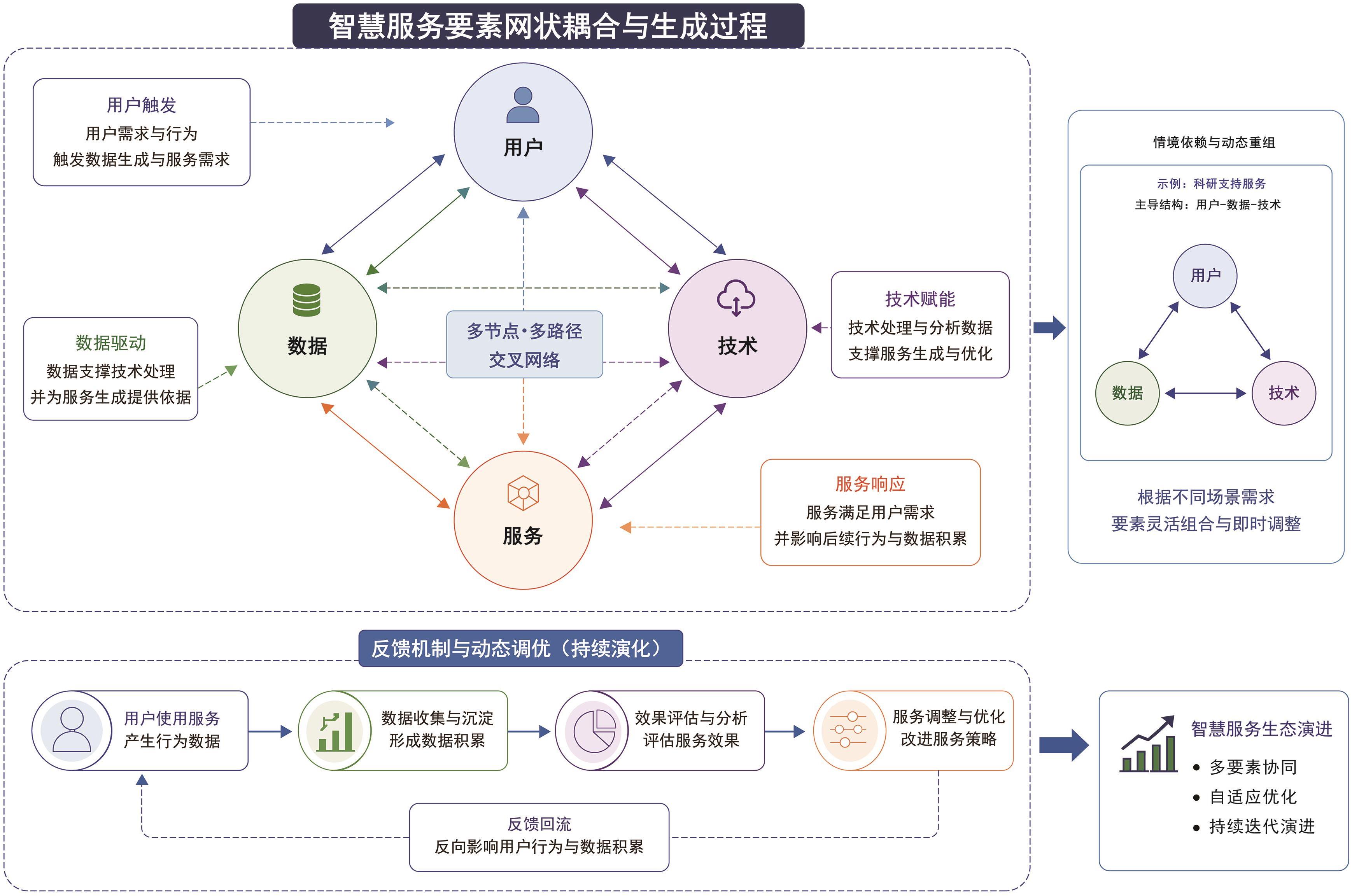
Coupling mechanism and service generation process of smart library services in university libraries"

[1]
国务院. 国务院关于印发“十四五”数字经济发展规划的通知[EB/OL]. [2022-01-12].
[2]
中共中央, 国务院. 数字中国建设整体布局规划[EB/OL]. [2023-02-27].
[3]
文化和旅游部, 国家发展和改革委员会, 财政部. 关于推动公共文化服务高质量发展的意见[EB/OL]. [2021-03-08].
[4]
侯冬尽. 面向高校图书馆“十五五”规划的战略规划研究——世界一流大学图书馆战略规划的分析及其启示[J/OL]. 农业图书情报学报, 2026: 1-11[2026-05-03].
Hou Dongjin. Strategic planning research for university libraries in the "15th Five-Year Plan" period: Analysis and implications of strategic planning of world-class university libraries[J/OL]. Journal of Agricultural Library and Information Science, 2026: 1-11[2026-05-03].
[5]
孙小影, 贾佳, 江丽萍, 等. 构建新型研究型大学虚实融合的智慧图书馆生态——上海科技大学图书馆“十五五”建设路径探索[J]. 高校图书馆工作, 2026, 46(2): 31-38.
Sun Xiaoying, Jia Jia, Jiang Liping, et al. Virtual-real integration in the smart library ecosystem of new research universities: Exploring the construction path of ShanghaiTech University library during the 15th Five-Year Plan period[J]. Library Work in Colleges and Universities, 2026, 46(2): 31-38.
[6]
Mittal A. Emerging technologies and their impact on the libraries[J]. Indian Journal of Science and Technology, 2017, 10(31): 1-4.
[7]
Gul S, Bano S. Smart libraries: An emerging and innovative technological habitat of 21st century[J]. The Electronic Library, 2019, 37(5): 764-783.
[8]
Asemi A, Ko A, Nowkarizi M. Intelligent libraries: A review on expert systems, artificial intelligence, and robot[J]. Library Hi Tech, 2021, 39(2): 412-434.
[9]
只莹莹. 5G+区块链技术在图书馆智慧服务中的应用研究[J]. 图书馆工作与研究, 2020(10): 12-17.
Zhi Yingying. Research on the application of 5G+ blockchain technology in library intelligent service[J]. Library Work and Study, 2020(10): 12-17.
[10]
孔繁超. 基于数字孪生技术的智慧图书馆空间重构研究[J]. 情报理论与实践, 2020, 43(8): 146-151.
Kong Fanchao. The reconstruction of smart library space by digital twin technology[J]. Information Studies (Theory & Application), 2020, 43(8): 146-151.
[11]
薛卫双, 钟欢. “技术+人文”: 基于FOLIO平台的高校图书馆智慧服务平台研究[J]. 图书馆学研究, 2021(6): 36-42, 10.
Xue Weishuang, Zhong Huan. "Technology + humanities": A research on the intelligent service platform of university library based on FOLIO platform[J]. Research on Library Science, 2021(6): 36-42, 10.
[12]
刘炜, 张磊, 嵇婷, 等. 以AI塑形智慧图书馆: 基于智能体的下一代图书馆服务平台[J]. 农业图书情报学报, 2025, 37(5): 15-26.
Liu Wei, Zhang Lei, Ji Ting, et al. Shaping the smart libraries with AI: An agent-based, next-generation library service platform[J]. Journal of Library and Information Science in Agriculture, 2025, 37(5): 15-26.
[13]
覃玮境, 向立文, 左逸群. 融合与重构: AI技术驱动下智慧图书馆服务逻辑与路径[J]. 图书馆工作与研究, 2019(3): 29-33.
Qin Weijing, Xiang Liwen, Zuo Yiqun. Fusion and reconstruction: Service logic and path of smart library service in AI technology[J]. Library Work and Study, 2019(3): 29-33.
[14]
王超. 智慧图书馆知识服务生态系统模型构建研究[J]. 图书馆工作与研究, 2021(12): 16-21.
Wang Chao. Research on the construction of knowledge service ecosystem model of smart library[J]. Library Work and Study, 2021(12): 16-21.
[15]
International Federation of Library Associations and Institutions(IFLA). IFLA trend report 2018 update[R]. The Hague: IFLA, 2018.
[16]
OCLC. Libraries at scale: OCLC research agenda 2017-2021[R]. Dublin, OH: OCLC, 2017.
[17]
柯平, 李筱颖, 孙宣, 等. 中国图书馆“十五五”规划编制——基于环境扫描与需求分析的战略目标体系构建[J]. 农业图书情报学报, 2024, 36(12): 4-19.
Ke Ping, Li Xiaoying, Sun Xuan, et al. Drafting the "15th Five-Year Plan" of Chinese librariesth libraries: Constructing the strategic goals and systems based on environmental scanning and demand AnalysisGoals analysis[J]. Journal of Library and Information Science in Agriculture, 2024, 36(12): 4-19.
[18]
Odum. Fundamentals of ecology[M]. Philadelphia: W.B. Saunders Co., 1971.
[19]
Davenport T H, Prusak L. Information ecology: Mastering the information and knowledge environment[M]. New York: Oxford University Press, 1997.
[20]
刘炜, 陈晨, 张磊. 5G与智慧图书馆建设[J]. 中国图书馆学报, 2019, 45(5): 42-50.
Liu Wei, Chen Chen, Zhang Lei. 5G and smart library construction[J]. Journal of Library Science in China, 2019, 45(5): 42-50.
[21]
蒋继平. 生态化搜索视角下智慧图书馆信息服务模式研究[J/OL]. 农业图书情报学报, 2026: 1-11[2026-05-03].
Jiang Jiping. Research on smart library information service models from the perspective of ecological search[J/OL]. Journal of Agricultural Library and Information Science, 2026: 1-11[2026-05-03].
[22]
Vargo S L, Lusch R F. Evolving to a new dominant logic for marketing[J]. Journal of Marketing, 2004, 68(1): 1-17.
[23]
Dey A K. Understanding and using context[J]. Personal and Ubiquitous Computing, 2001, 5(1): 4-7.
[24]
Spohrer J C, Maglio P P. Toward a science of service systems[M]//Handbook of Service Science. Boston, MA: Springer US, 2010: 157-194.
[1] GUO Jinbo. Effects of AIGC on Reader Trust in Library Information [J]. Journal of library and information science in agriculture, 2026, 38(4): 84-98.
[2] SONG Lingling, ZHANG Xinghui. Efficacy of Intelligent Consulting Services in Libraries at Home and Abroad under the Background of AI Large Model Driving [J]. Journal of library and information science in agriculture, 2026, 38(4): 99-111.
[3] LIU Wei, JIN Jiaqin. Library Transformation in the Age of AI Agents: Service Reconfiguration and Governance Framework Based on the OpenClaw Architecture [J]. Journal of library and information science in agriculture, 2026, 38(4): 13-22.
[4] JIN Wugang. Establishment and Improvement of the Mechanisms for Directly Delivering Public Cultural Services to Grassroots Levels [J]. Journal of library and information science in agriculture, 2026, 38(3): 5-11.
[5] HU Anqi. Construction of an Artificial Intelligence Literacy Ability Framework and Training System for College Students [J]. Journal of library and information science in agriculture, 2026, 38(2): 42-55.
[6] MAO Kaiyan. Promotion of Chinese Classical Literature for Children's Reading: Applications and Initiatives of Sora-Type Video Generation [J]. Journal of library and information science in agriculture, 2026, 38(2): 90-103.
[7] HUANG Xiaotang, YAO Qibin. Collaborative Development Path of GLAM Institutions Based on AIGC Technology Application [J]. Journal of library and information science in agriculture, 2026, 38(2): 66-78.
[8] FENG Li, GUO Bochi, GAO Mian. Optimizing the Path of Cultivating Intellectual Property Literacy among College Students through AIGC Empowerment [J]. Journal of library and information science in agriculture, 2026, 38(1): 58-70.
[9] YANG Min. Investigation and Analysis on the Practice of Seoul Outdoor Library and its Enlightenment [J]. Journal of library and information science in agriculture, 2026, 38(1): 95-103.
[10] WU Dan, XU Huaqing. Affective Computing for Social Robots from the Perspective of Human-AI Interaction: A Literature Review and Theoretical Model Construction [J]. Journal of library and information science in agriculture, 2026, 38(1): 4-17.
[11] JIANG Jingze, ZHOU Tianmin, LI Mei, CHENG Cheng, CHEN Haiyan. A study of the Core Competence Model of Compound AI Librarians in the Intelligent Transformation of University Libraries [J]. Journal of library and information science in agriculture, 2025, 37(9): 97-109.
[12] LIU Ting, LIU Shuhan, LIU Zhenyan, ZENG Dequan, HU Yuan. Impact of Data Element Utilization Level on Enterprises' Supply Chain Discourse Power [J]. Journal of library and information science in agriculture, 2025, 37(9): 32-48.
[13] CHANG Hao, XU Taotao, LI Feng. A Multi-dimensional Feature Text Complexity Framework and Knowledge Base Augmentation Model [J]. Journal of library and information science in agriculture, 2025, 37(8): 61-77.
[14] SHEN Hongjie, SHEN Hongwei, WANG Junli. Generative AI Empowering Information Literacy Education in Digital Libraries: Path Exploration, Challenge Analysis, and Response Strategies [J]. Journal of library and information science in agriculture, 2025, 37(7): 50-60.
[15] ZHANG Tao, WU Sihang. How Achievement Goal Orientation Influences College Students' Usage Behaviors of AI Tutoring Tools: An Empirical Study Based on Dual Mediation [J]. Journal of library and information science in agriculture, 2025, 37(7): 91-105.
Viewed
Full text


Abstract

Cited

  Shared   
  Discussed   
No Suggested Reading articles found!