中文    English

Journal of library and information science in agriculture ›› 2025, Vol. 37 ›› Issue (9): 32-48.doi: 10.13998/j.cnki.issn1002-1248.25-0408

Previous Articles    

Impact of Data Element Utilization Level on Enterprises' Supply Chain Discourse Power

LIU Ting1,2, LIU Shuhan1, LIU Zhenyan1, ZENG Dequan3, HU Yuan1,2()   

  1. 1. School of Public Policy and Administration, Nanchang University, Nanchang 330031
    2. Digital Literacy and Skills Enhancement Center, Key Research Base of Philosophy and Social Sciences in Jiangxi Province, Nanchang University, Nanchang 330031
    3. School of Mechanical and Vehicle Engineering, East China Jiaotong University, Nanchang 330013
  • Received:2025-06-30 Online:2025-09-05 Published:2025-12-08
  • Contact: HU Yuan

Abstract:

[Purpose/Significance] In the digital age, data elements have become a key factor in production, while insufficient bargaining power in the supply chain poses significant operational risks to enterprises. How to leverage the opportunities of the digital economy, maximize the role of data elements, and avoid operational risks caused by insufficient discourse power in the supply chain has become a key issue that enterprises urgently need to address. Investigating how data utilization enhances this power is vital for building resilient supply chains and informing governance decisions. This method is also effective for further utilizing data elements. It provides micro evidence that helps us understand how data elements can optimize resource allocation and empower organizational decision making. [Method/Process] This study employs a rigorous, empirical approach using panel data from China's A-share listed companies from 2003 to 2022. A two-way fixed effects model serves as the primary estimator to control for unobserved heterogeneity. To credibly address potential endogeneity issues, such as reverse causality and sample selection bias, we implemented a comprehensive identification strategy. This methodology incorporates the use of instrumental variables, Heckman's two-stage correction model, and a series of robustness checks including alternative variable constructions and sub-sample analyses. Furthermore, we conducted mechanism analysis to elucidate the transmission channels and heterogeneity analysis to examine conditional effects across different types of firms. [Results/Conclusions] The empirical results demonstrate that the improvement of data element utilization level can effectively strengthen a firm's supply chain bargaining power and reduce the dependence of enterprises on large suppliers and customers, enhance their bargaining power and influence in the supply chain. This conclusion still holds true after robustness tests such as replacing the regression model, adding control variables, and adjusting the sample period. Mechanism analysis results indicate that the utilization level of data elements primarily empowers supply chain discourse through two channels: improving supply chain efficiency and alleviating financing constraints. Firstly, data elements optimize the inventory management, logistics scheduling, and supply chain collaboration of enterprises, improving operational efficiency and reducing dependence on key suppliers and customers. Secondly, data elements improve the information transparency of enterprises, reduce external financing costs, enhance the liquidity of funds, and make them more autonomous and bargaining power in supply chain transactions. A heterogeneity analysis revealed significant differences in the empowering effects of data elements among different types of enterprises. Among them, data elements have a more significant effect on enhancing the discourse power of supply chain for non-labor-intensive and non-asset-intensive enterprises, as well as a stronger promotional effect on non-technology-intensive and non-high-tech industry enterprises. This suggests that companies that rely less on traditional physical resources are better able to use data to gain a competitive advantage. This study establishes a robust theoretical basis for data-driven supply chain management and presents significant policy implications. One limitation is its focus on listed companies. Future research could expand this inquiry to include small and medium-sized enterprises and global supply chain contexts.

Key words: data element, supply chain discourse power, supply chain efficiency, financing constraints, supply chain resilience

CLC Number: 

  • G203

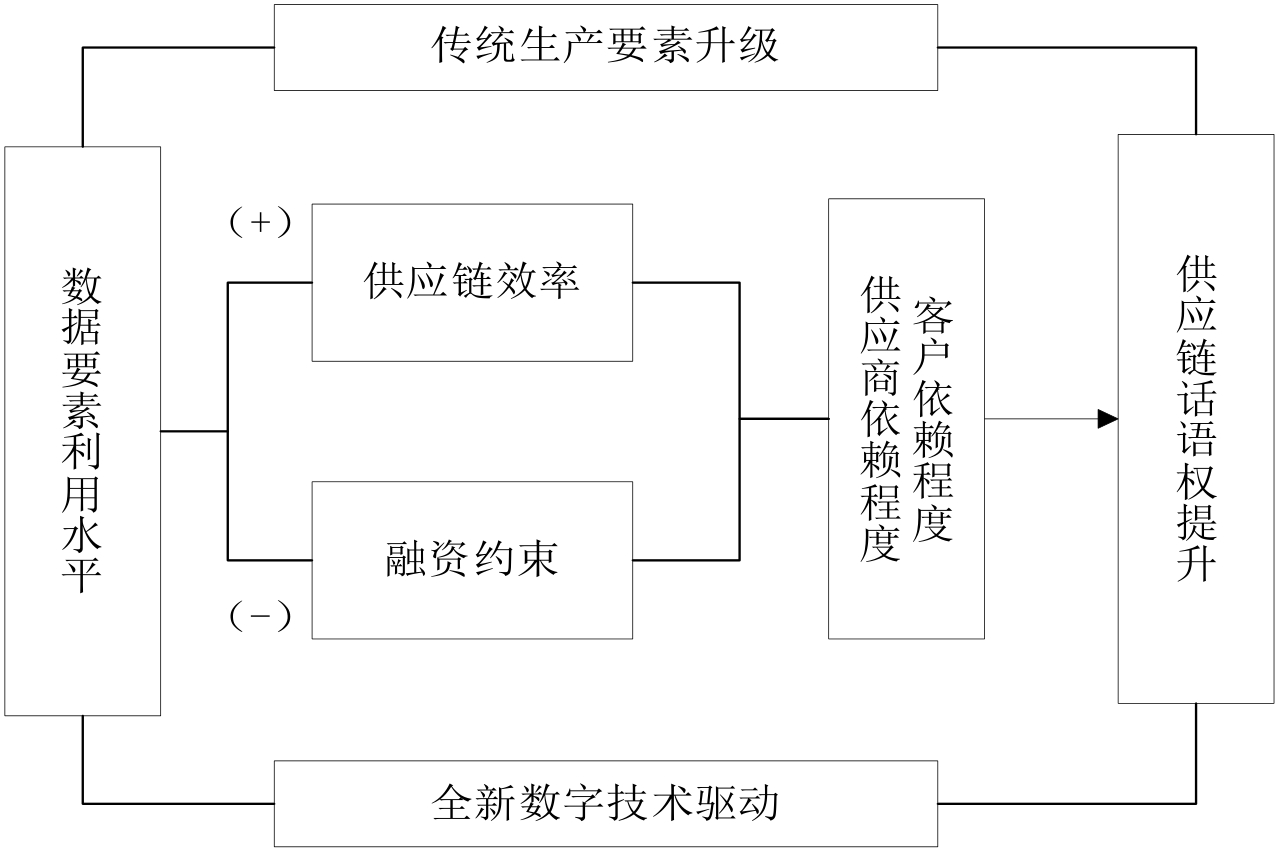
Fig.1

Research model on the impact of data element utilization levels on supply chain influence"

Table 1

Variable definition"

变量类型 变量名称 变量符号 变量定义
被解释变量 供应链话语权 SCC 上市公司对前五大供应商和前五大客户的采购与销售比重的平均值
客户话语权 CC 公司销售额中前五大客户所占的比重
供应商话语权 SC 公司采购总额中前五大供应商所占的份额
解释变量 数据要素利用水平 DEUL 数据要素相关指标出现频数加1取对数
控制变量 公司规模 Size 年总资产的自然对数
股权性质 SOE 国有控股企业为1,其他为0
资产负债率 Lev 年末总负债/年末总资产
总资产净利润率 ROA 净利润/总资产平均余额
净资产收益率 ROE 净利润/所有者权益平均余额
现金流比率 Cashflow 经营活动产生的现金流量净额/总资产
营业收入增长率 Growth 本年营业收入/上一年营业收入-1
资本密集度 CAP 总资产/营业收入
财务杠杆 FL (净利润+所得税费用+财务费用)/(净利润+所得税费用)
托宾Q值 TobinQ (流通股市值+非流通股股份数×每股净资产+负债账面值)/总资产
账面市值比 BM 账面价值/总市值

Table 2

Descriptive statistics of primary variables"

变量符号 样本量/个 均值 标准差 最小值 中位数 最大值
SCC 41 151 33.502 17.298 0.735 30.675 100.000
CC 41 151 31.508 22.395 0.010 25.600 100.000
SC 41 151 35.495 20.535 0.320 30.950 100.000
DEUL 41 151 1.217 1.387 0.000 0.693 4.990
Size 41 151 22.118 1.285 19.317 21.939 26.452
SOE 41 151 0.417 0.491 0.000 0.000 1.000
Lev 41 151 0.451 0.203 0.027 0.450 0.908
ROA 41 151 0.034 0.068 -0.373 0.034 0.257
ROE 41 151 0.052 0.149 -0.926 0.066 0.470
Cashflow 41 151 0.045 0.071 -0.235 0.044 0.283
Growth 41 151 0.175 0.429 -0.658 0.109 4.024
CAP 41 151 2.505 2.156 0.329 1.896 18.942
FL 41 151 1.326 1.067 -1.982 1.066 11.549
BM 41 151 0.636 0.251 0.064 0.639 1.246
TobinQ 41 151 2.010 1.350 0.802 1.571 15.607

Table 3

Results of benchmark regression analysis"

变量 (1) (2) (3) (4) (5) (6)
SC CC SCC SC CC SCC
DEUL

-1.018***

(0.092 4)

-0.699***

(0.086 6)

-0.859***

(0.070 8)

-0.528***

(0.092 1)

-0.332***

(0.086 5)

-0.430***

(0.069 8)

Size

-4.676***

(0.155)

-3.307***

(0.146)

-3.992***

(0.118)

SOE

1.021***

(0.366)

0.349

(0.344)

0.685**

(0.278)

Lev

-0.176

(0.635)

-2.451***

(0.596)

-1.314***

(0.482)

ROA

10.46***

(2.709)

10.22***

(2.543)

10.34***

(2.054)

ROE

-0.278

(1.116)

-2.155**

(1.048)

-1.217

(0.847)

Cashflow

-5.162***

(1.099)

-3.746***

(1.032)

-4.454***

(0.833)

Growth

1.352***

(0.162)

1.286***

(0.152)

1.319***

(0.123)

CAP

0.742***

(0.048 3)

0.751***

(0.045 3)

0.747***

(0.036 6)

FL

-0.033 1

(0.065 1)

0.038 7

(0.061 1)

0.002 79

(0.049 4)

TobinQ

0.045 4

(0.093 0)

0.300***

(0.087 3)

0.173**

(0.070 5)

BM

-0.122

(0.625)

-2.190***

(0.587)

-1.156**

(0.474)

_cons

39.82***

(1.491)

45.23***

(1.397)

42.52***

(1.142)

134.3***

(3.376)

113.5***

(3.170)

123.9***

(2.560)

年份/地区 Yes Yes Yes Yes Yes Yes
N/个 41 151 41 151 41 151 41 151 41 151 41 151
调整后的R 2 0.022 0.015 0.023 0.060 0.049 0.079

Table 4

Results of instrumental variables regression analysis"

变量 2SLS第一阶段 2SLS第二阶段
(1) (2) (3) (4)
DE SC CC SCC
DCG

1.690***

(0.002 72)

DEUL

-1.470***

(0.079 5)

-0.711***

(0.074 5)

-1.091***

(0.060 9)

_cons _ _ _ _
控制变量 Yes Yes Yes Yes
年份/地区 Yes Yes Yes Yes
N/个 40 704 40 704 40 704 40 704
调整后的R 2 0.918 0.011 0.004 0.010

Table 5

Results of Heckman's two-stage regression analysis"

变量 Heckman检验第一阶段 Heckman检验第二阶段
(1) (2) (3) (4)
DEUL_m SC CC SCC
DEUL

-0.471***

(0.095 4)

-0.194**

(0.089 8)

-0.332***

(0.072 5)

IMR

-3.777***

(0.267)

-3.840***

(0.252)

-3.808***

(0.203)

_cons

-3.327

(0.051)

_ _ _
控制变量 Yes Yes Yes Yes
年份/地区 Yes Yes Yes Yes
N/个 41 151 40 704 40 704 40 704
调整后的R 2 _ 0.051 0.034 0.065

Table 6

Results of the robustness test"

变量 更换回归模型 增加控制变量 更改样本周期
(1) (2) (3) (4) (5) (6) (7) (8) (9)
SC CC SCC SC CC SCC SC CC SCC
DEUL

-1.482***

(0.082 2)

-1.811***

(0.090 4)

-1.647***

(0.068 0)

-0.524***

(0.092 2)

-0.327***

(0.086 6)

-0.425***

(0.069 9)

-0.527***

(0.096 7)

-0.397***

(0.090 5)

-0.462***

(0.073 2)

Board

-0.102

(0.595)

-1.858***

(0.559)

-0.980**

(0.452)

Indep

-0.012 3

(0.018 5)

-0.051 3***

(0.017 4)

-0.0318**

(0.014 0)

Dual

0.608***

(0.219)

-0.083 2

(0.206)

0.262

(0.166)

Top1

0.016 9*

(0.009 25)

0.006 16

(0.008 69)

0.011 5

(0.007 02)

_cons 104.4***(2.250) 91.35***(2.474) 97.85***(1.862) 134.3***(3.653) 118.1***(3.429) 126.2***(2.770) 132.2***(3.547) 111.0***(3.320) 121.6***(2.684)
控制变量 Yes Yes Yes Yes Yes Yes Yes Yes Yes
年份/地区 Yes Yes Yes Yes Yes Yes Yes Yes Yes
N/个 41 150 41 150 41 150 41 151 41 151 41 151 37 905 37 905 37 905
调整后的R 2 0.102 0.087 0.134 0.060 0.049 0.079 0.059 0.049 0.079

Table 7

Results of the mechanism analysis"

变量 供应链效率机制检验 融资约束机制检验
(1) (2) (3) (4) (5) (6) (7) (8)
Stock_day SC CC SCC WW_index SC CC SCC
Stock_day

-1.002***

(0.096 3)

-1.152***

(0.090 1)

-1.077***

(0.072 8)

WW_index

17.60***

(1.562)

17.69***

(1.458)

17.64***

(1.192)

DEUL

-0.0595***

(0.005 48)

-0.587***

(0.096 7)

-0.466***

(0.090 5)

-0.526***

(0.073 1)

-0.00554***

(0.000 340)

-0.898***

(0.097 4)

-0.638***

(0.091 0)

-0.768***

(0.074 3)

_cons

4.195***

(0.201)

136.4***

(3.564)

115.9***

(3.333)

126.1***

(2.693)

-0.814***

(0.008 28)

59.78***

(2.684)

70.22***

(2.507)

65.00***

(2.049)

控制变量 Yes Yes Yes Yes Yes Yes Yes Yes
年份/地区 Yes Yes Yes Yes Yes Yes Yes Yes
N/个 37 905 37 905 37 905 37 905 37 905 37 905 37 905 37 905
调整后的R 2 0.126 0.062 0.054 0.085 0.295 0.026 0.021 0.031

Table 8

Analysis results of industry heterogeneity characteristics for enterprises"

变量 劳动密集型 非劳动密集型 资产密集型 非资产密集型
(1) (2) (3) (4) (5) (6) (7) (8) (9) (10) (11) (12)
SC CC SCC SC CC SCC SC CC SCC SC CC SCC
DEUL

-0.296*

(0.171)

-0.417***

(0.160)

-0.357***

(0.129)

-0.373***

(0.117)

-0.372***

(0.108)

-0.373***

(0.087 7)

0.062 4

(0.216)

-0.132

(0.184)

-0.528***

(0.104)

-0.528***

(0.104)

-0.416***

(0.098 4)

-0.472***

(0.078 8)

_cons

125.4***

(6.360)

118.0***

(5.963)

121.7***

(4.818)

148.8***

(4.710)

92.74***

(4.329)

120.8***

(3.528)

111.4***

(7.279)

160.2***

(6.206)

121.0***

(4.041)

121.0***

(4.041)

108.5***

(3.826)

114.8***

(3.062)

控制变量 Yes Yes Yes Yes Yes Yes Yes Yes Yes Yes Yes Yes
年份/地区 Yes Yes Yes Yes Yes Yes Yes Yes Yes Yes Yes Yes
N/个 12 983 12 983 12 983 24 922 24 922 24 922 7 500 7 500 30 405 30 405 30 405 30 405
调整后的R 2 0.056 0.069 0.087 0.076 0.040 0.080 0.080 0.127 0.055 0.055 0.045 0.072

Table 9

Analysis results of heterogeneity in corporate characteristics"

变量 技术密集型 非技术密集型 高科技行业 非高科技行业
(1) (2) (3) (4) (5) (6) (7) (8) (9) (10) (11) (12)
SC CC SCC SC CC SCC SC CC SCC SC CC SCC
DEUL

-0.393***

(0.132)

-0.524***

(0.123)

-0.459***

(0.099 3)

-0.418***

(0.140)

-0.537***

(0.129)

-0.478***

(0.106)

-0.512***

(0.117)

-0.361***

(0.107)

-0.437***

(0.086 8)

-0.344**

(0.164)

-0.690***

(0.154)

-0.517***

(0.126)

_cons

106.2***

(12.21)

78.78***

(11.37)

92.47***

(9.173)

145.2***

(4.822)

123.6***

(4.432)

134.4***

(3.628)

130.9***

(4.861)

95.47***

(4.459)

113.2***

(3.611)

136.8***

(6.019)

125.5***

(5.641)

131.2***

(4.597)

控制变量 Yes Yes Yes Yes Yes Yes Yes Yes Yes Yes Yes Yes
年份/地区 Yes Yes Yes Yes Yes Yes Yes Yes Yes Yes Yes Yes
N/个 16 510 16 510 16 510 21 395 21 395 21 395 21 997 21 997 21 997 15 908 15 908 15 908
调整后的R 2 0.071 0.029 0.065 0.058 0.069 0.090 0.065 0.033 0.067 0.056 0.066 0.083
[1]
黄贤环, 贾敏, 王瑶. 产业链中的话语权与非金融企业金融投资: 基于产业链中商业信用水平的视角[J]. 会计研究, 2022(5): 118-130.
HUANG X H, JIA M, WANG Y. Discourse power in industrial chain and the financial investment of non-financial enterprises based on the perspective of industry chain of commercial credit level[J]. Accounting research, 2022(5): 118-130.
[2]
李颖, 周洋. 供应链协调与“营改增”的盈利效应[J]. 财经研究, 2020, 46(10): 93-108.
LI Y, ZHOU Y. Supply chain coordination and the profitability effect of "business tax to VAT"[J]. Journal of finance and economics, 2020, 46(10): 93-108.
[3]
李欢, 郑杲娉, 李丹. 大客户能够提升上市公司业绩吗 : 基于我国供应链客户关系的研究[J]. 会计研究, 2018(4): 58-65.
LI H, ZHENG G P, LI D. Do big customers influence listed firms' performance : Based on supplier-customer relationships in China[J]. Accounting research, 2018(4): 58-65.
[4]
王雄元, 高开娟. 客户集中度与公司债二级市场信用利差[J]. 金融研究, 2017(1): 130-144.
WANG X Y, GAO K J. Customer-based concentration and bond yield spread in secondary market[J]. Journal of financial research, 2017(1): 130-144.
[5]
BIRGE J R, CAPPONI A, CHEN P C. Disruption and rerouting in supply chain networks[J]. Operations research, 2023, 71(2): 750-767.
[6]
包群, 但佳丽. 网络地位、共享商业关系与大客户占比[J]. 经济研究, 2021, 56(10): 189-205.
BAO Q, DAN J L. Network centrality, shared business ties and share of large business partners[J]. Economic research journal, 2021, 56(10): 189-205.
[7]
李勇坚. 数据要素的经济学含义及相关政策建议[J]. 江西社会科学, 2022, 42(3): 50-63.
LI Y J. The economic meaning of data elements and relevant policy suggestions[J]. Jiangxi social sciences, 2022, 42(3): 50-63.
[8]
国家数据局等部门关于印发《“数据要素×”三年行动计划(2024—2026年)》的通知[EB/OL]. [2025-05-11].
[9]
谢康, 胡杨颂, 刘意, 等. 数据要素驱动企业高质量数字化转型: 索菲亚智能制造纵向案例研究[J]. 管理评论, 2023, 35(2): 328-339.
XIE K, HUYANG S, LIU Y, et al. Data factor driven high-quality digital transformation of enterprise: A longitudinal case study of sogal's intelligent manufacturing[J]. Management review, 2023, 35(2): 328-339.
[10]
梁琳, 金光敏. 数字经济赋能我国产业链韧性提升的路径研究[J]. 齐鲁学刊, 2023(5): 129-138.
LIANG L, JIN G M. Research on the path of digital economy to empower the resilience of China's industrial chain[J]. Qilu journal, 2023(5): 129-138.
[11]
谢康, 张祎, 吴瑶. 数据要素如何产生即时价值: 企业与用户互动视角[J]. 中国工业经济, 2023(11): 137-154.
XIE K, ZHANG Y, WU Y. How data elements generate instant value: An interactive perspective between enterprises and users[J]. China industrial economics, 2023(11): 137-154.
[12]
欧阳日辉, 孟凡新. “数据要素×”商贸流通: 基于加快发展新质生产力的逻辑[J]. 江西社会科学, 2024, 44(10): 83-94.
OUYANG R H, MENG F X. "Data Elements ×" business circulation: Based on the logic of accelerating the development of new quality productivity[J]. Jiangxi social sciences, 2024, 44(10): 83-94.
[13]
蒋殿春, 鲁大宇. 供应链关系变动、融资约束与企业创新[J]. 经济管理, 2022, 44(10): 56-74.
JIANG D C, LU D Y. Changes of supply chain, financing constraints and enterprise innovation[J]. Business and management journal, 2022, 44(10): 56-74.
[14]
张进财. 客户集中度、行业发展周期与企业市场竞争力[J]. 技术经济与管理研究, 2024(10): 20-26.
ZHANG J C. Customer concentration, industry development cycle and market competitiveness of enterprises[J]. Journal of technical economics & management, 2024(10): 20-26.
[15]
周文杰, 杨阳. 数据要素管理[M]. 北京: 知识产权出版社, 2025.
ZHOU W J, YANG Y. Data element management[M]. Beijng: Intellectual Property Publishing House, 2025.
[16]
索传军, 于莹莹, 杨文, 等. 数据资产盘点的相关问题探析[J/OL]. 情报理论与实践, 2025: 1-10.
SUO C J, YU Y Y, YANG W, et al. Exploring issues related to data asset inventory[J/OL]. Information studies: Theory & application, 2025: 1-10.
[17]
李健, 董小凡, 张金林, 等. 数据资产对企业创新投入的影响研究[J]. 外国经济与管理, 2023, 45(12): 18-33.
LI J, DONG X F, ZHANG J L, et al. The impact of data assets on enterprise innovation investment[J]. Foreign economics & management, 2023, 45(12): 18-33.
[18]
陈金晓, 陈剑. 从优化到重塑: 大变局中的供应链高质量发展[J]. 系统工程理论与实践, 2022, 42(3): 545-558.
CHEN J X, CHEN J. From optimization to reinvention: High-quality development of supply chains in great changes[J]. Systems engineering-theory & practice, 2022, 42(3): 545-558.
[19]
王应欢, 郭永祯. 企业数字化转型与ESG表现: 基于中国上市企业的经验证据[J]. 财经研究, 2023, 49(9): 94-108.
WANG Y H, GUO Y Z. Firm digital transformation and ESG performance: Evidence from chin's A-share listed firms[J]. Journal of finance and economics, 2023, 49(9): 94-108.
[20]
焦豪, 杨季枫, 王培暖, 等. 数据驱动的企业动态能力作用机制研究: 基于数据全生命周期管理的数字化转型过程分析[J]. 中国工业经济, 2021(11): 174-192.
JIAO H, YANG J F, WANG P N, et al. Research on data-driven operation mechanism of dynamic capabilities: Based on analysis of digital transformation process from the data lifecycle management[J]. China industrial economics, 2021(11): 174-192.
[21]
陶锋, 王欣然, 徐扬, 等. 数字化转型、产业链供应链韧性与企业生产率[J]. 中国工业经济, 2023(5): 118-136.
TAO F, WANG X R, XU Y, et al. Digital transformation, resilience of industrial chain and supply chain, and enterprise productivity[J]. China industrial economics, 2023(5): 118-136.
[22]
王玉. 数据要素、行业竞争与企业供应链质量关系研究[J]. 价格理论与实践, 2024(1): 145-150.
WANG Y. Data elements, industry competition, and the quality of enterprise supply chains[J]. Price: Theory & practice, 2024(1): 145-150.
[23]
DYCK A, VOLCHKOVA N, ZINGALES L. The corporate governance role of the media: Evidence from Russia [J]. The journal of finance, 2008, 63(3): 1093-1135.
[24]
孟庆伟, 胡林杉. 工业机器人应用与供应链效率提升: 基于供应链治理与营运效率的双重视角[J]. 华东经济管理, 2025, 39(1): 117-128.
MENG Q W, HU L S. Application of industrial robots and enhancement of supply chain efficiency: Based on the dual perspective of supply chain governance and operational efficiency[J]. East China economic management, 2025, 39(1): 117-128.
[25]
李治国, 孔维嘉, 李兆哲. 数字化转型、供应链联动与企业ESG表现[J]. 财经科学, 2024(8): 77-91.
LI Z G, KONG W J, LI Z Z. Digital transformation, linkage of supply chain and ESG performance of enterprises[J]. Finance & economics, 2024(8): 77-91.
[26]
关红阳. 智慧物流发展对供应链韧性的影响效应与作用机制[J]. 商业经济研究, 2024(20): 87-90.
GUAN H Y. Effect and mechanism of smart logistics development on supply chain resilience[J]. Journal of commercial economics, 2024(20): 87-90.
[27]
余丽. 数智化资源、供应链协同与零售企业商业模式创新[J]. 商业经济研究, 2024(7): 156-159.
YU L. Digital intelligence resources, supply chain collaboration and business model innovation of retail enterprises[J]. Journal of commercial economics, 2024(7): 156-159.
[28]
王少华, 王敢娟, 董敏凯. 供应链网络位置、数字化转型与企业全要素生产率[J]. 上海财经大学学报, 2024, 26(3): 3-17.
WANG S H, WANG G J, DONG M K. Supply-chain network location, digital transformation, and enterprise TFP[J]. Journal of Shanghai University of finance and economics, 2024, 26(3): 3-17.
[29]
鞠晓生, 卢荻, 虞义华. 融资约束、营运资本管理与企业创新可持续性[J]. 经济研究, 2013, 48(1): 4-16.
JU X S, LU D, YU Y H. Financing constraints, working capital management and the persistence of firm innovation[J]. Economic research journal, 2013, 48(1): 4-16.
[30]
翟华云, 刘易斯. 数字金融发展、融资约束与企业绿色创新关系研究[J]. 科技进步与对策, 2021, 38(17): 116-124.
ZHAI H Y, LIU Y S. Research on the relationship among digital finance development, financing constraint and enterprise green innovation[J]. Science & technology progress and policy, 2021, 38(17): 116-124.
[31]
苑泽明, 于翔, 李萌, 等. 数字化转型如何影响企业的融资约束[J]. 会计之友, 2022(19): 99-108.
YUAN Z M, YU X, LI M, et al. How does digital transformation affect the financing constraints of enterprises[J]. Friends of accounting, 2022(19): 99-108.
[32]
李健, 李俊豪, 李晏墅. 数字化转型能破解企业融资约束吗 : 商业信用融资视角[J]. 现代财经(天津财经大学学报), 2023, 43(7): 21-37.
LI J, LI J H, LI Y S. Can digital transformation break the financing constraints of enterprises From the perspective of trade credit financing[J]. Modern finance and economics-journal of Tianjin University of finance and economics, 2023, 43(7): 21-37.
[33]
万佳彧, 周勤, 肖义. 数字金融、融资约束与企业创新[J]. 经济评论, 2020(1): 71-83.
WAN J Y, ZHOU Q, XIAO Y. Digital finance, financial constraint and enterprise innovation[J]. Economic review, 2020(1): 71-83.
[34]
刘桂锋, 吴雅琪, 韩牧哲, 等. 面向数据要素价值化的数据资源应用场景创新研究[J]. 情报理论与实践, 2025, 48(1): 53-62.
LIU G F, WU Y Q, HAN M Z, et al. Research on the innovation of data resource application scenarios oriented to the valorization of data elements[J]. Information studies: Theory & application, 2025, 48(1): 53-62.
[35]
赵丽, 胡植尧. 数据要素、动态能力与企业全要素生产率: 破解“数据生产率悖论”之谜[J]. 经济管理, 2024, 46(7): 55-72.
ZHAO L, HU Z Y. Research on the influence mechanism of data elements on total factor productivity of enterprises: Crack the "data productivity paradox"[J]. Business and management journal, 2024, 46(7): 55-72.
[36]
李颖, 吴彦辰, 田祥宇. 企业ESG表现与供应链话语权[J]. 财经研究, 2023, 49(8): 153-168.
LI Y, WU Y C, TIAN X Y. Enterprise ESG performance and supply chain discourse power[J]. Journal of finance and economics, 2023, 49(8): 153-168.
[37]
李晓梅, 刘姗姗. 数据要素赋能企业供应链韧性: 理论机制与实证检验[J]. 科技进步与对策, 2025, 42(5): 1-11.
LI X M, LIU S S. The resilience of enterprise supply chain empowered by data elements: Theoretical mechanism and empirical test[J]. Science & technology progress and policy, 2025, 42(5): 1-11.
[38]
史青春, 牛悦, 徐慧. 企业数据要素利用水平影响投资效率机理研究: 利用数据要素激活冗余资源的中介作用[J]. 中央财经大学学报, 2023(11): 105-115.
SHI Q C, NIU Y, XU H. Research on the mechanism of the impact of enterprise data element utilization level on investment efficiency: Using data elements to activate the intermediary role of redundant resources[J]. Journal of central university of finance & economics, 2023(11): 105-115.
[39]
李姝, 李丹, 田马飞, 等. 技术创新降低了企业对大客户的依赖吗[J]. 南开管理评论, 2021, 24(5): 26-39.
LI S, LI D, TIAN M F, et al. Does technical innovation reduce the company's dependence on key customers[J]. Nankai business review, 2021, 24(5): 26-39.
[40]
吴非, 胡慧芷, 林慧妍, 等. 企业数字化转型与资本市场表现: 来自股票流动性的经验证据[J]. 管理世界, 2021, 37(7): 130-144, 10.
WU F, HU H Z, LIN H Y, et al. Enterprise digital transformation and capital market performance: Empirical evidence from stock liquidity[J]. Journal of management world, 2021, 37(7): 130-144, 10.
[41]
徐晔, 王志超. 数据要素市场化建设与企业数字化转型: 基于数据交易平台的准自然实验[J]. 软科学, 2024, 38(9): 24-29, 39.
XU Y, WANG Z C. Data elements marketization and enterprise digital transformation: A quasi-natural experiment based on data trading platform[J]. Soft science, 2024, 38(9): 24-29, 39.
[42]
张树山, 张佩雯, 谷城. 企业数字化转型与供应链效率[J]. 统计与决策, 2023, 39(18): 169-173.
ZHANG S S, ZHANG P W, GU C. Digital transformation of enterprises and supply chain efficiency[J]. Statistics & decision, 2023, 39(18): 169-173.
[43]
WHITED T M, WU G J. Financial constraints risk[J]. The review of financial studies, 2006, 19(2): 531-559.
[44]
尹美群, 盛磊, 李文博. 高管激励、创新投入与公司绩效: 基于内生性视角的分行业实证研究[J]. 南开管理评论, 2018, 21(1): 109-117.
YIN M Q, SHENG L, LI W B. Executive incentive, innovation input and corporate performance: An empirical study based on endogeneity and industry categories[J]. Nankai business review, 2018, 21(1): 109-117.
[45]
彭红星, 毛新述. 政府创新补贴、公司高管背景与研发投入: 来自我国高科技行业的经验证据[J]. 财贸经济, 2017, 38(3): 147-161.
PENG H X, MAO X S. Government subsidies for innovation, company executives background and R & D investment-evidence from the high-tech industry[J]. Finance & trade economics, 2017, 38(3): 147-161.
[1] GAO Dan, CUI Bin. Value Co-Creation Mechanism of Cultural Heritage Data Resources: An Analysis Based on the “Stage-Subject-Scenario” Framework [J]. Journal of library and information science in agriculture, 2025, 37(7): 61-72.
[2] Hecan ZHANG, Chengqi YI, Peng GUO, Qianqian HUANG, Xiaokun JIN. Copyright Data Dilemma of Building High-Quality Data System for AI: Present Situation, Coping Strategies, and Implementation Path [J]. Journal of library and information science in agriculture, 2024, 36(9): 32-43.
[3] ZHOU Zhian, WANG Jiewei. Integrated Model of Digital Construction and Operation of Rural Areas Guided by Value-added Data Elements [J]. Journal of library and information science in agriculture, 2024, 36(5): 43-51.
[4] MA Lecun, PEI Lei, LI Baiyang. Security Governance of Data Element Circulation: System Architecture and Practical Approach [J]. Journal of library and information science in agriculture, 2024, 36(3): 46-58.
[5] XIA Yikun, JIANG Jie, ZHANG Xiaheng, WANG Jiandong, ZHOU Wenjie, YANG Xinya, LI Yang. Developing the New Quality Productivity: Responses and Reflections on the Discipline of Information Resource Management [J]. Journal of library and information science in agriculture, 2024, 36(1): 4-32.
[6] SUN Lili, WANG WeiJie, SHENG Jiefei. Influencing Factors of Scientific Data Value Increment Based on System Dynamics [J]. Journal of library and information science in agriculture, 2023, 35(9): 28-42.
Viewed
Full text


Abstract

Cited

  Shared   
  Discussed   
No Suggested Reading articles found!