中文    English

Journal of library and information science in agriculture


The Influence of Artificial Intelligence Literacy on College Students' GenAI Usage Behavior: An Empirical Study Based on the UTAUT2 Model

ZHANG Baopei   

  1. Zhengzhou Shengda University, Zhengzhou 451191
  • Received:2026-08-06 Online:2026-10-23

Abstract:

[Purpose/Significance] Artificial intelligence literacy is increasingly recognized as a critical competency in the GenAI era. Generative AI tools, such as ChatGPT and similar applications, are rapidly reshaping how students learn, write, search for information, and solve problems in higher education. Although these tools offer considerable potential for coursework learning, they also raise concerns about hallucinated content, overreliance, academic integrity, and uncritical acceptance of machine-generated outputs. Few existing technology acceptance models incorporate AI literacy as a core predictor, and there is little empirical evidence on its role in shaping usage behaviour. Some studies report a positive association between AI literacy and GenAI acceptance, whereas others suggest that lower literacy may predict greater receptivity and more frequent use. These inconsistencies highlight the need to examine AI literacy within a coherent technology acceptance framework. [Method/Process] This study addresses this gap by extending the UTAUT2 model with AI literacy and testing it with a large sample of 1 492 Chinese university students from Henan Province. The predictors included effort expectancy, performance expectancy, social influence, facilitating conditions, hedonic motivation, price value, habit, and AI literacy. The outcome variables were behavioral intention and usage behavior. AI literacy was measured with four items adapted from a validated AI literacy scale, covering awareness, use, evaluation, and ethics. Other constructs were adapted from established UTAUT2 scales and measured on a seven-point Likert-type scale. Multiple linear regression analysis was employed to examine the factors influencing GenAI usage behavior in coursework learning. [Results/Conclusions] The results show that the extended model demonstrates good explanatory power for behavioral intention (adjusted R²=0.698). Habit (β=0.417) and social influence (β=0.215) replace performance expectancy as the core drivers, while effort expectancy and price value are non-significant due to the characteristics of digital natives and the free-ecosystem context. Facilitating conditions exhibit a "split effect"—negatively predicting intention but positively predicting actual use. Notably, AI literacy shows opposing associations with behavioral intention and use behavior: it positively predicts behavioral intention (β=0.200) but negatively predicts use behavior (β=-0.139). We tentatively interpret this finding as reflecting a "rational gatekeeper" effect, which suggests that highly literate students may be more cautious about using GenAI. This study contributes to the literature by integrating AI literacy into the UTAUT2 framework. This extends the theoretical boundaries of GenAI education and reveals the paradoxical role of AI literacy in GenAI usage. These findings provide empirical evidence for universities to formulate informed GenAI educational policies. This study also has limitations. The sample was drawn only from Henan Province, so generalizability is limited. AI literacy was measured with four items, which may omit deeper dimensions such as critical thinking and ethical judgment. The study only examined direct effects and did not test for mediating or moderating mechanisms. The explanatory power for self-reported usage frequency was modest, indicating that other factors may matter. Future research should employ more comprehensive AI literacy scales, examine mediation and moderation, conduct qualitative interviews, collect behavioral logs, and incorporate variables such as self-efficacy, technology anxiety, trust, and perceived credibility. Cross-regional and longitudinal designs would further clarify how AI literacy shapes responsible GenAI use in higher education.

Key words: generative artificial intelligence, UTAUT2, college students, artificial intelligence literacy, usage behavior

CLC Number: 

  • G40

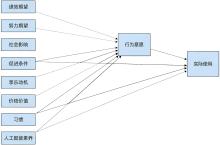
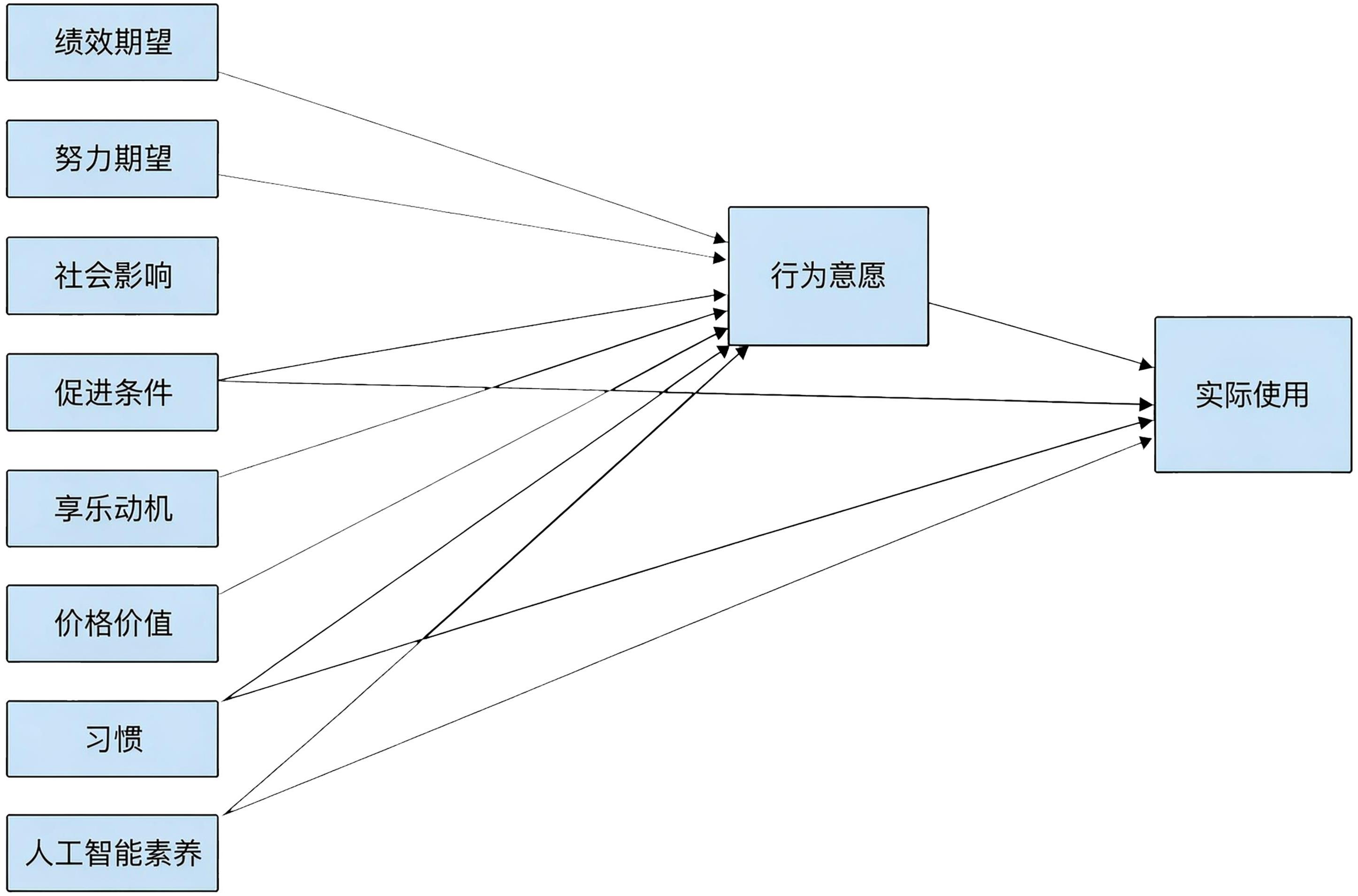
Fig.1

Model of influencing factors on GenAI usage behavior by university students"

Table 1

Scale items and their sources"

变量题项Items参考来源
努力期望通过数字媒体接触(访问)GenAI并不困难[24]
我认为学习如何使用GenAI工具来完成课业很容易[2,3]
我发现在课业学习中与GenAI的互动是清晰易懂的
对我来说,掌握使用GenAI用于课业学习会很容易
绩效期望我认为GenAI在我的日常课业学习中会很有用[2,3]
使用GenAI将帮助我更快地完成课业学习任务
在日常课业学习中使用GenAI可能会提高我的效率
使用GenAI工具能增加我完成学习任务的机会
社会影响对我重要的人(如家人、朋友)认为我应该使用GenAI工具[2,3]
对我有影响力的人(如老师)认为我应该使用GenAI工具
总的来说,我所在学校的大环境支持学生使用GenAI工具[25]
在我的社交圈中,使用GenAI工具是一种普遍行为
促进条件在课业学习中,我拥有使用GenAI所需的资源(如设备、网络)[2,3]
我拥有在课业学习中使用GenAI工具所需的知识
当我在课业学习中使用GenAI遇到困难时,我可以向他人寻求帮助
享乐动机在课业学习中使用GenAI工具让我感到有趣[3]
在课业学习中使用GenAI工具是令人愉快的
我认为在课业学习中使用GenAI很开心、有娱乐性
价格价值在课业学习中,GenAI工具的价格(费用成本)是合理的[3]
在课业学习中,GenAI提供了良好的性价比
就课业学习而言,以GenAI工具目前的价格,物有所值
习惯在课业学习中使用GenAI已成为我的习惯[3]
对我来说,在课业学习中使用GenAI是很自然的事情
我在课业学习中对GenAI的使用有点上瘾
我感到在课业学习中必须使用GenAI
人工智能素养我可以识别我所使用的应用程序和产品中使用的AI技术[8]
我通常很容易学会使用新的AI应用程序或产品
针对特定任务,我能从各种各样的AI应用程序或产品中选择使用最合适的
我一直在警惕人工智能技术的滥用
行为意愿我打算在未来的课业学习中继续使用GenAI[3]
我计划在课业学习中继续频繁使用GenAI
我将强烈推荐我的同学使用GenAI用于课业学习
实际使用

总体而言,在刚刚过去的一个月里,您使用GenAI辅助课业学习的整体频率是?

从不;2.很少(每月约1次);3.偶尔(每月2~3次);4.有时(每周约1次);5.经常(每周2-3次);6.几乎每天(每天1次);7.频繁(每天≥2次)

[3]

Table 2

Reliability and validity measures"

构念题项数/个Cronbach's α组合信度平均方差萃取值标准化载荷(β)范围
努力期望(EE)40.8980.8990.6900.753~0.866
绩效期望(PE)40.9490.9490.8240.896~0.923
社会影响(SI)40.8970.9000.6940.787~0.876
促进条件(FC)30.8870.8890.7270.812~0.878
享乐动机(HM)30.9360.9380.8350.877~0.951
价格价值(PV)30.9200.9220.7980.846~0.919
习惯(HB)40.9070.9070.7100.755~0.914
人工智能素养(AIL)40.8830.8900.6750.597~0.899
行为意愿(BI)30.8730.8810.7130.772~0.892
总量表320.972———

Table 3

Discriminant validity measures (Pearson correlation coefficients and AVE square root)"

变量123456789
1努力期望0.831
2绩效期望0.7390.907
3社会影响0.6680.7430.833
4促进条件0.6960.7650.7230.853
5享乐动机0.6570.7060.6920.7290.914
6价格价值0.5970.5910.6110.6380.6550.893
7习惯0.4820.4940.5400.4660.5740.5540.843
8人工智能素养0.6200.5940.6160.6680.6360.6500.5780.821
9行为意愿0.5860.6110.6750.5800.6700.6010.7440.6720.844

Table 4

Demographic characteristics of participants"

特征类别样本数/个占比/%
性别男33222.25
女1 16077.75
年级大一75750.74
大二44329.69
大三17711.86
大四1067.10
研究生90.60
学校性质公办71948.19
民办77351.81
学科背景人文类(哲学、文学、历史学等)65343.77
社科类(经济学、管理学、法学、教育学等)28519.10
自然科学类(理学、工学、农学、医学等)51234.32
其他类(艺术学、军事学、交叉学科)422.81

Table 5

Spearman correlation analysis between each variable and BI and UB (n=1 492)"

因变量努力期望绩效期望社会影响促进条件享乐动机价格价值习惯人工智能素养行为意愿
行为意愿0.5870.6170.5740.6570.6130.7370.6680.5871.000
实际使用———0.390——0.4240.3010.445

Table 6

Multiple linear regression of behavioral intention (n=1 492)"

自变量非标准化系数(B)标准误标准化系数(β)tpVIF
(常量)0.1680.096—1.7550.079—
努力期望0.0280.0240.0281.1840.2362.673
绩效期望0.0630.0290.0582.1720.0303.483
社会影响0.2360.0270.2158.866<0.0012.908
促进条件-0.0930.030-0.082-3.0740.0023.483
享乐动机0.1460.0250.1455.942<0.0012.949
价格价值0.0150.0210.0150.7100.4782.284
习惯0.3590.0160.41721.828<0.0011.801
人工智能素养0.2130.0240.2009.219<0.0012.435

Table 7

Multiple linear regression of use behavior (n=1 492)"

自变量非标准化系数(B)标准误标准化系数(β)tpVIF
(常量)0.7510.182—4.133<0.001—
促进条件0.3690.0440.2618.385<0.0011.913
习惯0.2020.0360.1905.574<0.0012.296
人工智能素养-0.1840.046-0.139-4.020<0.0012.365
行为意愿0.3000.0470.2436.323<0.0012.905

Table 8

Hypothesis of testing results"

假设编号假设路径标准化系数(β)p验证结果
H1a努力期望→行为意愿0.0280.236不成立
H2a绩效期望→行为意愿0.0580.030成立
H3a社会影响→行为意愿0.215<0.001成立
H4a促进条件→行为意愿-0.0820.002不成立(方向相反)
H5a享乐动机→行为意愿0.145<0.001成立
H6a价格价值→行为意愿0.0150.478不成立
H7a习惯→行为意愿0.417<0.001成立
H8a人工智能素养→行为意愿0.200<0.001成立
H9b促进条件→实际使用0.261<0.001成立
H10b习惯→实际使用0.190<0.001成立
H11b人工智能素养→实际使用-0.139<0.001不成立(方向相反)
H12b行为意愿→实际使用0.243<0.001成立
[1] Strzelecki A. Students' acceptance of ChatGPT in higher education: An extended unified theory of acceptance and use of technology[J]. Innovative Higher Education, 2024, 49(2): 223-245.
[2] Venkatesh V, Morris M G, Davis G B, et al. User acceptance of information technology: Toward a unified view[J]. MIS Quarterly, 2003, 27(3): 425-478.
[3] Venkatesh V, Thong J Y L, Xu Xin. Consumer acceptance and use of information technology: Extending the unified theory of acceptance and use of Technology[J]. MIS Quarterly, 2012, 36(1): 157-178.
[4] Polyportis A, Pahos N. Understanding students' adoption of the ChatGPT chatbot in higher education: The role of anthropomorphism, trust, design novelty and institutional policy[J]. Behaviour & Information Technology, 2025, 44(2): 315-336.
[5] Duong C D. Modeling the determinants of HEI students' continuance intention to use ChatGPT for learning: A stimulus-organism-response approach[J]. Journal of Research in Innovative Teaching & Learning, 2024, 17(2): 391-407.
[6] 杨秦晋, 王润兰. 基于UTAUT模型的大学生AIGC工具使用行为影响因素研究[J]. 中国教育技术装备, 2025(2): 36-42, 49.
Yang Qinjin, Wang Runlan. Study of influencing factors on college students' usage behavior toward AIGC tools based on the UTAUT model[J]. China Educational Technology & Equipment, 2025(2): 36-42, 49.
[7] Ng D T K, Leung J K L, Chu S K W, et al. Conceptualizing AI literacy: An exploratory review[J]. Computers and Education: Artificial Intelligence, 2021, 2: 100041.
[8] Wang Bingcheng, Rau P P, Yuan Tianyi. Measuring user competence in using artificial intelligence: Validity and reliability of artificial intelligence literacy scale[J]. Behaviour & Information Technology, 2023, 42(9): 1324-1337.
[9] 崔宇红, 赵锦涛. 人工智能素养视域下高校学生用户使用AIGC信息行为分析[J]. 农业图书情报学报, 2024, 36(11): 20-32.
Cui Yuhong, Zhao Jintao. AIGC using behavior analysis from the perspective of artificial intelligence literacy[J]. Journal of Library and Information Science in Agriculture, 2024, 36(11): 20-32.
[10] Tully S M, Longoni C, Appel G. Lower artificial intelligence literacy predicts greater AI receptivity[J]. Journal of Marketing, 2025, 89(5): 1-20.
[11] Davis F D. Perceived usefulness, perceived ease of use, and user acceptance of information technology[J]. MIS Quarterly, 1989, 13(3): 319-340.
[12] Venkatesh V, Thong J, Xu X. Unified theory of acceptance and use of technology: A synthesis and the road ahead[J]. Journal of the Association for Information Systems, 2016, 17(5): 328-376.
[13] 李书明, 王文情, 石沁语, 等. 大学生使用GenAI辅助学习的行为意向研究[J]. 湖北师范大学学报(自然科学版), 2026, 46(2): 83-90, 105.
Li Shuming, Wang Wenqing, Shi Qinyu, et al. Research on the behavioral intention of college students using GenAI-assisted learning[J]. Journal of Hubei Normal University (Natural Science), 2026, 46(2): 83-90, 105.
[14] Kandlhofer M, Steinbauer G, Hirschmugl-Gaisch S, et al. Artificial intelligence and computer science in education: From kindergarten to university[C]//2016 IEEE Frontiers in Education Conference (FIE). Piscataway, NJ: IEEE, 2016: 1-9.
[15] Long D, Magerko B. What is AI literacy? Competencies and design considerations[C]//Proceedings of the 2020 CHI Conference on Human Factors in Computing Systems. New York: ACM, 2020: 1-16.
[16] Domínguez Figaredo D, Stoyanovich J. Responsible AI literacy: A stakeholder-first approach[J]. Big Data & Society, 2023, 10(2): 20539517231219958.
[17] Mills K, Ruiz P, Lee K,et al. AI Literacy: A framework to understand, evaluate, and use emerging technology[R]. Washington: Digital Promise, 2024.
[18] 钟柏昌, 刘晓凡, 杨明欢. 何谓人工智能素养: 本质、构成与评价体系[J]. 华东师范大学学报(教育科学版), 2024, 42(1): 71-84.
Zhong Baichang, Liu Xiaofan, Yang Minghuan. What is artificial intelligence(AI) competency: Essence, composition and evaluation systems[J]. Journal of East China Normal University (Educational Sciences), 2024, 42(1): 71-84.
[19] Ng D T K, Wu W J, Leung J K L, et al. Design and validation of the AI literacy questionnaire: The affective, behavioural, cognitive and ethical approach[J]. British Journal of Educational Technology, 2024, 55(3): 1082-1104.
[20] Carolus A, Koch M J, Straka S, et al. MAILS - Meta AI literacy scale: Development and testing of an AI literacy questionnaire based on well-founded competency models and psychological change- and meta-competencies[J]. Computers in Human Behavior: Artificial Humans, 2023, 1(2): 100014.
[21] Laupichler M C, Aster A, Haverkamp N, et al. Development of the "Scale for the assessment of non-experts' AI literacy"—An exploratory factor analysis[J]. Computers in Human Behavior Reports, 2023, 12: 100338.
[22] Miao Fengchun, Shiohira K, Lao N, et al. AI Competency Framework for Students[M]. Paris, France: UNESCO, 2024.
[23] 葛子刚, 罗哲. 国外人工智能素养评估研究述评[J]. 中国教育信息化, 2025, 31(8): 55-69.
Ge Zigang, Luo Zhe. A systematic review of artificial intelligence literacy assessment abroad[J]. Chinese Journal of ICT in Education, 2025, 31(8): 55-69.
[24] Camilleri M A. Factors affecting performance expectancy and intentions to use ChatGPT: Using SmartPLS to advance an information technology acceptance framework[J]. Technological Forecasting and Social Change, 2024, 201: 123247.
[25] Venkatesh V, Zhang Xiaojun. Unified theory of acceptance and use of technology: U.S. vs. China[J]. Journal of Global Information Technology Management, 2010, 13(1): 5-27.
[26] Romero-Rodríguez J M, Ramírez-Montoya M S, Buenestado-Fernández M, et al. Use of ChatGPT at university as a tool for complex thinking: Students’ perceived usefulness[J]. Journal of New Approaches in Educational Research, 2023, 12(2): 323-339.
[1] SUN Xiaoyu, MENG Wenjie, ZHANG Xuesong, SHI Jinhua, LU Husheng. Model Construction and Empirical Study of a Three-Dimensional Spiral Model for GAI-Enhanced Information Literacy Education [J]. Journal of library and information science in agriculture, 2026, 38(8): 131-141.
[2] WU Dan, XU Hao. From Human-Computer Interaction to Human-AI Collaboration: A Frontier Perspective on Constructing an Independent Knowledge System for Information Resource Management in China [J]. Journal of library and information science in agriculture, 2026, 38(5): 55-64.
[3] AN Lin. Governance of Personal Information Security in the Iteration of Generative AI: From the Perspective of the Technological Evolution of Large Models [J]. Journal of library and information science in agriculture, 2026, 38(4): 61-70.
[4] LI Baiyang, REN Shangsheng. Technical Evolution and Application Scenarios of Open-Source Agents:A Case Study of "OpenClaw" [J]. Journal of library and information science in agriculture, 2026, 38(4): 23-35.
[5] HU Anqi. Construction of an Artificial Intelligence Literacy Ability Framework and Training System for College Students [J]. Journal of library and information science in agriculture, 2026, 38(2): 42-55.
[6] YI Chenhe, ZHANG Yuting. Risk Assessment and Early Warning of Generative Artificial Intelligence Impact on Network Public Opinion Based on Optimized BP Neural Network [J]. Journal of library and information science in agriculture, 2026, 38(2): 30-41.
[7] ZHANG Ling. Integrating Digital Humanities and Agricultural Knowledge Services A Simulation Modeling Perspectives [J]. Journal of library and information science in agriculture, 2026, 38(2): 79-89.
[8] SHEN Hongjie, SHEN Hongwei, WANG Junli. Generative AI Empowering Information Literacy Education in Digital Libraries: Path Exploration, Challenge Analysis, and Response Strategies [J]. Journal of library and information science in agriculture, 2025, 37(7): 50-60.
[9] ZHAI Jun, MENG Zihan, LI Fangsu, SHEN Lixin. AI Guides in Research Libraries of North America under the AI4S Context: Based on the Survey of 125 ARL Libraries [J]. Journal of library and information science in agriculture, 2025, 37(7): 35-49.
[10] SHI Xujie, YUAN Fan, LI Jia. Searching as Learning in the Context of Generative Artificial Intelligence: Technological Pathways, Behavioral Evolution, and Ethical Challenges [J]. Journal of library and information science in agriculture, 2025, 37(5): 40-57.
[11] ZHANG Li, WANG Bo, JING Shui. Generative AI-Driven Resource Discovery in Public Libraries: Service Optimization Based on a Dynamic Evaluation Model [J]. Journal of library and information science in agriculture, 2025, 37(5): 58-71.
[12] GOU Ruike, LUO Wei. Influencing Factors of Continuous Use Intention of "Generation Z" Users of an AIGC Platform [J]. Journal of library and information science in agriculture, 2025, 37(3): 66-80.
[13] QIAO Jinhua, MA Xueyun. Risks and Regulations for Application of the LLaMA Model in University Future Learning Centers [J]. Journal of library and information science in agriculture, 2025, 37(2): 37-48.
[14] SUN Lijuan. Exploring the Transition of Public Librarians to "Prompt Librarians" from the Perspective of New Quality Productive Forces [J]. Journal of library and information science in agriculture, 2025, 37(1): 17-32.
[15] LUO Guofeng, YI Tong, YAN Zhouzhou. Critical Information Literacy Education in University Libraries from the Perspective of AIGC Application [J]. Journal of library and information science in agriculture, 2025, 37(1): 47-58.
Viewed
Full text


Abstract

Cited

  Shared   
  Discussed   
No Suggested Reading articles found!