中文    English

Journal of library and information science in agriculture


Impact Mechanism of Digital Literacy on the Resilience of Rural E-Commerce Supply Chain

TIAN Bingjie1, LIU Qian2, PENG Xudan3   

  1. 1. International Education College, Hebei Finance University, Baoding 071000
    2. School of Management, Hebei Finance University, Baoding 071000
    3. School of Statistics and Data Science, Hebei Finance University, Baoding 071000
  • Received:2026-05-26 Online:2026-08-19

Abstract:

[Purpose/Significance] Against the backdrop of the further advancement of the digital countryside and rural revitalization strategies, digital empowerment serves as a key approach to enhancing the risk resistance capacity of rural e-commerce supply chains. However, existing research has kept the two areas of study, "digital literacy" and "supply chain resilience", relatively separate. A theoretical bridge between the two areas has yet to be established. Furthermore, there remains a notable lack of exploration into how digital literacy, through capability transmission and behavioral transformation, affects meso-level organizational systems such as supply chains; the intrinsic mechanism by which the digital literacy of agricultural business entities influences the overall operational efficiency and risk-resistance capacity of supply chains has not been systematically revealed. This study aims to explore the mechanism of how the digital literacy of supply chain subjects affects the resilience of rural e-commerce supply chains, so as to provide theoretical support and practical guidance for improving the quality and efficiency of the rural e-commerce industry and strengthening supply chain resilience. [Method/Process] Based on domestic and international digital literacy frameworks and supply chain resilience theory, a structural equation model was constructed, in which the digital literacy of supply chain subjects is taken as the independent variable, rural e-commerce supply chain resilience as the dependent variable, and technology perception capability, information acquisition capability and collaborative decision-making level as parallel mediating variables. Data were collected through a questionnaire survey, with respondents covering cooperative leaders, heads of agricultural enterprises, e-commerce operators, new-type professional farmers, and large-scale farmers in Hebei Province. The measurement instruments were adapted from validated scales in prior research and carefully contextualized for the rural e-commerce setting. All constructs were measured using multi-item Likert-type scales with established reliability and validity. Subsequently, empirical analysis was conducted using SPSS and AMOS software. [Results/Conclusions] The digital literacy of chain leaders exerts a significant positive direct effect on the resilience of rural e-commerce supply chains, with this direct path accounting for the largest proportion of the total effect. This finding suggests that, in the context of rural e-commerce supply chains, the digital literacy of chain leaders does not function solely through indirect pathways. Rather, it is as a core driving force in its own right. Technology perception capability, collaborative decision-making level, and information acquisition capability all play partial mediating roles in the relationship between chain leader digital literacy and supply chain resilience. Among the three mediating pathways, collaborative decision-making level demonstrates the highest mediating effect proportion, underscoring the central role of inter-organizational coordination in the process of digitally empowering supply chain resilience. This study reveals the multiple transmission pathways through which digital literacy empowers supply chain resilience, and proposes optimization strategies such as enhancing digital literacy of supply chain subjects and building multi-agent collaborative mechanisms, offering a reference for optimizing the digital governance of rural e-commerce supply chains and fostering a multi-agent collaborative development system. This study has several limitations. First, the research data were mainly collected via cross-sectional questionnaires, which cannot reflect the dynamic temporal relationship between chain leaders' digital literacy and supply chain resilience. Second, this research fails to incorporate moderating factors including regional context, policy support and supply chain structure. Future research can conduct further investigations through longitudinal data tracking and the construction of more complex mechanisms.

Key words: digital literacy, rural e-commerce, supply chain resilience, influencing mechanism

CLC Number: 

  • G252

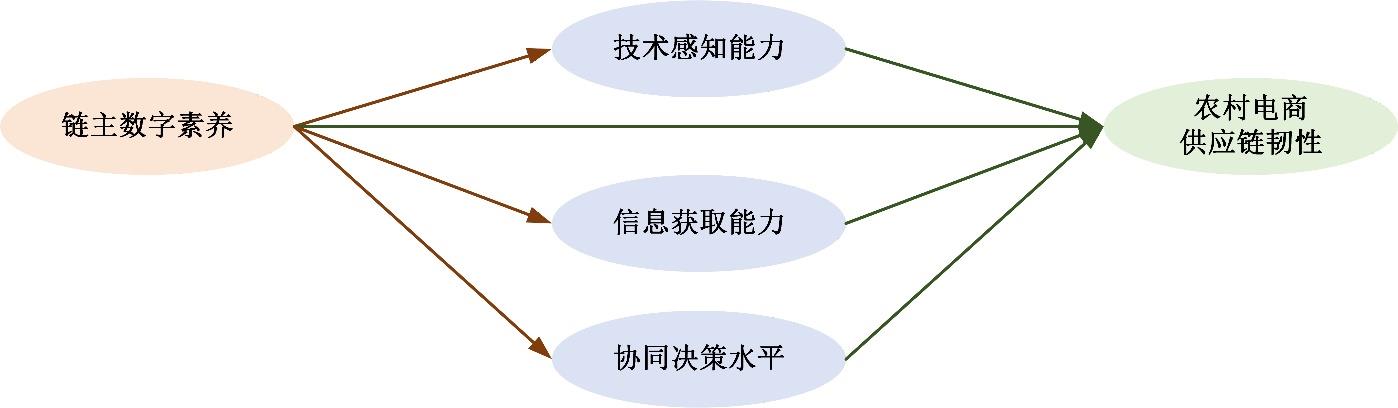
Fig.1

Theoretical model of digital literacy's impact on the resilience of rural e-commerce supply chains"

Table1

Descriptive statistical analysis (N=299)"

样本特征 样本量/人 占比/%
性别 168 56.20
131 43.80
年龄 25岁及以下 75 25.1
26~35岁 109 36.50
36~45岁 81 27.10
46~55岁 22 7.40
56岁及以上 12 4.00
教育程度 小学及以下 77 25.80
初中 58 19.40
高中/中专 83 27.80
大专/本科 21 7.00
研究生及以上 60 20.10
从业年限 1年以下 64 21.40
1~3年 109 36.50
3~5年 102 34.10
5~10年 17 5.70
10年以上 7 2.30
组织类型 个体农户 32 10.70
家庭农场 59 19.70
合作社 85 28.40
电商企业 100 33.40
其他 23 7.70
主营类型 生鲜果蔬 85 28.40
粮油干货 87 29.10
肉禽蛋奶 60 20.10
手工艺品 44 14.70
其他 23 7.70
经营模式 B2B 70 23.40
B2C 57 19.10
直播电商 74 24.70
社群团购 20 6.70
多模式混合 78 26.10

Table 2

Inter-item correlation matrix"

变量 数字素养 农村电商供应链韧性 技术感知能力 协同决策水平 信息获取能力
数字素养 0.903 0.333 0.218 0.300 0.216
农村电商供应链韧性 0.333 0.890 0.226 0.355 0.295
技术感知能力 0.218 0.226 0.887 0.186 0.174
协同决策水平 0.300 0.355 0.186 0.715 0.306
信息获取能力 0.216 0.295 0.174 0.306 0.850

Table3

Results of model path coefficient test"

关系 模型

Estimate

(标准化估计值)

S.E.

(标准误差)

C.R.

(临界比率)

P

(显著性)

被解释变量←解释变量 供应链韧性<---数字素养 0.199 0.055 3.283 0.001
中介变量←解释变量 技术感知能力<---数字素养 0.231 0.043 3.791 ***
协同决策水平<---数字素养 0.340 0.015 5.085 ***
信息获取能力<---数字素养 0.233 0.032 3.825 ***
被解释变量←中介变量 供应链韧性<---技术感知能力 0.121 0.074 2.132 0.033
供应链韧性<---协同决策水平 0.248 0.283 3.576 ***
供应链韧性<---信息获取能力 0.162 0.106 2.651 0.008

Table 4

Results of mediation effect test"

潜变量路径 效应值 Bootstrap SE 95%置信区间 显著性 占比/%
下限 上限
总效应模型 数字素养→农村电商供应链韧性 0.319 0.074 0.182 0.471 0.000 100.0
直接效应 数字素养→农村电商供应链韧性 0.182 0.070 0.054 0.335 0.005 57.0
间接效应 数字素养→技术感知能力→农村电商供应链韧性 0.026 0.016 0.003 0.070 0.026 8.1
数字素养→协同决策水平→农村电商供应链韧性 0.077 0.034 0.028 0.168 0.001 24.1
数字素养→信息获取能力→农村电商供应链韧性 0.034 0.022 0.004 0.092 0.022 10.8
[1]
Gilster P. Digital Literacy[M]. New York: Wiley, 1997.
[2]
常凌翀. 数字乡村战略下农民数字化素养的价值内涵与提升路径[J]. 湖南社会科学, 2021(6): 114-119.
Chang Lingchong. Value connotation and improvement path of farmers' digital literacy under the digital village strategy[J]. Social Sciences Hunan, 2021(6): 114-119.
[3]
陈桂生, 徐铭辰. 基于数字素养与技能的韧性治理[J]. 江淮论坛, 2023(1): 42-49.
Chen Guisheng, Xu Mingchen. Resilience governance based on digital literacy and skills[J]. Jianghuai Tribune, 2023(1): 42-49.
[4]
Rice J B Jr, Caniato F. Building a secure and resilient supply network[J]. Supply Chain Management Review, 2003, 7(5): 22-30.
[5]
Christopher M, Peck H. Building the resilient supply chain[J]. The International Journal of Logistics Management, 2004, 15(2): 1-14.
[6]
练百明, 顾静. 基于AHP层次分析法的农村电商供应链韧性评价研究[J]. 山西农经, 2024(19): 105-107.
Lian Baiming, Gu Jing. Research on evaluation of rural E-commerce supply chain resilience based on AHP[J]. Shanxi Agricultural Economy, 2024(19): 105-107.
[7]
乔星铭, 詹泽雄. 农村电商供应链韧性影响因素及组态效应研究[J]. 物流科技, 2024, 47(14): 135-142.
Qiao Xingming, Zhan Zexiong. Study on the influencing factors and configuration effect of rural E-commerce supply chain resilience[J]. Logistics Sci Tech, 2024, 47(14): 135-142.
[8]
高航, 周明生. 数字化转型何以提升企业韧性——基于动态能力理论和企业技术应用情境的考察[J]. 科学管理研究, 2024, 42(3): 53-65.
Gao Hang, Zhou Mingsheng. How digital transformation enhances enterprise resilience - Based on dynamic capability theory and enterprise technology application scenario[J]. Scientific Management Research, 2024, 42(3): 53-65.
[9]
史采薇. 数字乡村建设对农产品供应链绩效的影响[D]. 南宁: 南宁师范大学, 2024.
Shi Caiwei. The influence of digital rural construction on agricultural products supply chain performance[D]. Nanning: Nanning Normal University, 2024.
[10]
戴祥玉, 胡玥. 农村电商高质量发展:逻辑意蕴、现实挑战与适应性创新路径[J]. 云南大学学报(社会科学版), 2026, 25(1): 104-111.
Dai Xiangyu, Hu Yue. High-quality development of rural e-commerce: Logical implications, realistic challenges, and adaptive innovation paths[J]. The Journal of Yunnan University Social Sciences Edition, 2026, 25(1): 104-111.
[11]
Davis F D, Bagozzi R P, Warshaw P R. Extrinsic and intrinsic motivation to use computers in the Workplace1 [J]. Journal of Applied Social Psychology, 1992, 22(14): 1111-1132.
[12]
万绍荣. 农产品流通组织B2B电子商务采纳研究[D]. 合肥: 安徽农业大学, 2023.
Wan Shaorong. Study on the adoption of B2B e-commerce in agricultural product distribution organizations[D]. Hefei: Anhui Agricultural University, 2023.
[13]
董占奎, 董飞燕, 李思逸. 数字素养对农户绿色生产技术采纳行为的影响及其机制研究: 基于CLES混合截面数据的实证分析[J/OL]. 生态与农村环境学报, 1-14[2026-05-17].
Dong Zhankui, Dong Feiyan, Li Siyi. Study on the influence of digital literacy on farmers' adoption behavior of green production technology and its mechanism: An empirical analysis based on CLES mixed cross-sectional data[J/OL]. Journal of Ecology and Rural Environment, 1-14[2026-05-17].
[14]
袁峦. 大数据能力对供应链韧性的影响——供应链整合的中介作用[J]. 现代工业经济和信息化, 2024, 14(5): 184-189.
Yuan Luan. The impact of big data capabilities on supply chain resilience - The mediating role of supply chain integration[J]. Modern Industrial Economy and Informationization, 2024, 14(5): 184-189.
[15]
蒋洁洁, 青平, 蔡炜炜, 等. 数字技能如何影响农民电商参与行为?——基于信息获取的中介效应分析[J]. 中国农业大学学报, 2024, 29(4): 81-93.
Jiang Jiejie, Ping Qing, Cai Weiwei, et al. How do digital skills affect farmers' e-commerce participation behavior? A mediation effect based on information acquisition[J]. Journal of China Agricultural University, 2024, 29(4): 81-93.
[16]
张世虎, 顾海英. 互联网信息技术的应用如何缓解乡村居民风险厌恶态度?——基于中国家庭追踪调查(CFPS)微观数据的分析[J]. 中国农村经济, 2020(10): 33-51.
Zhang Shihu, Gu Haiying. How can the application of the Internet and information technologies alleviate rural residents' risk aversion attitude? An analysis based on the micro data of China family panel studies[J]. Chinese Rural Economy, 2020(10): 33-51.
[17]
苟建华, 娄朝晖. 信息技术对现代农产品供应链协调性的影响——基于浙江省典型涉农企业的调查研究[J]. 财经论丛, 2009(5): 99-103.
Gou Jianhua, Lou Zhaohui. Effects on supply chain coordination of modern agricultural products by information technology - Based on investigation on typical agricultural enterprises in Zhejiang[J]. Collected Essays on Finance and Economics, 2009(5): 99-103.
[18]
赵晓飞, 谭砚文, 李明. 数字赋能农产品供应链韧性提升的理论机制、现实困境与推进路径[J]. 农村经济, 2026(1): 80-87.
Zhao Xiaofei, Tan Yanwen, Li Ming. Digital empowerment in enhancing agri-food supply chain resilience: Theoretical mechanisms, practical challenges and implementation paths[J]. Rural Economy, 2026(1): 80-87.
[19]
苏岚岚, 张航宇, 彭艳玲. 农民数字素养驱动数字乡村发展的机理研究[J]. 电子政务, 2021(10): 42-56.
Su Lanlan, Zhang Hangyu, Peng Yanling. Study on the mechanism of farmers' digital literacy driving the development of digital countryside[J]. E-Government, 2021(10): 42-56.
[20]
Commission European. DigComp 2.2: The digital comp etence framework for Citizens[EB/OL]. [2026-05-16].
[21]
马帅, 陈真真, 高璐璐. 我国农村居民数字素养量表的开发与验证[J]. 图书馆论坛, 2023, 43(8): 43-50.
Ma Shuai, Chen Zhenzhen, Gao Lulu. Digital literacy scale for rural residents in China: Development and verification[J]. Library Tribune, 2023, 43(8): 43-50.
[22]
温涛, 万章浩. 管理者数字素养促进了新型农业经营主体的产业融合发展吗?[J]. 浙江工商大学学报, 2025(4): 110-121.
Wen Tao, Wan Zhanghao. Does managers' digital literacy promote the integrated industrial development of new agricultural business entities?[J]. Journal of Zhejiang Gongshang University, 2025(4): 110-121.
[1] WU Yanyan, ZHANG Jinling. Digital Literacy, Perception of New Quality Productive Forces, and Green Production Willingness: Evidence from Large-Scale Farmers in Northwest China [J]. Journal of library and information science in agriculture, 2026, 38(6): 115-130.
[2] YUAN Shuo. Digital Technology Empowering High-Quality Development of Public Cultural Services: Impact Effects and Influencing Mechanisms [J]. Journal of library and information science in agriculture, 2026, 38(4): 71-83.
[3] GUO Jinbo. Effects of AIGC on Reader Trust in Library Information [J]. Journal of library and information science in agriculture, 2026, 38(4): 84-98.
[4] LIU Ting, LIU Shuhan, LIU Zhenyan, ZENG Dequan, HU Yuan. Impact of Data Element Utilization Level on Enterprises' Supply Chain Discourse Power [J]. Journal of library and information science in agriculture, 2025, 37(9): 32-48.
[5] CUI Shaojie, LIU Yanping. Impact of Digital Literacy on Rural Governance Effectiveness: Based on the Survey of 306 Rural Residents in Xia County, Shanxi Province [J]. Journal of library and information science in agriculture, 2025, 37(4): 39-50.
[6] WANG Xiaokun. Comparative Research on International Online Open Digital Literacy Assessment Tools [J]. Journal of library and information science in agriculture, 2025, 37(3): 53-65.
[7] SUN Zhimei, LIU Yan, LIU Wenyun, LI Ruiqin. Perception and Utilization of Digital Literacy Knowledge by University Library Users from Representational Pers Perspective [J]. Journal of library and information science in agriculture, 2025, 37(2): 23-36.
[8] LUO Guofeng, YI Tong, YAN Zhouzhou. Critical Information Literacy Education in University Libraries from the Perspective of AIGC Application [J]. Journal of library and information science in agriculture, 2025, 37(1): 47-58.
[9] Xuemei LUO, Yuzhe LIN. Graduate Student Digital Literacy Promotion Pathway Driven by AIGC [J]. Journal of library and information science in agriculture, 2024, 36(9): 70-77.
[10] Baiyang LI, Rong SUN. Construction of an AI Literacy General Education Curriculum Based on "Knowledge-Skills" Navigation [J]. Journal of library and information science in agriculture, 2024, 36(8): 34-42.
[11] Chen MA, Jin LI, Zexin LI, Beibei FAN, Xian FENG. Evaluation and Influencing Factors of Farmers' Digital Literacy Levels in the Context of the Digital Countryside [J]. Journal of library and information science in agriculture, 2024, 36(7): 19-33.
[12] WANG Xiaoyu, ZHANG Suluo. Farmers' Digital Literacy under the Background of Digital Rural Construction: Concept and Framework Construction [J]. Journal of library and information science in agriculture, 2024, 36(5): 52-64.
[13] YANG Xing. Practice and Enlightenment of Developing Librarians' Digital Scholarship Service Skills at the University of Florida Library [J]. Journal of library and information science in agriculture, 2024, 36(5): 93-101.
[14] YI Tong, LUO Guofeng. Improving Digital Literacy of University Librarians Using Educational Technology [J]. Journal of library and information science in agriculture, 2024, 36(2): 61-70.
[15] WANG Weizheng, QIAO Hong, LI Xiaojun, WANG Jingjing. User Willingness to Use Generative Artificial Intelligence Based on AIDUA Framework [J]. Journal of library and information science in agriculture, 2024, 36(2): 36-50.
Viewed
Full text


Abstract

Cited

  Shared   
  Discussed   
No Suggested Reading articles found!