中文    English

Journal of library and information science in agriculture


Digital Literacy, Perception of New Quality Productive Forces, and Green Production Willingness: Evidence from Large-Scale Farmers in Northwest China

WU Yanyan, ZHANG Jinling()   

  1. School of Public Administration, Xinjiang University of Finance & Economics, Urumqi 830000
  • Received:2025-10-21 Online:2026-04-09
  • Contact: ZHANG Jinling E-mail:1571980505@qq.com

Abstract:

[Purpose/Significance] The rapid advancement of digital technologies has created substantial opportunities for promoting green agricultural transformation in China. Digital literacy plays a pivotal role in enabling large-scale farmers to understand and apply modern agricultural technologies, thereby shaping their willingness to adopt environmentally-friendly production practices. As the core actors in agricultural production, farmers' digital competence and their perception of new quality productive forces (PNQPF) directly influence how they respond to digital innovations and participate in green production. However, existing research has not yet established a systematic measurement framework for PNQPF, nor has it clarified the multi-stage cognitive mechanisms through which digital literacy affects farmers' green production willingness. [Method/Process] Drawing upon grounded theory and empirical investigation, this study adopted a mixed-method approach. First, in-depth interviews were conducted with diverse groups of large-scale farmers in northern and southern regions of the Xinjiang Uygur autonomous region, generating a rich textual corpus for qualitative analysis. Through open coding, selective coding, and theoretical coding, two fundamental cognitive dimensions - perception of labor tools and perception of labor objects - were identified, forming the basis of an eight-item PNQPF scale. In the quantitative stage, a structured survey was administered to 352 large-scale farmers across four provinces (Xinjiang, Shaanxi, Gansu, and Qinghai) andNingxia Hui Autonomous Region in Northwest China. The dataset encompasses demographic characteristics, operational features, digital literacy indicators, PNQPF perceptions, and evaluations of green production willingness. Exploratory and confirmatory factor analyses were employed to validate the construct reliability and structural robustness of the PNQPF scale, while regression-based mediation and moderation modeling enabled a systematic examination of the pathways, through which digital literacy influences green production willingness. This integrated analytical framework provides a comprehensive and evidence-based foundation for understanding farmers' decision-making processes in digital agricultural environments. [Results/Conclusions] The findings indicate that digital literacy significantly enhances farmers' willingness to adopt green production practices. Both cognitive dimensions of PNQPF - perception of labor tools and perception of labor objects - serve as key psychological mechanisms, exerting independent mediating effects and jointly forming a chain mediation pathway. This suggests that digital tools not only improve farmers' operational efficiency but also deepen their understanding of production objects, thereby reinforcing environmentally responsible behavior. Digital infrastructure further strengthens the impact of digital literacy on PNQPF, highlighting the importance of a supportive digital environment in amplifying farmers' behavioral transformation. Based on these insights, this study suggests that enhancing farmers' digital competence, improving regional digital infrastructure, and promoting targeted digital extension services are essential for advancing green agricultural development. Nevertheless, the sample is concentrated in Northwest China, where regional disparities in digital development and agricultural structure may limit the generalizability of the findings. Future research should expand the sample scope, incorporate longitudinal data, and explore the evolving role of digital technologies in shaping farmers' production decisions.

Key words: digital literacy, perception of new quality productive forces, perception of labor tools, perception of labor objects, green production willingness

CLC Number: 

  • F323.3

Table 1

Exploratory factor analysis results (N=133)"

题项劳动工具感知劳动对象感知
LTP1我们能够通过智能农机设备提升田间作业效率0.900
LTP2智能灌溉系统能够帮助我们精确控制水资源的使用0.906
LTP3我们利用无人机可以高效地监控农田状态0.825
LTP4数字化平台帮助我们实时记录和分析农作物的生长数据0.883
LOP1我们能够根据作物的生长周期精准安排种植和采收计划0.705
LOP2作物的土壤需求能够通过数据分析实现精确管理0.773
LOP3不同作物的种植需求差异能够通过智能技术得到有效满足0.751
LOP4农田土壤的肥力状况能够通过监测数据实现科学管理0.711

Table 2

Confirmatory factor analysis results (N=260)"

Modelχ²dfχ²/dfRMSEACFITLIIFISRMR
双因子模型45.00419.0002.3690.0730.9780.9680.9780.030
单因子模型494.37920.00024.7190.3030.6040.4460.6070.233

Table 3

Factor loadings and errors (N=260)"

维度题项因子载荷误差
劳动工具感知LTP1我们能够通过智能农机设备提升田间作业效率0.8990.233
LTP2智能灌溉系统能够帮助我们精确控制水资源的使用0.9040.201
LTP3我们利用无人机可以高效地监控农田状态0.7310.564
LTP4数字化平台帮助我们实时记录和分析农作物的生长数据0.8540.312
劳动对象感知LOP1我们能够根据作物的生长周期精准安排种植和采收计划0.8910.398
LOP2作物的土壤需求能够通过数据分析实现精确管理0.8760.383
LOP3不同作物的种植需求差异能够通过智能技术得到有效满足0.6440.961
LOP4农田土壤的肥力状况能够通过监测数据实现科学管理0.5751.335

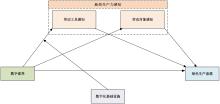
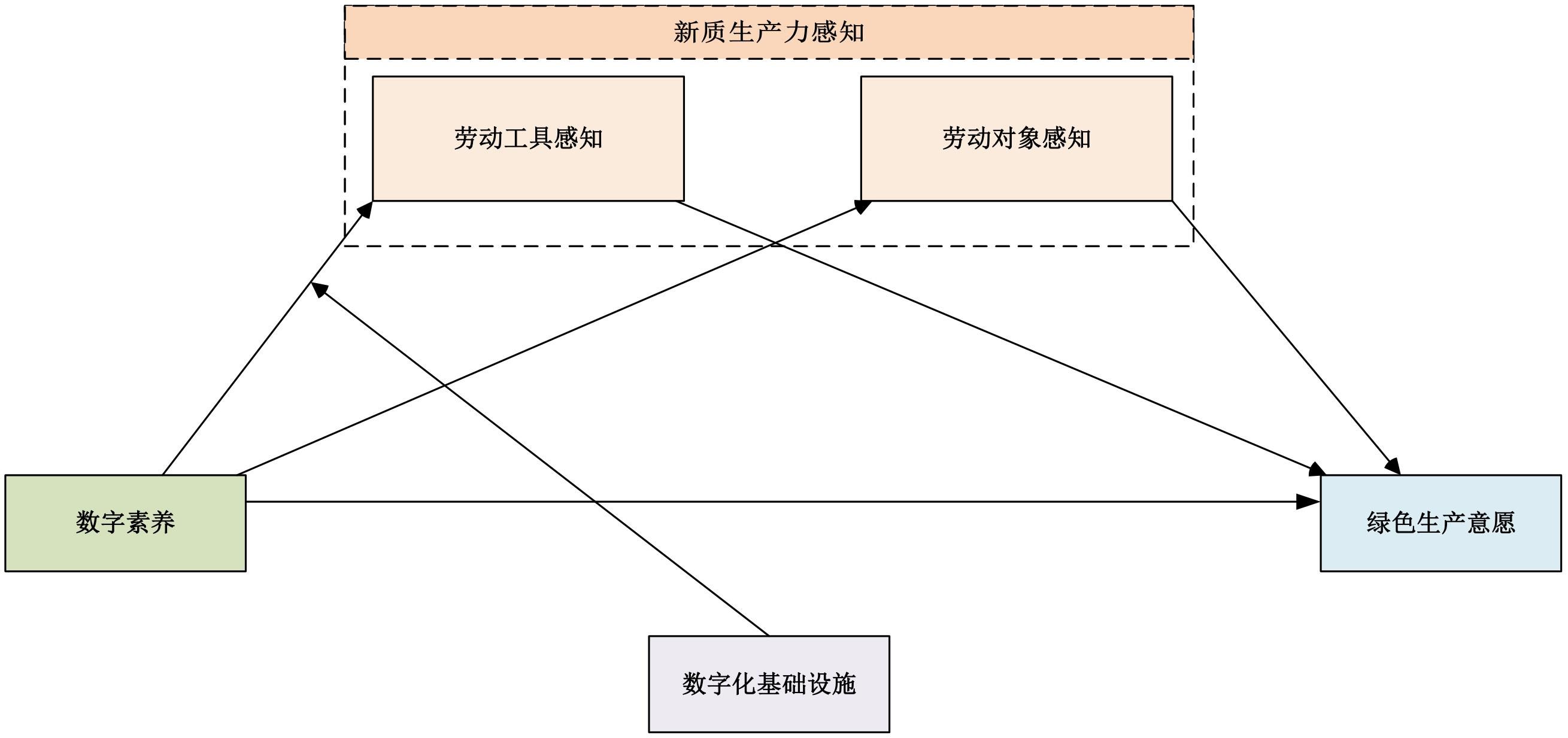
Fig.1

Mechanism model of digital literacy influencing large-scale farmers' green production willingness"

Table 4

Overview of sample characteristics (N=352)"

样本特征样本量/人占比/%样本特征样本量/人占比/%
性别18151.420种植品种棉花等经济作物19254.545
17148.580玉米等粮食作物16045.455
年龄30岁及以下195.398地区新疆13839.205
31~40岁6317.898陕西8524.148
41~50岁9727.557甘肃5415.341
51~60岁11131.534宁夏4312.216
61岁及以上6217.614青海329.091
学历小学及以下7922.443年收入4万元及以下71.989
初中12034.0914~6万元143.977
高中或中专12234.6597~10万元3610.227
大专246.81811~15万元19154.261
本科及以上71.98916~20万元6819.318
20万元及以上3610.227

Table 5

Measurement items and reliability assessment of core variables"

变量名称测量条目Cronbach's α
数字素养(DL)

我能够通过智能手机或计算机获取与农业生产相关的信息,例如天气预报、市场价格和政策资讯

我能够通过在线课程、教学视频或社交平台学习并掌握新型农业技术或工具的使用方法

我能够根据农田传感器、无人机或数字化平台提供的数据,分析作物的生长状况并据此制定生产决策

0.910
新质生产力感知劳动工具感知(LTP)

我们能够通过智能农机设备提升田间作业效率

智能灌溉系统能够帮助我们精确控制水资源的使用

我们利用无人机可以高效地监控农田状态

数字化平台帮助我们实时记录和分析农作物的生长数据

0.878
劳动对象感知(LOP)

我们能够根据作物的生长周期精准安排种植和采收计划

作物的土壤需求能够通过数据分析实现精确管理

不同作物的种植需求差异能够通过智能技术得到有效满足

农田土壤的肥力状况能够通过监测数据实现科学管理

0.900
绿色生产意愿(GWP)

我愿意投入劳动进行绿色生产

我愿意投入时间进行绿色生产

我愿意投入金钱进行绿色生产

我愿意放弃短期利益进行绿色生产

0.901

Table 6

Descriptive statistics and correlation coefficients of variables (N=352)"

变量均值标准差1234
数字素养5.8120.9291.000
劳动工具感知6.0050.762.591**1.000
劳动对象感知5.9600.777.576**.701**1.000
绿色生产意愿6.0620.752.518**.547**.500**1.000

Table 8

Bootstrap test of mediation effects"

路径间接效应估计值标准误差95%置信区间
下限上限
数字素养-劳动工具感知-绿色生产意愿0.1330.0430.0480.216
数字素养-劳动对象感知-绿色生产意愿0.0300.0160.0020.064
数字素养-劳动工具感知-劳动对象感知-绿色生产意愿0.0420.0210.0030.087

Table 9

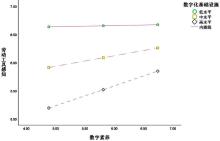
Test of moderated mediation effect"

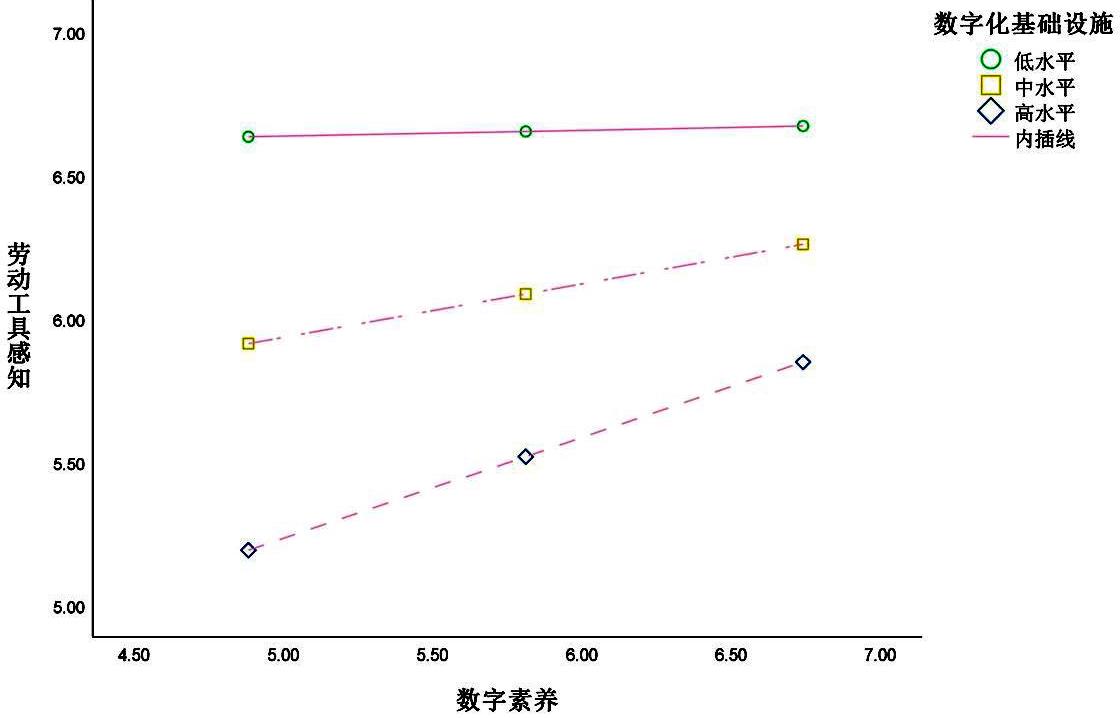
调节路径调节变量:数字化基础设施有条件间接效应95%置信区间
数字素养→劳动工具感知→绿色生产意愿低水平(-SD)0.006[-0.010,0.022]
高水平(+SD)0.097*[0.042,0.162]
差异0.091*[0.034,0.155]
数字素养→劳动工具感知→劳动对象感知→绿色生产意愿低水平(-SD)0.002[-0.004,0.007]
高水平(+SD)0.030*[0.002,0.063]
差异0.029*[0.002,0.060]

Fig.2

Moderating the effect of digital infrastructure on the relationship between digital literacy and labor tool perception"

[1] 陈甜梦. 新质生产力驱动人与自然和谐共生的内在意蕴和实践路径研究[J]. 改革与开放, 2024(13): 28-37.
Chen Tianmeng. Study on the internal implication and practical path of new productivity driving harmonious symbiosis between man and nature[J]. Reform & Opening, 2024(13): 28-37.
[2] 中共中央 国务院关于进一步深化农村改革 扎实推进乡村全面振兴的意见[EB/OL]. [2025-02-03]. .
[3] 全国人民代表大会常务委员会. 中华人民共和国乡村振兴促进法[EB/OL]. [2021-04-29]. .
[4] 李盛竹, 薛枫, 姜金贵. 农业数字化对中国粮食新质生产力的影响效应研究[J]. 农林经济管理学报, 2024, 23(4): 435-445.
Li Shengzhu, Xue Feng, Jiang Jingui. Effect of agricultural digitization on new productive forces of food in China[J]. Journal of Agro-Forestry Economics and Management, 2024, 23(4): 435-445.
[5] 陈健. 新质生产力助推农业农村现代化的核心要义与实践策略[J]. 江苏社会科学, 2024(4): 112-120.
Chen Jian. The core meaning and practical strategy of promoting agricultural and rural modernization by new quality productivity[J]. Jiangsu Social Sciences, 2024(4): 112-120.
[6] 樊胜岳, 李耀龙, 马晓杰, 等. 数字化水平对农业绿色发展影响的实证研究——基于中国30个省份的面板数据[J]. 世界农业, 2021(12): 4-16.
Fan Shengyue, Li Yaolong, Ma Xiaojie, et al. An empirical study of the impact of digital level on agricultural green development - Based on the panel data 30 provinces of China[J]. World Agriculture, 2021(12): 4-16.
[7] 董晓波. 新型数字基础设施驱动农业农村高质量发展的创新路径[J]. 学习与实践, 2023(1): 33-42.
Dong Xiaobo. Innovation path of the new digital infrastructure driving high-quality development in agriculture and rural areas[J]. Study and Practice, 2023(1): 33-42.
[8] 陈凯, 朱伟丽. 农户绿色生产驱动机制构建研究——基于TAM-SLA理论框架[J]. 中国特色社会主义研究, 2023(3): 71-79.
Chen Kai, Zhu Weili. Study on establishing green production driving mechanism of farmers: Based on theoretical framework of technology acceptance model and sustainable livelihood approach[J]. Studies on Socialism with Chinese Characteristics, 2023(3): 71-79.
[9] 陈转青. 政策导向、市场导向对农户绿色生产的影响——基于河南865个农户的实证分析[J]. 管理学刊, 2021, 34(5): 109-125.
Chen Zhuanqing. The influence of policy-orientation and market-orientation on farmers' green production - Based on the empirical analysis of 865 farmers in Henan[J]. Journal of Management, 2021, 34(5): 109-125.
[10] 何悦, 漆雁斌. 农户绿色生产行为形成机理的实证研究——基于川渝地区860户柑橘种植户施肥行为的调查[J]. 长江流域资源与环境, 2021, 30(2): 493-506.
He Yue, Qi Yanbin. An empirical study on the formation mechanism of farmers' green production behavior: Based on the investigation of fertilization behavior of 860 citrus growers in Sichuan and Chongqing[J]. Resources and Environment in the Yangtze Basin, 2021, 30(2): 493-506.
[11] 徐鲲, 杨静, 鲁钊阳. 西部地区新型农业经营主体绿色生产意愿的影响因素分析[J]. 农村经济, 2021(11): 53-61.
Xu Kun, Yang Jing, Lu Zhaoyang. Analysis on influencing factors of green production willingness of new agricultural management subjects in western China[J]. Rural Economy, 2021(11): 53-61.
[12] 石志恒, 张可馨. 农户绿色生产“强意愿弱行为”的再审视: 基于资源约束和社会规范视角——以个人规范为中介变量[J]. 中国农业资源与区划, 2022, 43(8): 43-54.
Shi Zhiheng, Zhang Kexin. Re-examination of farmers' green priduction "strong willings and weak behaviors": Based on the perspective of resource constraints and social norms - Personal norms as an intermediary variable[J]. Chinese Journal of Agricultural Resources and Regional Planning, 2022, 43(8): 43-54.
[13] 常凌翀. 数字乡村战略下农民数字化素养的价值内涵与提升路径[J]. 湖南社会科学, 2021(6): 114-119.
Chang Lingchong. The value connotation and promotion path of farmers' digital literacy under the digital village strategy[J]. Social Sciences in Hunan, 2021(6): 114-119.
[14] 杜凤君, 郑军, 赵晓颖. 从“旁观”到“实施”: 数字素养对农户低碳生产的影响——基于禀赋能力的中介效应[J]. 农村经济, 2024(6): 77-87.
Du Fengjun, Zheng Jun, Zhao Xiaoying. From "observing" to "implementing": The impact of digital literacy on low-carbon production of farmers[J]. Rural Economy, 2024(6): 77-87.
[15] 苏岚岚, 彭艳玲. 农民数字素养、乡村精英身份与乡村数字治理参与[J]. 农业技术经济, 2022(1): 34-50.
Su Lanlan, Peng Yanling. Farmers' digital literacy, elite identity and participation in rural digital governance[J]. Journal of Agrotechnical Economics, 2022(1): 34-50.
[16] 王邵军. 数字乡村建设促进农民农村共同富裕的作用机理、现实挑战与实现路径研究[J]. 南开经济研究, 2023(11): 21-36.
Wang Shaojun. Research on the mechanism, challenges, and promotion path of digital countryside enabling farmers to achieve common prosperity in rural areas[J]. Nankai Economic Studies, 2023(11): 21-36.
[17] 郭晓鸣, 吕卓凡. 农业新质生产力的内涵特征、发展阻滞与实践路径[J]. 中州学刊, 2024(8): 38-45.
Guo Xiaoming, Lv Zhuofan. The connotation characteristics, development obstacles, and promotion paths of agricultural new quality productivity[J]. Academic Journal of Zhongzhou, 2024(8): 38-45.
[18] 刘志彪, 凌永辉, 孙瑞东. 传统产业改造: 发展新质生产力的重点选择策略——兼论对农业现代化的启示[J]. 农业经济问题, 2024(4): 47-57.
Liu Zhibiao, Ling Yonghui, Sun Ruidong. The transformation of traditional industries: A focused strategy option for the development of new quality productivity and implications for agricultural modernization[J]. Issues in Agricultural Economy, 2024(4): 47-57.
[19] 罗建文. 论新质生产力赋能农业经济发展的迭代裂变[J]. 宁夏社会科学, 2024(3): 102-111.
Luo Jianwen. Iterative fission of agricultural economy development empowered by new quality productive forces[J]. Social Sciences in Ningxia, 2024(3): 102-111.
[20] Lu Feng, Meng Jixian, Cheng Baodong. How does improving agricultural mechanization affect the green development of agriculture evidence from China[J]. Journal of Cleaner Production, 2024, 472: 143298.
[21] 刘伟江, 刘冰琪. 农村数字基础设施建设赋能乡村振兴的路径——基于数字化与现代农业产业融合的视角[J]. 山西财经大学学报, 2024, 46(10): 72-88.
Liu Weijiang, Liu Bingqi. Paths of rural digital infrastructure construction empowering rural revitalization - Based on the perspective of the industrial integration of digitization and modern agricultural industry[J]. Journal of Shanxi Finance and Economics University, 2024, 46(10): 72-88.
[22] 谢璐, 韩文龙. 数字技术和数字经济助力城乡融合发展的理论逻辑与实现路径[J]. 农业经济问题, 2022(11): 96-105.
Xie Lu, Han Wenlong. Theoretical logic and practical path of digital technology and digital economy to promote urban-rural integration development[J]. Issues in Agricultural Economy, 2022(11): 96-105.
[23] 殷浩栋, 霍鹏, 汪三贵. 农业农村数字化转型: 现实表征、影响机理与推进策略[J]. 改革, 2020(12): 48-56.
Yin Haodong, Huo Peng, Wang Sangui. Agricultural and rural digital transformation: Realistic representation, impact mechanism and promotion strategy[J]. Reform, 2020(12): 48-56.
[24] 郑志浩, 高杨, 霍学喜. 农户经营规模与土地生产率关系的再探究——来自第三次全国农业普查规模农户的证据[J]. 管理世界, 2024, 40(1): 89-108.
Zheng Zhihao, Gao Yang, Huo Xuexi. Revisiting the relationship between farm size and land productivity: Evidence from large-scale farms in the third national agricultural census[J]. Journal of Management World, 2024, 40(1): 89-108.
[25] Hackfort S. Patterns of inequalities in digital agriculture: A systematic literature review[J]. Sustainability, 2021, 13(22): 12345.
[26] 姜立康, 赵伟, 张化楠. 数字技术使用、绿色技术采纳与农业生产效率[J]. 科学决策, 2024(9): 1-14.
Jiang Likang, Zhao Wei, Zhang Huanan. Digital technology use, green technology adoption and agricultural productivity[J]. Scientific Decision-Making, 2024(9): 1-14.
[27] 文丰安. 数字经济发展、要素配置效率与城市绿色生产效率[J]. 产业经济研究, 2023(3): 57-71, 86.
Wen Feng'an. Digital economy development, factor allocation efficiency, and urban green productivity[J]. Industrial Economics Research, 2023(3): 57-71, 86.
[28] Liu Xiao, Wang Zhenyu, Han Xiaoyan. The impact of digital literacy on farmers' green production behavior: Mediating effects based on ecological cognition[J]. Sustainability, 2024, 16(17): 7507.
[29] Usigbe M J, Asem-Hiablie S, Uyeh D D, et al. Enhancing resilience in agricultural production systems with AI-based technologies[J]. Environment, Development and Sustainability, 2024, 26(9): 21955-21983.
[30] Yang Chunfang, Ji Xing, Cheng Changming, et al. Digital economy empowers sustainable agriculture: Implications for farmers' adoption of ecological agricultural technologies[J]. Ecological Indicators, 2024, 159: 111723.
[31] 陈兴山. 数智时代劳动的存在特征、发生原因与发展导向——基于马克思主义政治经济学的分析[J]. 经济学家, 2024(7): 35-44.
Chen Xingshan. The characteristics, causes and development trends of labor in the era of digital intelligence - Analysis based on Marxist political economy[J]. Economist, 2024(7): 35-44.
[32] Guo Zhangdong, Chen Xiaoqi, Zhang Yongwang. Impact of environmental regulation perception on farmers' agricultural green production technology adoption: A new perspective of social capital[J]. Technology in Society, 2022, 71: 102085.
[33] 钟平玉, 齐磊磊. 数智劳动的能力、本质与影响——基于马克思劳动对象化理论的分析[J]. 经济学家, 2024(12): 25-33.
Zhong Pingyu, Qi Leilei. Ability, essence and impact of digital intelligence labor - An analysis based on Marx’s theory of objectification of labor[J]. Economist, 2024(12): 25-33.
[34] Sarkar A, Wang H, Rahman A, et al. Evaluating the roles of the farmer's cooperative for fostering environmentally friendly production technologies-a case of kiwi-fruit farmers in Meixian, China[J]. Journal of Environmental Management, 2022, 301: 113858.
[35] 王菲, 孙淑惠, 刘天军. 数字经济发展推进了农业生产方式变革吗——来自黄河流域地级市的证据[J]. 中国农村经济, 2023(9): 122-143.
Wang Fei, Sun Shuhui, Liu Tianjun. Has the development of digital economy promoted changes in agricultural production methods? Evidence from prefectures in the Yellow River Basin[J]. Chinese Rural Economy, 2023(9): 122-143.
[36] 石志恒, 符越. 技术扩散条件视角下农户绿色生产意愿与行为悖离研究——以无公害农药技术采纳为例[J]. 农林经济管理学报, 2022, 21(1): 29-39.
Shi Zhiheng, Fu Yue. Contradiction between green production intention and farmers' behavior from the perspective of technology diffusion conditions: Taking adoption of pollution-free pesticide technology as an example[J]. Journal of Agro-Forestry Economics and Management, 2022, 21(1): 29-39.
[37] Li Mingyue, Liu Yu, Huang Yuhe, et al. Impacts of risk perception and environmental regulation on farmers' sustainable behaviors of agricultural green production in China[J]. Agriculture, 2022, 12(6): 831.
[1] CUI Shaojie, LIU Yanping. Impact of Digital Literacy on Rural Governance Effectiveness: Based on the Survey of 306 Rural Residents in Xia County, Shanxi Province [J]. Journal of library and information science in agriculture, 2025, 37(4): 39-50.
[2] WANG Xiaokun. Comparative Research on International Online Open Digital Literacy Assessment Tools [J]. Journal of library and information science in agriculture, 2025, 37(3): 53-65.
[3] SUN Zhimei, LIU Yan, LIU Wenyun, LI Ruiqin. Perception and Utilization of Digital Literacy Knowledge by University Library Users from Representational Pers Perspective [J]. Journal of library and information science in agriculture, 2025, 37(2): 23-36.
[4] LUO Guofeng, YI Tong, YAN Zhouzhou. Critical Information Literacy Education in University Libraries from the Perspective of AIGC Application [J]. Journal of library and information science in agriculture, 2025, 37(1): 47-58.
[5] Xuemei LUO, Yuzhe LIN. Graduate Student Digital Literacy Promotion Pathway Driven by AIGC [J]. Journal of library and information science in agriculture, 2024, 36(9): 70-77.
[6] Baiyang LI, Rong SUN. Construction of an AI Literacy General Education Curriculum Based on "Knowledge-Skills" Navigation [J]. Journal of library and information science in agriculture, 2024, 36(8): 34-42.
[7] Chen MA, Jin LI, Zexin LI, Beibei FAN, Xian FENG. Evaluation and Influencing Factors of Farmers' Digital Literacy Levels in the Context of the Digital Countryside [J]. Journal of library and information science in agriculture, 2024, 36(7): 19-33.
[8] WANG Xiaoyu, ZHANG Suluo. Farmers' Digital Literacy under the Background of Digital Rural Construction: Concept and Framework Construction [J]. Journal of library and information science in agriculture, 2024, 36(5): 52-64.
[9] YANG Xing. Practice and Enlightenment of Developing Librarians' Digital Scholarship Service Skills at the University of Florida Library [J]. Journal of library and information science in agriculture, 2024, 36(5): 93-101.
[10] YI Tong, LUO Guofeng. Improving Digital Literacy of University Librarians Using Educational Technology [J]. Journal of library and information science in agriculture, 2024, 36(2): 61-70.
[11] WANG Weizheng, QIAO Hong, LI Xiaojun, WANG Jingjing. User Willingness to Use Generative Artificial Intelligence Based on AIDUA Framework [J]. Journal of library and information science in agriculture, 2024, 36(2): 36-50.
[12] Xiaoyu WANG, Shuo LI, Suluo ZHANG. Constructing and Researching the Collaborative Cultivation Model of Farmers' Digital Literacy from the Perspective of Activity Theory [J]. Journal of library and information science in agriculture, 2024, 36(10): 63-75.
[13] CUI Kai. Analysis of Farmers' Information Acquisition Behavior for Digital Inclusion: Group Focus and Practical Concerns [J]. Journal of library and information science in agriculture, 2024, 36(1): 33-45.
[14] XIAO Keyi, LI Yunfan. Present Situation and Enlightenment of Chinese University Libraries' Participation in Digital Humanistic Educational Service from the Perspective of Supply and Demand Matching [J]. Journal of library and information science in agriculture, 2023, 35(5): 37-50.
[15] HUI Xiaomeng, CHEN Yuqing, HUI Lianghong. Modeling the Relationship Between Digital Nativity and Digital Citizenship: Based on the Analysis of SEM and fsQCA [J]. Journal of library and information science in agriculture, 2023, 35(3): 37-51.
Viewed
Full text


Abstract

Cited

  Shared   
  Discussed   
No Suggested Reading articles found!