中文    English

Journal of library and information science in agriculture


Scenario-Adaptive Intelligent Knowledge Services in the Construction of China's Independent Knowledge System: Supporting Capabilities and Talent Cultivation in the Discipline of Information Resource Management

NIU Chunhua1,2, WANG Yaqi1, SHA Yongzhong1,2   

  1. 1. School of Management, Lanzhou University, Lanzhou 730000
    2. Institute of Tibetan Plateau Humanistic Environment, Lanzhou University, Lanzhou 730000
  • Received:2026-04-11 Online:2026-05-13

Abstract:

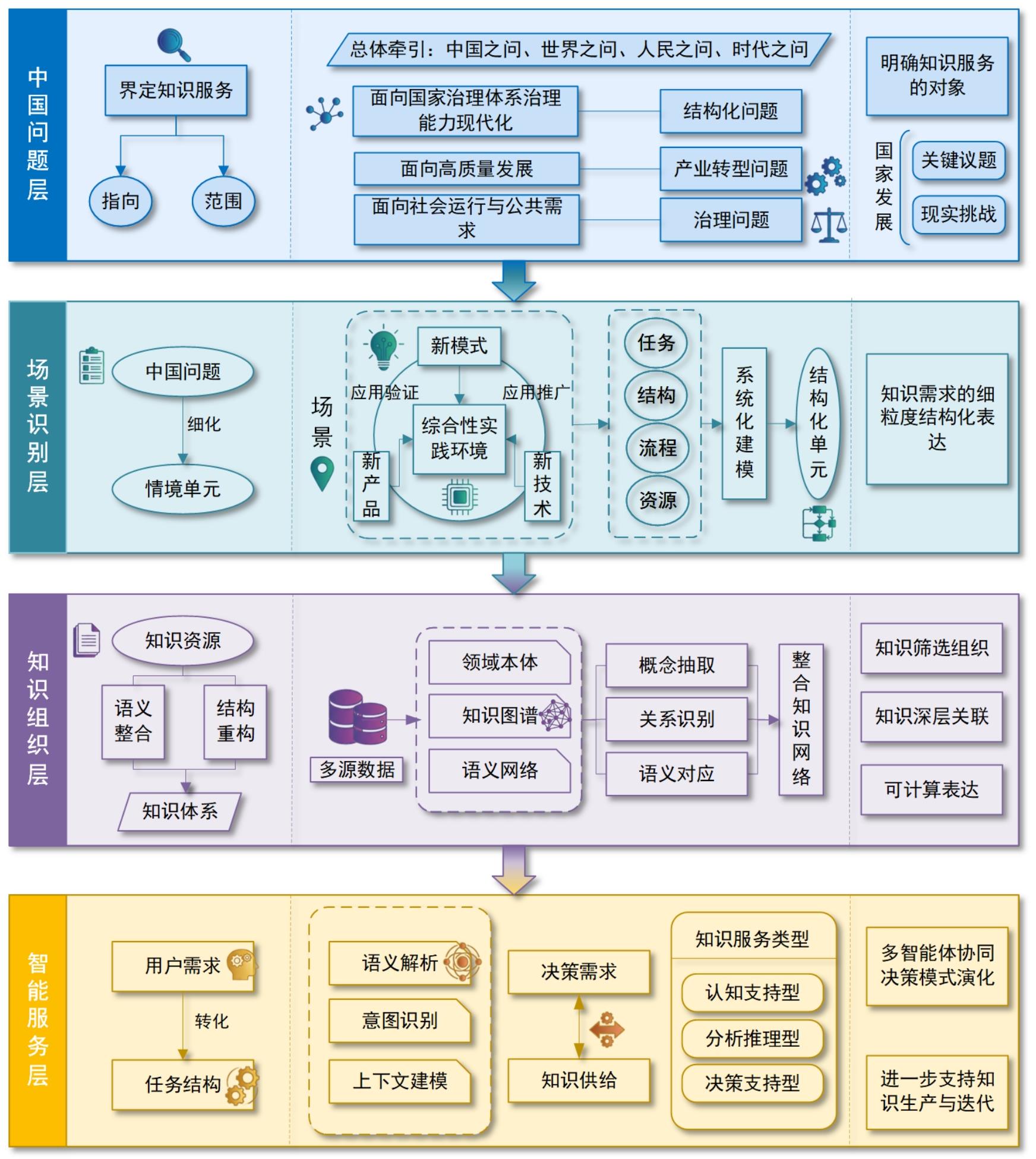
[Purpose/Significance] In the context of the ongoing process of Chinese modernization and the increasingly rigorous requirements for knowledge adaptability arising from complex governance contexts, this research explores the critical strategic value of promoting the fundamental transformation of knowledge services toward "scenario adaptation" within the comprehensive theoretical framework of China's Independent Knowledge System. This paper aims to construct a scenario-adaptive knowledge service model and delineate the essential supportive pathways of knowledge services for the overall development of China's independent knowledge system. [Method/Process] Fundamentally proceeding from the situational logic of knowledge production, we conducted an in-depth analysis of China's independent knowledge system construction for advanced knowledge services, focusing on the internal demand mechanism. On the basis of a thorough review of research related to knowledge services, knowledge organization, and intelligent services, this paper constructed and articulated the operational mode of scenario-adaptive intelligent knowledge services. This mode is synergistically driven by four key dimensions: the problem layer is responsible for perceiving and defining core pain points under complex governance contexts; the scenario identification layer refines problems into specific situational units and projects them into praxis spaces with clear structures and operational logics, thereby achieving a fine-grained structured expression of knowledge demands. The knowledge organization layer serves as the core supportive nexus of scenario-adaptive knowledge services, with its primary function being to bridge the problem situations depicted by the scenario identification layer. It performs semantic integration and structural reconstruction of dispersed, multi-source and heterogeneous knowledge resources, and transforms them into a structured, computable, and reusable knowledge system to provide a stable and callable knowledge foundation for subsequent intelligent services. The intelligent knowledge service layer converts user requirements into computable task structures through semantic parsing, intent recognition, and contextual modeling, and performs precise matching between knowledge supply and decision support on this basis. Furthermore, the article evaluates the supportive capacity of the information resource management (IRM) discipline for scenario-adaptive intelligent knowledge services and discusses the strategic pathways for cultivating intelligent knowledge service professionals. [Results/ [Conclusions] The research clarifies that the construction of China's independent knowledge system necessitates the development of scenario-adaptive intelligent knowledge services, and the IRM discipline provides crucial support for scenario-adaptive intelligent knowledge services in terms of heterogeneous knowledge resource integration, scenario-based knowledge configuration, and the systematic governance of knowledge resources. The collaborative construction of the "Technology-Knowledge-Scenario" should be further strengthened to promote the development of interdisciplinary professionals specialising in knowledge service and oriented toward the era of digital intelligence.

Key words: China's independent knowledge system, scenario adaptation, intelligent knowledge service, information resource management (IRM), knowledge governance

CLC Number: 

  • G203

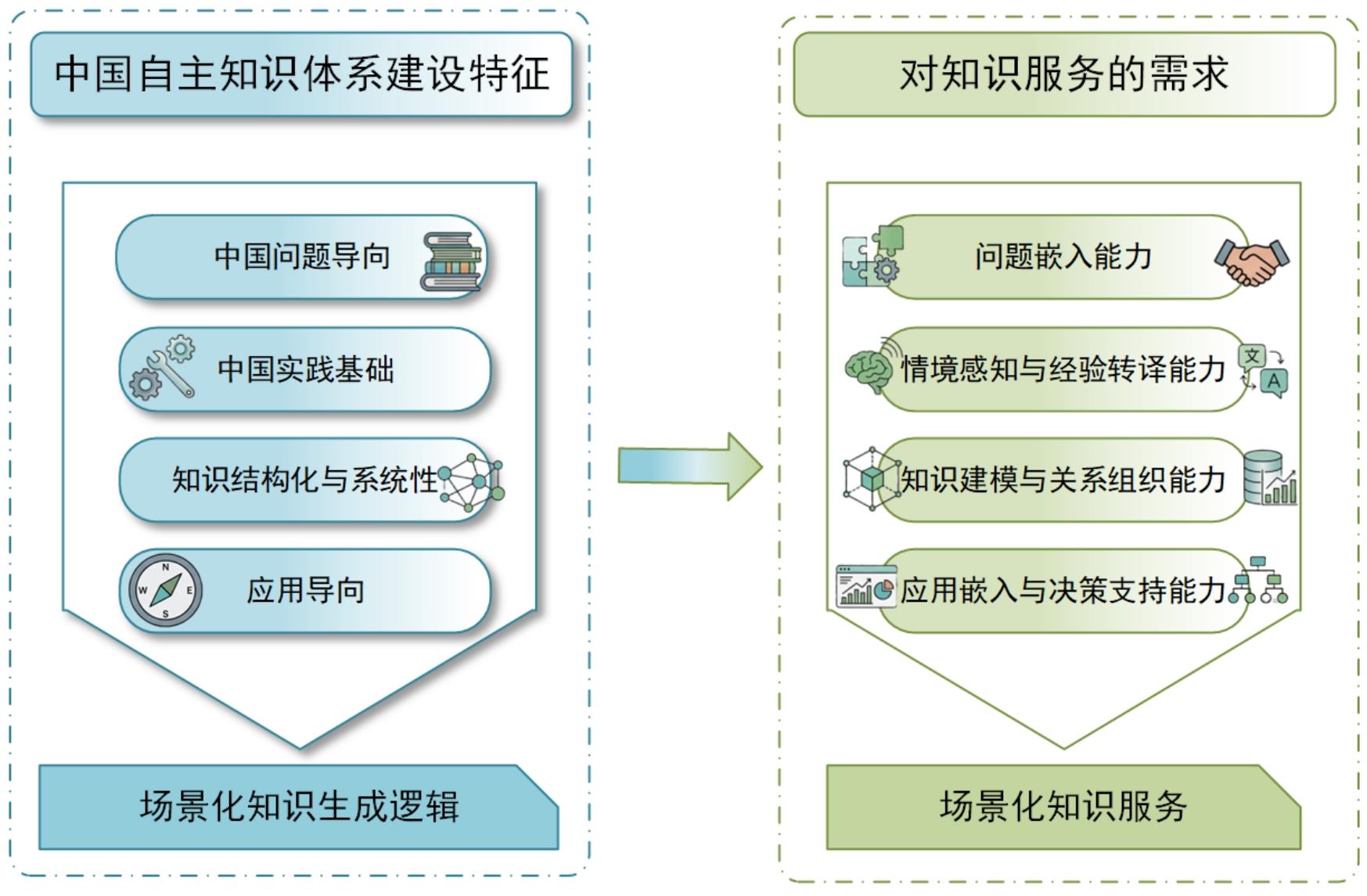
Fig.1

Demand for knowledge services in the construction of china's independent knowledge system"

Fig.2

Four-layer model of scenario-adaptive intelligent knowledge service"

[1]
张冠梓. 努力构建中国式现代化自主知识体系[EB/OL]. (2026-01-19)[2026-04-09].
[2]
张文喜. 构建中国自主知识体系: 基于知识财产权知识体系创新的思考[J]. 浙江学刊, 2025(2): 12-20.
Zhang Wenxi. The construction of China's independent knowledge system: Based on the innovation of intellectual property rights' knowledge system[J]. Zhejiang Academic Journal, 2025(2): 12-20.
[3]
黄海. 把握构建中国特色哲学社会科学之“道”[N]. 光明日报, 2026-04-27(007).
[4]
孟照海. 中国教育学自主知识体系的生成逻辑[J]. 教育研究, 2024, 45(8): 46-58.
Meng Zhaohai. The generative logic of the autonomous knowledge system of Chinese pedagogy[J]. Educational Research, 2024, 45(8): 46-58.
[5]
刘嗣方. 构建中国特色哲学社会科学的方向与路径[N]. 中国社会科学报, 2023-07-27(002).
[6]
鲍雅茹, 顾金喜. 构建中国特色哲学社会科学的方向与路径[J]. 浙江学刊, 2025(2): 12-20.
[7]
詹承豫, 徐明婧. 基于“情景应对-知识整合”的中国应急管理跨学科自主知识体系构建逻辑研究[J]. 公共管理与政策评论, 2024, 13(2): 1-12.
Zhan Chengyu, Xu Mingjing. Research on the construction logic of China's autonomous interdisciplinary knowledge system of emergency management based on "scenario response-knowledge integration"[J]. Public Administration and Policy Review, 2024, 13(2): 1-12.
[8]
王俊秀. 社会心态理论——一种宏观社会心理学范式[M]. 北京: 社会科学文献出版社, 2014.
Wang Junxiu. The theory of social mentality[M]. Beijing: Social Sciences Literature Publishing House, 2014.
[9]
李培林. 社会学与中国社会巨变[M]. 北京: 社会科学文献出版社·群学出版分社, 2020.
Li Peilin. Sociology and the great transformation of China[M]. Beijing: Social Sciences Literature Publishing House, 2020.
[10]
张东刚. 建构中国自主的知识体系的若干思考[J]. 中国社会科学, 2024(5): 90-104.
Zhang Donggang. Reflections on constructing China's independent knowledge system[J]. Social Sciences in China, 2024(5): 90-104.
[11]
栗元邦, 彭蓉, 季晶晶, 等. 经验研究中情景感知需求获取与建模系统文献综述[J]. 软件学报, 2018, 29(2): 320-339.
Li Yuanbang, Peng Rong, Ji Jingjing, et al. Systematic literature review of empirical studies on context aware requirement elicitation and modeling[J]. Journal of Software, 2018, 29(2): 320-339.
[12]
孙正聿. 原创性概念和标识性概念——建构中国自主知识体系的概念基础[J]. 中国社会科学, 2024(7): 38-51, 204-205.
Sun Zhengyu. Original concepts and iconic concepts - Conceptual foundations for constructing China's independent knowledge system[J]. Social Sciences in China, 2024(7): 38-51, 204-205.
[13]
王萌, 王昊奋, 李博涵, 等. 新一代知识图谱关键技术综述[J]. 计算机研究与发展, 2022, 59(9): 1947-1965.
Wang Meng, Wang Haofen, Li Bohan, et al. Survey on key technologies of new generation knowledge graph[J]. Journal of Computer Research and Development, 2022, 59(9): 1947-1965.
[14]
陆锋, 诸云强, 张雪英. 时空知识图谱研究进展与展望[J]. 地球信息科学学报, 2023, 25(6): 1091-1105.
Lu Feng, Zhu Yunqiang, Zhang Xueying. Spatiotemporal knowledge graph: Advances and perspectives[J]. Journal of Geo-Information Science, 2023, 25(6): 1091-1105.
[15]
Jiang Xuhui, Xu Chengjin, Shen Yinghan, et al. On the evolution of knowledge graphs: A survey and perspective[PP/OL]. V3. arXiv (2025-05-21)[2026-04-02].
[16]
杨洪源. 以党的二十届四中全会精神为指引 构建中国自主知识体系的哲学基础[J]. 哲学研究, 2025(12): 5-13, 169.
Yang Hongyuan. Constructing the philosophical foundation of China's independent knowledge system guided by the spirit of the fourth plenary session of the 20th CPC central committee[J]. Philosophical Research, 2025(12): 5-13, 169.
[17]
浪潮科技. 数字峰会探新“智”|浪潮科技发布“知涌一体化知识服务平台”, 以体系化知识平台为底座,赋能政务智能化[EB/OL]. (2026-04-30)[2026-04-30].
[18]
韩普, 李雄, 刘森岭, 等. 基于大语言模型的医疗健康领域知识服务模式研究[J]. 西华大学学报(哲学社会科学版), 2025, 44(1): 24-35.
Han Pu, Li Xiong, Liu Senling, et al. Research on knowledge service model in medical and health field based on large language model[J]. Journal of Xihua University (Philosophy & Social Sciences), 2025, 44(1): 24-35.
[19]
AI如何与企业法务和合规工作深度融合?[EB/OL]. (2025-07-17)[2026-04-07].
[20]
徐拥军, 杨红艳, 郭若涵. 中国自主知识体系建构背景下的主文献建设[J]. 中国人民大学学报, 2024, 38(1): 1-11.
Xu Yongjun, Yang Hongyan, Guo Ruohan. The construction of classic literature under the background of constructing an independent system of knowledge[J]. Journal of Renmin University of China, 2024, 38(1): 1-11.
[21]
中共中央. 中共中央关于坚持和完善中国特色社会主义制度 推进国家治理体系和治理能力现代化若干重大问题的决定[EB/OL]. (2019-11-05)[2026-03-09].
[22]
迟福林. 以结构转型推动高质量发展[EB/OL]. (2023-03-30)[2026-03-09].
[23]
刘伟. 以结构转型破解发展难题[EB/OL]. (2024-06-28)[2026-03-29].
[24]
国家发展改革委. 深入实施“人工智能+”行动 为高质量发展提供强大动能[EB/OL]. (2025-09-12)[2026-04-09].
[25]
孙美娟. 共探社会治理现代化新路径[EB/OL]. (2025-10-05)[2026-03-10].
[26]
陈一新. 加快推进社会治理现代化[N/OL]. 人民日报, 2019-05-21[2026-03-11].
[27]
郑国光, 吴佳. 构建中国自主的应急管理知识体系: 实践、问题与议程[J]. 中国应急管理科学, 2023(8): 1-9.
Zheng Guoguang, Wu Jia. Building autonomous emergency management knowledge system in China: Practice, questions and agenda[J]. Journal of China Emergency Management Science, 2023(8): 1-9.
[28]
李晓华. 未来产业的内涵、特征、难点及进路[J]. 新疆师范大学学报(哲学社会科学版), 2025, 46(3): 71-80, 2.
Li Xiaohua. Industries of future: Concept, characteristics, difficulties and development routes[J]. Journal of Xinjiang Normal University (Philosophy and Social Sciences), 2025, 46(3): 71-80, 2.
[29]
李纲, 王施运, 毛进, 等. 面向态势感知的国家安全事件图谱构建研究[J]. 情报学报, 2021, 40(11): 1164-1175.
Li Gang, Wang Shiyun, Mao Jin, et al. Construction of national security event map and its application for situation awareness[J]. Journal of the China Society for Scientific and Technical Information, 2021, 40(11): 1164-1175.
[30]
Liu Chang, Jin Hong, Wang Jianbo. Investigating the moderating effects of context-aware recommendations on the relationship between knowledge search and decision quality[J]. Journal of Organizational and End User Computing, 2024, 36(1): 1-21.
[31]
申姝婧, 杨建林, 刘明月. 情境化分析视角下的情报素养演化过程概念模型构建研究[J]. 情报学报, 2024, 43(2): 127-139.
Shen Shujing, Yang Jianlin, Liu Mingyue. Construction of the conceptual model of the evolutionary process of intelligence literacy from the perspective of contextualized analysis[J]. Journal of the China Society for Scientific and Technical Information, 2024, 43(2): 127-139.
[32]
章小童, 李月琳, 辛然. 用户健康信息搜索中交互感知、交互行为与交互质量的关系探究[J]. 情报学报, 2024, 43(11): 1349-1365.
Zhang Xiaotong, Li Yuelin, Xin Ran. Exploring the relationships among interaction perception, behavior, and quality during users' online health information searches[J]. Journal of the China Society for Scientific and Technical Information, 2024, 43(11): 1349-1365.
[33]
求是网. 场景建设, 4个关键环节很重要[EB/OL]. (2026-01-12)[2026-02-08].
[34]
刘炜, 金家琴, 张宁, 等. 从分类主题到语义空间: 人工智能驱动下图书馆知识组织体系的转型与发展[J/OL]. 中国图书馆学报: 1-20[2026-04-10].
Liu Wei, Jin Jiaqin, Zhang Ning, et al. From classification subject to semantic space: Transformation and development of library knowledge organization system driven by artificial intelligence[J/OL]. Journal of Library Science in China, 1-20[2026-04-10].
[35]
曾建勋, 林鑫, 吴茜. 产业链词表: 概念内涵、体系框架与应用场景[J/OL]. 中国图书馆学报: 1-14[2026-04-21].
Zeng Jianxun, Lin Xin, Wu Qian. Industrial chain thesaurus: Connotation, framework and application scenarios[J/OL]. Journal of Library Science in China, 1-14[2026-04-21].
[36]
蒋勋, 唐明伟. 基于多智能体的应急知识服务运行架构研究[J/OL]. 西华大学学报(哲学社会科学版): 1-10[2026-04-21].
Jiang Xun, Tang Mingwei. Research on the operation architecture of emergency knowledge service based on multi-agent[J/OL]. Journal of Xihua University (Philosophy & Social Sciences Edition), 1-10[2026-04-21].
[37]
刘轩琦, 褚伟, 王晓玉, 等. 数智化环境下人机协同的中医药语义知识组织与知识服务研究[J]. 图书与情报, 2025(6): 11-24.
Liu Xuanqi, Chu Wei, Wang Xiaoyu, et al. Research on human-machine collaborative methods for semantic knowledge discovery in Chinese medicine within a digital-intelligent environment[J]. Library and Information, 2025(6): 11-24.
[38]
刘晓轩, 李慧强, 陈伟. 生成式人工智能驱动图书馆知识服务研究现状分析[J]. 山东图书馆学刊, 2025(6): 22-28.
Liu Xiaoxuan, Li Huiqiang, Chen Wei. Analysis of the current state of research on GAI-driven library knowledge services[J]. The Library Journal of Shandong, 2025(6): 22-28.
[39]
张海涛, 于文慧, 苏欣宇, 等. 情报决策的内涵阐释、科学价值与实现路径[J]. 情报科学, 2026, 44(3): 1-9.
Zhang Haitao, Yu Wenhui, Su Xinyu, et al. Connotation interpretation, scientific value and realization path of intelligence decision-making[J]. Information Science, 2026, 44(3): 1-9.
[40]
任剑, 叶珂廷, 张威威, 等. 社会网络下基于大语言模型属性挖掘与TSK模型的应急决策方法[J/OL].中国管理科学, 1-25[2026-04-08].
Ren Jian, Ye Keting, Zhang Weiwei, et al. Emergency decision-making method based on large language model attribute mining and TSK model under social network[J/OL]. Chinese Journal of Management Science, 1-25[2026-04-08].
[41]
董学辉, 黄家铭, 郑吾昕, 等. AI驱动的国土空间规划多维协同决策创新及应用[J/OL]. 自然资源信息化, 1-9[2026-04-16].
Dong Xuehui, Huang Jiaming, Zheng Wuxin, et al. Innovation and application of ai-driven multi-dimensional collaborative decision-making for territorial spatial planning[J/OL]. Natural Resources Informatization, 1-9[2026-04-16].
[42]
苏维. 基于知识图谱与自然语言处理的生态环境政策智能分析与决策支持系统研究[J]. 科技与创新, 2026(4): 176-178, 185.
Su Wei. Research on intelligent analysis and decision support system of eco-environmental policy based on knowledge map and natural language processing[J]. Science and Technology & Innovation, 2026(4): 176-178, 185.
[43]
韩厢君. 融合大数据的农村劳动力信息集成与决策支持平台[J]. 数字经济, 2026(S1): 47-48.
Han Xiangjun. Information integration and decision support platform of rural labor force based on big data[J]. Digital Economy, 2026(S1): 47-48.
[44]
张思静. 财务决策支持系统的数据挖掘应用[J]. 数字经济, 2026(S1): 88-89.
Zhang Sijing. Application of data mining in financial decision support system[J]. Digital Economy, 2026(S1): 88-89.
[45]
吴畑, 胡宜君, 郑冰. 基于大语言模型的图书馆知识服务多智能体协作模型研究[J]. 图书情报工作, 2026, 70(10): 108-121.
Wu Tian, Hu Yijun, Zheng Bing. Research on multi-agent collaborative model for library knowledge services based on large language models[J]. Library and Information Service, 2026, 70(10): 108-121.
[46]
刘骁. AI赋能的学科知识服务隐性知识转化机制研究[J]. 图书馆学刊, 2025, 47(12): 18-24.
Liu Xiao. Research on the transformation mechanism of tacit knowledge in subject knowledge services empowered by AI[J]. Journal of Library Science, 2025, 47(12): 18-24.
[47]
龙跃, 陈启浩. 基于多源数据融合与知识关联聚合的战略性新兴产业关键技术识别研究[J]. 科技进步与对策, 2026, 43(5): 60-71.
Long Yue, Chen Qihao. Key technology identification of strategic emerging industries integrating multi-source data fusion with knowledge association and aggregation[J]. Science & Technology Progress and Policy, 2026, 43(5): 60-71.
[48]
储节旺, 张子芳. 多源异构空间数据融合的情报挖掘和知识发现研究[J]. 情报理论与实践, 2025, 48(11): 112-121, 179.
Chu Jiewang, Zhang Zifang. Research on intelligence mining and knowledge discovery based on multi-source heterogeneous spatial data fusion[J]. Information Studies (Theory & Application), 2025, 48(11): 112-121, 179.
[49]
夏义堃, 刘博文, 田聪. 情报分析中多源多模态数据融合的逻辑思路与技术路径研究[J]. 情报资料工作, 2025, 46(5): 5-15.
Xia Yikun, Liu Bowen, Tian Cong. Research on the logical approach and technical pathway of multi-source and multi-modal data fusion in intelligence analysis[J]. Information and Documentation Services, 2025, 46(5): 5-15.
[50]
窦路遥. 基于纵向联邦学习和大模型增强的跨机构数据融合优化[J/OL]. 现代情报, 1-12[2026-04-03] .
Dou Luyao. Cross-Organizational data fusion optimization based on vertical federated learning and large model enhancement[J/OL]. Modern Information, 1-12[2026-04-03].
[51]
胡锡晟, 付强, 黄晓林, 等. 基于多模态数据驱动的情报智能体模型构建[J/OL]. 情报杂志, 1-9[2026-01-15].
Hu Xisheng, Fu Qiang, Huang Xiaolin, et al. Construction of an intelligence agent model driven by multimodal data[J/OL]. Journal of Intelligence, 1-9[2026-01-15].
[52]
任萍萍, 方锐, 赵宁, 等. AI4S驱动下智慧图书馆知识服务范式重构及生态系统构建研究[J/OL]. 图书馆杂志, 1-9[2026-03-03].
Ren Pingping, Fang Rui, Zhao Ning, et al. Research on the paradigm reconstruction and ecosystem construction of smart library knowledge services driven by AI 4S[J/OL]. Library Journal, 1-9[2026-03-03].
[53]
陈凯华, 王硕, 张超, 等. 加强面向场景需求的公共治理信息技术预见[J]. 中国科学院院刊, 2025, 40(10): 1653-1662.
Chen Kaihua, Wang Shuo, Zhang Chao, et al. Enhancing scenario-oriented technology foresight on information technology for public governance[J]. Bulletin of Chinese Academy of Sciences, 2025, 40(10): 1653-1662.
[54]
孙雨生, 陈思妤, 刘涛, 等. 知识图谱赋能的智慧图书馆信息推荐框架与机理研究[J]. 图书馆学研究, 2025(10): 74-82.
Sun Yusheng, Chen Siyu, Liu Tao, et al. Research on the information recommendation framework and mechanism of smart library enabled by knowledge graph[J]. Research on Library Science, 2025(10): 74-82.
[55]
刘飘飘, 陈臣. 基于知识图谱和读者特征的图书馆智能检索与推送研究[J]. 新世纪图书馆, 2025(6): 62-68, 92.
Liu Piaopiao, Chen Chen. Research on library intelligent retrieval and push based on knowledge graph and reader characteristics[J]. New Century Library, 2025(6): 62-68, 92.
[56]
周利琴, 刘佳琪, 王晨. 基于知识图谱嵌入与检索增强的健康信息推荐模型研究[J]. 情报理论与实践, 2025, 48(10): 171-180.
Zhou Liqin, Liu Jiaqi, Wang Chen. A health information recommendation model based on knowledge graph embedding and retrieval-augmented generation[J]. Information Studies (Theory & Application), 2025, 48(10): 171-180.
[57]
柳亚, 毛谦昂, 颜嘉麒, 等. 面向用户动态偏好的科技论文推荐: 一种基于注意嵌入的知识图谱方法[J]. 信息资源管理学报, 2025, 15(1): 113-125.
Liu Ya, Mao Qian'ang, Yan Jiaqi, et al. Scientific paper recommendations with user dynamic preferences: A knowledge graph approach based on attention embeddings[J]. Journal of Information Resources Management, 2025, 15(1): 113-125.
[58]
田兆雪, 任奕, 王媛, 等. 用户需求导向的交叉学科专题信息资源导航建设实践——以清华大学双碳信息导航为例[J]. 图书情报工作, 2024, 68(2): 41-49.
Tian Zhaoxue, Ren Yi, Wang Yuan, et al. Practice of user demand-oriented interdisciplinary information navigation construction: A case study of the dual carbon information navigation in tsinghua university library[J]. Library and Information Service, 2024, 68(2): 41-49.
[59]
陈文珺, 杨佳佳. 基于共享知识迁移学习的跨领域推荐研究[J]. 情报科学, 2020, 38(6): 126-132.
Chen Wenjun, Yang Jiajia. Cross-domain recommendation based on shared knowledge transfer learning[J]. Information Science, 2020, 38(6): 126-132.
[60]
王金凤, 杨慧琳, 赵伟宇, 等. 知识迁移下基于融合知识网络与链路预测的技术机会识别[J]. 情报杂志, 2025, 44(5): 165-173, 198.
Wang Jinfeng, Yang Huilin, Zhao Weiyu, et al. Technology opportunity identification based on fused knowledge network and link prediction from the perspective of knowledge transfer[J]. Journal of Intelligence, 2025, 44(5): 165-173, 198.
[61]
陈欣, 周应冉. 基于数据生命周期管理阶段的社会科学数据开放平台数据标准建设研究[J]. 图书馆理论与实践, 2026(1): 90-103.
Chen Xin, Zhou Yingran. Research on the construction of data standards for social science data open plat-forms based on data life cycle management stages[J]. Library Theory and Practice, 2026(1): 90-103.
[62]
刘晓峰. 因何治、治什么、如何治: 图书馆数据治理“元问题”研究[J]. 图书馆工作与研究, 2026(3): 37-45.
Liu Xiaofeng. Why governance, what to govern, how to govern: A study on the meta-questions of library data governance[J]. Library Work and Study, 2026(3): 37-45.
[63]
李旭青, 沙武田. 数据治理时代的图书馆资源建设与管理指南——评《数据和数字资源标准规范》[J/OL]. 图书情报工作, 1-4[2026-04-08].
Li Xuqing, Sha Wutian. A guide to library resource construction and management in the era of data governance - A review of standards and specifications for data and digital resources[J/OL]. Library and Information Service, 1-4[2026-04-08].
[64]
公蓓, 朱明龙. 可信数据空间建设背景下档案数据安全治理研究: 基本特点、内在逻辑及实施路径[J/OL]. 档案与建设, 1-8[2026-05-06].
Gong Bei, Zhu Minglong. Research on archival data security governance under the background of trusted data space construction: Basic characteristics, internal logic and implementation path[J/OL]. Archives and Construction, 1-8[2026-05-06].
[65]
郭雪娇, 聂嫄芳. 数据确权实现数据治理研究[J]. 图书馆, 2025(12): 50-55, 95.
Guo Xuejiao, Nie Yuanfang. Research on achieving data governance through data rights confirmation[J]. Library, 2025(12): 50-55, 95.
[66]
胡安琪. 生成式人工智能背景下智慧图书馆数据治理体系构成、现实困境与变革路径[J]. 图书馆工作与研究, 2026(2): 51-60, 79.
Hu Anqi. System composition, realistic dilemmas, and transformation paths of data governance in smart libraries under the background of generative artificial intelligence[J]. Library Work and Study, 2026(2): 51-60, 79.
[67]
崔文波, 蔚海燕. 人工智能环境下多模态数据治理问题与路径研究[J/OL]. 图书馆杂志, 1-12[2025-11-03].
Cui Wenbo, Yu Haiyan. Research on problems and paths of multimodal data governance in artificial intelligence environment[J/OL]. Library Journal, 1-12[2025-11-03].
[68]
刘静, 袁莉. 数据要素驱动的信息资源管理学科人才培养体系重构探索[J/OL]. 现代情报, 1-13[2026-03-25].
Liu Jing, Yuan Li. Exploration on the reconstruction of talent training system for information resources management discipline driven by data elements[J/OL]. Modern Information, 1-13[2026-03-25].
[69]
杨海娟, 王淼, 刘坤锋. 智向未来: “十五五”信息资源管理学科发展与人才培养前瞻[J]. 档案管理, 2025(6): 109-110, 115.
Yang Haijuan, Wang Miao, Liu Kunfeng. Wisdom to the future: The prospect of the development of information resource management discipline and talent training in the fifteenth Five-Year Plan[J]. Archives Management, 2025(6): 109-110, 115.
[70]
赵峥. 塑造“人工智能+”信息资源管理人才培养新生态[J]. 图书馆建设, 2024(3): 24-26.
Zhao Zheng. Creating a new ecosystem for cultivating "artificial intelligence+" information resource management talents[J]. Library Development, 2024(3): 24-26.
[71]
张洋, 吴婷婷, 李晶. 交叉学科视角下的信息资源管理创新人才培养[J]. 信息资源管理学报, 2024, 14(3): 21-29, 55.
Zhang Yang, Wu Tingting, Li Jing. Cultivation of innovative talents in information resource management under interdisciplinary perspective[J]. Journal of Information Resources Management, 2024, 14(3): 21-29, 55.
[72]
裴雷, 胡志伟. 信息资源管理跨学科人才培养的实践逻辑与影响因素[J]. 数字图书馆论坛, 2024, 20(1): 13-22.
Pei Lei, Hu Zhiwei. Practical logic and influencing factors of interdisciplinary talent cultivation in information resources management[J]. Digital Library Forum, 2024, 20(1): 13-22.
[73]
张艳丰, 罗心晨. OBE-CDIO理念下信息资源管理学科人才培养与社会需求适配研究[J]. 图书馆学研究, 2025(12): 27-38.
Zhang Yanfeng, Luo Xinchen. OBE-CDIO driven alignment of information resource management(IRM) talent cultivation with social demands[J]. Research on Library Science, 2025(12): 27-38.
[74]
钱明辉, 刘越男. 双数计划: 面向国家数字化转型的信息资源管理本科人才培养改革探索[J]. 中国人民大学教育学刊, 2023(2): 43-57.
Qian Minghui, Liu Yuenan. Double digital project: Exploring the reform of information resource management undergraduate education for national digital transformation[J]. Renmin University of China Education Journal, 2023(2): 43-57.
[1] ZHAO Ruixue, LI Tian, GUAN Zhihao, XIAN Guojian, KOU Yuantao, SUN Tan. Bidirectional Empowerment Between Knowledge Service and New Quality Productive Forces Theoretical Interpretation and Practical Path [J]. Journal of library and information science in agriculture, 2024, 36(2): 4-14.
[2] LI Tian, ZHAO Ruixue, XIAN Guojian, KOU Yuantao. Agricultural Intelligent Knowledge Services to Enable Rural Revitalization: Internal Mechanism and Dilemma Relief [J]. Journal of library and information science in agriculture, 2023, 35(8): 43-54.
[3] SUN Tan, ZHANG Zhixiong, ZHOU Lihong, WANG Dongbo, ZHANG Hai, LI Baiyang, YONG Suhua, ZUO Wangmeng, YANG Guanglei. The Transformation and Observations of AI for Science (AI4S) Driven by Artificial Intelligence [J]. Journal of library and information science in agriculture, 2023, 35(10): 4-32.
[4] ZHAO Ruixue, HUANG Yongwen, MA Weilu, DONG Wenjia, XIAN Guojian, SUN Tan. Insights and Reflections of the Impact of ChatGPT on Intelligent Knowledge Services in Libraries [J]. Journal of library and information science in agriculture, 2023, 35(1): 29-38.
[5] WANG Chun-fang. Research on the Knowledge Governance of Regional Library Cluster [J]. Journal of library and information science in agriculture, 2014, 26(10): 78-80.
Viewed
Full text


Abstract

Cited

  Shared   
  Discussed   
No Suggested Reading articles found!