中文    English

Journal of library and information science in agriculture


Construction of Library Human-Intelligence Symbiosis Service Model from the Perspective of Generative Artificial Intelligence

GUO Haiming   

  1. Weifang University Library, Weifang 261061
  • Received:2026-04-28 Online:2026-08-13

Abstract:

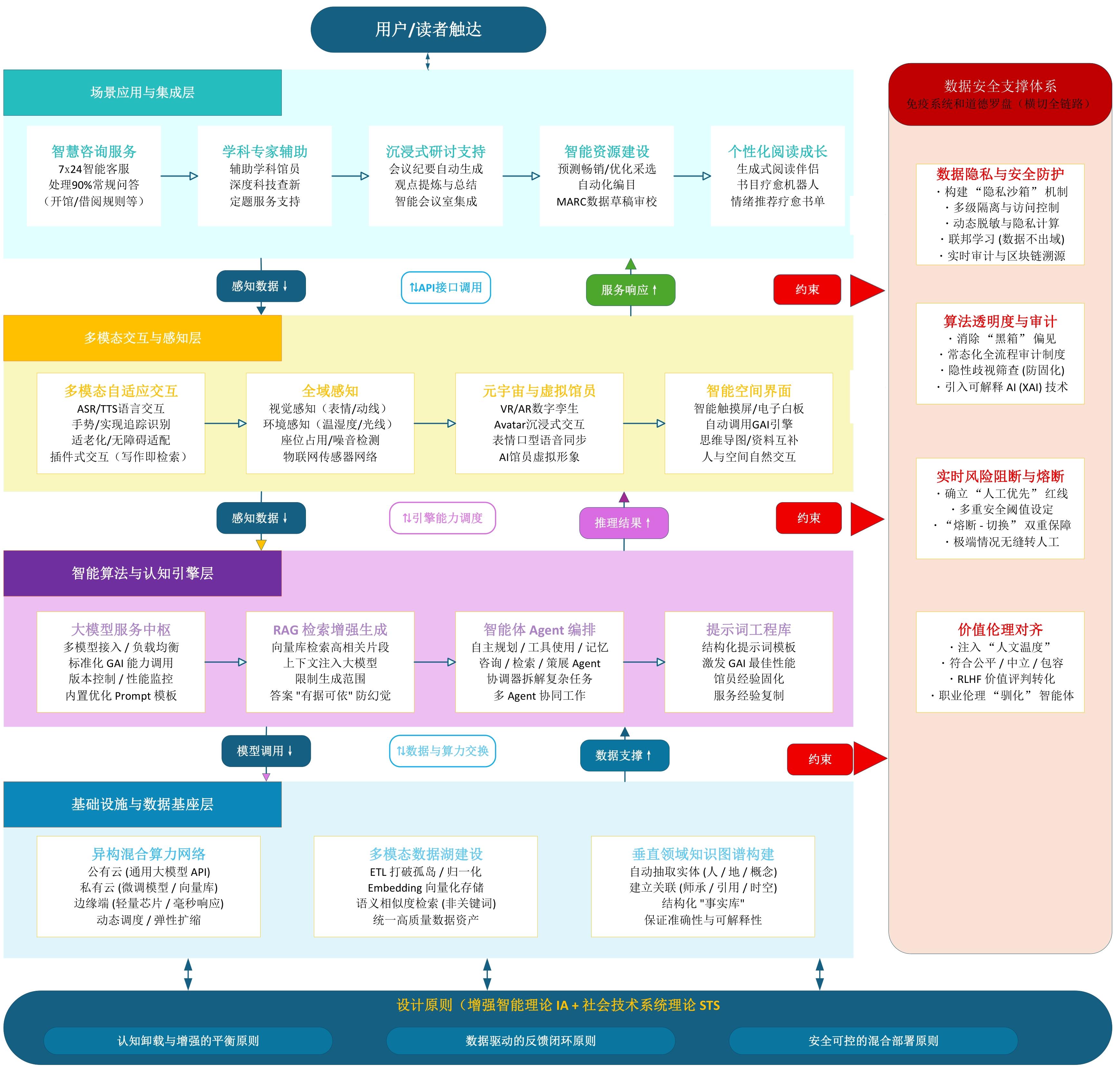
[Purpose/Significance] With the explosive development of generative artificial intelligence (GAI) technologies represented by ChatGPT and DeepSeek, GAI has fundamentally transformed the traditional service logic of libraries through natural language interaction, content generation, and multimodal comprehension capabilities, driving the transition from document storage centers to intelligent knowledge service hubs. In the realm of library services, GAI has evolved beyond its role as a mere retrieval tool, gradually transforming into a digital librarian capable of perception, reasoning, and even generation. The aim of this study is to adapt to the trend of highly autonomous intelligent agents in the GAI environment, address the limitations of traditional library technical support models, and provide theoretical references and practical pathways for the intelligent transformation of libraries. [Method/Process] While numerous achievements have been made in domestic and international research on library services in the GAI context, there remains a lack of systematic and comprehensive integration of library service models from the human-intelligence symbiosis perspective, making it difficult to adapt to the current trend of highly autonomous intelligent agents. On the basis of analyzing the evolution process of the human mechanism system in the development of library technology, including the tool assisted period, intelligent assisted period, and human intelligence symbiotic period, this paper elaborates on the core connotations of library human-intelligence symbiosis from three dimensions - cognitive, emotional, and value. It analyzes the practical logic of library human-intelligence symbiotic library services around three core mechanisms: cognitive dual enhancement, circular feedback, and emotional interaction. It innovates the library service paradigm in the GAI environment, reconstructs the library service model in the GAI context, and establishes a library human-intelligence symbiotic library service system. [Results/Conclusions] In the face of increasingly complex user demands and vast, heterogeneous data resources, service paradigms that rely solely on machines or unidirectional human input have been shown to be inadequate. The construction of a deeply coupled, complementary library human-intelligence symbiotic service model has become an inevitable choice. This study establishes the library human-intelligence symbiotic service concept of bidirectional empowerment and co-evolution between human and artificial intelligence, breaking the boundaries of human-machine duality and positioning GAI as a cognitive partner within the library service ecosystem, thereby advancing the transition from a tool-based to a symbiotic paradigm in library services. It constructs a library human-intelligence symbiotic service system architecture featuring "one base, dual engines, three interactions, and multi-scenarios" along with a data security support system covering the entire data lifecycle, algorithm decision-making process, and all interaction service scenarios. By internalizing GAI technology as a core productivity of libraries, it achieves cognitive offloading and enhancement while reshaping the depth and breadth of library knowledge services. In the future, with breakthroughs in cutting-edge technologies such as brain-computer interfaces, quantum computing, and generative artificial intelligence, human-intelligence symbiosis will advance to a deeper stage of consciousness coupling. Libraries will no longer merely serve as repositories of knowledge but will become pivotal nodes for the interactive evolution of collective human wisdom and artificial intelligence. This symbiosis represents not only an innovation in library service models but also the continuation and elevation of human knowledge transmission in the intelligent era, charting a new direction for the high-quality development of the library industry.

Key words: generative artificial intelligence, library service, human-intelligence symbiosis, service mode

CLC Number: 

  • G250

Fig.1

Logic diagram of the evolution stage of library human-machine relationship"

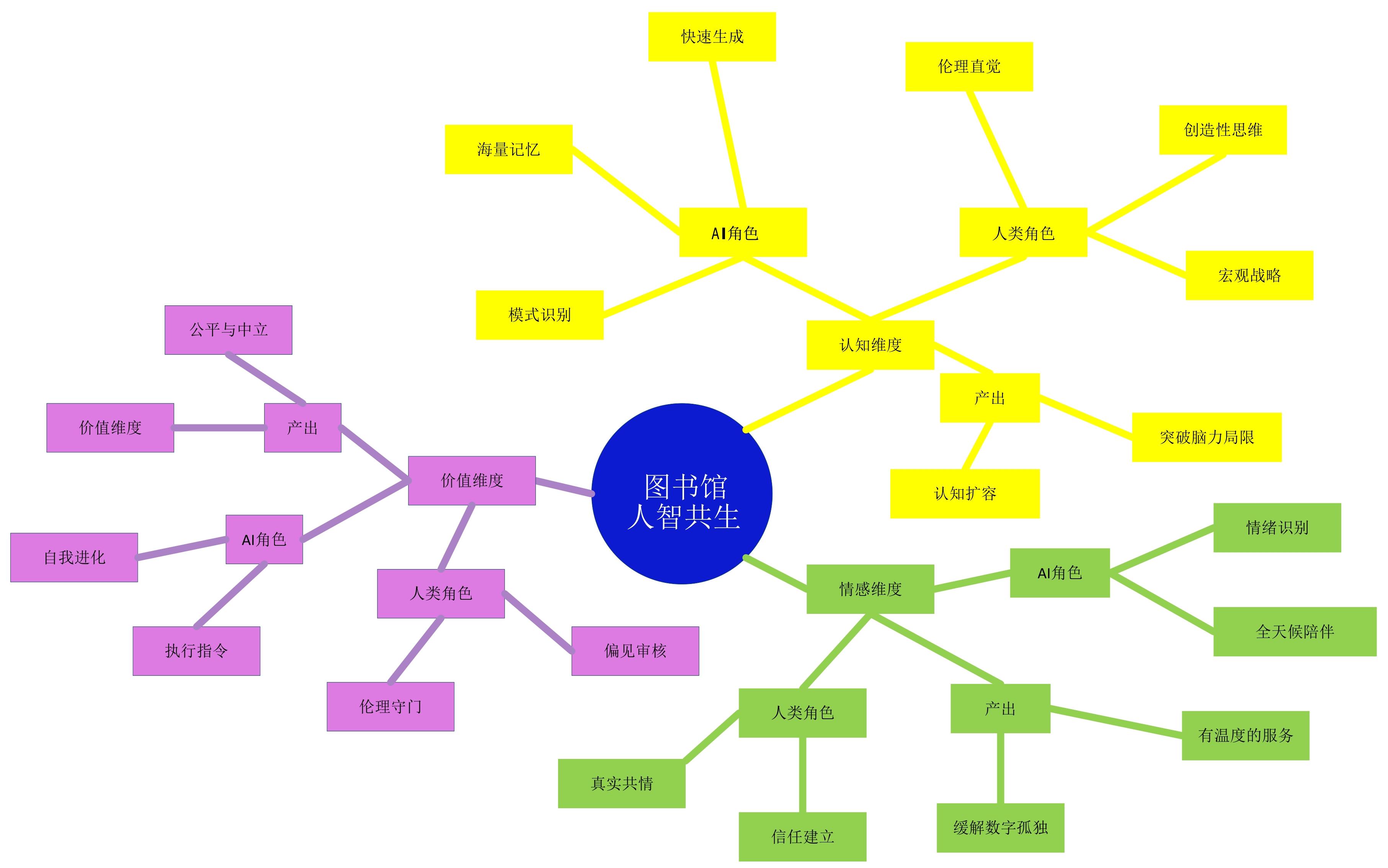
Fig.2

Conceptual logic diagram of human-AI coexistence service model in libraries"

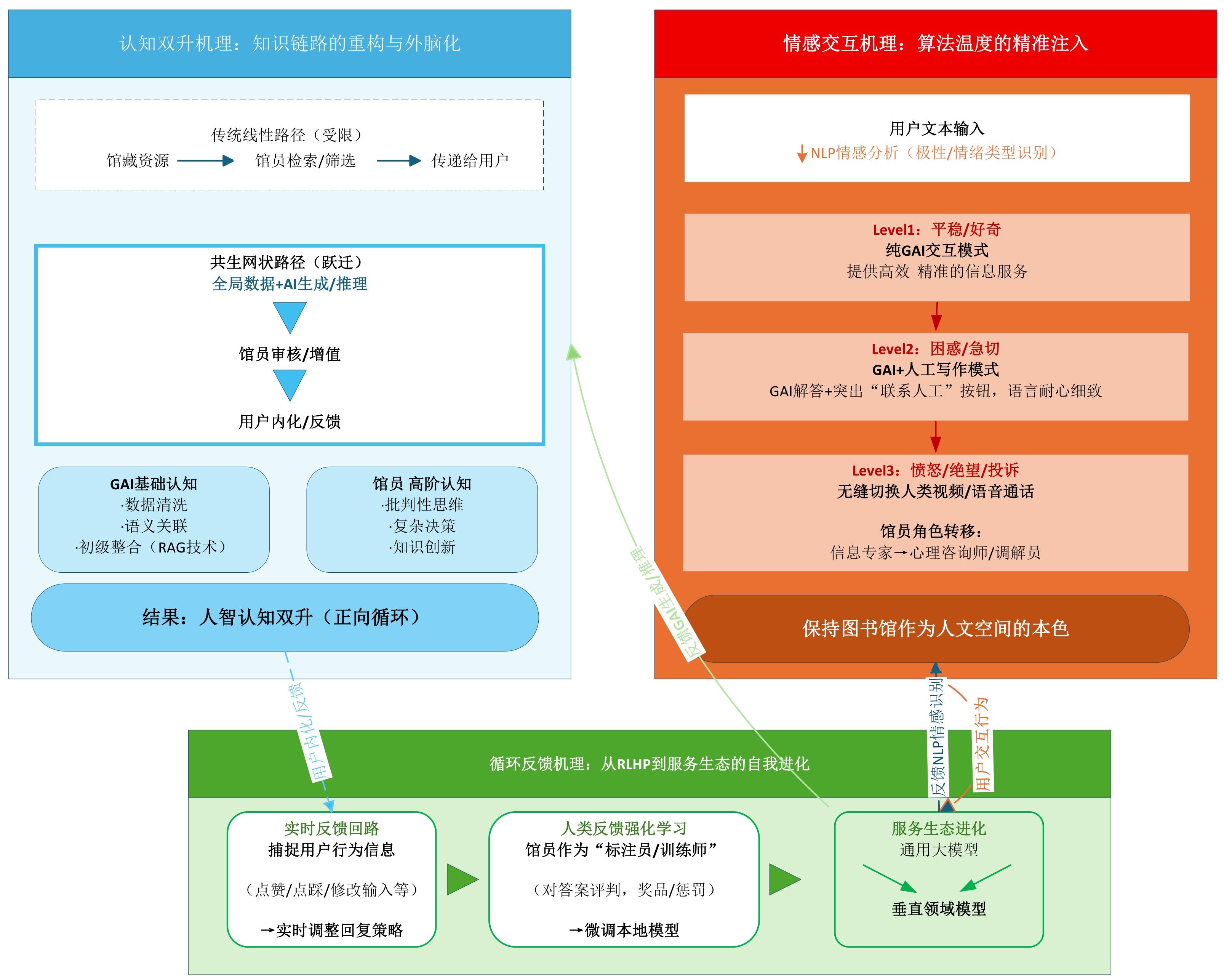
Fig.3

Practical logic diagram of library human-wisdom coexistence service mode"

Fig.4

Architecture model of library human-intelligence symbiosis service system"

[1]
陈观婷, 张震, 黄奇. 元宇宙视域下的智慧图书馆: 融合人的智慧与物的智能的服务生态[J]. 图书情报工作, 2023, 67(10): 15-25.
Chen Guanting, Zhang Zhen, Huang Qi. The smart library from the perspective of metaverse: A service ecology integrating wisdom of humans and IntelligenceofThings[J]. Library and Information Service, 2023, 67(10): 15-25.
[2]
袁新辉, 崔永, 周芬, 等. 面向生成式AI的高校图书馆数据资源体系构建与实践探索——以中南大学图书馆为例[J]. 大学图书馆学报, 2026, 44(2): 45-52.
Yuan Xinhui, Cui Yong, Zhou Fen, et al. Construction and practical exploration of a generative AI-oriented data resource system in academic libraries: A case study of central south university library[J]. Journal of Academic Libraries, 2026, 44(2): 45-52.
[3]
陈传夫, 肖诗依, 陈一, 等. 生成式人工智能赋能图书馆传统服务场景: 文献进展与应用展望[J]. 图书馆论坛, 2026, 46(4): 92-104.
Chen Chuanfu, Xiao Shiyi, Chen Yi, et al. Generative AI in traditional library services: A literature review and application prospects[J]. Library Tribune, 2026, 46(4): 92-104.
[4]
赵瑞雪, 黄永文, 马玮璐, 等. ChatGPT对图书馆智能知识服务的启示与思考[J]. 农业图书情报学报, 2023, 35(1): 29-38.
Zhao Ruixue, Huang Yongwen, Ma Weilu, et al. Insights and reflections of the impact of ChatGPT on intelligent knowledge services in libraries[J]. Journal of Library and Information Science in Agriculture, 2023, 35(1): 29-38.
[5]
Rysavy M D T, Michalak R. Reimagining library FAQs with Generative AI: A case study in metadata optimization [J]. Journal of Library Administration, 2026, 66(2): 189-206.
[6]
Joselin J, Beatrice B A, Indhumathi S. Enhanced services of next-gen libraries through artificial intelligence[M]//Improving Library Systems with AI. Hershey: IGI Global, 2024: 107-114.
[7]
Sousa N. Ethical and practical implications of AI in academic library research[J]. IFLA Journal, 2025: 03400352251391753.
[8]
Chen Xiaotian. ChatGPT and its possible impact on library reference services[J]. Internet Reference Services Quarterly, 2023, 27(2): 121-129.
[9]
周洪宇, 常顺利. 生成式人工智能嵌入高等教育的未来图景、潜在风险及其治理[J]. 现代教育管理, 2023(11): 1-12.
Zhou Hongyu, Chang Shunli. Generative AI embedded in higher education: Future scenarios, potential risks and solutions[J]. Modern Education Management, 2023(11): 1-12.
[10]
许可, 赵星, 李嘉宇. 融合元宇宙场景与AIGC应用的图书馆价值共创机制研究[J]. 图书情报工作, 2025, 69(21): 5-15.
Xu Ke, Zhao Xing, Li Jiayu. Research on the value co-creation mechanism in libraries by integrating the metaverse scenarios and AIGC applications[J]. Library and Information Service, 2025, 69(21): 5-15, 3.
[11]
陈定权, 袁俊聪, 吴亦乐. 21世纪国外图书馆技术产业的历史考察——对Marshall Breeding图书馆技术产业报告的分析[J]. 图书馆论坛, 2022, 42(12): 149-158.
Chen Dingquan, Yuan Juncong, Wu Yile. Historical review on foreign library technology industry in the 21st century: Analysis on Marshall breeding's library technology industry reports[J]. Library Tribune, 2022, 42(12): 149-158.
[12]
童云海, 陈建龙. DeepSeek热潮下的双重变革: 大模型的技术革新与高校图书馆服务范式的重构[J]. 大学图书馆学报, 2025, 43(1): 66-70.
Tong Yunhai, Chen Jianlong. Dual transformation under the DeepSeek wave: Technological innovation in large models and the restructuring of service paradigms in academic libraries[J]. Journal of Academic Libraries, 2025, 43(1): 66-70.
[13]
Herzog A, Rentzsch M, Götte G, et al. EMOTION vectors: Enabling self-organizing production through efficient information processing in distributed cognitive systems[J]. Procedia CIRP, 2026, 138: 138-143.
[14]
张红. 从科技伦理到法律伦理:人工智能伦理的规范化[J]. 比较法研究, 2026(1): 33-48.
Zhang Hong. From technological ethics to legal ethics: The normalization of artificial intelligence ethics[J]. Journal of Comparative Law, 2026(1): 33-48.
[15]
Lewis P, Perez E, Piktus A, et al. Retrieval-augmented generation for knowledge-intensive NLP tasks[C]//Proceedings of the 34th International Conference on Neural Information Processing Systems. New York: ACM, 2020: 9459-9474.
[16]
Ouyang Long, Wu J, Jiang Xu, et al. Training language models to follow instructions with human feedback[C]//Advances in Neural Information Processing Systems 35. Neural Information Processing Systems Foundation, Inc. (NeurIPS), 2022: 27730-27744.
[17]
浦江. 需求影响下多层次认知-情感交互机理[J]. 北京邮电大学学报, 2014, 37(3): 109-114.
Pu Jiang. Research of multi-level cognitive-emotional interaction mechanism under need influence[J]. Journal of Beijing University of Posts and Telecommunications, 2014, 37(3): 109-114.
[18]
吴丹, 孙国烨. 迈向可解释的交互式人工智能: 动因、途径及研究趋势[J]. 武汉大学学报(哲学社会科学版), 2021, 74(5): 16-28.
Wu Dan, Sun Guoye. Towards explainable interactive artificial intelligence: Motivations, approaches, and research trends[J]. Wuhan University Journal (Philosophy & Social Sciences), 2021, 74(5): 16-28.
[19]
Engelbart D C. Augmenting human intellect: A conceptual framework (1962)[M]//Ideas That Created the Future. Cambridge, MA, USA: The MIT Press, 2021: 225-236.
[20]
Trist E L, Bamforth K W. Some social and psychological consequences of the long wall method of coal-getting[J]. Human Relations, 1951, 4(1): 3-38.
[21]
Risko E F, Gilbert S J. Cognitive offloading[J]. Trends in Cognitive Sciences, 2016, 20(9): 676-688.
[22]
胡继东, 马欣, 韩冰, 等. 支持混合业务的异构算力调度平台设计与实现[J]. 计算机与现代化, 2026(1): 91-100.
Hu Jidong, Ma Xin, Han Bing, et al. Design and implementation of a heterogeneous computing scheduling platform supporting hybrid services[J]. Computer and Modernization, 2026(1): 91-100.
[23]
Menke P, Cimiano P. MExiCo: A library for managing multimodal data collections[J]. Procedia - Social and Behavioral Sciences, 2013, 95: 105-110.
[24]
罗学炜, 霍雨佳. 信息技术与信息化[J]. 信息技术与信息化, 2026(2): 142-145.
Luo Xuewei, Huo Yujia. Information technology and informatization[J]. Information Technology & Informatization, 2026(2): 142-145.
[25]
胡玉宁. 从人工语言到用户提示词: 论情报检索语言的形态演变[J]. 情报杂志, 2026, 45(3): 167-175.
Hu Yuning. From artificial language to user prompt: The form evolution of information retrieval language[J]. Journal of Intelligence, 2026, 45(3): 167-175.
[26]
Lee D, Palmer E. Prompt engineering in higher education: A systematic review to help inform curricula[J]. International Journal of Educational Technology in Higher Education, 2025, 22(1): 7.
[27]
毛向南. 基于数据沙箱技术的政府开放数据安全保障体系构建[J]. 网络安全技术与应用, 2026(3): 66-69.
Mao Xiangnan. Construction of government open data security guarantee system based on data sandbox technology[J]. Network Security Technology & Application, 2026(3): 66-69.
[1] WU Dan, XU Hao. From Human-Computer Interaction to Human-AI Collaboration: A Frontier Perspective on Constructing an Independent Knowledge System for Information Resource Management in China [J]. Journal of library and information science in agriculture, 2026, 38(5): 55-64.
[2] GUO Jinbo. Effects of AIGC on Reader Trust in Library Information [J]. Journal of library and information science in agriculture, 2026, 38(4): 84-98.
[3] AN Lin. Governance of Personal Information Security in the Iteration of Generative AI: From the Perspective of the Technological Evolution of Large Models [J]. Journal of library and information science in agriculture, 2026, 38(4): 61-70.
[4] LI Baiyang, REN Shangsheng. Technical Evolution and Application Scenarios of Open-Source Agents:A Case Study of "OpenClaw" [J]. Journal of library and information science in agriculture, 2026, 38(4): 23-35.
[5] YI Chenhe, ZHANG Yuting. Risk Assessment and Early Warning of Generative Artificial Intelligence Impact on Network Public Opinion Based on Optimized BP Neural Network [J]. Journal of library and information science in agriculture, 2026, 38(2): 30-41.
[6] ZHANG Ling. Integrating Digital Humanities and Agricultural Knowledge Services A Simulation Modeling Perspectives [J]. Journal of library and information science in agriculture, 2026, 38(2): 79-89.
[7] SHEN Hongjie, SHEN Hongwei, WANG Junli. Generative AI Empowering Information Literacy Education in Digital Libraries: Path Exploration, Challenge Analysis, and Response Strategies [J]. Journal of library and information science in agriculture, 2025, 37(7): 50-60.
[8] ZHAI Jun, MENG Zihan, LI Fangsu, SHEN Lixin. AI Guides in Research Libraries of North America under the AI4S Context: Based on the Survey of 125 ARL Libraries [J]. Journal of library and information science in agriculture, 2025, 37(7): 35-49.
[9] LIU Wei, ZHANG Lei, JI Ting, CHEN Xiaoyang. Shaping the Smart Libraries with AI: An Agent-based, Next-Generation Library Service Platform [J]. Journal of library and information science in agriculture, 2025, 37(5): 15-26.
[10] SHI Xujie, YUAN Fan, LI Jia. Searching as Learning in the Context of Generative Artificial Intelligence: Technological Pathways, Behavioral Evolution, and Ethical Challenges [J]. Journal of library and information science in agriculture, 2025, 37(5): 40-57.
[11] ZHANG Li, WANG Bo, JING Shui. Generative AI-Driven Resource Discovery in Public Libraries: Service Optimization Based on a Dynamic Evaluation Model [J]. Journal of library and information science in agriculture, 2025, 37(5): 58-71.
[12] GOU Ruike, LUO Wei. Influencing Factors of Continuous Use Intention of "Generation Z" Users of an AIGC Platform [J]. Journal of library and information science in agriculture, 2025, 37(3): 66-80.
[13] QIAO Jinhua, MA Xueyun. Risks and Regulations for Application of the LLaMA Model in University Future Learning Centers [J]. Journal of library and information science in agriculture, 2025, 37(2): 37-48.
[14] CHEN Nan. Strategies for Smart Library Services in Public Libraries during the Digitally-Intelligence Era under the 15th Five-Year Plan [J]. Journal of library and information science in agriculture, 2025, 37(12): 64-80.
[15] SUN Lijuan. Exploring the Transition of Public Librarians to "Prompt Librarians" from the Perspective of New Quality Productive Forces [J]. Journal of library and information science in agriculture, 2025, 37(1): 17-32.
Viewed
Full text


Abstract

Cited

  Shared   
  Discussed   
No Suggested Reading articles found!