中文    English

Journal of library and information science in agriculture


Library Knowledge Service Empowered by Smart Data and Synthetic Data

XU Tongyang, DOU Lijuan   

  1. School of Information, Shanxi University of Finance and Economics, Taiyuan 030006
  • Received:2026-03-05 Online:2026-05-13

Abstract:

[Purpose/Significance] Data are playing an increasingly prominent role in driving library knowledge services, providing core support for enhancing service potential and improving accuracy. At present, the intelligent transformation of library knowledge services is hindered by issues such as insufficient resource value mining, limited service interactivity, and poor user privacy protection. These problems seriously restrict improvements to service efficiency and the transformation process. Focusing on library knowledge services empowered by the collaboration of smart data and synthetic data, this paper aims to solve the above transformation dilemmas, providing theoretical support and practical guidance for libraries to optimize knowledge service models, enhance resource utilization efficiency, and strengthen privacy protection, so as to further advance the in-depth development of intelligent transformation. [Method/Process] Based on literature research through keyword retrieval and citation tracing, we sorted out the expressions of smart data in four subfields of information resource management, namely digital humanities, library services, scientific and technical information, and archival studies. We then clarified the connotation of smart data-empowered library knowledge services from three dimensions: service concept, driving process, and value realization, and reviewed the definition and generation methods of synthetic data. On this basis, we discussed the value manifestations of smart data in empowering library knowledge services, and drew on the research and application of synthetic data in other fields to explore its potential value in empowering library knowledge services. Finally, we analyzed the advantages and disadvantages of the two types of data, and discussed the direction of their collaborative empowerment of library knowledge services. [Results/Conclusions] Smart data have advantages in terms of data sources, credibility, and value-added properties. Supported by high-quality data and algorithmic models, synthetic data can expand data scale and diversity, and alleviate challenges in privacy protection to a certain extent. The two complement each other, and their value in collaboratively empowering library knowledge services is mainly reflected in the knowledge resource layer, knowledge interaction layer, and data security layer. However, in the process of collaborative empowerment, they still face practical difficulties such as insufficient interpretability of synthetic data and disputes over data property rights. In the future, libraries should focus on strengthening the credibility of synthetic data in data generation and quality evaluation, clarify the boundaries of rights and responsibilities through contractual agreements and authorization protocols, and improve the transparency of data property rights tracing by integrating blockchain technology, so as to fully release the collaborative value of the two and build a more resilient library knowledge service system.

Key words: smart data, synthetic data, data-driven, library, knowledge service

CLC Number: 

  • G250.7

Table 1

Expressions of smart data by some scholars in the field of information resource management"

学者 表述 细分方向
曾蕾等[7] 智慧数据是通过对数据的处理与使用而提炼出的具有实际应用价值的信息。图档博机构丰富的原始数据资源及其所提供的智慧数据服务可支持数字人文研究者开展深入研究 数字人文
王雅丽[11] 智慧数据是将大数据通过智能处理转化为可操作信息和决策支持的关键方法,具备可再生、流动性强、技术依赖性强等特征,是图书馆实现智慧化转型的核心资源 图书馆服务
常志军等[12] 智慧数据是科技情报迈入数据驱动时代的核心支撑,科技情报智慧数据具备数据要素本身质量高、数据维度丰富、多源信息融合的网络体系以及认知与理解信息能力特征 科技情报
华林等[13] 智慧数据是在大数据语境下形成的高级数据组织形态,具有富语义性、可计算、可推理、可追溯等特征,可为档案知识聚合与服务提供核心驱动力 档案研究

Table 2

Comparison between the two types of generation methods"

对比维度 基于统计模型的方法 基于深度学习模型的方法
原理 概率分布估计与参数拟合 神经网络与特征学习
代表模型/技术

高斯混合模型(GMM)

核密度估计(KDE)

Copula联合分布建模

生成对抗网络(GANs)

变分自编码器(VAEs)

大语言模型(LLM)

适配数据类型

低维结构化数据

分布明确的小规模数据

高维数据

多模态数据

复杂异构数据

优势

可解释性强

计算效率高

数据需求量小

生成样本逼真且多样

捕捉数据深层关联

支持多模态数据生成

不足

维度适应性受限

高度依赖预设合理性

无法生成多模态数据

不可解释性

数据量要求高

计算成本高

Table 3

Comparison of advantages and disadvantages between smart data and synthetic data"

数据类型 优势 不足
智慧数据

数据来源可追溯

内容可信

可实现数据增值

支持决策

依赖存量数据

数据隐私问题

合成数据

扩充数据规模

改善数据质量

优化多模态资源形态

缓解隐私难题

依赖高质量数据与算法

模型崩溃

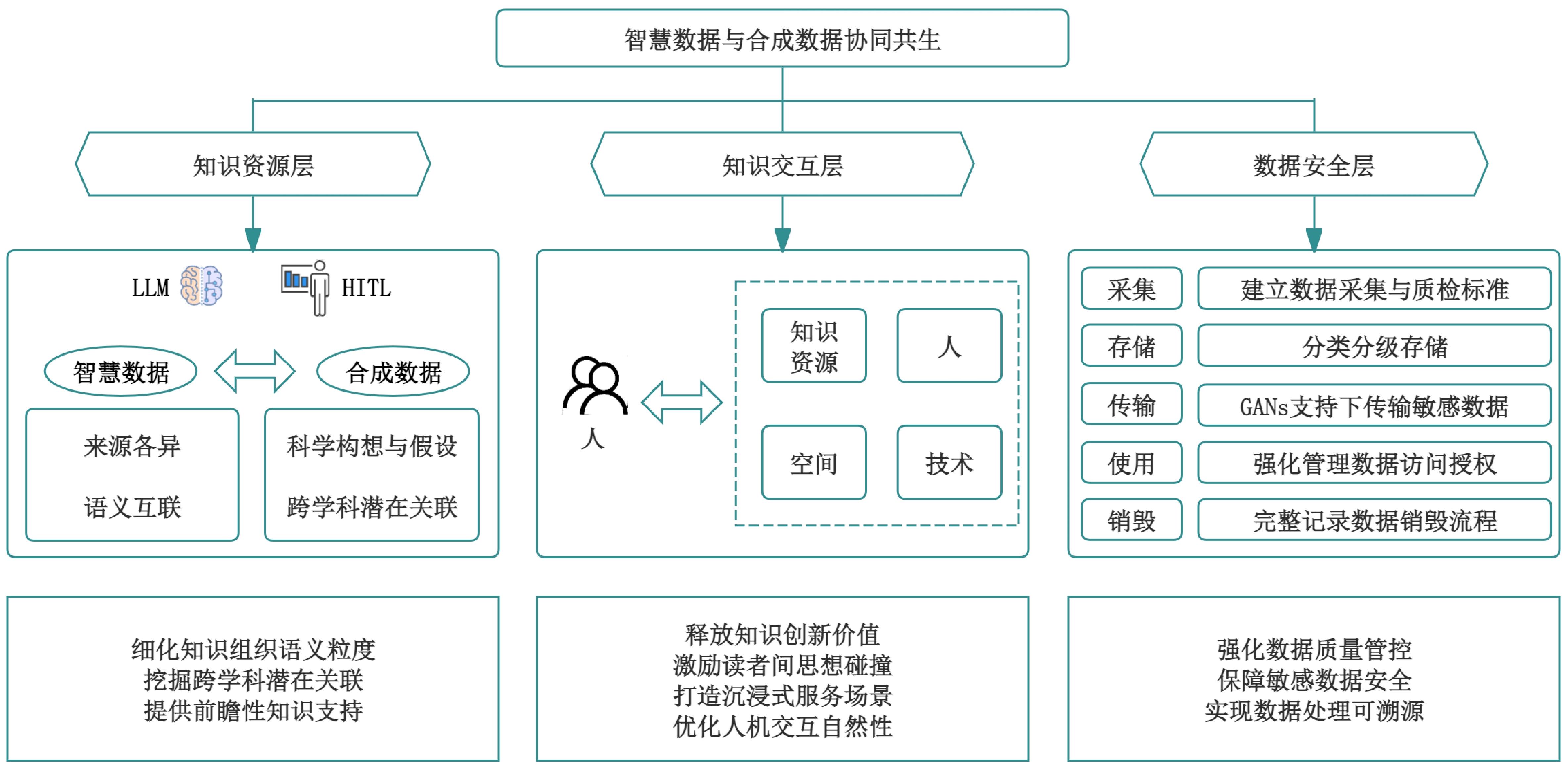
Fig.1

Performance of collaborative empowerment of library knowledge services by smart data and synthetic data"

[1]
张晓林. 走向知识服务: 寻找新世纪图书情报工作的生长点[J]. 中国图书馆学报, 2000, 26(5): 30-35.
Zhang Xiaolin. Towards knowledge services: Seeking development opportunities for library and information services in the 21st century[J]. Journal of Library Science in China, 2000, 26(5): 30-35.
[2]
史忠艳, 雷洁, 孙坦, 等. DeepSeek赋能领域知识图谱低成本构建研究[J]. 农业图书情报学报, 2025, 37(3): 4-17.
Shi Zhongyan, Lei Jie, Sun Tan, et al. Research on DeepSeek-empowered low-cost construction of domain-specific knowledge graphs[J]. Journal of Library and Information Science in Agriculture, 2025, 37(3): 4-17.
[3]
李宗俊, 范炜. 面向智慧数据的语义丰富化方法及应用评述[J]. 情报科学, 2021, 39(7): 186-192.
Li Zongjun, Fan Wei. Review on smart data oriented semantic enrichment method and applications[J]. Information Science, 2021, 39(7): 186-192.
[4]
赵慧, 陈璟浩, 郭沙, 等. 人工智能国际合作机制中的跨境数据治理范式构建[J]. 农业图书情报学报, 2025, 37(11): 6-29.
Zhao Hui, Chen Jinghao, Guo Sha, et al. Constructing a cross-border data governance paradigm in the international cooperation mechanism of artificial intelligence[J]. Journal of Library and Information Science in Agriculture, 2025, 37(11): 6-29.
[5]
郭亚楠, 马瑞强, 崔旭, 等. 数据合成技术研究: 从统计模型到深度学习模型系统综述[J/OL]. 计算机工程与应用, 1-20[2026-01-30].
Guo Yanan, Ma Ruiqiang, Cui Xu, et al. A systematic review of synthetic data generation techniques: From statistical models to deep learning[J/OL].Computer Engineering and Applications, 1-20[2026-01-30].
[6]
蔡祎然, 胡正银, 刘春江. 大语言模型赋能科技文献数据挖掘进展分析[J]. 农业图书情报学报, 2025, 37(2): 4-22.
Cai Yiran, Hu Zhengyin, Liu Chunjiang. Analysis of progress in data mining of scientific literature using large language models[J]. Journal of Library and Information Science in Agriculture, 2025, 37(2): 4-22.
[7]
曾蕾, 王晓光, 范炜. 图档博领域的智慧数据及其在数字人文研究中的角色[J]. 中国图书馆学报, 2018(1): 17-34.
Zeng Lei, Wang Xiaoguang, Fan Wei. Smart data from libraries, archives and museums and its role in the digital humanity researches[J]. Journal of Library Science in China, 2018(1): 17-34.
[8]
Lee S, Roh G H, Kim J Y, et al. Effective data quality management for electronic medical record data using SMART DATA[J]. International Journal of Medical Informatics, 2023, 180: 105262.
[9]
García-Gil D, Luengo J, García S, et al. Enabling smart data: Noise filtering in big data classification[J]. Information Sciences, 2019, 479: 135-152.
[10]
张杨燚, 谢辉, 毛进, 等. 面向城市数据画像构建的多源数据需求与融合方法研究[J]. 情报理论与实践, 2020, 43(6): 88-96.
Zhang Yangyi, Xie Hui, Mao Jin, et al. Multi-source information need and data fusion methods oriented to the construction of city profile[J]. Information Studies (Theory & Application), 2020, 43(6): 88-96.
[11]
王雅丽. 图书馆智慧数据服务策略研究[J]. 图书馆学研究, 2021(15): 77-82.
Wang Yali. Research on library smart data service strategies[J]. Library Science Research, 2021(15): 77-82.
[12]
常志军, 钱力, 吴垚葶, 等. 面向主题场景的科技文献AI数据体系建设: 技术框架研究与实践[J]. 农业图书情报学报, 2024, 36(9): 4-17.
Chang Zhijun, Qian Li, Wu Yaoting, et al. Construction of a scientific literature AI data system for the thematic scenario: Technical framework research and practice[J]. Journal of Library and Information Science in Agriculture, 2024, 36(9): 4-17.
[13]
华林, 冯安仪, 吴皎钰. 基于智慧数据的海疆历史档案知识聚合与服务研究[J]. 档案学研究, 2025(4): 59-69.
Hua Lin, Feng Anyi, Wu Jiaoyu. Research on knowledge aggregation and service of maritime historical archives based on smart data[J]. Archives Science Study, 2025(4): 59-69.
[14]
Giomi M, Boenisch F, Wehmeyer C, et al. A unified framework for quantifying privacy risk in synthetic data[PP/OL]. V1. arXiv (2022-11-18)[2026-01-30].
[15]
Goyal M, Mahmoud Q H. A systematic review of synthetic data generation techniques using generative AI[J]. Electronics, 2024, 13(17): 3509.
[16]
Hassan C, Salomone R, Mengersen K. Deep generative models, synthetic tabular data, and differential privacy: An overview and synthesis[PP/OL]. V2. arXiv (2023-08-27)[2026-01-30].
[17]
Song Zhihang, He Zimin, Li Xingyu, et al. Synthetic datasets for autonomous driving: A survey[J]. IEEE Transactions on Intelligent Vehicles, 2024, 9(1): 1847-1864.
[18]
Zhan Fangneng, Yu Yingchen, Wu Rongliang, et al. Multimodal image synthesis and editing: The generative AI era[PP/OL]. V6. arXiv (2023-08-24)[2026-01-30].
[19]
Chen R J, Lu M Y, Chen T Y, et al. Synthetic data in machine learning for medicine and healthcare[J]. Nature Biomedical Engineering, 2021, 5(6): 493-497.
[20]
孟祥保, 高冕. 图书馆数据资源建设: 内涵、价值与路径[J]. 新世纪图书馆, 2023(5): 48-54.
Meng Xiangbao, Gao Mian. Library data resources construction: Connotation, value and approach[J]. New Century Library, 2023(5): 48-54.
[21]
周笑盈. 我国智慧图书馆体系下的知识资源建设: 内涵、路径和策略分析[J]. 图书馆理论与实践, 2022(6): 84-91.
Zhou Xiaoying. Knowledge resource construction under national smart library system: Connotation, path and strategy analysis[J]. Library Theory and Practice, 2022(6): 84-91.
[22]
王学琴, 李爱国. 高校图书馆信息文化培育实践与探索——以东南大学图书馆为例[J]. 大学图书馆学报, 2025, 43(6): 35-42.
Wang Xueqin, Li Aiguo. Practice and exploration of information culture cultivation in university libraries - A case study of southeast university library[J]. Journal of Academic Libraries, 2025, 43(6): 35-42.
[23]
王曰芬, 李佳琦, 秦晓云, 等. AI4S背景下的知识创新服务应用模式、平台系统与微服务设计研究[J]. 情报科学, 2025, 43(8): 1-9.
Wang Yuefen, Li Jiaqi, Qin Xiaoyun, et al. Application mode, platform system and microservice design of knowledge innovation services in the context of AI4S[J]. Information Science, 2025, 43(8): 1-9.
[24]
夏翠娟, 林海青, 刘炜. 面向循证实践的中文古籍数据模型研究与设计[J]. 中国图书馆学报, 2017, 43(6): 16-34.
Xia Cuijuan, Lin Haiqing, Liu Wei. Designing a data model of Chinese ancient books for evidence-based practice[J]. Journal of Library Science in China, 2017, 43(6): 16-34.
[25]
蔡祎然, 胡正银, 刘春江. 大语言模型赋能科技文献数据挖掘进展分析[J]. 农业图书情报学报, 2025, 37(2): 4-22.
Cai Yiran, Hu Zhengyin, Liu Chunjiang. Analysis of progress in data mining of scientific literature using large language models[J]. Journal of Library and Information Science in Agriculture, 2025, 37(2): 4-22.
[26]
孙坦, 张智雄, 周力虹, 等. 人工智能驱动的第五科研范式(AI4S)变革与观察[J]. 农业图书情报学报, 2023, 35(10): 4-32.
Sun Tan, Zhang Zhixiong, Zhou Lihong, et al. The transformation and observations of AI for science(AI4S) driven by artificial intelligence[J]. Journal of Library and Information Science in Agriculture, 2023, 35(10): 4-32.
[27]
赵丽琴. 人工智能科学(AI4S)驱动的图书馆服务与变革研究[J]. 图书与情报, 2024(6): 131-135.
Zhao Liqin. Artificial intelligence for science driven library service and transformation research[J]. Library and Information, 2024(6): 131-135.
[28]
San Diego UC. TritonGPT: AI powered support[EB/OL]. [2026-02-03].
[29]
钱力, 刘志博, 刘细文, 等. 科技文献数据资源建设模式数智化转型研究——中国科学院文献情报中心的实践探索[J]. 图书情报工作, 2025, 69(10): 4-13.
Qian Li, Liu Zhibo, Liu Xiwen, et al. Research on digitalization & intelligentization transformation of scientific and technological literature data resources construction: Practical exploration of national science library, CAS[J]. Library and Information Service, 2025, 69(10): 4-13.
[30]
叶梓萌, 钱力, 刘细文, 等. 面向图书馆数据资源建设的智慧数据研究: 内涵界定、技术应用与研究启示[J]. 情报科学, 2024, 42(12): 31-41.
Ye Zimeng, Qian Li, Liu Xiwen, et al. A review of smart data for library data resource construction: Connotation, technical application and inspiration[J]. Information Science, 2024, 42(12): 31-41.
[31]
钱力, 刘志博, 胡懋地, 等. AI就绪的科技情报数据资源建设模式研究[J]. 农业图书情报学报, 2024, 36(3): 32-45.
Qian Li, Liu Zhibo, Hu Maodi, et al. Construction model of AI-ready for scientific and technological intelligence data resources[J]. Journal of Library and Information Science in Agriculture, 2024, 36(3): 32-45.
[32]
储节旺, 周柯堰. 多模态大模型驱动下的图书馆个性化知识服务模式研究[J/OL]. 情报理论与实践, 1-10[2026-02-11].
Chu Jiewang, Zhou Keyan. Research on the MLLMs-driven personalized knowledge service model for libraries[J/OL]. Information Studies: Theory & Application, 1-10[2026-02-11].
[33]
吴畑, 胡宜君, 郑冰. 基于大语言模型的图书馆知识服务多智能体协作模型研究[J/OL]. 图书情报工作, 1-14[2026-02-11] .
Wu Tian, Hu Yijun, Zheng Bing. Research on multi-agent collaborative model for library knowledge services based on large language models[J/OL]. Library and Information Service, 1-14[2026-02-11].
[34]
Kumaran V S, Latha R. Towards personal learning environment by enhancing adaptive access to digital library using ontology-supported collaborative filtering[J]. Library Hi Tech, 2023, 41(6): 1658-1675.
[35]
张晓林. 超越资源、超越技术、超越自我——用知识服务生产关系改革创新推动知识服务新质生产力发展[J]. 农业图书情报学报, 2024, 36(6): 4-15.
Zhang Xiaolin. Beyond resources, beyond technologies, beyond one’s institution: Developing new productive forces for knowledge services through reform and innovation of traditional knowledge service mechanisms[J]. Journal of Library and Information Science in Agriculture, 2024, 36(6): 4-15.
[36]
张进澳, 卢新元, 郭一若,等. 图书馆多源跨模态知识服务: 内涵、模式及发展路径[J/OL]. 图书馆杂志, 1-13[2026-02-11].
Zhang Jinao, Lu Xinyuan, Guo Yiruo, et al. Library multi-source cross-modal knowledge service: Connotation, mode and development path[J/OL]. Library Journal, 1-13[2026-02-11].
[37]
张晓林. “人工智能+”背景下的高质量数据集建设: 图书馆的机遇与挑战[J]. 中国图书馆学报, 2025, 51(6): 4-17.
Zhang Xiaolin. High-quality dataset construction in AI+environment: Library's opportunities and challenges[J]. Journal of Library Science in China, 2025, 51(6): 4-17.
[38]
Wang Yizhong, Kordi Y, Mishra S, et al. Self-instruct: Aligning language models with self-generated instructions[PP/OL]. V2. arXiv (2023-05-25)[2026-02-15].
[39]
Ding Ning, Chen Yulin, Xu Bokai, et al. Enhancing chat language models by scaling high-quality instructional conversations[PP/OL]. V1. arXiv (2023-05-23)[2026-02-15].
[40]
Yehudai A, Carmeli B, Mass Y, et al. Genie: Achieving human parity in content-grounded datasets generation[PP/OL]. V1. arXiv (2024-01-25)[2026-02-15].
[41]
Bourne J. Scrambled text: Training Language Models to correct OCR errors using synthetic data[PP/OL]. V1. arXiv (2024-09-29)[2026-02-15].
[42]
Frid-Adar M, Klang E, Amitai M, et al. Synthetic data augmentation using GAN for improved liver lesion classification[C]//2018 IEEE 15th International Symposium on Biomedical Imaging (ISBI 2018). Piscataway, New Jersey: IEEE, 2018: 289-293.
[43]
Ma Feipeng, Zhou Yizhou, Rao Fengyun, et al. Image captioning with multi-context synthetic data[J]. Proceedings of the AAAI Conference on Artificial Intelligence, 2024, 38(5): 4089-4097.
[44]
Cascante-Bonilla P, Shehada K, Smith J S, et al. Going beyond nouns with vision & language models using synthetic data[C]//2023 IEEE/CVF International Conference on Computer Vision (ICCV). Piscataway, New Jersey: IEEE, 2024: 20098-20108.
[45]
胡安琪, 吉顺权. AIGC嵌入图书馆知识服务的价值、风险及其防控策略[J]. 图书馆工作与研究, 2024(5): 63-70.
Hu Anqi, Ji Shunquan. Value, risk and prevention and control strategies of AIGC embedding library knowledge services[J]. Library Work and Study, 2024(5): 63-70.
[46]
Bellovin S M, Dutta P K, Reitinger N. Privacy and synthetic datasets[J]. Stanford Technology Law Review, 2019, 22(1): 1-52.
[47]
Liu Fan, Cheng Zhiyong, Chen Huilin, et al. Privacy-preserving synthetic data generation for recommendation systems[PP/OL]. V1. arXiv (2022-09-27)[2026-02-19].
[48]
He Zhenxiang, Chen Ke, Zhao Zhenyu. Generating user privacy-controllable synthetic data for recommendation systems[J]. IEEE Access, 2025, 13: 6643-6655.
[49]
Zhang Weili, Liu Ran, Zhu Xinyi, et al. Enhancing privacy protection of physical examination data through synthetic algorithms based on differential privacy[J]. BMC Medical Informatics and Decision Making, 2025, 25(1): 324.
[50]
Guillaudeux M, Rousseau O, Petot J, et al. Patient-centric synthetic data generation, no reason to risk re-identification in biomedical data analysis[J]. NPJ Digital Medicine, 2023, 6: 37.
[51]
朱嘉珺. 生成式人工智能虚假有害信息规制的挑战与应对——以ChatGPT的应用为引[J]. 比较法研究, 2023(5): 34-54.
Zhu Jiajun. To regulate the disinformation brought by generative artificial intelligence as exemplified by the application of ChatGPT: Challenges and possible solutions[J]. Journal of Comparative Law, 2023(5): 34-54.
[52]
李颖婷. 生成式人工智能给图书馆带来的机遇、挑战及应对策略[J]. 图书与情报, 2023(2): 42-48.
Li Yingting. Opportunities, challenges, and strategies for libraries in the era of artificial intelligence generated content[J]. Library & Information, 2023(2): 42-48.
[53]
景奎, 徐凤敏, 王柯蕴. 生成式人工智能传播风险: 理论内涵、形成机理与治理策略[J]. 西安交通大学学报(社会科学版), 2025, 45(2): 130-138.
Jing Kui, Xu Fengmin, Wang Keyun. Communication risks of generative artificial intelligence: Theoretical connotation, formation mechanism, and governance strategies[J]. Journal of Xi’an Jiaotong University (Social Sciences), 2025, 45(2): 130-138.
[54]
徐芳. 智慧图书馆生成式人工智能应用场景及其法律问题[J]. 情报资料工作, 2024, 45(2): 24-29.
Xu Fang. Application scenarios and legal issues of generative artificial intelligence in smart libraries[J]. Information and Documentation Services, 2024, 45(2): 24-29.
[55]
韩丽, 梁国庆, 许洁. 基于大语言模型的古籍中医药知识服务智能体建设[J/OL]. 信息与管理研究, 1-13[2026-04-19].
Han Li, Liang Guoqing, Xu Jie. Development of an intelligent agent for traditional Chinese medicine knowledge services from ancient texts based on large language models[J/OL]. Journal of Information and Management, 1-13[2026-04-19].
[56]
Ge Tao, Chen Xin, Wang Xiaoyang, et al. Scaling synthetic data creation with 1, 000, 000, 000 personas[PP/OL]. V3. arXiv (2025-05-08)[2026-02-24].
[57]
HY-World T, Cao Chenjie, Zuo Xuhui, et al. HY-world 2.0: A multi-modal world model for reconstructing, generating, and simulating 3D worlds[PP/OL]. V1. arXiv (2026-04-15)[2026-04-19].
[58]
曹高辉, 董焕晴. AI数字人赋能图书馆服务创新研究[J/OL]. 图书情报工作, 1-16[2026-04-19].
Cao Gaohui, Dong Huanqing. Research on AI digital humans empowering library service innovation[J/OL]. Library and Information Service, 1-16[2026-04-19].
[59]
霍瑞娟. 图书馆智慧化转型中数据治理体系建设路径探究[J]. 图书情报工作, 2024, 68(22): 37-44.
Huo Ruijuan. Exploration of data governance system construction for intelligent transformation of libraries[J]. Library and Information Service, 2024, 68(22): 37-44.
[60]
卢小宾, 洪先锋, 蒋玲. 智慧图书馆数据标准体系研究[J]. 图书情报知识, 2021(4): 50-61.
Lu Xiaobin, Hong Xianfeng, Jiang Ling. Research on data standard system of smart libraries[J]. Documentation, Information & Knowledge, 2021(4): 50-61.
[61]
胡谦锋. 基于生成式人工智能的高校智慧图书馆用户画像数据管理研究[J]. 图书馆工作与研究, 2025(7): 31-39.
Hu Qianfeng. Research on user profile data management in university smart library based on generative artificial intelligence[J]. Library Work and Study, 2025(7): 31-39.
[62]
Masood I, Daud A, Wang Yongli, et al. A blockchain-based system for patient data privacy and security[J]. Multimedia Tools and Applications, 2024, 83(21): 60443-60467.
[63]
Pestana G, Antunes W, Carvalho J. Digital chain of custody operational framework[C]//2023 IEEE International Workshop on Technologies for Defense and Security (TechDefense). Piscataway, New Jersey: IEEE, 2024: 417-422.
[64]
霍敬裕. 合成数据赋能数字法治政府建设的风险及其规制[J]. 行政法学研究, 2025(5): 63-76.
Huo Jingyu. Risks of empowering the construction of a digital government ruled by law with synthetic data and their regulation[J]. Administrative Law Review, 2025(5): 63-76.
[65]
赵春玉, 章丹丹, 王希骅, 等. 数据蒸馏的研究进展与未来展望[J]. 数据分析与知识发现, 2026, 10(1): 4-17.
Zhao Chunyu, Zhang Dandan, Wang Xihua, et al. Research progress and future prospects of data distillation[J]. Data Analysis and Knowledge Discovery, 2026, 10(1): 4-17.
[1] GUO Jinbo. Effects of AIGC on Reader Trust in Library Information [J]. Journal of library and information science in agriculture, 2026, 38(4): 84-98.
[2] SONG Lingling, ZHANG Xinghui. Efficacy of Intelligent Consulting Services in Libraries at Home and Abroad under the Background of AI Large Model Driving [J]. Journal of library and information science in agriculture, 2026, 38(4): 99-111.
[3] ZHANG Ling. Integrating Digital Humanities and Agricultural Knowledge Services A Simulation Modeling Perspectives [J]. Journal of library and information science in agriculture, 2026, 38(2): 79-89.
[4] WU Yuhao, LIU Yihao, LI Qingjun, HU Xu. Open Sharing of Library Data Based on Large Language Models: Logic, Path and Strategy [J]. Journal of library and information science in agriculture, 2026, 38(1): 28-43.
[5] YANG Min. Investigation and Analysis on the Practice of Seoul Outdoor Library and its Enlightenment [J]. Journal of library and information science in agriculture, 2026, 38(1): 95-103.
[6] JIANG Jingze, ZHOU Tianmin, LI Mei, CHENG Cheng, CHEN Haiyan. A study of the Core Competence Model of Compound AI Librarians in the Intelligent Transformation of University Libraries [J]. Journal of library and information science in agriculture, 2025, 37(9): 97-109.
[7] SONG Yaping, LIAN Kangping. Pathways for Public Library Study Tour Services in the Context of Cultural and Tourism Integration [J]. Journal of library and information science in agriculture, 2025, 37(8): 92-103.
[8] HUO Ruijuan, ZHANG Hai. Connotations and Influencing Factors of the Professionalization of Library Reading Promoters [J]. Journal of library and information science in agriculture, 2025, 37(8): 29-39.
[9] SHEN Hongjie, SHEN Hongwei, WANG Junli. Generative AI Empowering Information Literacy Education in Digital Libraries: Path Exploration, Challenge Analysis, and Response Strategies [J]. Journal of library and information science in agriculture, 2025, 37(7): 50-60.
[10] JIANG Yumeng. An Investigation and Enlightenment on the Current Status of AI Literacy Education in Nordic University Libraries [J]. Journal of library and information science in agriculture, 2025, 37(7): 19-34.
[11] GAO Dan, CUI Bin. Value Co-Creation Mechanism of Cultural Heritage Data Resources: An Analysis Based on the “Stage-Subject-Scenario” Framework [J]. Journal of library and information science in agriculture, 2025, 37(7): 61-72.
[12] LIU Wei, ZHANG Lei, JI Ting, CHEN Xiaoyang. Shaping the Smart Libraries with AI: An Agent-based, Next-Generation Library Service Platform [J]. Journal of library and information science in agriculture, 2025, 37(5): 15-26.
[13] CHEN Jiayong, GONG Jiaoteng, WANG Yuyi. Research of Interdisciplinary Comparison and Collaborative Paradigm on the Concept of Agent in Library Science [J]. Journal of library and information science in agriculture, 2025, 37(5): 27-39.
[14] ZHANG Li, WANG Bo, JING Shui. Generative AI-Driven Resource Discovery in Public Libraries: Service Optimization Based on a Dynamic Evaluation Model [J]. Journal of library and information science in agriculture, 2025, 37(5): 58-71.
[15] LIU Han. Interdisciplinary Integration and Curricular Innovation in Data Science Degree Programs: An Empirical Study of Eight U.S. iSchools [J]. Journal of library and information science in agriculture, 2025, 37(4): 94-107.
Viewed
Full text


Abstract

Cited

  Shared   
  Discussed   
No Suggested Reading articles found!