中文    English

Journal of library and information science in agriculture


Strategic Planning Research for the "15th Five-Year Plan" of Academic Libraries: An Analysis of Strategic Planning in World-Class University Libraries and Its Implications

Hou Dongjin   

  1. People's Public Security University of China Library, Beijing 100038
  • Received:2026-01-04 Online:2026-04-02

Abstract:

[Purpose/Significance] The formulation of the "15th Five-Year Plan" represents a pivotal strategic task for academic libraries in China. This plan coincides with a period of profound transformation, which is driven by the national agenda for high-quality development in higher education, as well as by the disruptive advancements in artificial intelligence (AI) and open science. This study aims to provide a reference for strategic planning and service innovation by systematically deconstructing the strategic plans of world-class university libraries. [Method/Process] This study employed a qualitative research design centered on document analysis. The research sample comprised the publicly available strategic planning documents of ten university libraries affiliated with institutions ranked within the top 50 of the QS World University Rankings 2026. A combination of text analysis and directed qualitative content analysis was applied to systematically deconstruct the sample. The analytical process involved three primary phases. 1) A formal text analysis was conducted to examine the planning documents' attributes, including their formulation bodies, planning cycles, and temporal scopes. 2) A coding framework consisting of ten strategic categories was deductively developed based on core elements of library strategic planning. 3) Using this framework, a detailed content analysis was performed. Every sentence or segment within the strategic texts that expressed a discrete strategic goal, initiative, or key action was identified as a unit of analysis, systematically coded, and categorized. This process enabled a two-dimensional examination: a frequency analysis of strategic foci and a more granular, qualitative interpretation of strategic objectives and specific measures. This methodological approach allowed for the extraction of both quantitative patterns and rich qualitative insights into the strategic direction and operational tactics of the world's leading academic libraries. [Results/Conclusions] The analysis reveals several key patterns and shifts in the strategic planning of world-class university libraries. Regarding formulation and governance, a parallel model is prevalent, featuring leadership from dedicated strategic offices or committees coupled with collaborative input from a multi-stakeholder body including staff, faculty, and students. Planning cycles are predominantly five years but are increasingly characterized by dynamic iteration, with provisions for mid-cycle reviews and updates, balancing long-term vision with operational agility. The substantive content of the strategies indicates a decisive transition from a focus on collection stewardship to an integrated knowledge service paradigm. Three dominant strategic thrusts are identified: 1) intelligent service ecosystem, emphasizing tiered information literacy, AI-embedded teaching support, and human-centered space design; 2) comprehensive research support, aiming to provide seamless services across the entire research life cycle-from idea generation and data management to publication, impact tracking, and public engagement; 3) extended social value creation, manifesting in commitments to digital inclusion, cultural heritage stewardship, community partnership, and environmental sustainability. Based on these findings, the study proposed a tailored pathway for Chinese academic libraries to formulate their "15th Five-Year Plan." Our recommendations include: 1) strengthening strategic governance by establishing a permanent planning unit to enable rolling revisions; 2) constructing an AI-enabled, integrated ecosystem that synergizes resources, services, and smart spaces; 3) establishing a data-driven, full life cycle research support chain; 4) building an open resource system and actively integrating into the global open science network; 5) expanding the social service matrix to concurrently address cultural heritage, inclusive access, and green transformation; and 6) deepening organizational capacity reform to foster a skilled, agile, and resilient workforce. A limitation of this study is its reliance on published planning texts, which may not fully capture the nuances of implementation challenges or internal organizational dynamics. Future research should employ mixed methods, such as surveys or interviews with library strategists, to study the execution barriers, success factors, and impact assessment of these strategic plans. This will provide an even more holistic understanding of strategic management in the complex, technology-driven future of academic librarianship.

Key words: university libraries, 15th Five-Year Plan, strategic planning, world-class universities

CLC Number: 

  • G258.6

Table 1

Categories and descriptions for content analysis of strategic plans from 10 world-class university libraries"

类目编号 类目名称 说明
S1 服务相关 信息素养、用户体验、教学支持、公众参与等
S2 馆藏相关 数字馆藏、特藏建设、资源发现、资源保存等
S3 技术相关 AI、数据挖掘、数字平台(如开放获取平台、研究数据管理平台等)
S4 空间相关 实体空间改造、学习空间设计、无障碍空间、虚拟空间等
S5 员工相关 员工发展、技能培训、职业路径、平等多元包容等
S6 科研相关 科研支持、研究数据服务、学术出版、研究影响力提升等
S7 合作相关 校内外合作、跨部门协同、国际图书馆联盟、社区参与等
S8 管理相关 战略执行、组织文化、资源配置、运营模式、治理结构、财务可持续性等
S9 多样性与包容性相关 残障支持、文化多样性、包容性服务、原住民合作等
S10 可持续性相关 碳中和、绿色运营、环保空间、可持续资源管理等

Table 2

Sample overview of strategic plans from 10 world-class university libraries"

序号 2026QS世界排名 图书馆所在学校名称 规划题目 ​规划周期 规划年限 ​制定主体​
1 4 牛津大学 分享知识,激发学术——从牛津大学的核心出发通过展览、官方和解锁世界信息推动学习、研究和创新[6] 2022—2027年(2024年更新) 5年 战略规划及运行办公室、全校教职工
2 4 伦敦大学学院 LCCOS:图书馆、文化、收藏和开放科学[7] 2024—2027年 3年 图书馆与文化服务部副校长、LCCOS跨部门联合体、教工代表、学生代表
3 10 加州理工学院 图书馆规划2024—2027年[8] 2024—2027年 3年 加州理工学院图书馆
4 13 芝加哥大学 芝加哥大学图书馆2025—2028年战略计划​——开启知识,改变生活[9] 2025—2028年 4年 芝加哥大学图书馆
5 25 悉尼大学 大学图书馆发展战略2023—2033年[10] 2023—2033年 10年 悉尼大学图书馆
6 29 多伦多大学 无障碍获取所有正确信息:2020—2025年战略规划[11] 2020-2025 5年 图书馆战略规划指导委员会
7 31 伦敦国王学院 图书馆演进计划2029[12] 未注明 至2029年 未注明
8 35 曼彻斯特大学 畅享2030[13] 未注明 约10年 曼彻斯特大学图书馆
9 36 莫纳什大学 2020—2025年图书馆战略规划(2025更新)[14] 2020—2025年 5年 大学图书馆馆长牵头
10 38 不列颠哥伦比亚大学 不列颠哥伦比亚大学图书馆战略框架2018—2028年[15] 2018—2028年 10年 图书馆领导层、图书馆全体员工、读者

Table 3

Strategic priorities of 10 world-class university libraries"

类目 提及次数/次 提及内容(示例)
S1服务相关 13 牛津大学“服务转变”、伦敦大学学院“分层信息素养教育”、芝加哥大学“全场景学术支持”……
S2馆藏相关 11 牛津大学“馆藏升级”、伦敦大学学院“特色馆藏资源”、芝加哥大学“全域资源共享网络”……
S3技术相关 2 伦敦大学学院“AI全流程嵌入”、芝加哥大学“数据驱动决策支持”……
S4空间相关 4 多伦多大学“空间:学术容器”、伦敦国王学院“人性化馆舍空间再造”……
S5员工相关 3 伦敦大学学院“建设专业馆员团队”、伦敦大学学院“员工发展”……
S6科研相关 6 伦敦大学学院“覆盖全周期的科研服务链条”、芝加哥大学“跨学科创新研究支撑网络”、伦敦国王学院“科研创新共同体”……
S7合作相关 6 悉尼大学“社区伙伴关系建设”、不列颠哥伦比亚大学“扩大学术影响力”……
S8管理相关 5 牛津大学“工作模式转变”、伦敦大学学院“赋能变革”、不列颠哥伦比亚大学“加强财务可持续性”……
S9多样性与包容性相关 3 加州理工学院“包容性知识获取环境”、曼彻斯特大学“践行公平、多元与包容理念”……
S10可持续性相关 2 芝加哥大学“践行持续发展承诺”、悉尼大学“可持续的知识生态”……

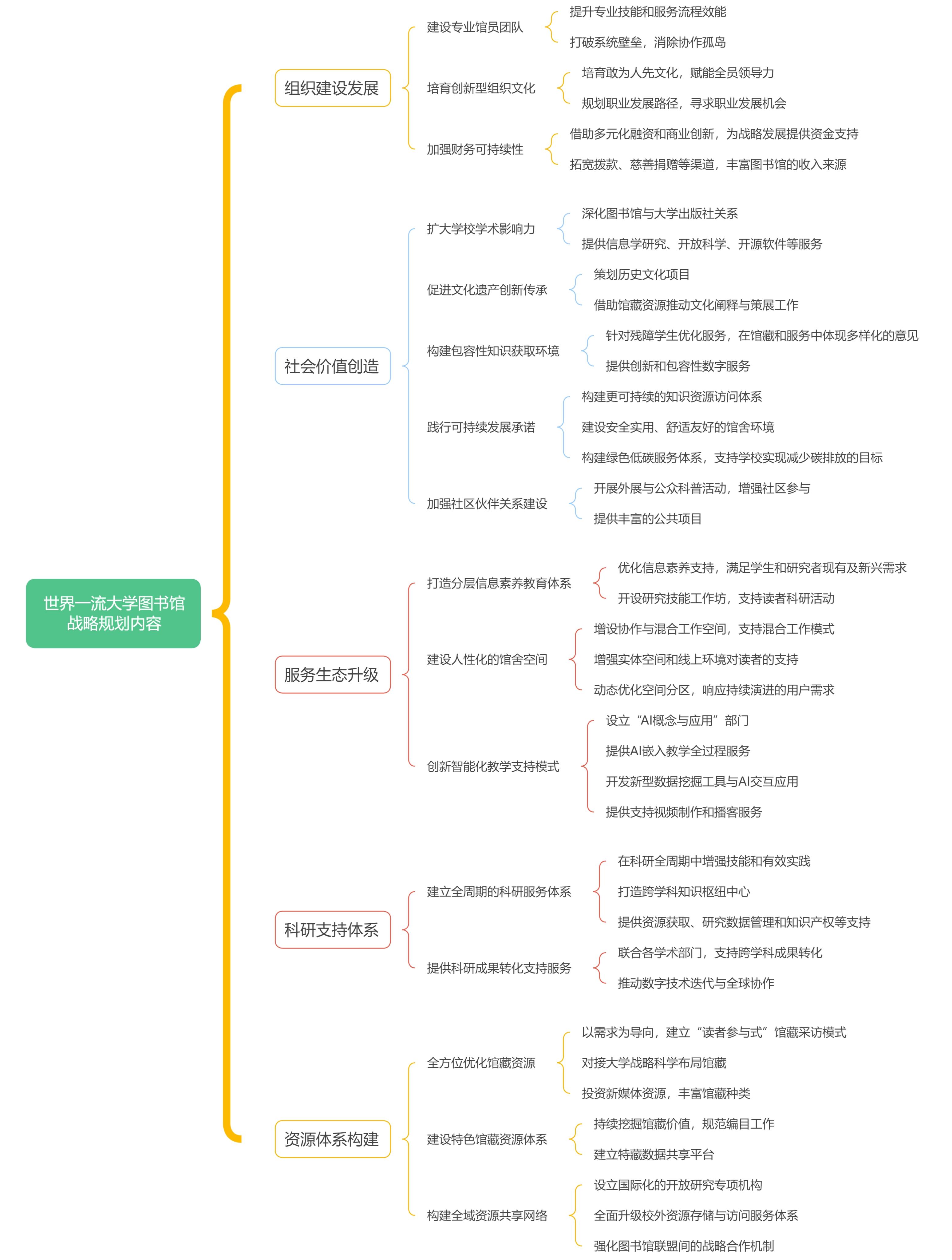
Fig.1

Strategic priorities, objectives, and measures of international academic libraries"

Table 4

Strategic objectives and measures of 10 world-class university libraries"

类目 提及次数/次 提及内容(示例)
S1服务相关 42 牛津“分层信息素养教育”、莫纳什“研究技能工作坊”……
S2馆藏相关 38 牛津“需求导向采购”、伦敦大学学院“学生参与式馆藏”、多伦多“推动全媒体典藏建设”……
S3技术相关 35 伦敦大学学院AI工具嵌入课程教学和支持自媒体创作、曼彻斯特大学设立“AI与理念应用总监部”、伦敦国王学院“馆藏智能标引、AI辅助阅读”……
S4空间相关 30 牛津“支持混合工作”、伦敦国王学院“空间重构”、多伦多“动态优化空间分区”……
S5员工相关 25 牛津“提升员工数字能力”、伦敦大学学院“职业发展路径”、多伦多“馆员战略”……
S6科研相关 33 牛津“一站式科研支持服务”、伦敦国王学院“开放数据与技能培训”、莫纳什“分阶段培训和嵌入式学科馆员服务”……
S7合作相关 28 牛津“与GLAM合作”、曼大“COLIM联盟”“‘馆藏、出版、传播’一体化合作模式”……
S8管理相关 20 牛津“多元化融资”、曼大“资源优化配置”、芝加哥“吸引社会资源”……
S9多样性与包容性相关 22 牛津“残障学生服务”、伦敦大学学院“EDI行动计划”、不列颠哥伦比亚大学“殖民主义遗留问题”……
S10可持续性相关 18 牛津“2035净零排放”、伦敦大学学院“绿色低碳服务体系”、芝加哥“减排50%”……
[1]
周晓燕, 宰冰欣. 从战略规划看国外高校图书馆的发展趋势——以28所世界一流高校图书馆的战略规划为例[J]. 大学图书馆学报, 2016, 34(1): 62-68.
Zhou Xiaoyan, Zai Bingxin. On the development trends of academic libraries from point of view of strategic plans - Through content analysis of 28 superb academic libraries' strategic plans[J]. Journal of Academic Libraries, 2016, 34(1): 62-68.
[2]
刘琼, 刘桂锋. 高校图书馆事业发展战略重点研究——基于国外高校图书馆战略规划文本的分析[J]. 图书馆, 2021(7): 16-23.
Liu Qiong, Liu Guifeng. Research on strategic focus on the development of university libraries: Based on the analysis of strategic planning texts of foreign university libraries[J]. Library, 2021(7): 16-23.
[3]
石笑, 贡金涛. 国外一流大学图书馆最新战略规划的文本分析及启示[J]. 图书馆, 2021(1): 31-39.
Shi Xiao, Gong Jintao. Text analysis and implication of the latest strategic planning of foreign first-class university libraries[J]. Library, 2021(1): 31-39.
[4]
O'Connor Steve. Strategic planning for academic libraries: A step-by-step guide[J]. Journal of the Australian Library and Information Association, 2019, 68(4): 405-406.
[5]
Leo Appleton. Positioning the Academic Library within the University[M]. London: Routledge, 2021.
[6]
University of Oxford Library. Sharing knowledge, inspiring scholarship[EB/OL]. [2025-08-25].
[7]
University College London Library. LCCOS: Library,culture, collectionsand open science[EB/OL]. [2025-08-25].
[8]
Library Caltech. Strategic plan 2024-2027[EB/OL]. [2025-08-25].
[9]
The University of Chicago Library. Library strategic plan for FY2025-FY2028: Opening knowledge, transforming lives[EB/OL]. [2025-08-25].
[10]
The University of Sydney Library. The university of Sydney library strategy[EB/OL]. [2025-08-15]. local%20trends%20in%20the%20library%20and%20information%20sector.
[11]
University of Toronto Libraries. Barrier-free according all of the right information strategic plan 2020-2025[EB/OL]. [2025-08-15].
[12]
King's College London Libraries. Library evolution 2029[EB/OL]. [2025-08-15].
[13]
King's College London Libraries. Imagine 2030 a library refined[EB/OL]. [2025-08-25].
[14]
Monash University Library. 2020 - 2025 library strategy map[EB/OL]. [2025-08-25].
[15]
University of British Columbia Library. UBC library strategic framework[EB/OL]. [2025-08-25].
[16]
教育部等九部门. 教育部等九部门关于加快推进教育数字化的意见[EB/OL]. [2025-08-25].
[17]
新华社. 教育强国建设规划纲要(2024-2035年)[EB/OL]. [2025-08-25].
[18]
中国同巴西、南非、非盟发起“开放科学国际合作倡议”[EB/OL]. [2025-08-25].
[1] JIN Wugang. Establishment and Improvement of the Mechanisms for Directly Delivering Public Cultural Services to Grassroots Levels [J]. Journal of library and information science in agriculture, 2026, 38(3): 5-11.
[2] GUO Hailing, ZENG Meiyun, FENG Yuxi. Model Construction and Strategies for AI-enabled University Library Services to Facilitate Scientific and Technological Achievement Transformation [J]. Journal of library and information science in agriculture, 2026, 38(2): 56-65.
[3] QIAO Jinhua, MA Xueyun. Risks and Regulations for Application of the LLaMA Model in University Future Learning Centers [J]. Journal of library and information science in agriculture, 2025, 37(2): 37-48.
[4] CHEN Nan. Strategies for Smart Library Services in Public Libraries during the Digitally-Intelligence Era under the 15th Five-Year Plan [J]. Journal of library and information science in agriculture, 2025, 37(12): 64-80.
[5] ZHANG Xingwang, LI Jie, LI Sifan, WANG Xiaopei. Theoretical Model, Model Innovation, and Important Implications of DeepSeek Empowering Library Knowledge Services [J]. Journal of library and information science in agriculture, 2025, 37(1): 4-16.
[6] LUO Guofeng, YI Tong, YAN Zhouzhou. Critical Information Literacy Education in University Libraries from the Perspective of AIGC Application [J]. Journal of library and information science in agriculture, 2025, 37(1): 47-58.
[7] Keyi XIAO, Yingying CHEN. Scientific Data Management Based on a Data Life Cycle Perspective: Using the Institutional Repositories Base of 24 Universities in the United States as an Example [J]. Journal of library and information science in agriculture, 2024, 36(7): 88-99.
[8] YI Tong, LUO Guofeng. Improving Digital Literacy of University Librarians Using Educational Technology [J]. Journal of library and information science in agriculture, 2024, 36(2): 61-70.
[9] KE Ping, LI Xiaoying, SUN Xuan, LIU Yue. Drafting the "15th Five-Year Plan" of Chinese Libraries: Constructing the Strategic Goals and Systems Based on Environmental Scanning and Demand Analysis [J]. Journal of library and information science in agriculture, 2024, 36(12): 4-19.
[10] YANG Xinya, RAN Weiran, LI Li. Key Points of the 15th Five-Year Plan for University Libraries to Support the Construction of a Powerful Country in the Education Sector [J]. Journal of library and information science in agriculture, 2024, 36(12): 35-44.
[11] LIU Xiwen, FU Yun, WEI Huanan. DIS Agent: New Paradigm of S&T Documentation and Information Service for the Fifteenth Five-Year Plan [J]. Journal of library and information science in agriculture, 2024, 36(12): 20-34.
[12] Xiao SHI. Analysis of Strategic Planning Content and Development Trends of American University Libraries [J]. Journal of library and information science in agriculture, 2024, 36(10): 38-52.
[13] WAN Qiao. The Integrated Development Model and Approach of University Libraries from a Multivariate Collaboration Perspective [J]. Journal of library and information science in agriculture, 2024, 36(1): 97-104.
[14] WAN Qiao. Future Learning Centers: Educational Paradigms, Basic Characteristics and Space Construction [J]. Journal of library and information science in agriculture, 2023, 35(9): 57-65.
[15] DONG Panpan, LI Yongming, ZHU Yan. Knowledge Service Mode of University Libraries from the Perspective of Value Co-creation [J]. Journal of library and information science in agriculture, 2023, 35(7): 39-51.
Viewed
Full text


Abstract

Cited

  Shared   
  Discussed   
No Suggested Reading articles found!