中文    English

Journal of library and information science in agriculture


Agent-Driven Controllable Style Transfer of Intangible Cultural Heritage Patterns: A Case Study of Nanjing Brocade

CHEN Tao1, ZHANG Xinran1, LIN Zhijian1,2()   

  1. 1. School of Information Management, Sun Yat-sen University, Guangzhou 510006
    2. School of Electronics and Information Engineering, Shunde Polytechnic University, Foshan 528000
  • Received:2026-06-30 Online:2026-10-22
  • Contact: LIN Zhijian

Abstract:

[Purpose/Significance] The digital preservation and transmission of intangible cultural heritage (ICH) has increasingly benefited from the development of digital technologies. However, compared with text-, audio-, and video-based documentation, research on image generation and visual reproduction of ICH remains relatively insufficient. In particular, visual-based approaches for representing, reconstructing, and creatively transforming traditional patterns have not yet fully addressed the challenges of preserving cultural characteristics during the generation process. As generative artificial intelligence has rapidly advanced, image-based style transfer has gradually become an important approach for digitally reproducing and innovatively utilizing ICH. Nevertheless, when existing style transfer methods are applied to weaving-based ICH, they frequently encounter three major instability problems: cultural semantic confusion, structural distortion of patterns, and the loss of fine-grained color regularities. These problems lead to inaccurate representation of cultural meanings, deformation of traditional pattern structures, and weakening of distinctive color features, thereby limiting the reliability of ICH feature transfer and visual reconstruction. Therefore, formal modeling of transferable cultural features and the establishment of structured constraint mechanisms are urgently required to improve the controllability and cultural authenticity of the ICH generation. Based on the four-layer cultural gene framework of ICH, this study proposes an agent-driven multi-stage controllable transfer framework for ICH patterns. [Method/Process] The proposed framework introduces digital gene-based cultural representation and structured constraint mechanisms to achieve controllable migration of ICH patterns. Specifically, the framework adopts the Hermes Agent as the cognitive center, which enables semantic understanding, reasoning, and instruction generation during the transfer process. The pattern transfer task is broken down into three layers of hierarchical instruction: semantic parsing, cultural gene hierarchy priority determination, and generation parameter compilation. Through the coordination and scheduling of these instructions, the framework integrates perceptual encoding and generative decoding modules to realize the transformation from cultural knowledge representation to controllable image generation. The four-layer cultural gene system is embedded throughout the entire framework as a hierarchical constraint mechanism. Different gene layers provide corresponding constraints for the generated results: the phenotype layer guides the preservation of visual features such as pattern forms, symbols, and colors; the technique layer constrains weaving structures and craftsmanship-related characteristics; the semantic layer maintains cultural meanings and historical contexts; and the spirit layer ensures the continuity of cultural values and emotional expressions. Through the interaction of these four layers, the framework establishes structured constraints for the generation process and improves the cultural authenticity of transferred patterns. The study selects the Zhuanghua variety of Nanjing Yun brocade as an empirical case. As a representative traditional weaving technique, Nanjing Yun brocade contains complex cultural information, pattern structures, and color organization rules, making it suitable for evaluating controllable style transfer of weaving-based ICH. The effectiveness of the proposed framework is evaluated through quantitative indicators, including pattern semantic retention rate, garment silhouette retention rate, and instance color accuracy. In addition, ablation experiments are conducted to verify the contribution of the four-layer cultural gene constraints and examine their effectiveness in reducing instability during the generation process. [Results/Conclusions] Experimental results demonstrate that the proposed framework effectively maintains the flexibility of ICH pattern generation while ensuring the reliability of cultural semantics and visual characteristics. The integration of the four-layer cultural gene system significantly improves the controllability of generated outputs and effectively suppresses the three major instability problems in ICH style transfer, including cultural semantic confusion, structural distortion of patterns, and loss of fine-grained color regularities. The results indicate that cultural gene-based structured constraints can provide an effective solution for connecting cultural knowledge representation with generative artificial intelligence models. This study establishes a structured and controllable approach for the digital reproduction and creative transformation of weaving-based ICH patterns. It not only provides a practical framework for improving the authenticity and controllability of AI-generated cultural heritage images, but also offers a potential pathway for intelligent inheritance, digital preservation, and innovative development of traditional cultural heritage.

Key words: intangible cultural heritage (ICH), agent, cultural DNA, controllable transfer, Nanjing brocade, digital humanities

CLC Number: 

  • TP18

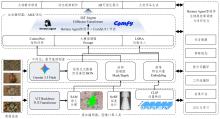
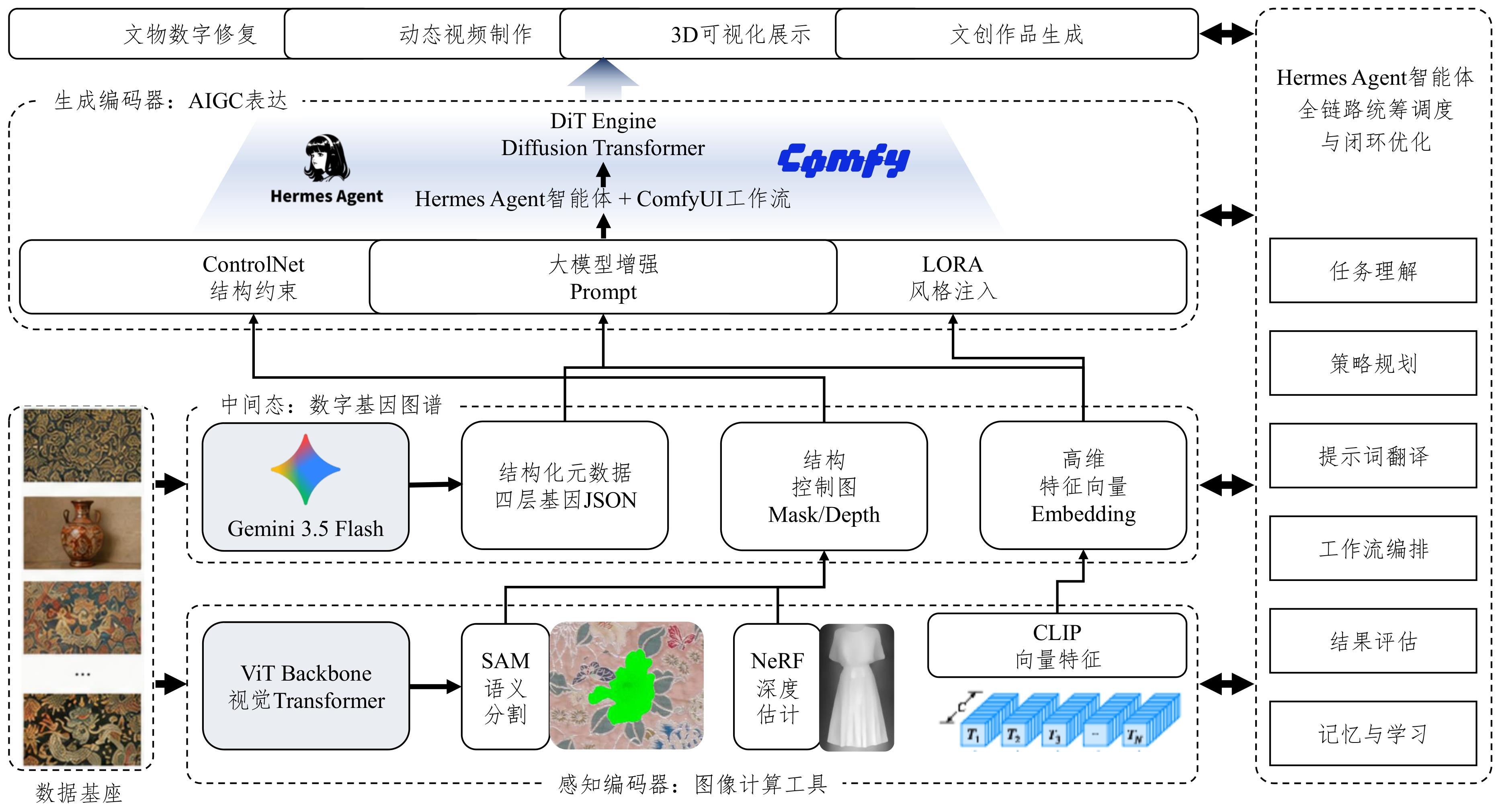
Fig.1

Overall research framework of agent-driven controllable transfer of intangible cultural heritage patterns"

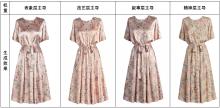
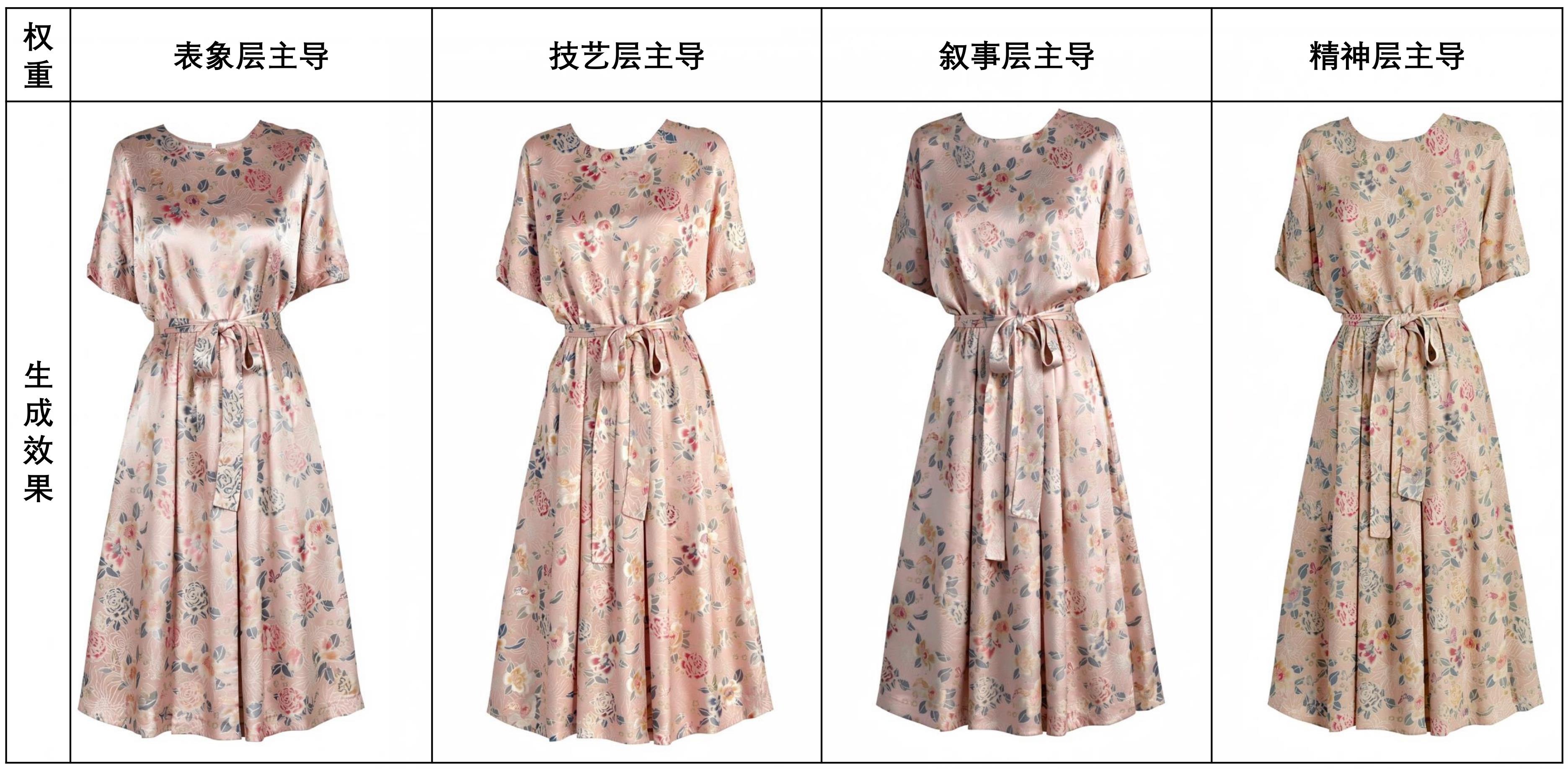
Fig.2

Comparison of generations results in different dominant weights of gene layers"

Fig.3

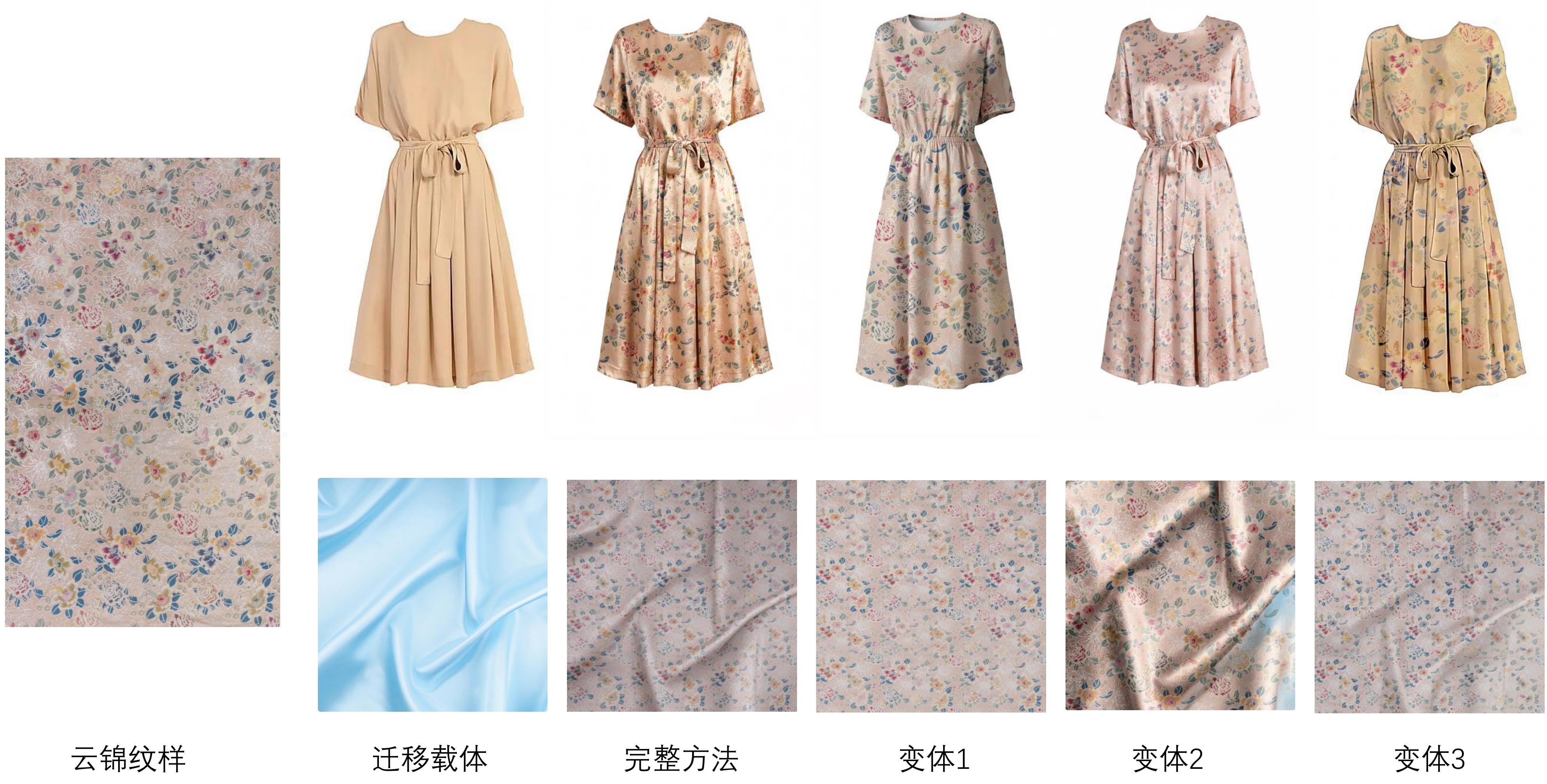
Comparison of generated results with different transfer carriers"

Table 2

Results of ablation experiments"

实验组 PSR/% GSR/% ICA/%
完整方法 75.07 90.06 52.89
变体1:移除技艺层结构约束 74.17 87.87 48.65
变体2:移除非遗纹样4层文化基因体系语义引导 70.84 89.96 47.51
变体3:移除南京云锦LoRA节点 72.51 89.34 45.74
[1]
中华人民共和国中央人民政府. 中共中央办公厅 国务院办公厅印发《关于进一步加强非物质文化遗产保护工作的意见》[EB/OL]. (2022-05-22)[2026-05-05].
[2]
中国非物质文化遗产网·中国非物质文化遗产数字博物馆. 加快建设文化强国[EB/OL]. (2022-05-22)[2026-05-05].
[3]
郑文昕. 非物质文化遗产服务直达基层的创新实践与机制建设[J]. 农业图书情报学报, 2026, 38(3): 44-54.
Zheng Wenxin. Innovative practices and mechanism building of channeling high-quality intangible cultural heritage services directly to the grassroots level[J]. Journal of Library and Information Science in Agriculture, 2026, 38(3): 44-54.
[4]
黄永林, 谈国新. 中国非物质文化遗产数字化保护与开发研究[J]. 华中师范大学学报(人文社会科学版), 2012, 51(2): 49-55.
Huang Yonglin, Tan Guoxin. Research on the digital preservation and development of China's intangible cultural heritage[J]. Journal of Huazhong Normal University (Humanities and Social Sciences), 2012, 51(2): 49-55.
[5]
夏海斌, 刘丹, 张宇. VR技术在“非遗”展示和保护中的实践研究——以景德镇传统制瓷工艺仿真为例[J]. 装饰, 2024(10): 130-132.
Xia Haibin, Liu Dan, Zhang Yu. Research on the practical application of VR technology in the preservation and display of intangible cultural heritage: A case study of simulating the traditional porcelain-making craft inJingdezhen[J]. 1, 2024(10): 130-132.
[6]
陈辉. 基于AR技术的非遗产品交互媒体技术研究[J]. 现代电子技术, 2017, 40(22): 116-118.
Chen Hui. Research on non-heritage product interactive media technology based on AR technology[J]. Modern Electronics Technique, 2017, 40(22): 116-118.
[7]
魏鋆涛, 任利民. 数字孪生视域下的非物质文化遗产设计转化研究[J]. 包装工程, 2023, 44(6): 302-310.
Wei Yuntao, Ren Limin. Design transformation of intangible cultural heritage from the perspective of digital twin[J]. Packaging Engineering, 2023, 44(6): 302-310.
[8]
王明洁, 喻国明. 生成式AI驱动下非遗纪录片叙事范式的重构——试析“新媒介催生新文明”的实践样式[J]. 民族学刊, 2026, 17(3): 143-152, 166.
Wang Mingjie, Yu Guoming. Reconstruction of narrative paradigms in intangible cultural heritage documentaries enhanced by generative AI: An analysis of practical patterns in "new media breeding new civilizations"[J]. Journal of Ethnology, 2026, 17(3): 143-152, 166.
[9]
Gatys L A, Ecker A S, Bethge M. A neural algorithm of artistic style[PP/OL]. V2. arXiv (2015-09-02)[2026-05-05].
[10]
Johnson J, Alahi A, Li Feifei. Perceptual losses for real-time style transfer and super-resolution[C]//Computer Vision-ECCV 2016. Cham: Springer International Publishing, 2016: 694-711.
[11]
Huang Xun, Belongie S. Arbitrary style transfer in real-time with adaptive instance normalization[C]//2017 IEEE International Conference on Computer Vision (ICCV). Piscataway, New Jersey: IEEE, 2017: 1510-1519.
[12]
Zhu Junyan, Park T, Isola P, et al. Unpaired image-to-image translation using cycle-consistent adversarial networks[C]//2017 IEEE International Conference on Computer Vision (ICCV). Piscataway, New Jersey: IEEE, 2017: 2242-2251.
[13]
Way D L, Lo C H, Wei Y H, et al. TwinGAN: Twin generative adversarial network for Chinese landscape painting style transfer[J]. IEEE Access, 2023, 11: 60844-60852.
[14]
刘贝芬, 张坦坦, 冯峥嵘. 基于改进Cycle GAN的清代官补风格迁移研究[J]. 纺织学报, 2025, 46(9): 213-224.
Liu Beifen, Zhang Tantan, Feng Zhengrong. Research on style design of Qing dynasty mandarin square based on Cycle GAN[J]. Journal of Textile Research, 2025, 46(9): 213-224.
[15]
陈佛计, 朱枫, 吴清潇, 等. 生成对抗网络及其在图像生成中的应用研究综述[J]. 计算机学报, 2021, 44(2): 347-369.
Chen Foji, Zhu Feng, Wu Qingxiao, et al. A survey about image generation with generative adversarial nets[J]. Chinese Journal of Computers, 2021, 44(2): 347-369.
[16]
Rombach R, Blattmann A, Lorenz D, et al. High-resolution image synthesis with latent diffusion models[C]//2022 IEEE/CVF Conference on Computer Vision and Pattern Recognition (CVPR). Piscataway, New Jersey: IEEE, 2022: 10674-10685.
[17]
Zhang Lvmin, Rao Anyi, Agrawala M. Adding conditional control to text-to-image diffusion models[C]//2023 IEEE/CVF International Conference on Computer Vision (ICCV). Piscataway, New Jersey: IEEE, 2023: 3813-3824.
[18]
Zhang Yuxin, Huang Nisha, Tang Fan, et al. Inversion-based style transfer with diffusion models[C]//2023 IEEE/CVF Conference on Computer Vision and Pattern Recognition (CVPR). Piscataway, New Jersey: IEEE, 2023: 10146-10156.
[19]
Rao Yongsheng, Chen Sailan, Xuan Yingshuang, et al. Diffusion model-based image generation method for Cantonese embroidery artistic styles[J]. npj Heritage Science, 2026, 14: 79.
[20]
Zhao Zhixiao, Wang Dongbo. Evaluation of large language models for the intangible cultural heritage domain[J]. npj Heritage Science, 2025, 13: 439.
[21]
牟丽君, 许鑫. 基于NFT的非遗数字资源开发研究[J]. 农业图书情报学报, 2022, 34(6): 14-23.
Mou Lijun, Xu Xin. Research on intangible cultural heritage digital resources development based on NFT[J]. Journal of Library and Information Science in Agriculture, 2022, 34(6): 14-23.
[22]
Ye Wenhao, Zheng Tiansheng, Qi Yue, et al. ICH-qwen: A large language model towards Chinese intangible cultural heritage[PP/OL]. arXiv (2025-05-28)[2026-05-05].
[23]
崔因, 杨建明, 李芳, 等. 磁州窑装饰纹样智能辅助设计研究[J]. 包装工程, 2023, 44(16): 1-9.
Cui Yin, Yang Jianming, Li Fang, et al. AI-assisted design for decorative pattern of Cizhou Kiln[J]. Packaging Engineering, 2023, 44(16): 1-9.
[24]
Yu Qianwen, Tao Xuyuan, Wang Jianping. Sustainable design on intangible cultural heritage: Miao embroidery pattern generation and application based on diffusion models[J]. Sustainability, 2025, 17(17): 7657.
[25]
王雪超, 赵博文, 杨慧宇, 等. 具身智能赋能文化遗产数字活化的现实图景与未来展望[J]. 农业图书情报学报, 2026, 38(7): 20-31.
Wang Xuechao, Zhao Bowen, Yang Huiyu, et al. Embodied intelligence empowering the digital revitalization of cultural heritage: Realistic prospects and future outlook[J]. Journal of Library and Information Science in Agriculture, 2026, 38(7): 20-31.
[26]
陈涛. 基于检索增强与知识库协同的古籍本体智能系统构建研究[J]. 南通大学学报(社会科学版), 2026, 42(3): 116-132, 164.
Chen Tao. A research into an intelligent ontology system for ancient books driven by retrieval-augmented generation and model context protocol[J]. Journal of Nantong University (Social Sciences Edition), 2026, 42(3): 116-132, 164.
[27]
王剑强, 吴捍新. 南京云锦[M]. 济南: 山东友谊出版社, 2013.
Wang Jianqiang, Wu Hanxin. Yun brocade of Nanjing[M]. Jinan: Shandong Friendship Press, 2013.
[1] JIANG Jiping. Information Service Model of Smart Libraries from the Perspective of Ecological Search [J]. Journal of library and information science in agriculture, 2026, 38(8): 120-130.
[2] HUANG Shuiqing, ZHANG Wei, LIU Liu. Construction and Development of an Autonomous Knowledge System for Computational Humanities [J]. Journal of library and information science in agriculture, 2026, 38(5): 16-34.
[3] LI Baiyang, REN Shangsheng. Technical Evolution and Application Scenarios of Open-Source Agents:A Case Study of "OpenClaw" [J]. Journal of library and information science in agriculture, 2026, 38(4): 23-35.
[4] LIU Wei, JIN Jiaqin. Library Transformation in the Age of AI Agents: Service Reconfiguration and Governance Framework Based on the OpenClaw Architecture [J]. Journal of library and information science in agriculture, 2026, 38(4): 13-22.
[5] QIAN Li, YANG Yanxi, ZHANG Yuanzhe, HU Maodi, CHANG Zhijun. The Impacts and Implications of OpenClaw for Scientific and Technical Literature Intelligence Work [J]. Journal of library and information science in agriculture, 2026, 38(4): 4-12.
[6] DENG Qiping, KE Jiaxiu, GAN Peng, ZHOU Song. Construction of an Intelligent Agent for Academic Output Data Analysis Oriented to Academic Evaluation [J]. Journal of library and information science in agriculture, 2026, 38(3): 76-87.
[7] ZHANG Ling. Integrating Digital Humanities and Agricultural Knowledge Services A Simulation Modeling Perspectives [J]. Journal of library and information science in agriculture, 2026, 38(2): 79-89.
[8] LIU Wei, ZHANG Lei, JI Ting, CHEN Xiaoyang. Shaping the Smart Libraries with AI: An Agent-based, Next-Generation Library Service Platform [J]. Journal of library and information science in agriculture, 2025, 37(5): 15-26.
[9] CHEN Jiayong, GONG Jiaoteng, WANG Yuyi. Research of Interdisciplinary Comparison and Collaborative Paradigm on the Concept of Agent in Library Science [J]. Journal of library and information science in agriculture, 2025, 37(5): 27-39.
[10] QIAN Li, WANG Qianying, LIU Yi, ZHANG Yuanzhe, CHANG Zhijun. Agent Technology and Its Applications in Scientific Research [J]. Journal of library and information science in agriculture, 2025, 37(5): 5-14.
[11] GUO Limin, LIU Yueru, FU Yaming. Design and Transformation Pathways of Library Systems Driven by Generative Agents [J]. Journal of library and information science in agriculture, 2025, 37(12): 36-47.
[12] LIU Yihan, CHU Yuxia, ZHAI Yujia. Factors Influencing the Communication Effectiveness of Intangible Cultural Heritage Short Videos: A Multimodal Machine Learning Approach [J]. Journal of library and information science in agriculture, 2025, 37(12): 20-35.
[13] Haoxian WANG, Ziming ZHOU, Feifei DING, Chengfu WEI. Digital Humanities & Large Language Models: Practice and Research in Semantic Retrieval of Ancient Documents [J]. Journal of library and information science in agriculture, 2024, 36(9): 89-101.
[14] Qiaofei CHEN, Haomin ZHOU, Xin XU. Digital-Intelligence Empowers Cultural Heritage Protection and Inheritance:Taking the International Communication of Chinese Tea Culture as an Example [J]. Journal of library and information science in agriculture, 2024, 36(6): 62-78.
[15] LIU Xiwen, FU Yun, WEI Huanan. DIS Agent: New Paradigm of S&T Documentation and Information Service for the Fifteenth Five-Year Plan [J]. Journal of library and information science in agriculture, 2024, 36(12): 20-34.
Viewed
Full text


Abstract

Cited

  Shared   
  Discussed   
No Suggested Reading articles found!