中文    English

Journal of library and information science in agriculture


Construction and Empirical Research of Data Security Literacy Evaluation Index System of College Students' Data Security Literacy

ZHU Shiqin1,2, LV Jialin1,2, GU Xiulun1   

  1. 1. School of Business, East China University of Science &Technology, Shanghai 200237
    2. Institute of Science & Technology Information, East China University of Science &Technology, Shanghai 200237
  • Received:2026-04-18 Online:2026-07-02

Abstract:

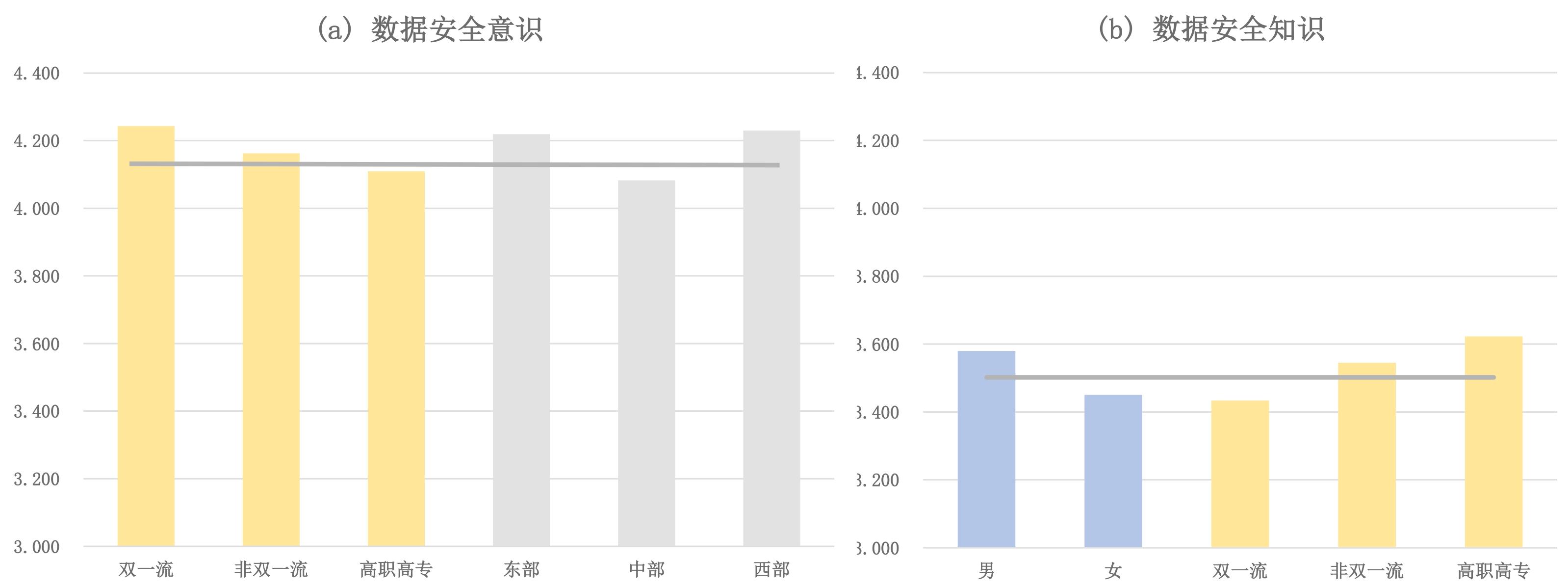
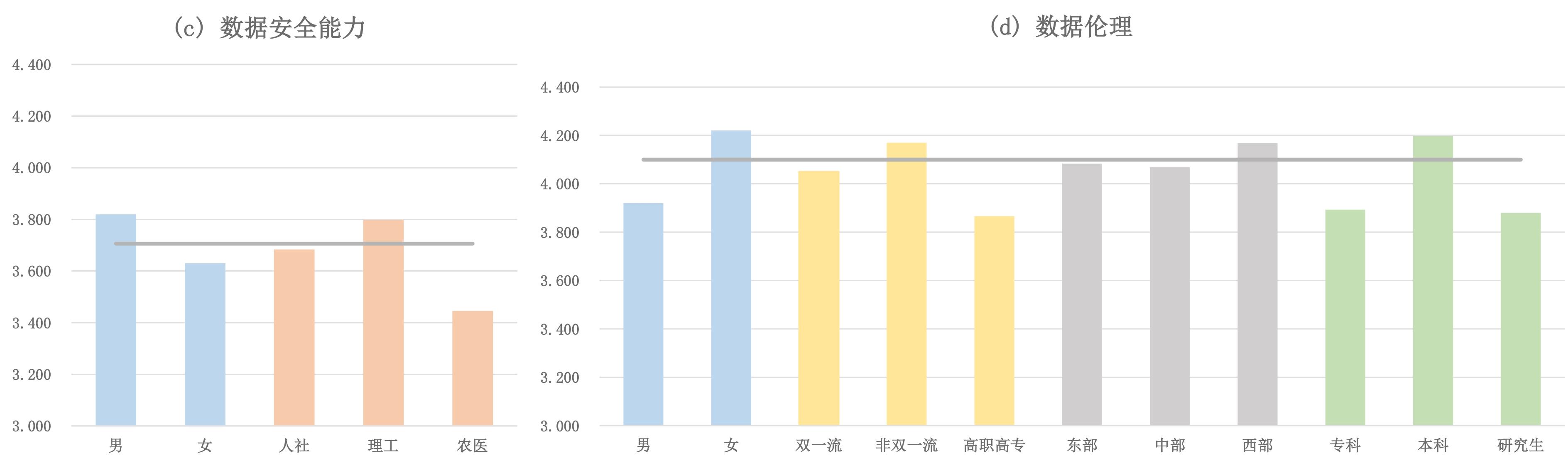
[Purpose/Significance] Improving data security literacy is an important measure to eliminate data security risks and improve national security. The purpose of this study is to explore the elements of data security literacy, and to explore the current state of college students' data security literacy to improve their data security literacy. [Method/Process] This paper first determines the elements of college students' data security literacy through grounded theory and literature research, and then uses expert consultation and factor analysis to optimize and modify the evaluation indicators to determine the final evaluation index system, and uses questionnaires to collect data. We evaluate college students' data security literacy through independent sample T test and one-way variance analysis and verify their differences and various dimensions. [Results/Conclusions] The data security literacy evaluation index system consists of data security awareness, data security knowledge, data security capability and data ethics. Through empirical analysis, it has been proven that the evaluation index system constructed in this study is highly rational and operable. We provide a quantitative analysis of data security literacy that serves as an important reference for college students looking to improve their literacy in this area. The weight proportion of the first-level index is similar. It shows that improving data security literacy requires implementing a comprehensive data security education strategy. College students have above-average data security literacy. They perform well in terms of data security awareness and data ethics, but not so well in terms of data security knowledge and data security capability. Based on the demographic characteristics, there are some differences in data security literacy among different types of groups. The study of data security literacy takes place in the family's permanent residence. There are significant differences in students' experience and their parents' education level. Students in urban areas, college students, and students whose parents are involved have significantly higher data security literacy than other students. The analysis of each dimension shows that data security literacy differs among different types of groups. Gender, college level and university region are the key factors affecting students' data security awareness. Gender and college level have prominent differences in data security knowledge. Different genders and professional categories lead to differences in data security capability. Gender, college level, education level and university region all affect data ethics. The improvement of data security literacy requires students, families and universities to play their respective roles. College students should improve their data security literacy according to their own data security status. Male students should enhance security awareness, and female students should enhance data security capability level. Non-double first-class college students need to consolidate their theoretical foundation, while double first-class undergraduate students should increase technical practice learning to improve data security capabilities. Students in higher vocational colleges should deepen their understanding of data ethics. Students who are not science or engineering majors need to make up for their lack of capability. With the rapid development of data intelligence, the data security literacy requirements are constantly changing. This study focuses on traditional data life cycle security scenarios. In the future, a data security evaluation index system suitable for emerging fields such as artificial intelligence and large models can be constructed.

Key words: grounded theory, college students, data security literacy, evaluation index system, information literacy education

CLC Number: 

  • G252

Table 1

Elements of college students' data security literacy"

主范畴 范畴内容 参考文献
数据安全意识 保密意识、风险意识、敏感意识、检视意识、反思意识、甄别意识 文献[19-24]、访谈
数据安全知识 维权知识、法律知识、威胁知识、学科知识、防范知识、工具知识、检索知识 文献[20,22,25-28]、访谈
数据安全能力 数据采集、数据存储、数据处理、数据传输、数据共享、数据销毁 文献[24,29-33]、访谈
数据伦理 环境秩序、学术道德、学术规范、使用规范、职责义务 文献[22,25,34-36]、访谈

Table 2

The results of rotation component matrix of data security literacy evaluation index system"

题项 成分 题项 成分
1 2 3 4 1 2 3 4
保密意识 0.770 数据采集 0.612
风险意识 0.702 数据存储 0.595
敏感意识 0.756 数据处理 0.661
检视意识 0.625 数据传输 0.682
反思意识 0.715 数据共享 0.672
维权知识 0.750 数据销毁 0.719
法律知识 0.811 环境秩序 0.869
威胁知识 0.692 学术道德 0.867
学科知识 0.744 学术规范 0.884

Table 3

Evaluation index system of college students' data security literacy"

一级指标 二级指标 指标描述 参考来源
数据安全意识 保密意识 具有保密和保护个人隐私、商业机密、国家安全等重要数据的意识 文献[15-19]、访谈
风险意识 能够意识到数据潜在的安全威胁,如侵犯公民隐私、数字内容篡改、电子支付欺诈等
敏感意识 时常保持谨慎态度以应对可能出现的数据安全问题
检视意识 会以动态的眼光看待自身的数据安全水平,并主动关注新兴数据安全问题
反思意识 能够通过自己或他人信息泄露的经历分析深层次的原因并吸取教训
数据安全知识 维权知识 了解维权的法律法规,知道维权方法和渠道

文献[20,22,25,26,28]、访谈

法律知识 了解数据安全相关的法律法规和政策,如《中华人民共和国数据安全法》《中华人民共和国网络安全法》《中华人民共和国个人信息保护法》等
威胁知识 了解数据威胁的相关知识,包括信息茧房、大数据杀熟等传统风险,和AI幻觉、深度欺骗伪造等新型挑战
学科知识 了解计算机科学与技术、信息安全、网络安全等学科的相关知识,如哈希值、网络安全协议、电子数据取证等
数据安全能力 数据采集 会使用校验、过滤、清洗、格式规范等技术保证数据采集过程中的数据质量,避免数据错误与数据损坏 文献[24,29-33]、访谈
数据存储 能通过定期备份、云备份、纸质备份等进行数据长期保存
数据处理 对可能出现的紧急事件和潜在风险有预案,能够妥善处理数据安全威胁
数据传输 会使用加密协议、使用哈希函数等保证数据的完整性、机密性和可用性
数据共享 会使用加密、打码、打水印、设置有效期等措施保护数据共享安全
数据销毁 会通过撕毁、粉碎、永久删除、格式化等技术对数据进行彻底销毁,使其无法被恢复
数据伦理 环境秩序 会配合营造一个健康、安全的数据使用环境和秩序,遵循伦理道德,不造谣、不传谣等 文献[34-36]、访谈
学术道德 遵守学术道德,不偷窃他人成果,尊重他人数据,使用标明出处等
学术规范 对科学研究过程中产生的数据真实有效性负责

Table 4

Data security literacy evaluation index system and weight"

一级指标 权重/% 二级指标 权重/% 一级指标 权重/% 二级指标 权重/%
数据安全意识 26.465 保密意识 5.710 数据安全能力 27.258 数据采集 4.231
风险意识 5.206 数据存储 4.112
敏感意识 5.606 数据处理 4.581
检视意识 4.641 数据传输 4.717
反思意识 5.302 数据共享 4.647
数据安全知识 24.954 维权知识 6.237 数据销毁 4.970
法律知识 6.751 数据伦理 21.323 环境秩序 7.074
威胁知识 5.773 学术道德 7.055
学科知识 6.193 学术规范 7.194

Table 5

Sample descriptive statistics"

基本信息 类别 人数/人 占比/% 基本信息 类别 人数/人 占比/%
性别 427 40.207 高校地域 东部 599 56.403
635 59.793 中部 219 20.621
院校层次 双一流 453 42.655 西部 244 22.976
非双一流本科 542 51.036 学习经历 学习过 637 59.981
高职高专类 67 6.309 未学习过 425 40.019
教育程度 专科生 50 4.708 家庭常住地 城镇 559 52.637
本科生 734 69.115 乡村 503 47.363
研究生 278 26.177 父母受教育程度 初中及以下 367 34.557
专业背景 人社 583 54.896 高中(含中专) 333 31.356
理工 392 36.912 大学(大专以上) 362 34.087
农医 87 8.192

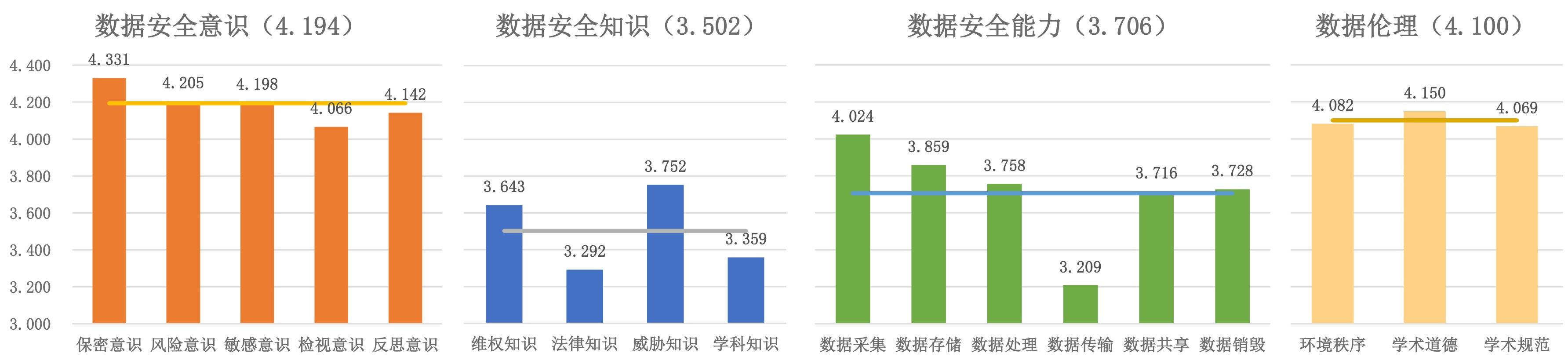
Fig.1

Mean value map of each dimension of data security literacy"

Table 6

Analysis of significant differences in individual characteristics"

变量 具体内容 均值标准差
家庭常住地 城市 3.498±0.422
乡村 3.376±0.487
学习经历 学习过 3.539±0.414
未学习过 3.291±0.479
父母受教育程度 初中及以下 3.375±0.524
高中(含中专) 3.414±0.515
大学(大专及以上) 3.989±0.518

Table 7

Difference analysis of each dimension of college students' data security literacy"

变量 数据安全意识 数据安全知识 数据安全能力 数据伦理
性别 ×
院校层次 ×
教育程度 × × ×
专业类别 × × ×
高校地域 × ×

Fig.2

Mean value diagram of college students' data security awareness and data security knowledge"

Fig.3

Mean value diagram of college students' data security capability and data ethics"

[1]
新华网. 习近平总书记首次提到“新质生产力”[EB/OL]. [2023-09-10].
[2]
臧梓健. 京津冀政府数据开放平台安全风险评价研究[D]. 秦皇岛: 燕山大学, 2022.
Zang Zijian. Research on Security Risk Evaluation of Beijing-Tianjin-Hebei Government Data Open Platform[D]. Qinhuangdao: Yanshan University, 2022.
[3]
张超颖. 山东省H市D区税务人员信息安全素养研究[D]. 北京: 中国地质大学(北京), 2020.
Zhang Chaoying. Research on information security literacy of tax personnel in D district of H city, Shandong Province[D]. Beijing: China University of Geosciences(Beijing), 2020.
[4]
石雅冰. 档案数据馆员的数据安全素养研究[D]. 太原: 山西大学, 2023.
Shi Yabing. Research on Data Security Literacy of Archival Data Librarians[D]. Taiyuan: Shanxi University, 2023.
[5]
庄国波, 韩惠. 5G时代政府数据开放共享的安全风险及防范[J]. 理论探讨, 2020(5): 48-54.
Zhuang Guobo, Han Hui. Security risks and prevention of open sharing of government data in the 5G era[J]. Theoretical discussion, 2020(5): 48-54.
[6]
王张华, 李赛赛. 公共数据合作开发的动力机制与风险规避——基于政府与大数据平台企业合作的视角[J]. 学术交流, 2024(1): 31-43.
Wang Zhanghua, Li Saisai. Dynamic Mechanism and Risk Avoidance of Public Data Cooperative Development - Based on the perspective of cooperation between government and big data platform enterprises[J]. Academic Exchange, 2024(1): 31-43.
[7]
Schield M. Statistical literacy: Thinking critically about statistics[J]. Significance, 2007, 1(1): 15-20.
[8]
刘枫. 大学生信息安全素养分析与形成[J]. 计算机教育, 2010(21): 77-80.
Liu Feng. Undergraduates' information security literacy analysis and formation[J]. Computer Education, 2010(21): 77-80.
[9]
Alotaibi F, Furnell S, Stengel I, et al. A survey of cyber-security awareness in Saudi Arabia[C]//2016 11th International Conference for Internet Technology and Secured Transactions (ICITST). Piscataway, New Jersey: IEEE, 2016: 154-158.
[10]
Zwilling M, Klien G, Lesjak D, et al. Cyber security awareness, knowledge and behavior: A comparative study[J]. Journal of Computer Information Systems, 2022, 62(1): 82-97.
[11]
Garba A, Sirat M B, Hajar S, et al. Cyber security awareness among university students: A case study[J]. Science Proceedings Series, 2020, 2(1): 82-86.
[12]
Filippidis A P, Hilas C S, Filippidis G, et al. Information security awareness of Greek higher education students - Preliminary findings[C]//2018 7th International Conference on Modern Circuits and Systems Technologies (MOCAST). Piscataway, New Jersey: IEEE, 2018: 1-4.
[13]
司莉, 邢文明. 科学数据管理与共享的理论与实践[M]. 武汉: 武汉大学出版社, 2017.
Si Li, Xing Wenming. Theory and practice of scientific data management and sharing[M]. Wuhan: Wuhan University Press, 2017.
[14]
马浩淼. “互联网+”环境下电子政务的数据安全治理研究——以安徽省为例[J]. 宿州学院学报, 2023, 38(9): 47-53.
Ma Haomiao. Research on data security governance of E-government under the "Internet+" environment: A case study of Anhui Province[J]. Journal of Suzhou University, 2023, 38(9): 47-53.
[15]
李青维, 刘燕, 周航. 互联网企业数据从业者数据安全素养影响因素及培育策略研究[J/OL]. 高校图书馆工作, 1-9[2026-06-10].
Li Qingwei, Liu Yan, Zhou Hang. Research on the influencing factors and cultivation strategies of data security literacy of Internet enterprise data practitioners[J/OL]. University library work, 1-9[2026-06-10].
[16]
余维杰, 周娅莉, 吴锦池. 我国研究生在科研活动中的数据素养现状研究——以双生命周期理论为视角[J]. 图书情报工作, 2020, 64(7): 84-93.
Yu Weijie, Zhou Yali, Wu Jinchi. Investigation and research on the status of Chinese Postgraduates'Data literacy in scientific research activities - From the perspective of dual life cycles[J]. Library and Information Service, 2020, 64(7): 84-93.
[17]
齐乾坤, 王文龙. 基于数据生命周期的高校研究生数据素养评价研究[J]. 情报科学, 2021, 39(9): 125-130, 145.
Qi Qiankun, Wang Wenlong. Data literacy evaluation of university graduate students based on data life CycleLife cycle[J]. Information Science, 2021, 39(9): 125-130, 145.
[18]
马腾, 孙玲. 信息生态视域下高校大学生数据素养评价研究[J]. 情报科学, 2019, 37(8): 120-126.
Ma Teng, Sun Ling. Data literacy evaluation of college students from the perspective of information ecology[J]. Information Science, 2019, 37(8): 120-126.
[19]
Zhen Jie, Dong Kunxiang, Xie Zongxiao, et al. Factors influencing employees' information security awareness in the telework environment[J]. Electronics, 2022, 11(21): 3458.
[20]
阙凤仪. 大数据时代高校学生网络安全素养评价指标体系及应用研究[D]. 武汉: 武汉工程大学, 2022.
Que Fengyi. Research on Evaluation Index System and Application Ideological of College Students' Network Security Literacy in the Era of Big Data[D]. Wuhan: Wuhan Institute of Technology, 2022.
[21]
Takemura. A quantitative study on Japanese workers awareness to information security using the data collected by web-based survey[J]. American Journal of Economics and Business Administration, 2010, 2(1): 20-26.
[22]
陈琦, 熊回香, 代沁泉, 等. 平台社会视阈下大学生网络信息安全素养能力评价及提升策略研究[J]. 图书情报工作, 2022, 66(7): 75-87.
Chen Qi, Xiong Huixiang, Dai Qinquan, et al. Research on the evaluation and promotion strategy of college students' network information security literacy ability from the perspective of platform society[J]. Library and Information Service, 2022, 66(7): 75-87.
[23]
Ahlan A R, Lubis M, Lubis A R. Information security awareness at the knowledge-based institution: Its antecedents and measures[J]. Procedia Computer Science, 2015, 72: 361-373.
[24]
Tzafilkou K, Perifanou M, Economides A A. Development and validation of students' digital competence scale (SDiCoS)[J]. International Journal of Educational Technology in Higher Education, 2022, 19(1): 30.
[25]
印熙媛. 师范生数据素养模型、能力指标体系构建及其应用研究[D]. 无锡: 江南大学, 2022.
Yin Xiyuan. Research on the Construction and Application of Data Literacy Model and Ability System of Normal Students[D]. Wuxi: Jiangnan University, 2022.
[26]
Ahmad Khan S, Bhatti R. Digital competencies for developing and managing digital libraries: An investigation from university librarians in Pakistan[J]. The Electronic Library, 2017, 35(3): 573-597.
[27]
王伟军, 刘辉, 王玮, 等. 中小学生网络素养及其评价指标体系研究[J]. 华中师范大学学报(人文社会科学版), 2021, 60(1): 165-173.
Wang Weijun, Liu Hui, Wang Wei, et al. Research on the evaluating indicators system of Internet literacy for K12 students[J]. Journal of Huazhong Normal University (Humanities and Social Sciences), 2021, 60(1): 165-173.
[28]
Salem A, Kaoru Sumi. Deception detection in educational AI: Challenges for Japanese middle school students in interacting with generative AI robots[J]. Frontiers in Artificial Intelligence, 2024, 7: 1493348.
[29]
Saraçlı S, Erdoğmuş A. Determining the effects of information security knowledge on information security awareness via structural equation modelings[J]. Hacettepe Journal of Mathematics and Statistics, 2018, 48(4): 1201-1212.
[30]
钟庆虹, 查颖, 罗靖琳, 等. 高校图书馆馆员数据素养培育体系的构建研究[J]. 大学图书馆学报, 2023, 41(2): 34-44.
Zhong Qinghong, Zha Ying, Luo Jinglin, et al. Research on the construction of data information literacy cultivation system for university librarians[J]. Journal of Academic Libraries, 2023, 41(2): 34-44.
[31]
Bitton R, Boymgold K, Puzis R, et al. Evaluating the information security awareness of smartphone users[C]//Proceedings of the 2020 CHI Conference on Human Factors in Computing Systems. New York: ACM, 2020: 1-13.
[32]
刘桂锋, 阮冰颖, 包翔. 数据生命周期视角下高校科学数据安全内容框架构建[J]. 情报杂志, 2021(2): 146-153.
Liu Guifeng, Ruan Bingying, Bao Xiang. Construction of content framework of university scientific data security from the perspective of data life cycle[J]. Journal of Intelligence, 2021(2): 146-153.
[33]
Na-Nan K, Roopleam T, Wongsuwan N. Validation of a digital intelligence quotient questionnaire for employee of small and medium-sized Thai enterprises using exploratory and confirmatory factor analysis[J]. Kybernetes, 2019, 49(5): 1465-1483.
[34]
徐绪堪, 薛梦瑶. 面向大数据管理与应用专业的数据素养能力评价指标体系构建[J]. 情报理论与实践, 2021, 44(9): 50-56.
Xu Xukan, Xue Mengyao. Research on data literacy ability evaluation index system for big data management and application major[J]. Information Studies (Theory & Application), 2021, 44(9): 50-56.
[35]
郭倩, 李建霞. 聚焦安全伦理教育的高校学生数据素养能力实证研究[J]. 新世纪图书馆, 2019(5): 14-19.
Guo Qian, Li Jianxia. An empirical study on data literacy ability of college students focusing on safety ethics education[J]. New Century Library, 2019(5): 14-19.
[36]
张晓阳, 李楣. 基于胜任特征的研究生数据素养能力测评量表研究[J]. 图书情报工作, 2017, 61(8): 89-95.
Zhang Xiaoyang, Li Mei. Research on the evaluation scale of postgraduate students' data literacy based on the competency[J]. Library and Information Service, 2017, 61(8): 89-95.
[37]
An Qin, Hong W C H, Xu Xiaoshu, et al. How education level influences Internet security knowledge, behaviour, and attitude: A comparison among undergraduates, postgraduates and working graduates[J]. International Journal of Information Security, 2023, 22(2): 305-317.
[1] HU Anqi. Construction of an Artificial Intelligence Literacy Ability Framework and Training System for College Students [J]. Journal of library and information science in agriculture, 2026, 38(2): 42-55.
[2] REN Fubing, LUO Ya. Evolution Mechanism of User's Network Cluster Behavior from the Perspective of Cognitive Bias [J]. Journal of library and information science in agriculture, 2025, 37(9): 18-31.
[3] SHEN Hongjie, SHEN Hongwei, WANG Junli. Generative AI Empowering Information Literacy Education in Digital Libraries: Path Exploration, Challenge Analysis, and Response Strategies [J]. Journal of library and information science in agriculture, 2025, 37(7): 50-60.
[4] LUO Guofeng, YI Tong, YAN Zhouzhou. Critical Information Literacy Education in University Libraries from the Perspective of AIGC Application [J]. Journal of library and information science in agriculture, 2025, 37(1): 47-58.
[5] Huimin HE. Reader Knowledge Construction in Public Library Information Literacy Education based on the MOA Model [J]. Journal of library and information science in agriculture, 2024, 36(9): 58-69.
[6] Fan YUAN, Jia LI. Opportunities, Challenges, and Future Directions for Generative Artificial Intelligence in Library Information Literacy Education: A Scoping Review [J]. Journal of library and information science in agriculture, 2024, 36(9): 44-57.
[7] LUO Guofeng, LIU Qingsheng. Application Scene and Practice of ChatGPT Empowering Information Literacy Education [J]. Journal of library and information science in agriculture, 2024, 36(4): 91-101.
[8] Jia XU. The Optimization Path of VR Red Resource Reading Style under the Embodied Cognition: An Exploratory Study Based on Grounded Theory [J]. Journal of library and information science in agriculture, 2024, 36(11): 33-46.
[9] ZHANG Hongping. Promotion Mechanism of User Demand to Library Literature Resource Construction, Management and Service: Based on Grounded Theory [J]. Journal of library and information science in agriculture, 2022, 34(9): 95-103.
[10] GUO Weijia. Influencing Factors of Artificial Intelligence Readiness in Libraries [J]. Journal of library and information science in agriculture, 2022, 34(5): 47-56.
[11] LUO Menglan, WEN Tingxiao. A qualitative Study on the Professional Identity of Agricultural College Students [J]. Journal of library and information science in agriculture, 2022, 34(4): 84-93.
[12] LYU Kun, CHEN Yaoyao, XIANG Minhao. Influencing Factors of Sina Weibo Information Service Quality from the Perspective of Users: Exploratory Analysis Based on Grounded Theory [J]. Journal of library and information science in agriculture, 2022, 34(10): 70-81.
[13] ZHANG Min. Overseas Copyright Literacy Research: Origins, Progress and Advances [J]. Journal of library and information science in agriculture, 2021, 33(9): 83-92.
[14] WANG Jie. College Students' Information Literacy Education in the Information Age: Taking Shenyang Ligong University Library as an Example [J]. Journal of library and information science in agriculture, 2021, 33(8): 88-95.
[15] MENG Yintao, ZHAO Leixia, YU Qianqian. Scientific Data Evaluation Index System for Scientific Data Preservation [J]. Journal of library and information science in agriculture, 2021, 33(12): 48-59.
Viewed
Full text


Abstract

Cited

  Shared   
  Discussed   
No Suggested Reading articles found!