中文    English

Journal of library and information science in agriculture ›› 2026, Vol. 38 ›› Issue (2): 4-15.doi: 10.13998/j.cnki.issn1002-1248.26-0063

    Next Articles

Research on the Construction and Evaluation of a Low-Altitude Economy Urban Development Index

YANG Guancan, SHI Yingying, ZHANG Zihe   

  1. School of Information Resource Management, RenMin University of China, Beijing 100872
  • Received:2026-01-05 Online:2026-02-05 Published:2026-03-19

Abstract:

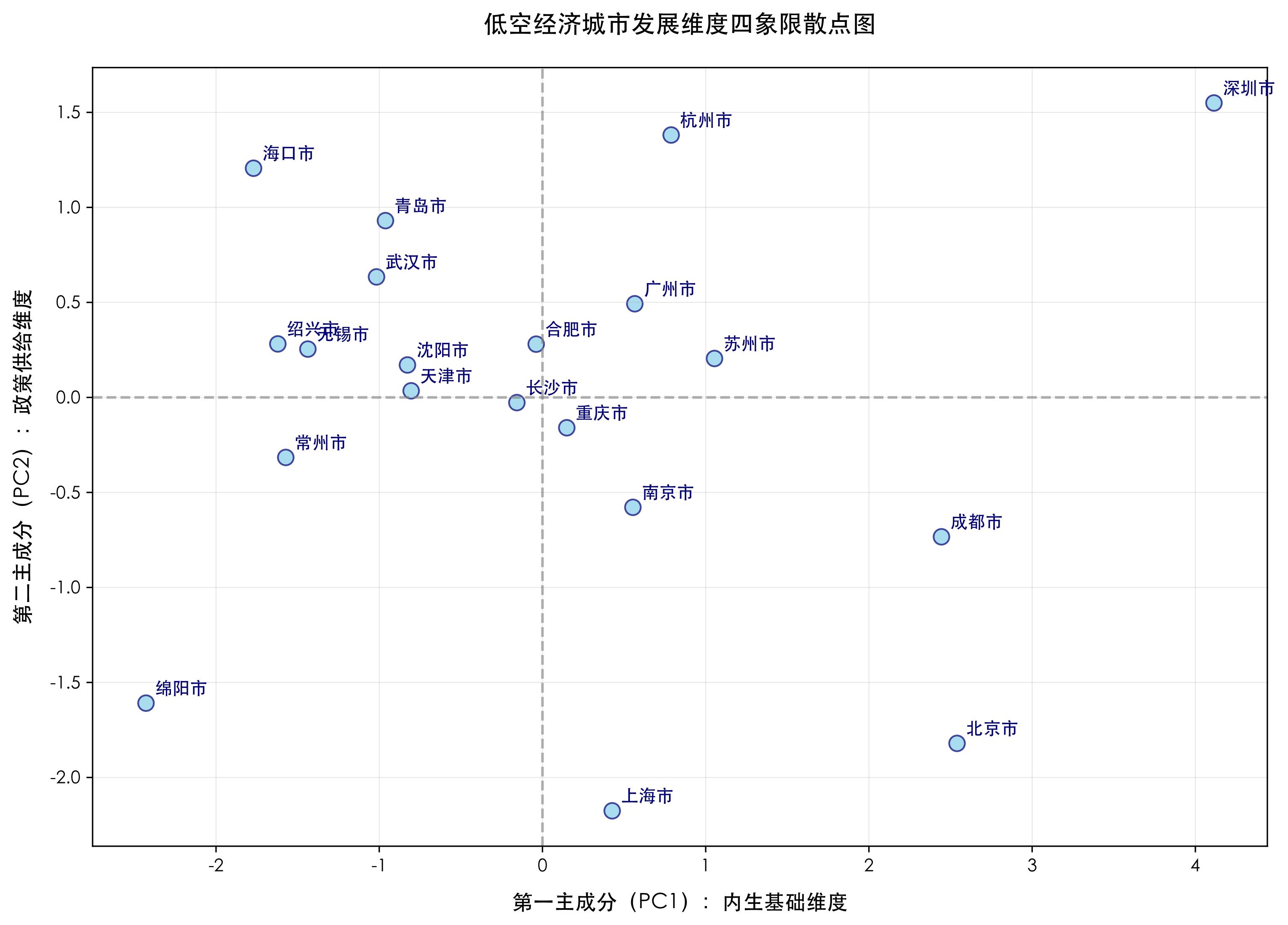
[Purpose/Significance] As China's low-altitude economy transitions from pilot experimentation to large-scale deployment, city governments are increasingly confronted with intelligence challenges rather than mere information shortages. Development signals are scattered across heterogeneous sources-enterprise activities, patents and R&D outputs, infrastructure readiness, investment dynamics, and municipal policy documents - often with inconsistent definitions, update cycles, and measurement units. This fragmentation raises cognitive burden and decision uncertainty: policymakers may "know a lot" but still lack a structured understanding of urban development posture, making cross-city comparison, policy-tool matching, and pathway selection difficult. To address this gap, this study re-frames index construction from an information science perspective as a data-information-knowledge transformation process and develops an interpretable measurement tool to support urban situation assessment and policy reasoning in the early diffusion stage. [Method/Process] We propose a Low-altitude Economy City Development Index (LCDI) using the analytical boundary of three heterogeneous signal systems - industrial chain, technology chain and policy chain. The index operationalizes four interpretable dimensions: technological innovation vitality, market expansion potential, ecological coordination capability, and policy empowerment effectiveness. Multiple objective data sources are integrated and normalized to ensure cross-city comparability. Indicator weights are determined through expert judgment combined with the Analytic Hierarchy Process (AHP), translating perceived importance of signals into an explicit weighting structure. The empirical assessment covers 58 Chinese cities that have issued dedicated low-altitude economy policies and satisfy data availability and comparability requirements. Beyond computing composite scores and dimension profiles, Principal Component Analysis (PCA) is used as a structural representation test: it examines whether the four-dimensional signal system can be stably abstracted into a small set of dominant cognitive axes suitable for decision-oriented interpretation. Cities are further mapped into a two-axis space and categorized via a four-quadrant configuration to facilitate type recognition and mismatch diagnosis. Finally, a concise set of typical-city cases is employed for interpretive validation, checking whether index-implied structures can be meaningfully mapped to observable governance practices and implementation pathways. [Results/Conclusions] Results reveal a clear hierarchical gradient across cities. Leading cities tend to show coordinated advantages across multiple dimensions, indicating that urban low-altitude economy development depends on systemic coupling among technology, market, ecosystem coordination, and institutional supply rather than single-factor expansion. PCA suggests that urban development posture can be summarized along two dominant structural axes: an endogenous capability axis (driven by innovation, market expansion, and coordination) and an institutional empowerment axis (driven by policy and governance capacity). The four-quadrant typology highlights structural mismatches where capability accumulation and policy supply evolve asynchronously. While the study is constrained by data availability and the sector's early-stage diffusion, the LCDI provides a replicable, updatable, and interpretable intelligence tool for cross-city comparison, type-based diagnosis, and differentiated policy calibration, and it points to future work on dynamic monitoring and broader externality indicators.

Key words: low-altitude economy, new quality productive forces, indicator system, development trends, policy

CLC Number: 

  • G350.7

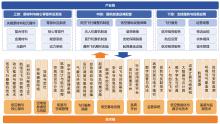
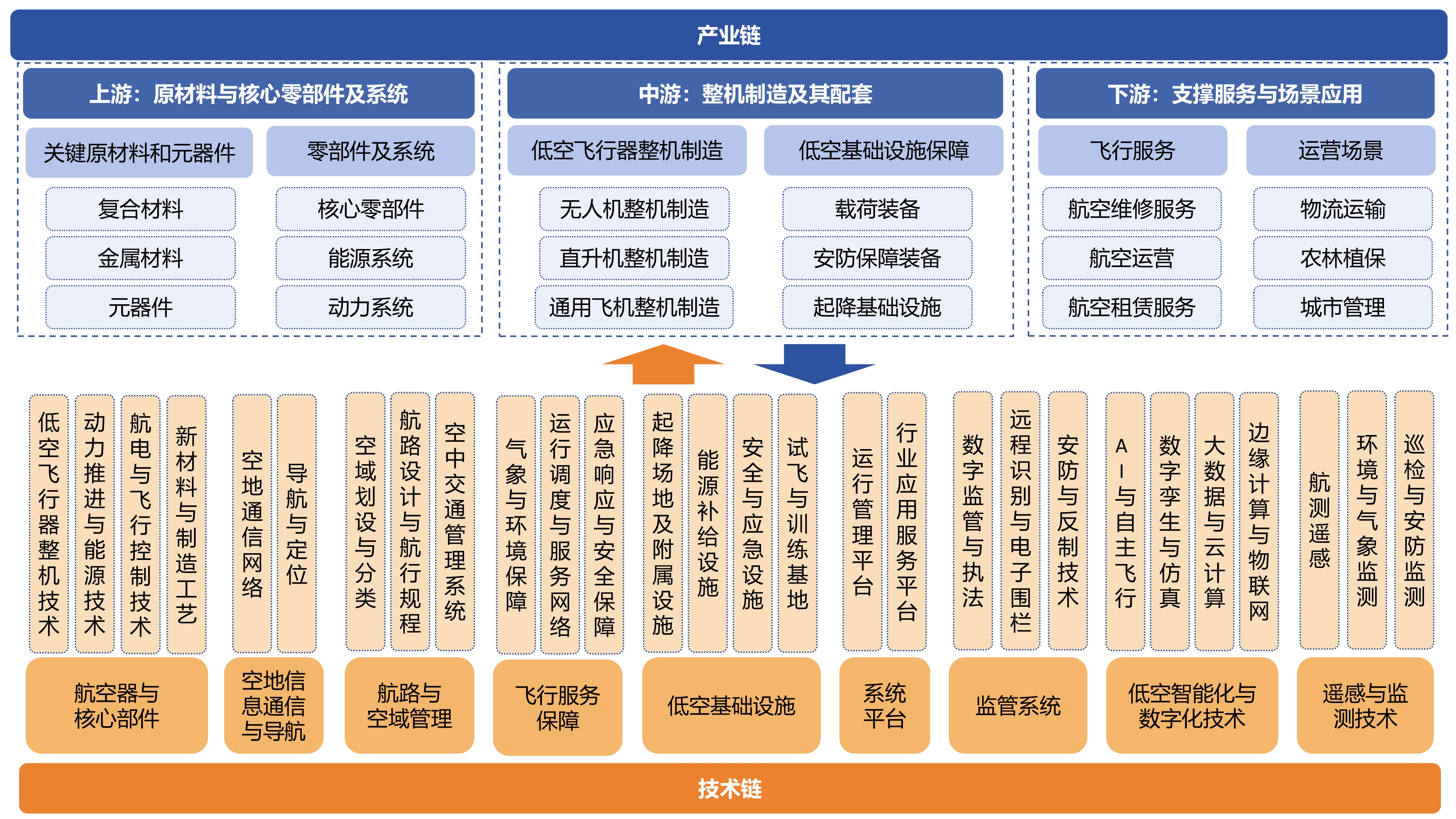
Fig.1

The overall framework of the industrial and technology chain of the low-altitude economy"

Table 1

Indicator system and weights for the technological innovation vitality dimension"

一级指标 二级指标(权重) 三级指标(方案层) 三级权重

技术创新活力

(0.25)

产业创新强基度

(0.50)

低空经济企业总量 0.24
规模以上低空经济企业数量 0.38
低空经济人才培养单位数量 0.18
低空经济职业技能培训机构数量 0.21

技术创新优质度

(0.50)

获得科技荣誉的企业比例 0.38
拥有发明专利授权的企事业单位数量 0.08
获得国标/行标企业比例 0.40
获得国家立项项目数量 0.11
获得省级立项项目数量 0.03

Table 2

Indicator system and weights for the market expansion potential dimension"

一级指标 二级指标权重 三级指标方案层 三级权重

市场开拓潜力

(0.20)

市场规模广域度

(0.50)

通用机场数量 0.10
低空经济备案产品种类数量 0.15
低空起降场点数量 0.40
低空经济应用场景企业比例 0.35

市场增量驱动度

(0.50)

近3年融资/上市企业数量 0.43
近3年低空经济产业基金增量 0.12
近3年低空经济新增企业 0.23
近3年低空经济人才持续招聘企业数量 0.22

Table 3

Indicator system and weights for the ecological coordination capability dimension"

一级指标 二级指标(权重) 三级指标(方案层) 三级权重

生态协同能力

(0.30)

产业链条匹配度

(0.50)

同时占有产业链上中下游多节点的企业数量 0.50
与低空经济产业链条紧密联系的企业数 0.50

基础设施适配度

(0.50)

低空经济产业园数量 0.24
低空经济示范区建设城市 0.18
eVTOL试点城市 0.35
低空空域管理改革试点城市 0.24

Table 4

Indicator system and weights for the policy empowerment effectiveness dimension"

一级指标 二级指标(权重) 三级指标(方案层) 三级权重

政策赋能效力

(0.25)

政策体系健全度

(0.26)

地方性法规及管理条例 0.20
专项政策及实施细则 0.20
中长期规划及行动方案 0.20
服务保障及管理办法 0.20
支持性配套文件 0.20

产业政策覆盖度

(0.33)

上游环节政策覆盖率 0.33
中游环节政策覆盖率 0.33
下游环节政策覆盖率 0.33

政策工具使用度

(0.41)

财税激励工具使用情况 0.20
要素保障工具使用情况 0.20
行政协调工具使用情况 0.20
市场培育工具使用情况 0.20
创新生态工具使用情况 0.20

Table 5

Top 10 cities by composite scores of the low-altitude economy development index"

排名 城市 综合指数 技术创新活力 市场开拓潜力 生态协同能力 政策赋能效力
1 深圳市 90.0 82.7 89.0 92.3 95.3
2 北京市 85.8 91.1 88.1 76.4 90.1
3 成都市 85.5 84.5 86.5 81.0 91.1
4 苏州市 80.4 74.7 83.0 74.0 91.6
5 上海市 79.2 81.6 83.7 66.9 88.0
6 杭州市 79.2 71.3 78.7 74.3 93.3
7 广州市 78.9 76.7 76.5 71.0 92.3
8 南京市 78.5 82.0 79.9 64.0 91.3
9 重庆市 78.1 74.7 76.4 71.8 90.6
10 合肥市 77.6 75.3 72.0 71.7 91.4

Table 6

Principal component loadings of urban low-altitude economy development dimensions"

原始维度 PC1 载荷 PC2 载荷
技术创新活力 0.491 707 -0.516 025
市场开拓潜力 0.582 152 -0.158 196
生态协同能力 0.558 773 0.131 961
政策赋能效力 0.327 256 0.831 432

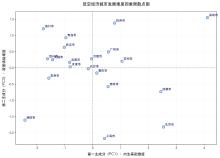
Fig.2

Four-quadrant scatter plot of urban low-altitude economy development dimensions"

Table 7

Representative urban development cases of the low-altitude economy"

类型 代表城市 低空产业政策推进逻辑 关键机制 对应指数解释 适用城市条件
政策链条完善型 深圳 以政策工具贯通产业链关键环节 “研发支持-制造要素-运营准入”形成闭环 政策赋能与内生基础同步增强 产业基础较强、企业活跃度高
生态协同发展型 北京 以平台化体系支撑多主体协同 园区集聚、产学研协同、设施与网络一体化 技术创新与生态协同维度突出 科研资源集中、治理协调能力强
试点引领型 成都 以试点机制推动能力转化 试点政策+空域改革+示范验证 制度供给带动内生基础逐步积累 产业处于成长阶段
需求驱动型 杭州 以市场运行问题反向塑造制度 企业需求反馈、政企协同治理 市场活跃但制度需动态校正 市场主体活跃、应用场景丰富
基础设施引领型 重庆 以基础设施构建运行底座 起降点网络、应急平台、调度系统 制度供给先行、能力逐步累积 地理条件特殊、公共服务需求强
制度推动型 海口 以制度安排推动项目落地 行动计划、项目清单、资源统筹 政策维度显著、内生基础待培育 新兴培育阶段城市
[1]
李连成, 李名良. 论低空经济: 内涵构成、动力特征与实践路径[J]. 北京交通大学学报(社会科学版), 2025, 24(4): 98-106.
Li Liancheng, Li Mingliang. On the low-altitude economy: Connotation composition, dynamic characteristics, and practical paths[J]. Journal of Beijing Jiaotong University (Social Sciences Edition), 2025, 24(4): 98-106.
[2]
于一, 张凯. 中国区域通用航空发展评价指数研究[J]. 中国民航大学学报, 2014, 32(6): 42-47.
Yu Yi, Zhang Kai. Development index of China's regional general aviation[J]. Journal of Civil Aviation University of China, 2014, 32(6): 42-47.
[3]
王馨培, 高艳云, 李国荣. 中国战略性新兴产业进程指数构建及评价[J]. 统计学报, 2024, 5(2): 53-63.
Wang Xinpei, Gao Yanyun, Li Guorong. Construction and evaluation of the process index of strategic emerging industries in China[J]. Journal of Statistics, 2024, 5(2): 53-63.
[4]
蔡冬松, 柴艺琳, 田志雄. 基于PMC指数模型的吉林省数字经济政策文本量化评价[J]. 情报科学, 2021, 39(12): 139-145.
Cai Dongsong, Chai Yilin, Tian Zhixiong. Quantitative evaluation of Jilin Province digital economy policy based on PMC index model[J]. Information Science, 2021, 39(12): 139-145.
[5]
徐朋飞, 蔡小慎. 基于PMC指数模型的低空经济政策文本量化研究[J]. 管理现代化, 2025, 45(2): 1-9.
Xu Pengfei, Cai Xiaoshen. Quantitative evaluation of low-altitude economy policies based on PMC index model[J]. Modernization of Management, 2025, 45(2): 1-9.
[6]
陈旭, 李洋, 梅佳乐. 我国地方政府低空经济政策文本量化研究——基于“主体-工具-目标-效力”四维框架[J]. 当代经济, 2025, 42(12): 73-83.
Chen Xu, Li Yang, Mei Jiale. A quantitative analysis of local government policy texts on the LowAltitude economy in China: A four-dimensional actors-instruments-objectives-effectiveness framework[J]. Contemporary Economics, 2025, 42(12): 73-83.
[7]
吴秋媛, 范文, 孙靓, 等. 基于政策“工具-目标”视角的地方政府低空经济政策文本量化研究[J]. 中国科技资源导刊, 2025, 57(3): 80-89.
Wu Qiuyuan, Fan Wen, Sun Jing, et al. Quantitative study on the text of local government low-altitude economy policy from the perspective of policy "tools-objectives"[J]. China Science & Technology Resources Review, 2025, 57(3): 80-89.
[8]
Spühler F, Siebenrock K, Terekhov I, et al. A framework for ranking potential cities for implementing emerging urban mobility technologies: A case study for eVTOL aircraft[J]. Journal of Urban Mobility, 2025, 7: 100102.
[9]
Gong Caiyue, Wang Mengxin. Measurement of the development level of low-altitude economy in the greater bay area[J]. Applied Statistics and Data Science, 2025, 1(2): 17-21.
[10]
毕马威中国. 低空经济的黄金时代:解构行业生态,助力企业绘就增长蓝图[R/OL]. 北京: 毕马威企业咨询(中国)有限公司, (2025-10-31)[2026-02-04].
KPMG China. The Golden Age of the Low-Altitude Economy: Deconstructing the Industry Ecosystem and Enabling Enterprises to Chart a Growth Blueprint[R/OL]. Beijing: KPMG Advisory (China) Limited, (2025-10-31)[2026-02-04].
[11]
王珏, 李子成. 低空经济对新质生产力的作用机制与因素分析——基于金融发展与企业集聚的调节效应[J]. 湖北经济学院学报, 2024, 22(3): 86-100.
Wang Jue, Li Zicheng. Analysis of the mechanisms and factors of low-altitude economy on new quality productivity - The moderating effect of financial development and business agglomeration[J]. Journal of Hubei University of Economics, 2024, 22(3): 86-100.
[12]
常建娥, 蒋太立. 层次分析法确定权重的研究[J]. 武汉理工大学学报(信息与管理工程版), 2007, 29(1): 153-156.
Chang Jiane, Jiang Taili. Research on the weight of coefficient through analytic hierarchy process[J]. Journal of Wuhan University of Technology (Information & Management Engineering), 2007, 29(1): 153-156.
[13]
Rothwell R, Zegveld W. Reindustrialization and Technology[M]. London: Frances Pinter, 1985.
[14]
程显扬. 基于政策工具的《健康中国行动(2019—2030年)》文本分析[J]. 东北大学学报(社会科学版), 2020, 22(5): 65-72.
Cheng Xianyang. Text analysis of health China action (2019-2030) based on policy tools[J]. Journal of Northeastern University (Social Science), 2020, 22(5): 65-72.
[15]
中国人民大学课题组. 中国低空经济城市发展指数(LCDI)2025(发布版)[R/OL]. 北京: 中国人民大学, (2025-03-28)[2026-02-04].
Team Research, Renmin University of China. 2025 Low-Altitude Economy City Development Index (LCDI) Research Report (Public Release Edition)[R/OL]. Beijing: Renmin University of China, (2025-03-28)[2026-02-04].
[1] CHI Yuzhuo, ZHANG Bing. Determinants and Configurations of Open Scientific Data Policy Diffusion in China [J]. Journal of library and information science in agriculture, 2025, 37(9): 49-62.
[2] CHENG Fan, GU Liping. Research Data Cloud of Japan's Open Science Consortium [J]. Journal of library and information science in agriculture, 2025, 37(8): 78-91.
[3] DONG Ke, SONG Yuchen, WU Jiachun. Layout and Characteristics of European AI Data Governance Policy [J]. Journal of library and information science in agriculture, 2025, 37(7): 4-18.
[4] LIU Hao, JIN Xiaohe. Digital Economy and Household Consumption: Timely or Conservative Consumption: Evidence from the "Broadband Village" Pilot Policy [J]. Journal of library and information science in agriculture, 2025, 37(7): 73-90.
[5] MA Haiqun, MAN Zhenliang. Policy Analysis and Evaluation of the Development and Utilization of Public Data Resources Based on the S-CAD Method [J]. Journal of library and information science in agriculture, 2025, 37(6): 4-19.
[6] LIU Jie, YUAN Yongxu, WU Juan. Strategies for Enhancing Intellectual Property Literacy Education in Academic Libraries from the Perspective of New Quality Productive Forces [J]. Journal of library and information science in agriculture, 2025, 37(3): 32-41.
[7] HE Ying, SUN Wei, LI Zhoujing, MA Xiaomin. Research and Application of Evidence Recommendation Methods in Science and Technology Evidence-Based Policy Making [J]. Journal of library and information science in agriculture, 2025, 37(11): 90-103.
[8] LI Xinxin, MA Yumeng, JU Zihan, WANG Jing. Aspect-Level Sentiment Analysis of Science and Technology Policy Reviews Based on Large Language Models: A Case Study of the New Energy Vehicle Industry [J]. Journal of library and information science in agriculture, 2025, 37(10): 53-66.
[9] SUN Lijuan. Exploring the Transition of Public Librarians to "Prompt Librarians" from the Perspective of New Quality Productive Forces [J]. Journal of library and information science in agriculture, 2025, 37(1): 17-32.
[10] Anqi HU, Shunquan JI. Driving Path of High-quality Development of China's Artificial Intelligence Technology Industry from the Perspective of Policy Instruments [J]. Journal of library and information science in agriculture, 2024, 36(7): 50-62.
[11] ZHANG Zhixiong, WANG Yuju, ZHAO Yang. Development Trends of International Open Peer Review Platforms and Recommendations for China [J]. Journal of library and information science in agriculture, 2024, 36(5): 14-22.
[12] LI Mengli, WANG Ying, QIAN Li, XIE Jing, CHANG Zhijun, JIA Haiqing. Building an Scientific and Technological Talent Database for New Quality Productive Forces [J]. Journal of library and information science in agriculture, 2024, 36(2): 15-25.
[13] ZHAO Ruixue, LI Tian, GUAN Zhihao, XIAN Guojian, KOU Yuantao, SUN Tan. Bidirectional Empowerment Between Knowledge Service and New Quality Productive Forces Theoretical Interpretation and Practical Path [J]. Journal of library and information science in agriculture, 2024, 36(2): 4-14.
[14] WANG Shan, TAN Zongying. Identification of Key Core Technologies Enables the Development of New Quality Productive Forces [J]. Journal of library and information science in agriculture, 2024, 36(2): 26-35.
[15] ZHANG Liman, WU Yueting, CHENG Wenjing, LIU Tianyi, SUN Xinxin. Public Opinion Risk Early Warning Model on Government-Citizen Interaction Data: A Perspective on Evidence-based Decision Making [J]. Journal of library and information science in agriculture, 2024, 36(12): 89-103.
Viewed
Full text


Abstract

Cited

  Shared   
  Discussed   
No Suggested Reading articles found!