中文    English

Journal of library and information science in agriculture


Formation Logic and Governance Paths of Impaired Accessibility to Medical Services for Older Adults from the Perspective of Digital Capital

HU Rui, CHEN Xuanyuan   

  1. School of Public Administration, Sichuan University, Chengdu 610065
  • Received:2026-05-18 Online:2026-08-20

Abstract:

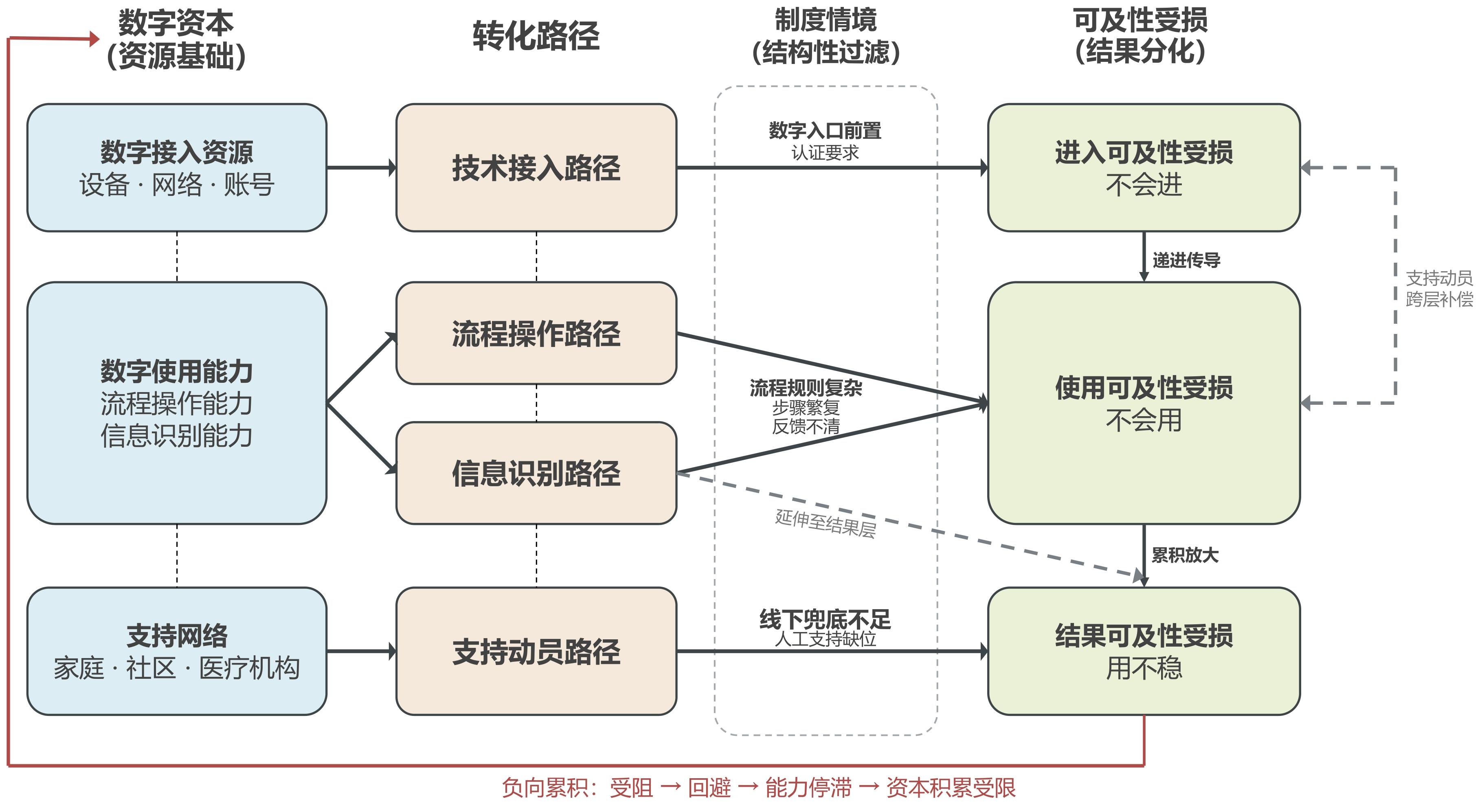
[Purpose/Significance] The aging population and the digital transformation of health services are profoundly altering the conditions under which older adults access healthcare. Although online appointment systems, electronic credentials, mobile payment, and internet-based consultations may increase overall efficiency, they can also make access to devices, accounts, operational skills, and assistance implicit prerequisites for care. This study examines how such prerequisites impair older adults' access to medical services. It clarifies why the issue should be understood as a question of inclusive digital governance and health equity rather than as an individual deficit alone. [Method/Process] This study is a theory-driven conceptual inquiry based on a structured literature review. It first synthesizes scholarship on digital capital, the digital divide, and health-service accessibility. Then, it conducts a structured reading of national policy documents, official health statistics, and publicly available measures designed to facilitate medical treatment for older persons. The analysis proceeds in four steps: defining the outcome as a continuous process of entry, use, and outcome attainment; identifying the resource, competence, and relational components of digital capital; translating these components into the institutional setting of digital health services; and examining whether policy and practice materials are consistent with the proposed mechanisms. The materials are used for cross-source comparison and contextual corroboration rather than causal estimation or claims of statistical generalizability. [Results/Conclusions] The analysis identifies three interrelated components of digital capital: digital access resources, digital-use capability, and support networks. Their unequal distribution impairs accessibility through four pathways: technological access, procedural operation, information recognition, and support mobilization. These pathways jointly affect the ability to enter a service system, complete a service process, and secure a meaningful and continuous service outcome. More specifically, impaired entry accessibility occurs when older adults lack the necessary devices, network connections, and registered accounts for digital medical platforms. Impaired use accessibility occurs when multi-step processes and information-dense interfaces exceed their operational and cognitive capacities. Impaired outcome accessibility occurs when intermittent or absent support networks prevent them from sustaining engagement over time. These three layers are nested and cumulative: failure at the entry level forecloses subsequent use, and fragile use undermines stable outcomes, so that initial resource gaps may compound into structural exclusion through repeated cycles of frustration, avoidance, and skill stagnation. Institutional conditions, including the digitization of service entrances, complex procedural rules, and inadequate offline fallback arrangements, filter and amplify these differences. Official requirements for parallel traditional and intelligent services, multi-channel appointment, family-assisted registration, and age-friendly healthcare arrangements provide practical support for treating the identified barriers as institutionally mediated. The governance implication is, therefore, not to require every older adult to adapt fully to a digital system. Instead, policy should preserve accessible non-digital channels, simplify and clarify digital interfaces, and institutionalize coordinated support from families, communities, and medical institutions. The study contributes an integrated framework that connects resources, conversion pathways, institutional filtering, and differentiated outcomes. Its limitation is that the framework has not been tested with individual-level survey data or longitudinal evidence. Future research should assess pathway strength, interaction effects, and variation across regions and medical institutions.

Key words: digital capital, older adults, access to medical services, digital transformation, digital divide, inclusive governance

CLC Number: 

  • C913.6

Fig.1

Analytical framework of digital capital conversion and impaired medical service accessibility among older adults"

[1]
国家统计局. 中华人民共和国2023年国民经济和社会发展统计公报[R]. (2024-02-29)[2026-05-09]. https://www.stats.gov.cn/sj/zxfb/202402/t20240228_1947915.html.
[2]
World Health Organization. Global strategy on digital health 2020-2025[R]. Geneva: World Health Organization, 2021.
[3]
World Health Organization, United Nations Children's Fund. Operational framework for primary health care: transforming vision into action[R]. Geneva: World Health Organization, 2020.
[4]
中共中央, 国务院. “健康中国2030”规划纲要[Z]. 2016-10-25.
[5]
中共中央办公厅, 国务院办公厅. 关于进一步完善医疗卫生服务体系的意见[Z]. 2023-03-23.
[6]
龚秀全, 曹恬. 医疗可及性对老年人死亡质量不平等的影响研究——基于CLHLS死亡老人调查数据[J]. 保险研究, 2025(5): 70-85.
Gong Xiuquan, Cao Tian. The effect of healthcare accessibility on inequality in the quality of death among the elderly - Based on CLHLS mortality survey data[J]. Insurance Studies, 2025(5): 70-85.
[7]
Hargittai E. Second-level digital divide: Differences in people's online skills[J]. First Monday, 2002, 7(4): 1-20.
[8]
王甫勤. 健康数字鸿沟: 互联网如何改变健康不平等?[J]. 社会学评论, 2025(2): 5-28.
Wang Fuqin. Health digital divide: How does the Internet change health inequalities?[J]. Sociological Review of China, 2025(2): 5-28.
[9]
张胜杰, 陶纪坤. 数字鸿沟、社会资本与健康不平等[J]. 西北人口, 2026, 47(3): 14-28.
Zhang Shengjie, Tao Jikun. Digital divide, social capital, and health inequality[J]. Northwest Population Journal, 2026, 47(3): 14-28.
[10]
代佳欣. 基本公共服务可及性概念: 理论释义与本土建构[J]. 政治学研究, 2025(5): 77-93, 218-219.
Dai Jiaxin. Concept of accessibility of basic public services: Theoretical interpretation and indigenous construction[J]. CASS Journal of Political Science, 2025(5): 77-93, 218-219.
[11]
缪小林, 袭著昊. 均衡与可及: 基本公共服务的理论内涵、互动机制与实现路径[J]. 学术探索, 2026(2): 130-144.
Miao Xiaolin, Xi Zhuhao. Equilibrium and accessibility: Theoretical connotations, interaction mechanisms, and realization paths of basic public services[J]. Academic Exploration, 2026(2): 130-144.
[12]
戴艳清, 王智慧, 郑燃. 公共数字文化资源可及性测评研究[J]. 图书馆学研究, 2025(12): 79-91.
Dai Yanqing, Wang Zhihui, Zheng Ran. Research on the accessibility of public digital cultural resources[J]. Research on Library Science, 2025(12): 79-91.
[13]
Penchansky R, Thomas J W. The concept of access: Definition and relationship to consumer satisfaction[J]. Medical Care, 1981, 19(2): 127-140.
[14]
Andersen R M. Revisiting the behavioral model and access to medical care: Does it matter?[J]. Journal of Health and Social Behavior, 1995, 36(1): 1-10.
[15]
胡宜, 吴彬, 袁靖云. “赋能”与“负能”: 乡村医疗中数字技术的实践与困境——以“数字化医疗服务平台”为例[J]. 科学·经济·社会, 2025, 43(1): 52-64.
Hu Yi, Wu Bin, Yuan Jingyun. "Empowerment" and "negative energy": The practice and dilemma of digital technology in rural healthcare - Take the "digital medical service platform" as an example[J]. Science Economy Society, 2025, 43(1): 52-64.
[16]
马述忠, 张道涵, 潘钢健. 数字金融与老年人健康: 基于优质医疗服务可及机制视角[J]. 求是学刊, 2022, 49(5): 56-70.
Ma Shuzhong, Zhang Daohan, Pan Gangjian. Digital finance and the health of older people: A perspective based on the accessibility mechanism of high-quality medical services[J]. Seeking Truth, 2022, 49(5): 56-70.
[17]
Ragnedda M. The Third Digital Divide: A Weberian Approach to Digital Inequalities[M]. Routledge, 2017.
[18]
晁伟鹏, 杨兵红, 张长江. 数字禀赋、社会资本与老年人身心健康[J]. 西北人口, 2026, 47(1): 99-112.
Chao Weipeng, Yang Binghong, Zhang Changjiang. Digital endowment, social capital, and the physical and mental health of older people [J]. Northwest Population Journal, 2026, 47(1): 99-112.
[19]
康传彬. 注意力偏移与主体性消解: 数字化转型中的老年群体政务服务可及性障碍及其破解[J]. 电子政务, 2026(2): 85-97.
Kang Chuanbin. Attention deviation and subjectivity elimination: Obstacles to the accessibility of government services for older people in digital transformation and their solutions [J]. E-Government, 2026(2): 85-97.
[20]
聂阳. 数字资本如何形塑社会空间结构: 样态、机理与矛盾[J]. 内蒙古社会科学, 2025, 46(6): 55-63.
Nie Yang. How digital capital shapes social spatial structure: Forms, mechanisms and contradictions[J]. Inner Mongolia Social Sciences, 2025, 46(6): 55-63.
[21]
Bourdieu P. The forms of capital[M]//Richardson J G, ed. Handbook of Theory and Research for the Sociology of Education. New York: Greenwood Press, 1986: 241-258.
[22]
张宁, 贺波云. 老年人的数字资本: 内涵解构、维度划分与量表开发[J]. 农业图书情报学报, 2026, 38(2): 16-29.
Zhang Ning, He Boyun. Digital capital for older people: Conceptual connotation, structural dimensions and scale development[J]. Journal of Library and Information Science in Agriculture, 2026, 38(2): 16-29.
[23]
李文杰, 谢奋羽, 张艳. 生活方式数字化、医疗卫生服务可及性与农村边民健康——基于VBEP数据的实证分析[J]. 西北民族研究, 2024(6): 139-155.
Li Wenjie, Xie Fenyu, Zhang Yan. Digitization of lifestyles, accessibility of healthcare services, and the health of rural border inhabitants: Empirical analysis based on the data of VBEP[J]. Journal of Northwestern Ethnic Studies, 2024(6): 139-155.
[24]
郑荣, 张默涵, 王晓宇, 等. 数字医疗背景下乡村公共健康信息服务可及性演化机制研究[J]. 现代情报, 2025, 45(2): 145-159.
Zheng Rong, Zhang Mohan, Wang Xiaoyu, et al. Research on the evolutionary mechanism of accessibility of rural public health information services in the background of digital healthcare[J]. Journal of Modern Information, 2025, 45(2): 145-159.
[25]
国务院办公厅. 关于切实解决老年人运用智能技术困难的实施方案[Z]. 2020-11-15.
[26]
中国互联网络信息中心. 第53次中国互联网络发展状况统计报告[R]. 北京: 中国互联网络信息中心, 2024.
[27]
燕颖川. 数字医疗的价值意蕴、发展困境与实现路径[J/OL]. 中国医学伦理学, 1-8[2026-05-09].
Yan Yingchuan. Value implications, development dilemmas, and realization paths of digital medical care[J/OL]. Chinese Medical Ethics, 1-8[2026-05-09].
[28]
国家卫生健康委员会. 2022年我国卫生健康事业发展统计公报[R]. 北京: 国家卫生健康委员会, 2023.
[29]
潘義承, 王佃利. 可及性养老资源与老年人口匹配格局及其驱动力——以长三角城市群为例[J]. 经济地理, 2025(7): 95-107.
Pan Yicheng, Wang Dianli. Matching patterns and driving forces of accessible elderly care resources and elderly population: A case study of the Yangtze River Delta urban agglomeration[J]. Economic Geography, 2025(7): 95-107.
[30]
王蔚. 老年教育可及性及影响因素[J]. 开放教育研究, 2025, 31(3): 112-120.
Wang Wei. Influencing factors in elderly education from the perspective of public service accessibility[J]. Open Education Research, 2025, 31(3): 112-120.
[31]
翁昱岑, 李伦. 健康公正与技术权利——老年群体数字医疗实践中公平性与可及性问题的伦理分析[J]. 科学与社会, 2025, 15(1): 133-149.
Weng Yucen, Li Lun. Health justice and technological rights - An ethical analysis on equity and accessibility issues in digital healthcare practices for older adults[J]. Science and Society, 2025, 15(1): 133-149.
[32]
国家卫生健康委办公厅. 关于实施进一步便利老年人就医举措的通知: 国卫办医函〔2021〕311号[Z]. 2021-06-15.
[33]
四川省卫生健康委员会. 关于四川省第十四届人民代表大会第四次会议第14040638号建议的复函[EB/OL]. (2025-06-03)[2026-05-09].
[34]
翁列恩. 中国基本公共服务均等化的理论框架与实现路径[J]. 中国社会科学, 2025(5): 54-71, 205.
Weng Lie'en. The theoretical framework and implementation pathway for the equalization of basic public services in China[J]. Social Sciences in China, 2025(5): 54-71, 205.
[35]
张立荣, 张振昌. 数字技术赋能视角下农村基本公共服务可及性提升的机理与路径研究[J]. 农村经济, 2025(6): 105-114.
Zhang Lirong, Zhang Zhenchang. Research on the mechanism and path of improving the accessibility of rural basic public services from the perspective of digital technology empowerment[J]. Rural Economy, 2025(6): 105-114.
[36]
侯建明, 李淞. 社区嵌入式养老服务可及性对老年人生活满意度的影响[J/OL]. 西北人口,1-15[2026-05-09].
Hou Jianming, Li Song. The influence of accessibility of community embedded pension services on life satisfaction of older people [J/OL]. Northwest Population Journal, 1-15[2026-05-09].
[37]
胡志平, 袁凤欣, 张欣远. 角色匹配: 城市社区智慧养老服务可及性的实现机理[J]. 人文杂志, 2025(6): 105-115.
Hu Zhiping, Yuan Fengxin, Zhang Xinyuan. Role matching: The realization mechanism of the accessibility of smart old-age care services in urban communities[J]. The Journal of Humanities, 2025(6): 105-115.
[38]
杨宝, 李万亮. 社区养老服务的可及性差异: 基于“制度-网络-文化”整合性框架的实证分析[J]. 中国行政管理, 2024, 40(2): 54-64.
Yang Bao, Li Wanliang. The discrepancies in access to community elderly care service: An empirical analysis based on an integrated framework of institutions, networks, and culture[J]. Chinese Public Administration, 2024, 40(2): 54-64.
[1] ZHANG Ning, HE Boyun. Digital Capital for the Elderly: Conceptual Connotation, Structural Dimensions and Scale Development [J]. Journal of library and information science in agriculture, 2026, 38(2): 16-29.
[2] MA Liying. The Logic, Challenges, and Responses of Digital Supply and Acquisition of Public Cultural Goods [J]. Journal of library and information science in agriculture, 2024, 36(12): 64-73.
[3] ZHANG Jingbei, XU Yaping, ZHOU Qiong, CAI Yingchun. Future Learning Centers: A Study on Libraries' Role Reorientation, Function Reconstruction, and Practical Innovations [J]. Journal of library and information science in agriculture, 2023, 35(6): 43-50.
[4] Xiong Xue, Nie Fengying, Bi Jieying, Cao Shenshen. Poverty Alleviation from the Perspective of Precision Poverty Alleviation: A case study of We County [J]. Journal of library and information science in agriculture, 2017, 29(5): 5-8.
[5] ZHANG Xiang-ning. The Strategies and Relative Effects of Reducing Digital Divide In Taiwan [J]. Journal of library and information science in agriculture, 2014, 26(9): 142-145.
[6] YAO Yin. Services Ageing Readers to Build a Harmonious Society [J]. Journal of library and information science in agriculture, 2014, 26(1): 164-166.
Viewed
Full text


Abstract

Cited

  Shared   
  Discussed   
No Suggested Reading articles found!