中文    English

Journal of library and information science in agriculture


Impact Effect and Mechanism of Digital Literacy on the Sense of Gain of Urban and Rural Residents: A Case Study of Beijing

MA Chen1,2, LI Jin1,2()   

  1. 1. Information Technology Research Center of Beijing Academy of Agriculture and Forestry Sciences, Beijing 100097
    2. National Agricultural Information Engineering Technology Research Center, Beijing 100097
  • Received:2025-12-21 Online:2026-08-20
  • Contact: LI Jin

Abstract:

[Purpose/Significance] As digital technologies continue to advance, digital literacy has evolved from an emerging skill to a fundamental capability for survival for urban and rural residents alike. The link between digital literacy and residents' sense of gain has gradually become a key way to assess the effectiveness of Digital China initiatives. [Method/Process] This study selected urban and rural residents in Beijing as the research subjects, and used 3,926 survey questionnaires as samples to empirically analyze the impact effect and mechanism of digital literacy on urban and rural residents' sense of gain. First, based on the theoretical definition of digital literacy and the sense of gain of urban and rural residents, a system of indicator encompassing digital literacy and the sense of gain of urban and rural residents was constructed. Then, the impact mechanism of digital literacy on the sense of gain of urban and rural residents is analyzed theoretically. Second, based on questionnaire survey data from 16 districts in Beijing, a more comprehensive and complex model was established using Partial Least Squares Structural Equation Modeling (PLS-SEM) after measuring the digital literacy level of urban and rural residents in Beijing. The impact path of digital literacy on the sense of gain was systematically analyzed, the mediating effect of digital social participation was verified, and further multi-group analysis was conducted from multiple perspectives such as education level, age, and urban-rural differences, revealing the boundary and intensity differences of the impact of digital literacy on the sense of gain. The aim is to provide the government with a theoretical reference for formulating relevant development policies, and to offer other regions forward-looking experience to draw upon. [Results/Conclusions] First, digital literacy has a positive impact on the spiritual, political, economic, and livelihood gains of urban and rural residents, exhibiting a gradient effect. Specifically, the impact on spiritual gains (0.348) is greater than that on livelihood gains (0.330), economic gains (0.279), and political gains (0.249). This finding breaks through the traditional research focus on a single dimension of gains by systematically confirming the enhancing effect of digital literacy on the high-order, multidimensional gains in the areas of spirituality, economics, politics, and livelihood. Second, digital social participation plays a significant mediating role in the process of digital literacy influencing the four types of sense of gain. 21% to 30% of the impact of digital literacy on sense of gain is achieved by activating the digital social participation of urban and rural residents. Moreover, there are differences among different mediating effects, with digital social participation having the highest mediating effect on political sense of gain (30.1%) and the lowest mediating effect on people's livelihood sense of gain (21.8%). Third, there are differentiated adjustments in the effects of demographic characteristics such as urban-rural, age, and education on the path of digital literacy influencing the sense of gain. Among them, the differences between urban and rural groups and education groups are more prominent in key dimensions such as spiritual, political, and people's livelihood, while the influence of age groups is relatively limited.

Key words: digital literacy, urban and rural residents, sense of gain, digital social participation, PLS-SEM model, mediating effect, Beijing

CLC Number: 

  • F328

Table 1

Digital literacy index system and weights"

一级指标 二级指标 三级指标 测量题项 权重
数字素养水平 数字概念意识 数字化概念意识 能否区分数字化与机械化、工业化等概念的差异? 0.048 9
数字化基础意识 数字信息在生产、治理、服务等场景中的价值与重要性如何? 0.028 9
数字化应用意识 运用数字化手段工作、生产、学习的意愿如何? 0.026 8
数字通用素养 基本硬件使用 能否掌握智能手机、电脑等智能终端的基本操作流程? 0.028 0
基本硬件维护 能否完成智能终端设备清洁、软件更新等日常维护任务? 0.031 1
基本软件下载 是否具备常规软件、APP的下载与安装能力? 0.028 9
基本软件使用 是否具备常规软件基础功能模块的操作技能? 0.030 2
数字技术素养 数字信息获取能力 能否掌握通过互联网获取有用信息的技能? 0.050 7
数字理解与分析能力 掌握简单分析数字信息的能力? 0.049 8
数字化生产场景应用能力 是否掌握运用数字化软件设备开展办公、生产、经营等的能力? 0.056 7
数字化生活场景应用能力 是否掌握运用数字化软件设备处理吃穿住行等日常生活事务的能力? 0.054 1
数字化学习场景应用能力 是否掌握运用数字化软件设备在线学习专业技能、专业知识的能力? 0.053 9
数字化金融场景应用能力 是否掌握运用数字化软件设备进行支付及获取金融服务等的能力 0.052 1
数字化娱乐场景应用能力 是否掌握运用数字化软件设备进行娱乐休闲等的能力? 0.051 8
数字创新素养 数字化文本创新 是否具备运用数字化资源撰写文案、博客、产品介绍等开展数字化文本创作的能力? 0.057 1
数字化图像创新 是否具备基于数字化图片制作电子相册、简易海报等开展数字化图像创作的能力? 0.059 6
数字化视频创新 是否具备基于数字化视频在网上制作短视频、VLOG等数字化音视频创作的能力? 0.061 9
数字媒体内容创新 是否具备提出数字化创意、想法、模式、提案、方案设计,参与开放创新活动的能力? 0.054 0
数字社交素养 亲人社交数字化 是否具备运用视频通话等数字工具强化家庭、亲朋情感连接的能力? 0.027 7
熟人社交数字化 是否具备运用电子邮件等数字工具开展熟人、社群数字化关系运营的能力? 0.031 4
陌生人社交数字化 是否具备运用数字工具参与公共事务讨论、提升社会影响力的能力? 0.033 1
数字安全素养 网络安全意识 是否具备根据敏感与重要程度对个人隐私信息进行保护与隐私设置的能力? 0.026 4
安全鉴别意识 是否具备识别网络谣言、防范钓鱼链接等能力? 0.029 0
网络法治观念 是否具备不传播违法违规信息、维护网络生态健康的能力? 0.028 0

Table 2

Descriptive statistics of variables related to digital literacy and residents' sense of gain"

变量名称 测量维度 测量题项 平均值 标准差
数字素养水平 数字概念意识-数字通用素养-数字技术素养-数字创新素养-数字社交素养-数字安全素养 根据熵值法计算得出 75.000 7.593
城乡居民获得感 精神获得感 您对个人认知升级与思想深化的满意度如何 5.057 0.940
您是否认为通过微信、QQ等线上交流方式增进了您与家人朋友的感情
政治获得感 您对智慧城市、数字乡村的公平性满意度如何 4.659 1.000
您是否认为通过互联网能够使政府工作人员直接地关心大众的想法
经济获得感 您是否认为通过互联网能够获得更多的商业信息 5.036 1.121
您是否认为通过互联网能够获得更多的就业渠道资源
民生获得感 您对智慧政务的“一网通办”惠民服务获得感如何 5.037 0.938
您对智慧城市、数字乡村运行管理服务的一网通管服务获得感如何
您对智慧城市、数字乡村一网慧治理服务的获得感如何
数字社会参与 基本公共服务的数字参与 您近一年是否经常通过互联网、智能手机等享受教育、医疗、社保、税务缴纳等基本公共服务 5.269 1.043
政治活动的数字参与 您近一年是否经常通过互联网、智能手机等参与过在线投票、网上选举、社会调查等活动 5.255 1.028
经济活动的数字参与 您近一年是否经常通过互联网、智能手机等参与线上购物、线上商务讲座、线上会议等活动 5.276 1.022
社群关系活动的数字参与 您近一年是否经常通过QQ、微信、朋友圈、微博、抖音、小红书等平台展示、分享、交流自己的生活 5.289 1.033
年龄差异 中青年/中老年 将年龄小于等于45岁的界定为“中青年”,赋值为1;将年龄大于45岁的界定为“中老年”,赋值为2 1.381 0.486
受教育程度差异 高学历/低学历差异 将大专以下的学历水平界定为“低学历”,赋值为1;将大专及以上的学历水平界定为“高学历”,赋值为2 1.285 0.452
城乡差异 城市居民、农村居民 将户口类型为农业户口的界定为农村居民,赋值为1;将户口类型为非农业户口的界定为城市居民,赋值为2 1.416 0.493

Table 3

Results of variable reliability and validity testing"

题项 t P Cronbach's α系数 CR AVE
精神获得感 YA1 87.359 0.000 0.744 0.886 0.796
YA2 89.159 0.000
政治获得感 YB1 61.788 0.000 0.723 0.878 0.783
YB2 52.531 0.000
经济获得感 YC1 52.431 0.000 0.726 0.879 0.785
YC2 74.720 0.000
民生获得感 YD1 48.254 0.000 0.727 0.846 0.647
YD2 46.995 0.000
YD3 32.934 0.000
数字社会参与 M1 43.571 0.000 0.800 0.870 0.625
M2 44.433 0.000
M3 41.533 0.000
M4 45.500 0.000

Table 4

Discriminant validity based on the Fornell-Larcker criterion"

题项 数字素养 数字社会参与 精神获得感 政治获得感 经济获得感 民生获得感
数字素养 -
数字社会参与 0.416 0.791
精神获得感 0.444 0.375 0.892
政治获得感 0.324 0.284 0.28 0.885
经济获得感 0.351 0.289 0.223 0.234 0.886
民生获得感 0.402 0.311 0.252 0.261 0.192 0.804

Table 5

Estimation results of structural equation model"

路径 标准化系数 标准误 t P 95%置信区间 f 2 VIF
2.50% 97.50%
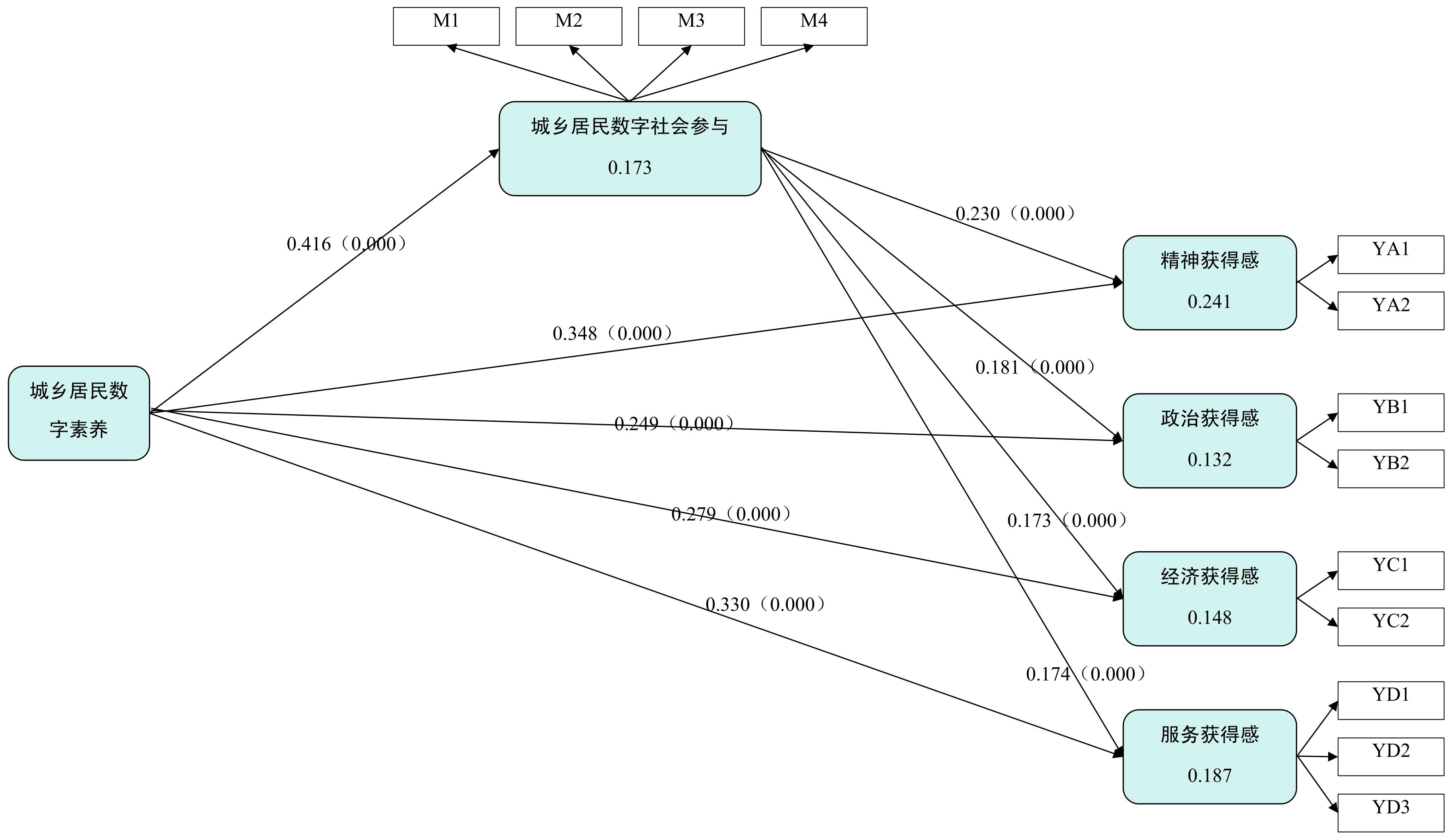
数字素养->精神获得感 0.348 0.042 8.386 0.000 0.258 0.421 0.132 1.209
数字素养->政治获得感 0.249 0.039 6.370 0.000 0.170 0.322 0.059 1.209
数字素养->经济获得感 0.279 0.042 6.684 0.000 0.194 0.359 0.075 1.209
数字素养->民生获得感 0.330 0.041 8.080 0.000 0.247 0.406 0.111 1.209
数字素养->数字社会参与 0.416 0.035 11.803 0.000 0.343 0.481 0.209 1.000
数字社会参与->精神获得感 0.230 0.038 5.987 0.000 0.153 0.303 0.058 1.209
数字社会参与->政治获得感 0.181 0.041 4.408 0.000 0.099 0.258 0.031 1.209
数字社会参与->经济获得感 0.173 0.038 4.554 0.000 0.097 0.248 0.029 1.209
数字社会参与->民生获得感 0.174 0.042 4.168 0.000 0.087 0.254 0.031 1.209

Table 6

PLS predict results"

题项 Q²预测值 PLS-SEM模型 线性模型 PLS-LM
RMSE MAE RMSE MAE ΔRMSE ΔMAE
PLS Predict LV Summary
数字社会参与 0.171 0.914 0.696
精神获得感 0.193 0.900 0.723
政治获得感 0.101 0.951 0.773
经济获得感 0.119 0.940 0.748
民生获得感 0.159 0.919 0.722
PLS Predict MV Summary
M1 0.104 0.988 0.787 0.988 0.787 0.000 0.000
M2 0.113 0.969 0.780 0.969 0.780 0.000 0.000
M3 0.105 0.968 0.791 0.968 0.791 0.000 0.000
M4 0.106 0.978 0.789 0.978 0.790 0.000 -0.001
YA1 0.154 0.794 0.646 0.794 0.647 0.000 -0.001
YA2 0.153 1.138 0.923 1.138 0.923 0.000 0.000
YB1 0.086 0.986 0.824 0.987 0.823 -0.001 0.001
YB2 0.072 1.184 0.964 1.184 0.965 0.000 -0.001
YC1 0.082 1.217 0.996 1.217 0.996 0.000 0.000
YC2 0.105 1.195 0.963 1.195 0.963 0.000 0.000
YD1 0.110 1.182 0.956 1.182 0.956 0.000 0.000
YD2 0.105 1.168 0.946 1.168 0.946 0.000 0.000
YD3 0.094 0.965 0.787 0.965 0.788 0.000 -0.001

Fig.1

The impact mechanism of digital literacy on the sense of gain of urban and rural residents"

Table 7

Significance test of the mediating effect of digital social participation"

总效应路径 标准化系数 标准误 95%置信区间
2.50% 97.50%
数字素养->精神获得感 Total Effect 0.444 0.037 0.366 0.510
Direct Effect 0.348 0.042 0.258 0.421
Indirect Effect 0.096 0.017 0.065 0.131
数字素养->政治获得感 Total Effect 0.324 0.034 0.256 0.388
Direct Effect 0.249 0.039 0.170 0.322
Indirect Effect 0.075 0.018 0.041 0.112
数字素养->经济获得感 Total Effect 0.351 0.036 0.277 0.418
Direct Effect 0.279 0.042 0.194 0.359
Indirect Effect 0.072 0.018 0.040 0.109
数字素养->民生获得感 Total Effect 0.402 0.036 0.328 0.467
Direct Effect 0.330 0.041 0.247 0.406
Indirect Effect 0.072 0.018 0.038 0.109

Table 8

Multi-group analysis results"

路径 城乡差异 年龄差异 学历差异
农村(I) 城市(J) Δ(I-J) 中青年(I) 中老年(J) Δ(I-J) 低学历(I) 高学历(J) Δ(I-J)
数字素养→精神获得感 0.241*** 0.52*** -0.279*** 0.382*** 0.306*** 0.076 0.317*** 0.440*** -0.123
数字素养→政治获得感 0.198*** 0.300*** -0.102 0.276*** 0.196** 0.08 0.236*** 0.262*** -0.026
数字素养→经济获得感 0.262*** 0.288*** -0.026 0.268*** 0.279*** -0.011 0.266*** 0.299*** -0.032
数字素养→民生获得感 0.296*** 0.365*** -0.068 0.311*** 0.340*** -0.029 0.276*** 0.481*** -0.204*
数字素养→数字社会参与 0.344*** 0.492*** -0.149* 0.441*** 0.354*** 0.087 0.375*** 0.493*** -0.118
数字社会参与→精神获得感 0.265*** 0.137* 0.128 0.190*** 0.279*** -0.089 0.241*** 0.165* 0.076
数字社会参与→政治获得感 0.096 0.301*** -0.205* 0.145** 0.210** -0.065 0.104* 0.324*** -0.220*
数字社会参与→经济获得感 0.120** 0.251*** -0.131 0.150** 0.187** -0.037 0.138** 0.221** -0.083
数字社会参与→民生获得感 0.156** 0.185** -0.029 0.279*** 0.019 0.260** 0.162** 0.170* -0.008
[1]
光明日报. 科学统筹突出重点对准焦距, 让人民群众对改革有更多获得感[EB/OL]. (2015-02-28)[2025-04-28].
[2]
新华社. 习近平: 决胜全面建成小康社会 夺取新时代中国特色社会主义伟大胜利——在中国共产党第十九次全国代表大会上的报告[EB/OL]. (2017-10-2)[2025-04-28].
[3]
文宏, 林彬. 人民获得感: 美好生活期待与国民经济绩效间的机理阐释——主客观数据的时序比较分析[J]. 学术研究, 2021(1): 66-73.
Wen Hong, Lin Bin. The sense of people's gains: The mechanism between the good life expectation and national economic performance - Comparative analysis of time series based on subjective and objective data[J]. Academic Research, 2021(1): 66-73.
[4]
李丹. 数字社会的“权利鸿沟”及其弥合[J]. 河北法学, 2024, 42(6): 127-143.
Li Dan. The "right divide" in digital society and its bridging[J]. Hebei Law Science, 2024, 42(6): 127-143.
[5]
单志广. 什么是智慧城市 [J]. 供用电, 2014, 31(10): 14-15, 22, 4.
Shan Zhiguang. Smartcity applied in practice[J]. Distribution & Utilization, 2014, 31(10): 14-15, 22, 4.
[6]
王也. 数字鸿沟与数字弱势群体的国家保护[J]. 比较法研究, 2023(5): 121-137.
Wang Ye. Digital divide and the state protection of digitally disadvantaged groups[J]. Journal of Comparative Law, 2023(5): 121-137.
[7]
湛礼珠, 张延龙, 马晓蕾. 悬浮推进、工具理性与数字乡村建设转型[J]. 农村经济, 2023(6): 1-10.
Zhan Lizhu, Zhang Yanlong, Ma Xiaolei. Suspended promotion, instrumental rationality and transformation of digital rural construction[J]. Rural Economy, 2023(6): 1-10.
[8]
陈文旭, 聂嘉琪. 21世纪全球数字鸿沟审视与中国方案[J]. 新疆社会科学(汉文版), 2023(6): 147-155.
Chen Wenxu, Nie Jiaqi. Review of the global digital divide and China's solution in the 21st century[J]. Social Sciences in Xinjiang, 2023(6): 147-155.
[9]
焦豪, 朱永麒, 李宛蓉. 数字素养对流动人口社会融入影响机制研究[J]. 商业经济与管理, 2025(2): 62-73.
Jiao Hao, Zhu Yongqi, Li Wanrong. Study on the mechanisms of digital literacy on Migrants'Social integration[J]. Journal of Business Economics, 2025(2): 62-73.
[10]
苏红键. 数字城乡建设: 通往城乡融合与共同富裕之路[J]. 电子政务, 2022(10): 88-98.
Su Hongjian. Digital urban and rural construction: the road to urban-rural integration and common prosperity[J]. E-Government, 2022(10): 88-98.
[11]
李静. 全民数字素养何以筑基智慧城市建设 [J]. 中国建设信息化, 2024(13): 62-65.
Li Jing. How to lay the foundation of nationwide digital literacy for smart city construction [J]. Informatization of China Construction, 2024(13): 62-65.
[12]
杨仲山, 初放. 数字素养对老年人主观福利的影响——基于新人力资本理论的研究视角[J]. 山西财经大学学报, 2025, 47(1): 31-47.
Yang Zhongshan, Chu Fang. Impact of digital literacy on subjective welfare of the elderly - Research perspective based on new human capital theory[J]. Journal of Shanxi Finance and Economics University, 2025, 47(1): 31-47.
[13]
单志广. 新型智慧城市与智慧社会建设[J]. 中国建设信息化, 2018(5): 12-15.
Shan Zhiguang. New smart city and smart society construction[J]. Informatization of China Construction, 2018(5): 12-15.
[14]
丛雅静, 蔡宁. 北京智慧城市评价研究——基于3263位市民的电话调查[J]. 电子政务, 2014(12): 86-92.
Cong Yajing, Cai Ning. Research on the evaluation of smart cities in Beijing - Based on the telephone survey of 3263 citizens[J]. E-Government, 2014(12): 86-92.
[15]
北京市统计局. 北京统计年鉴2024[EB/OL]. (2025-03-20)[2025-04-28].
[16]
Gilster P. Digital Literacy[M]. New York, NY: Wiley, 1997: 25-48.
[17]
Calvani A, Fini A, Ranieri M, et al. Are young generations in secondary school digitally competent A study on Italian teenagers[J]. Computers & Education, 2012, 58(2): 797-807.
[18]
Fraillon J, Schulz W, Ainley J. International Computer and Information Literacy Study: Assessment Framework[M]. the Netherlands: IEA Secretariat, 2013.
[19]
Kuhlemeier H, Hemker B. The impact of computer use at home on students' Internet skills[J]. Computers & Education, 2007, 49(2): 460-480.
[20]
马晨, 李瑾, 李泽欣, 等. 数字乡村背景下的农民数字素养水平评价与影响因素研究[J]. 农业图书情报学报, 2024, 36(7): 19-33.
Ma Chen, Li Jin, Li Zexin, et al. Evaluation and influencing factors of farmers' digital literacy levels in the context of the digital countryside[J]. Journal of Library and Information Science in Agriculture, 2024, 36(7): 19-33.
[21]
中共中央网络安全和信息化委员会办公室. 提升全民数字素养与技能行动纲要[EB/OL]. [2021-11-05].
[22]
兰国帅, 郭倩, 张怡, 等. 欧盟教育者数字素养框架:要点解读与启示[J]. 现代远程教育研究, 2020, 32(6): 23-32.
Lan Guoshuai, Guo Qian, Zhang Yi, et al. Key points and considerations of European framework for the digital competence of educators[J]. Modern Distance Education Research, 2020, 32(6): 23-32.
[23]
高欣峰, 陈丽. 信息素养、数字素养与网络素养使用语境分析——基于国内政府文件与国际组织报告的内容分析[J]. 现代远距离教育, 2021(2): 70-80.
Gao Xinfeng, Chen Li. The usage context analysis of information literacy, digital literacy and network literacy - Content analysis based on domestic government documents and reports from international organizations[J]. Modern Distance Education, 2021(2): 70-80.
[24]
中国社会科学院信息化研究中心. 乡村振兴战略背景下中国乡村数字素养调查分析报告[EB/OL]. [2023-03-23].
[25]
曹现强, 李烁. 获得感的时代内涵与国外经验借鉴[J]. 人民论坛·学术前沿, 2017(2): 18-28.
Cao Xianqiang, Li Shuo. The connotation of "gain" and the foreign experiences[J]. Frontiers, 2017(2): 18-28.
[26]
陈海玉, 郭学静, 刘庚常. 基于结构方程模型的劳动者主观获得感研究[J]. 西北人口, 2018, 39(6): 85-95.
Chen Haiyu, Guo Xuejing, Liu Gengchang. Study on the laborer's subjective sense of gain based on SEM[J]. Northwest Population Journal, 2018, 39(6): 85-95.
[27]
郑风田, 陈思宇. 获得感是社会发展最优衡量标准——兼评其与幸福感、包容性发展的区别与联系[J]. 人民论坛·学术前沿, 2017(2): 6-17.
Zheng Fengtian, Chen Siyu "Sense of gain" is the best measure of social development - Also on its differences and connections with happiness and inclusive development[J]. Frontiers, 2017(2): 6-17.
[28]
王艳丽, 陈红. 城市社区居民获得感量表的编制[J]. 心理与行为研究, 2021, 19(5): 665-670.
Wang Yanli, Chen Hong. The development of sense of gain questionnaire among urban community residents[J]. Studies of Psychology and Behavior, 2021, 19(5): 665-670.
[29]
赵卫华. 消费视角下城乡居民获得感研究[J]. 北京工业大学学报(社会科学版), 2018, 18(4): 1-7.
Zhao Weihua. Research on the people's sense of gain from the perspective of consumption[J]. Journal of Beijing University of Technology (Social Sciences Edition), 2018, 18(4): 1-7.
[30]
文宏. 政治获得感评价指标体系与地区比较实证研究——基于因子分析和聚类分析[J]. 经济社会体制比较, 2020(3): 96-106.
Wen Hong. An empirical study of the evaluation index system of the political sense of acquisition, and the comparison between the regional political sense of acquisition: Based on a factor analysis and cluster analysis[J]. Comparative Economic & Social Systems, 2020(3): 96-106.
[31]
姚迎春, 杨业华. 论思想政治理论课获得感的内涵[J]. 湖北社会科学, 2018(4): 183-187.
Yao Yingchun, Yang Yehua. On the connotation of the sense of acquisition in the course of ideological and political theory[J]. Hubei Social Sciences, 2018(4): 183-187.
[32]
董瑛. 增进人民群众对反腐倡廉的“获得感”研究——新形势下反腐倡廉建设新理念新布局[J]. 理论与改革, 2017(1): 99-103.
Dong Ying. Research on enhancing people's sense of gaining from fighting corruption and advocating honesty - New concept and layout of fighting corruption and advocating honesty under the new situation[J]. Theory and Reform, 2017(1): 99-103.
[33]
吕小康, 黄妍. 如何测量“获得感” ——以中国社会状况综合调查(CSS)数据为例[J]. 西北师大学报(社会科学版), 2018, 55(5): 46-52.
Lv Xiaokang, Huang Yan. Measuring "sense of gain": Based on the analysis of the survey data of Chinese society[J]. Journal of Northwest Normal University (Social Sciences), 2018, 55(5): 46-52.
[34]
阳义南. 民生公共服务的国民“获得感”: 测量与解析——基于MIMIC模型的经验证据[J]. 公共行政评论, 2018, 11(5): 117-137, 189.
Yang Yinan. The obtained sense from the Minsheng public services: Measurement and explanation[J]. Journal of Public Administration, 2018, 11(5): 117-137, 189.
[35]
董洪杰, 谭旭运, 豆雪姣, 等. 中国人获得感的结构研究[J]. 心理学探新, 2019, 39(5): 468-473.
Dong Hongjie, Tan Xuyun, Dou Xuejiao, et al. The structure of Chinese sense of gain[J]. Psychological Exploration, 2019, 39(5): 468-473.
[36]
邵雅利. 新时代人民主观获得感的指标构建与影响因素分析[J]. 新疆社会科学, 2019(4): 139-147.
Shao Yali. Index construction and influencing factors analysis of people's subjective sense of acquisition in the new era[J]. Social Sciences in Xinjiang, 2019(4): 139-147.
[37]
徐延辉, 李志滨. 社会质量与城市居民的获得感研究[J]. 南开学报(哲学社会科学版), 2021(4): 169-181.
Xu Yanhui, Li Zhibin. Social quality and urban Residents’Sense of gain[J]. Nankai Journal (Philosophy Literature and Social Science Edition), 2021(4): 169-181.
[38]
汤峰, 苏毓淞. “内外有别”: 政治参与何以影响公众的获得感 [J]. 公共行政评论, 2022, 15(2): 22-41, 195-196.
Tang Feng, Su Yusong. A study on the sense of gain from the perspective of political participation: Based on CSS 2015-2019[J]. Journal of Public Administration, 2022, 15(2): 22-41, 195-196.
[39]
凌珑. 就业质量与居民主观福利——基于中国劳动力动态调查的实证研究[J]. 统计研究, 2022, 39(10): 149-160.
Ling Long. Employment quality and residents' subjective well-being: An empirical study based on China labor force dynamic survey[J]. Statistical Research, 2022, 39(10): 149-160.
[40]
郑建君, 马璇, 刘丝嘉. 公共服务参与会增加个体的获得感吗 ——基于政府透明度与信任的调节作用分析[J]. 公共行政评论, 2022, 15(2): 42-59.
Zheng Jianjun, Ma Xuan, Liu Sijia. Will public service participation increase individuals' sense of gain - Based on the analysis of moderating effect of government transparency and government trust[J]. Journal of Public Administration, 2022, 15(2): 42-59.
[41]
王恬, 谭远发, 付晓珊. 我国居民获得感的测量及其影响因素[J]. 财经科学, 2018(9): 120-132.
Wang Tian, Tan Yuanfa, Fu Xiaoshan. The residents' sense of gain in China and its determinants[J]. Finance & Economics, 2018(9): 120-132.
[42]
谭旭运, 张若玉, 董洪杰, 等. 青年人获得感现状及其影响因素[J]. 中国青年研究, 2018(10): 49-57.
Tan Xuyun, Zhang Ruoyu, Dong Hongjie, et al. The young people's sense of acquisition and its influencing factors[J]. China Youth Study, 2018(10): 49-57.
[43]
张玫, 霍增辉. 农户主观获得感测度及影响因素研究——以浙江省16个村为例[J]. 地域研究与开发, 2022, 41(6): 136-141.
Zhang Mei, Huo Zenghui. Study on measurement and determinants of rural households' sense of gain: Taking 16 villages in Zhejiang Province as example[J]. Areal Research and Development, 2022, 41(6): 136-141.
[44]
张连刚. 基于多群组结构方程模型视角的绿色购买行为影响因素分析——来自东部、中部、西部的数据[J]. 中国农村经济, 2010(2): 44-56.
Zhang Liangang. Analysis on influencing factors of green purchasing behavior based on multi-group structural equation model - Data from East, Middle and West China[J]. Chinese Rural Economy, 2010(2): 44-56.
[45]
崔登峰, 黎淑美. 特色农产品顾客感知价值对顾客购买行为倾向的影响研究——基于多群组结构方程模型[J]. 农业技术经济, 2018(12): 119-129.
Cui Dengfeng, Li Shumei. The influence of customer perceived value of featured agricultural products on customer purchase behavior - Based on multi-group structural equation model[J]. Journal of Agrotechnical Economics, 2018(12): 119-129.
[46]
郭秀荣, 王娟. 熵权法和灰色分析的一个教学案例设计及软件实现[J]. 统计与管理, 2014, 29(2): 175-176.
Guo Xiurong, Wang Juan. A teaching case design and software implementation of entropy weight method and grey analysis[J]. Statistics and Management, 2014, 29(2): 175-176.
[47]
Hair J F, Hult G T M, Ringle C M, et al. Partial least squares structural equation modeling (PLS-SEM) using R: A workbook[M]. Cham: Springer International Publishing, 2021.
[48]
朱宏城, 田甜. 微观视角下居民消费碳排放结构及影响因素研究——基于PLS-SEM模型的实证分析[J]. 干旱区资源与环境, 2022, 36(1): 59-65.
Zhu Hongcheng, Tian Tian. Research on the carbon emission structure of household consumption and its influencing factors from the micro perspective[J]. Journal of Arid Land Resources and Environment, 2022, 36(1): 59-65.
[49]
郑彩华. 联合国教科文组织《数字素养全球框架》: 背景、内容及启示[J]. 外国中小学教育, 2019(9): 1-9.
Zheng Caihua. The digital literacy global framework(DLGF): Background, characteristics and enlightenment[J]. Primary & Secondary Schooling Abroad, 2019(9): 1-9.
[50]
文宏, 刘志鹏. 人民获得感的时序比较——基于中国城乡社会治理数据的实证分析[J]. 社会科学, 2018(3): 3-20.
Wen Hong, Liu Zhipeng. Timing comparison of the sense of gain to China: Trends and disparities empirical analysis based on Chinese urban and rural social governance data[J]. Journal of Social Sciences, 2018(3): 3-20.
[51]
张正, 金丽馥. 获得感研究述评与展望——基于2015-2020年文献CiteSpace可视化分析[J]. 江苏大学学报(社会科学版), 2021, 23(5): 91-101.
Zhang Zheng, Jin Lifu. Review and prospect of research on sense of gain - Visual analysis of CiteSpace based on 2015-2019 literature[J]. Journal of Jiangsu University (Social Science Edition), 2021, 23(5): 91-101.
[52]
罗强强, 郑莉娟, 郭文山, 等. “银发族”的数字化生存:数字素养对老年人数字获得感的影响机制[J]. 图书馆论坛, 2023, 43(5): 130-139.
Luo Qiangqiang, Zheng Lijuan, Guo Wenshan, et al. Being digital senior citizens: The influence mechanism of digital literacy on the sense of digital fulfillment of the elderly[J]. Library Tribune, 2023, 43(5): 130-139.
[53]
马晨, 李瑾, 冯献. 农民数字素养对其数字乡村参与的影响机制研究[J]. 西南农业大学学报, 2024, 37(9): 1937-1949.
Ma Chen, Li Jin, Feng Xian. Impact mechanism of farmers' digital literacy on their participation in digital village[J]. Southwest China Journal of Agricultural Sciences, 2024, 37(9): 1937-1949.
[54]
林龙飞, 祝仲坤. 频繁换工: 数字技术助推农民工 “短工化” 现象吗 [J]. 南京农业大学学报(社会科学版), 2023, 23(3): 141-154.
Lin Longfei, Zhu Zhongkun. Frequent job changes: Is digital technology contributing to migrant workers' shortage of jobs [J]. Journal of Nanjing Agricultural University (Social Sciences Edition), 2023, 23(3): 141-154.
[55]
田鸽, 张勋. 数字经济、非农就业与社会分工[J]. 管理世界, 2022, 38(5): 72-84.
Tian Ge, Zhang Xun. Digital economy, non-agricultural employment, and division of labor[J]. Journal of Management World, 2022, 38(5): 72-84.
[56]
石宝峰, 田锦萱, 孙梦遥. “低学历”抑或“高学历”: 谁带来了更高的违约率[J]. 农业技术经济, 2024(3): 4-19.
Shi Baofeng, Tian Jinxuan, Sun Mengyao. Low education or high education: Which brings higher default rates [J]. Journal of Agrotechnical Economics, 2024(3): 4-19.
[57]
徐彩瑶, 钱晨, 孔凡斌. 数字乡村建设能否缩小城乡收入差距——基于农业科技进步中介和门槛效应的实证检验[J]. 农业技术经济, 2024(12): 4-24.
Xu Caiyao, Qian Chen, Kong Fanbin. Can digital village construction narrow urban-rural income gap: An empirical test based on the mediating and threshold effect of agricultural scientific and technological progress[J]. Journal of Agrotechnical Economics, 2024(12): 4-24.
[58]
杨怡, 陶文清, 王亚飞. 数字普惠金融对城乡居民收入差距的影响[J]. 改革, 2022(5): 64-78.
Yang Yi, Tao Wenqing, Wang Yafei. The impact of digital inclusive finance on the income gap between urban and rural residents[J]. Reform, 2022(5): 64-78.
[59]
Hair J F Jr, Black W C, Babin B J, et al. Multivariate Data Analysis[M]. 8th ed. Upper Saddle River, NJ: Cengage, 2019.
[60]
Cronbach L J. Coefficient alpha and the internal structure of tests[J]. Psychometrika, 1951, 16(3): 297-334.
[61]
周欣, 王耀斌, 贺相春. 教师数字化教学能力影响因素实证研究——基于PLS-SEM和fsQCA方法[J]. 现代教育技术, 2025, 35(3): 66-76.
Zhou Xin, Wang Yaobin, He Xiangchun. An empirical study on the influencing factors of teachers' digital teaching ability - Based on PLS-SEM and fsQCA methods[J]. Modern Educational Technology, 2025, 35(3): 66-76.
[62]
Hair J F, Ringle C M, Sarstedt M. PLS-SEM: Indeed a silver bullet[J]. Journal of Marketing Theory and Practice, 2011, 19(2): 139-152.
[63]
Henseler J, Dijkstra T K, Sarstedt M, et al. Common beliefs and reality about partial least squares: Comments on Rönkkö and Evermann[J]. Organizational Research Methods, 2014, 17(2): 182-209.
[64]
Shmueli G, Ray S, Velasquez Estrada J M, et al. The elephant in the room: Predictive performance of PLS models[J]. Journal of Business Research, 2016, 69(10): 4552-4564.
[1] WU Yanyan, ZHANG Jinling. Digital Literacy, Perception of New Quality Productive Forces, and Green Production Willingness: Evidence from Large-Scale Farmers in Northwest China [J]. Journal of library and information science in agriculture, 2026, 38(6): 115-130.
[2] GUO Jinbo. Effects of AIGC on Reader Trust in Library Information [J]. Journal of library and information science in agriculture, 2026, 38(4): 84-98.
[3] CUI Shaojie, LIU Yanping. Impact of Digital Literacy on Rural Governance Effectiveness: Based on the Survey of 306 Rural Residents in Xia County, Shanxi Province [J]. Journal of library and information science in agriculture, 2025, 37(4): 39-50.
[4] WANG Xiaokun. Comparative Research on International Online Open Digital Literacy Assessment Tools [J]. Journal of library and information science in agriculture, 2025, 37(3): 53-65.
[5] SUN Zhimei, LIU Yan, LIU Wenyun, LI Ruiqin. Perception and Utilization of Digital Literacy Knowledge by University Library Users from Representational Pers Perspective [J]. Journal of library and information science in agriculture, 2025, 37(2): 23-36.
[6] LUO Guofeng, YI Tong, YAN Zhouzhou. Critical Information Literacy Education in University Libraries from the Perspective of AIGC Application [J]. Journal of library and information science in agriculture, 2025, 37(1): 47-58.
[7] Xuemei LUO, Yuzhe LIN. Graduate Student Digital Literacy Promotion Pathway Driven by AIGC [J]. Journal of library and information science in agriculture, 2024, 36(9): 70-77.
[8] Baiyang LI, Rong SUN. Construction of an AI Literacy General Education Curriculum Based on "Knowledge-Skills" Navigation [J]. Journal of library and information science in agriculture, 2024, 36(8): 34-42.
[9] Chen MA, Jin LI, Zexin LI, Beibei FAN, Xian FENG. Evaluation and Influencing Factors of Farmers' Digital Literacy Levels in the Context of the Digital Countryside [J]. Journal of library and information science in agriculture, 2024, 36(7): 19-33.
[10] YANG Xing. Practice and Enlightenment of Developing Librarians' Digital Scholarship Service Skills at the University of Florida Library [J]. Journal of library and information science in agriculture, 2024, 36(5): 93-101.
[11] WANG Xiaoyu, ZHANG Suluo. Farmers' Digital Literacy under the Background of Digital Rural Construction: Concept and Framework Construction [J]. Journal of library and information science in agriculture, 2024, 36(5): 52-64.
[12] WANG Weizheng, QIAO Hong, LI Xiaojun, WANG Jingjing. User Willingness to Use Generative Artificial Intelligence Based on AIDUA Framework [J]. Journal of library and information science in agriculture, 2024, 36(2): 36-50.
[13] YI Tong, LUO Guofeng. Improving Digital Literacy of University Librarians Using Educational Technology [J]. Journal of library and information science in agriculture, 2024, 36(2): 61-70.
[14] Xiaoyu WANG, Shuo LI, Suluo ZHANG. Constructing and Researching the Collaborative Cultivation Model of Farmers' Digital Literacy from the Perspective of Activity Theory [J]. Journal of library and information science in agriculture, 2024, 36(10): 63-75.
[15] CUI Kai. Analysis of Farmers' Information Acquisition Behavior for Digital Inclusion: Group Focus and Practical Concerns [J]. Journal of library and information science in agriculture, 2024, 36(1): 33-45.
Viewed
Full text


Abstract

Cited

  Shared   
  Discussed   
No Suggested Reading articles found!