中文    English

Journal of library and information science in agriculture ›› 2025, Vol. 37 ›› Issue (9): 4-17.doi: 10.13998/j.cnki.issn1002-1248.25-0560

    Next Articles

Construction of a Dynamic Perception System for Talent Supply-Demand Matching: Theoretical Framework and Implementation Path

YANG Guancan, ZHANG Zihe   

  1. School of Information Resource Management, RenMin University of China, Beijing 100872
  • Received:2025-07-20 Online:2025-09-05 Published:2025-12-08

Abstract:

[Purpose/Significance] Against the backdrop of rapid technological change and industrial transformation, China's labor market is undergoing profound restructuring, giving rise to multi-dimensional mismatches in the scale, structure, skills, and spatial distribution of talent supply and demand. Traditional governance models, which are largely dependent on statistical reporting and periodic planning, are increasingly inadequate in terms of timeliness, granularity, and evidence support. In response, this study focuses on matching talent supply and demand and integrates situation awareness theory with the intelligence-processing paradigm of "from information to decision." We propose a five-layer dynamic perception framework - "Data-Perception-Comprehension-Projection-Decision" - tailored to talent governance. The framework addresses the limitations of existing research, which often focuses on static measurements and neglects external events and policy shocks. It establishes a governance-oriented theoretical tool that meets major national strategic needs. By incorporating an event-driven dynamic sensing mechanism, the framework enables real-time identification and forward-looking regulation of talent mismatches in complex and evolving environments. [Method/Process] Theoretically, the study builds on Endsley's situation awareness model and further incorporates intelligence processes, causal inference, and complex systems theory, expanding the traditional "perception-comprehension-projection" cognitive sequence into a social closed loop governance system anchored by a robust data foundation and decision-feedback mechanism. Technically, we construct an event ontology and slot schema specific to talent supply-demand scenarios. Through event extraction and large language model-based semantic reasoning, the system generates structured "event-entity-relation" knowledge units from heterogeneous sources such as policy documents, industry reports, and job postings. Knowledge is then aligned and integrated using retrieval-augmented generation, domain knowledge graphs, and authoritative classification standards. At the modeling level, the framework integrates efficiency assessment, causal inference, and risk analysis into a unified "situation comprehension-situation projection" analytical architecture. Methods such as stochastic frontier analysis, difference-in-differences, and multi-agent simulation are employed to examine talent allocation efficiency, policy impacts, and supply-demand evolution. In application, a prototype system - combining data governance, event sensing, early warning, and decision support - is developed and tested using higher education major-industry matching as an empirical case. [Results/Conclusions] This research has developed an operational and verifiable theoretical and technical framework for the dynamic sensing of talent supply-demand alignment. It establishes a coherent chain that spans from "multi-source data integration" to "event-driven sensing," "causal mechanism analysis," "medium- and long-term trend projection," and "policy scenario evaluation," thereby facilitating a transformation in talent governance from static planning to dynamic monitoring, and from experience-based judgment to evidence-driven decision-making. The proposed system not only converts heterogeneous multi-source data into computable event knowledge, but also identifies the root causes of mismatches through causal inference and efficiency assessment. Moreover, it delineates potential future trajectories via trend forecasting and risk alerts. Building upon this foundation, decision-makers can leverage scenario simulation and strategy recommendations to obtain quantitative evidence and actionable plans for program restructuring, enrollment planning optimization, and curriculum reform. Nevertheless, the study has several limitations, including uneven data quality across sources, model dependence on historical samples, and the need for more fine-grained representation of complex behavioral mechanisms. Future research could build on the current work in several directions. For instance, it could incorporate richer data on individual behaviors and organizational strategies to enhance the model's ability to depict micro-level decision-making processes. It could also deepen the integration of causal inference with knowledge-graph techniques to improve the accuracy and clarity of identifying the effects of complex policy portfolios.

Key words: talent supply-demand matching, dynamic perception, data governance, event extraction, knowledge graph

CLC Number: 

  • G350.7

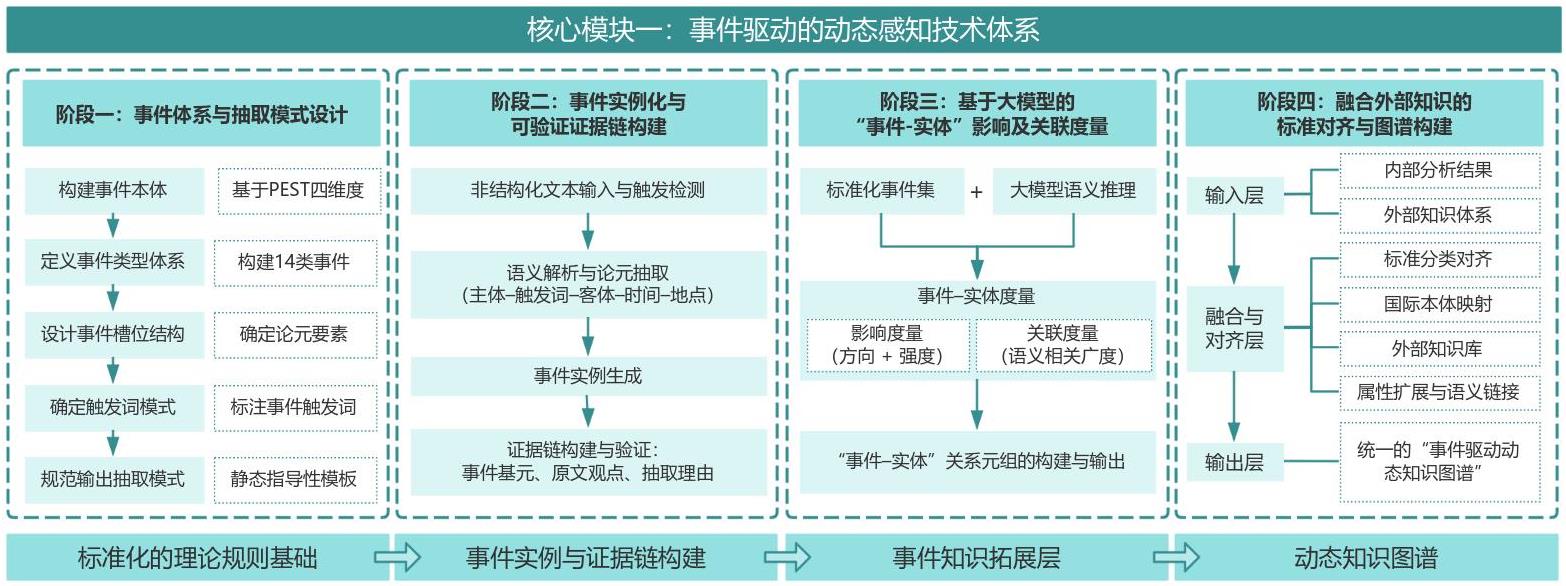
Fig.1

Four stages of the event-driven dynamic perception technology framework"

Table 1

Framework of the dynamic perception modeling system"

分析目标 方法类别 核心问题 典型场景 方法工具
态势理解 效能评估 资源配置效率如何?优化空间多大? 区域人才配置效能评估、专业结构性失衡诊断 随机前沿分析、数据包络分析、生产率分解
机制解析 特定因素的因果效应是什么? 政策效果评估、技术冲击影响分析 双重差分、断点回归、匹配估计
证据挖掘 问题背后的深层模式是什么? 就业困境根源分析、新兴产业风险识别 主题建模、情感分析、因果网络挖掘
态势预测 趋势外推 未来供需如何定量变化? 重点产业需求预测、就业市场波动分析 时间序列分析、机器学习预测、联立方程模型
行为模拟 策略互动下系统如何演化? 技术变革影响推演、政策连锁反应模拟 多智能体仿真、动态博弈分析、系统动力学
风险评估 可能面临哪些风险情景? 人才过剩预警、岗位冲击评估 情景分析、蒙特卡洛模拟、贝叶斯网络

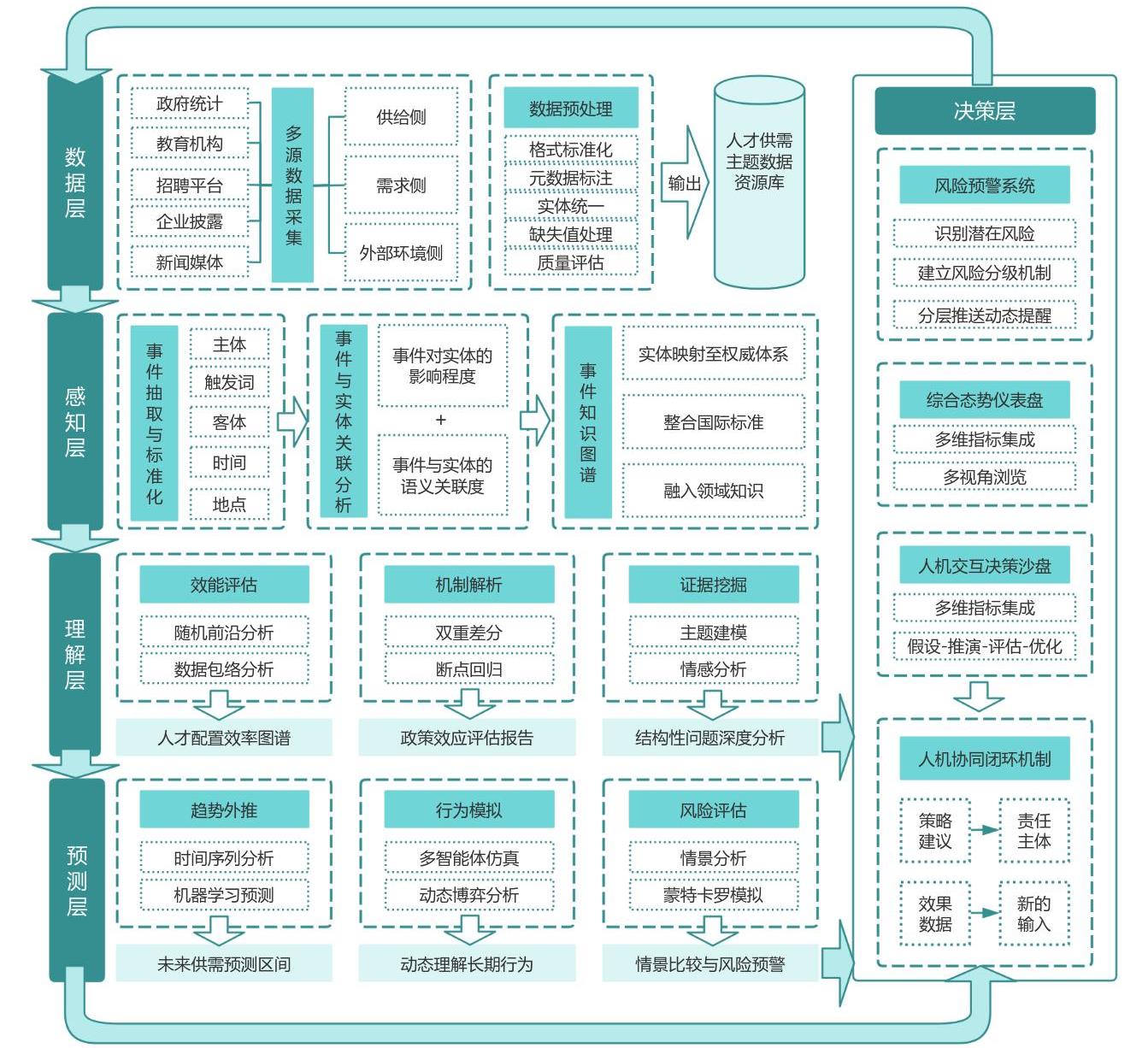
Fig.2

A closed-loop governance system for dynamically matching talent supply and demand"

Fig.3

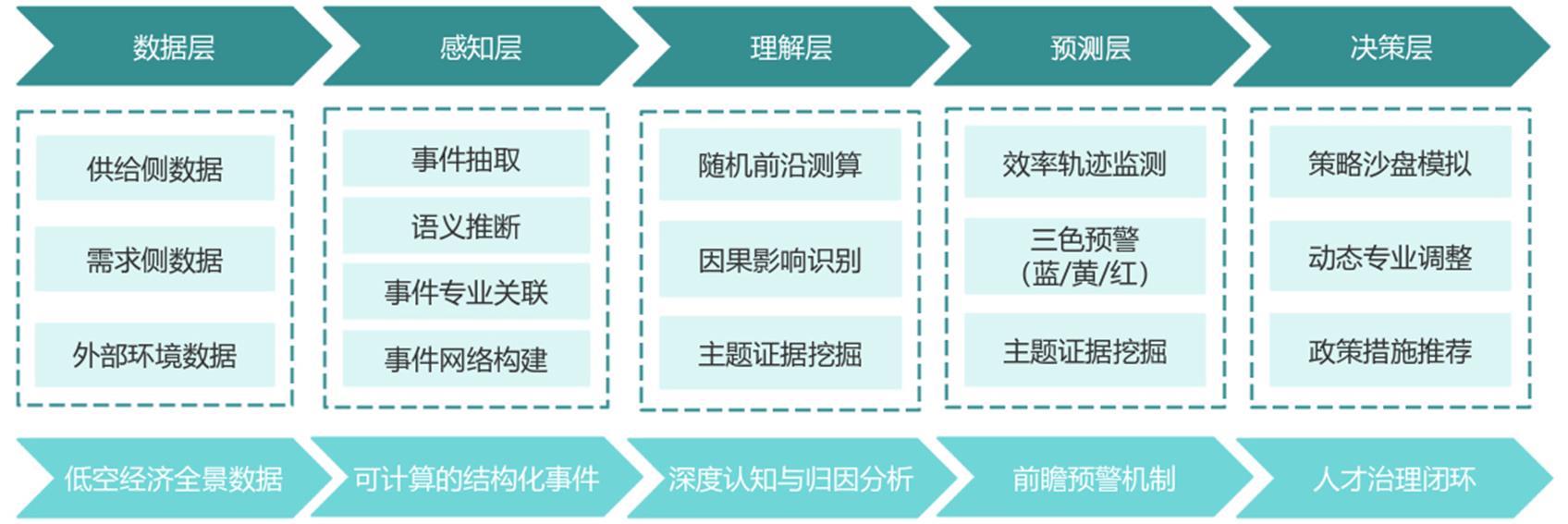
Dynamic perception and early-warning system for talent supply-demand efficiency in the low-altitude economy"

[1]
SCHULTZ T W. Investment in human capital[J]. American economic review, 1961, 51(1): 1-17.
[2]
CAIRE G, BECKER G S. Human capital, a theoretical and empirical analysis with special reference to education[J]. Revue économique, 1967, 18(1): 132.
[3]
SPENCE M. Job market signaling[J]. The quarterly journal of economics, 1973, 87(3): 355.
[4]
STIGLITZ. The theory of screening, education, and the distribution of income[J]. 1975, 65(3): 283-300.
[5]
MORTENSEN D T, PISSARIDES C A. Job creation and job destruction in the theory of unemployment[J]. The review of economic studies, 1994, 61(3): 397-415.
[6]
DOERINGER P B, PIORE M J. Internal Labor Markets and Manpower Analysis[M]. Lexington, Mass.: Heath, 1971.
[7]
ZOLBERG A R, PIORE M J. Birds of passage: Migrant labor and industrial societies[J]. International migration review, 1981, 15(1/2): 404.
[8]
KAIN J F. Housing segregation, Negro employment, and metropolitan decentralization[J]. The quarterly journal of economics, 1968, 82(2): 175-197.
[9]
ACEMOGLU D, AUTOR D. Skills, tasks and technologies: Implications for employment and earnings[M]//Handbook of Labor Economics. Amsterdam: Elsevier, 2011: 1043-1171.
[10]
HARTOG J. Over-education and earnings: Where are we, where should we go?[J]. Economics of education review, 2000, 19(2): 131-147.
[11]
GROOT W, MAASSEN VAN DEN BRINK H. Overeducation in the labor market: A meta-analysis[J]. Economics of education review, 2000, 19(2): 149-158.
[12]
QUINTINI G. Over-qualified or under-skilled: A review of existing literature[J/OL]. SocialOECD, employment and migration working papers, 2011. DOI:10.1787/5kg58j9d7b6d-en .
[13]
HANDEL M J. Skills mismatch in the labor market[J]. Annual review of sociology, 2003, 29 (1): 135-165.
[14]
ENDSLEY M R. Toward a theory of situation awareness in dynamic systems[J]. Human factors, 1995, 37(1): 32-64.
[15]
SALMON W, STANTON N A, JENKINS D P. Human factors methods: A practical guide for engineering and design[J]. Ergonomics, 2014, 57(11): 1767-1769.
[16]
ENDSLEY M R, JONES D G. SA in command and control[M]//Designing for Situation Awareness. Boca Raton: CRC Press, 2025: 328-355.
[17]
杨宇, 谷宇恒. 网络安全态势感知综述[J]. 科学技术与工程, 2022, 22(34): 15011-15019.
YANG Y, GU Y H. Overview of network security situation awareness[J]. Science technology and engineering, 2022, 22(34): 15011-15019.
[18]
SABEUR Z, ANGELOPOULOS C M, COLLICK L, et al. Advanced cyber and physical situation awareness in urban smart spaces[C]//Advances in Neuroergonomics and Cognitive Engineering. Cham: Springer, 2021: 428-441.
[19]
黄梅银, 王芳, 刘清民. 网络媒体态势感知: 基于系统性综述的理论框架构建[J]. 情报学报, 2024, 43(9): 1046-1058.
HUANG M Y, WANG F, LIU Q M. Online-media situation awareness: Development of theoretical framework based on systematic literature review[J]. Journal of the China society for scientific and technical information, 2024, 43(9): 1046-1058.
[20]
王延飞, 杜元清. 融汇情报刻画的情报感知研究路径[J]. 科技情报研究, 2020, 2(1): 1-11.
WANG Y F, DU Y Q. On research path of information awareness converging on information description[J]. Scientific information research, 2020, 2(1): 1-11.
[21]
袁雯, 毛丹, 张继龙, 等. 基于劳动力市场适配性的高等教育人才供需机制研究[J]. 教育发展研究, 2024, 44(17): 1-9.
YUAN W, MAO D, ZHANG J L, et al. Research on the supply and demand mechanism of higher education talents based on the adaptability of labor market[J]. Research in educational development, 2024, 44(17): 1-9.
[22]
李培园, 成长春. 科技人才非均衡流动对区域经济差距的影响: 基于长江经济带104个城市的实证研究[J]. 长江流域资源与环境, 2024, 33(8): 1599-1608.
LI P Y, CHENG C C. Impact of uneven mobility of scientific and technological talents on regional economic disparities: Based on 104 cities in the Yangtze River economic belt[J]. Resources and environment in the Yangtze Basin, 2024, 33(8): 1599-1608.
[23]
李晓光, 陆瑶, 吴晓刚. 高学历劳动者的教育失配[J]. 教育研究, 2023, 44(6): 122-137.
LI X G, LU Y, WU X G. Education-occupation mismatch among highly-educated workers[J]. Educational research, 2023, 44(6): 122-137.
[24]
丁守海, 徐政. 中国劳动力市场研究新进展: 内在动力不足与外在不确定性交织的劳动力市场[J]. 兰州学刊, 2021(6): 111-123.
DING S H, XU Z. New progress in Chinese labor market research: Labor market with insufficient internal motivation and external uncertainty[J]. Lanzhou academic journal, 2021(6): 111-123.
[25]
管怀鎏. 市场均衡就业区间与劳动市场的“连续非出清”特性[J]. 天津社会科学, 2002(6): 78-82.
GUAN H L. Market equilibrium employment interval and the feature of labor market's "continuous non-clearing"[J]. Tianjin social sciences, 2002(6): 78-82.
[26]
李维思, 邬亭玉, 毛进, 等. 面向国家科技人才安全服务的情报态势感知研究[J]. 情报理论与实践, 2025, 48(6): 20-28.
LI W S, WU T Y, MAO J, et al. Research on information situation awareness for national science and technology talents' security service[J]. Information studies: Theory & application, 2025, 48(6): 20-28.
[27]
PATRICK L, ETHAN P, ALEKSANDRA P, et al. Retrieval-augmented generation for knowledge-intensive NLP tasks[J/OL]. arXiv.2005.2020.
[28]
AIGNER D, KNOX LOVELL C A, SCHMIDT P. Formulation and estimation of stochastic frontier production function models[J]. Journal of econometrics, 1977, 6(1): 21-37.
[29]
CHARNES A, COOPER W W, RHODES E. Measuring the efficiency of decision making units[J]. European journal of operational research, 1978, 2(6): 429-444.
[30]
RAY S C, DESLI E. Productivity growth, technical progress, and efficiency change in industrialized countries: Comment[J]. The American economic review, 1997, 87(5): 1033-1039.
[31]
富丽莎, 秦涛, 潘焕学, 等. 森林保险保费补贴政策的林业产出规模效应实证分析: 基于双重差分模型与事件研究模型[J]. 浙江农业学报, 2021, 33(2): 355-368.
FU L S, QIN T, PAN H X, et al. Empirical analysis on scale effect of forest insurance premium subsidy policy: Based on double difference model and event research model[J]. Acta agriculturae zhejiangensis, 2021, 33(2): 355-368.
[32]
YANG Y H, PAN H, TANG L. A survey of regression discontinuity design in policy evaluation research: Logic, status quo and prospects[J]. Data analysis and knowledge discovery, 2024, 8(6): 1-15.
[33]
DEHEJIA R H, WAHBA S. Propensity score-matching methods for nonexperimental causal studies[J]. The review of economics and statistics, 2002, 84(1): 151-161.
[34]
WANG X, KONG M M, CHEN J X, et al. Modeling topic evolution in public opinion events: An unsupervised spatio-temporal graph attention approach[J]. Applied intelligence, 2024, 54(20): 9706-9722.
[35]
刘畅, 时二鹏, 郭诗怡, 等. 基于公众网络参与语义分析的城市公共交通感知服务质量识别与优化[J]. 地球信息科学学报, 2025, 27(3): 585-600.
LIU C, SHI E P, GUO S Y, et al. Semantic analysis of public network participation for urban public transportation perceived service quality identification and optimization[J]. Journal of geo-information science, 2025, 27(3): 585-600.
[36]
张玉洁, 白如江, 鞠孜涵, 等. 面向科学事件的因果关联与创新发现[J]. 情报理论与实践, 2022, 45(6): 147-156.
ZHANG Y J, BAI R J, JU Z H, et al. Causality and innovation discovery oriented to scientific events[J]. Information studies: Theory & application, 2022, 45(6): 147-156.
[37]
TAYLOR S J, LETHAM B. Forecasting at scale[J]. The American statistician, 2018, 72(1): 37-45.
[38]
李新, 王颖, 闫相斌, 等. 面向多源数据细粒度情感挖掘的旅游需求预测[J]. 系统工程理论与实践, 2024, 44(7): 2293-2308.
LI X, WANG Y, YAN X B, et al. Tourism demand prediction for fine-grained sentiment mining based on multi-source data[J]. Systems engineering: Theory & practice, 2024, 44(7): 2293-2308.
[39]
俞立平. 长三角高技术出口:从产业集聚走向产业均衡——基于面板联立方程与向量自回归模型的发现[J]. 国际贸易问题, 2015(10): 120-130.
YU L P. Study on high-tech export trade and industrial agglomeration in Yangtze River Delta based on panel data simultaneous equation model and panel data auto-regression model[J]. Journal of international trade, 2015(10): 120-130.
[40]
WANG C, MA X T, JIN X, et al. HMAE: A high-fidelity multi-agent simulator for economic phenomenon emergence[J]. Frontiers in physics, 2024, 12: 1451423.
[41]
陈玉山. 基于动态博弈下的区域间人才合作分析[J]. 技术经济与管理研究, 2015(2): 16-19.
CHEN Y S. Analysis on human talents cooperation of the regions based on the complete information dynamic game[J]. Journal of technical economics & management, 2015(2): 16-19.
[42]
杨剑, 杨锋, 王树恩, 等. 基于系统动力学的区域创新系统运行机制研究[J]. 科学管理研究, 2010, 28(4): 1-6.
YANG J, YANG F, WANG S E, et al. Research on operation mechanism of regional innovation system based on system dynamics[J]. scientific management research, 2010, 28(4): 1-6.
[43]
王知津, 周鹏, 韩正彪. 基于情景分析法的技术预测研究[J]. 图书情报知识, 2013(5): 116-122.
WANG Z J, ZHOU P, HAN Z B. A study of the technological forecasting based on scenario analysis[J]. Documentation, information & knowledge, 2013(5): 116-122.
[44]
GARG N, YADAV S, ASWAL D K. Monte Carlo simulation in uncertainty evaluation: Strategy, implications and future prospects[J]. MAPAN, 2019, 34(3): 299-304.
[45]
GUO X X, JI J, KHAN F, et al. A novel fuzzy dynamic Bayesian network for dynamic risk assessment and uncertainty propagation quantification in uncertainty environment[J]. Safety science, 2021, 141: 105285.
[46]
邓雪琳. 基于模糊综合评价法的现代企业知识型员工绩效考核[J]. 商业时代, 2010(16): 98-99.
DENG X L. Performance appraisal of knowledge-based employees in modern enterprises based on the fuzzy comprehensive evaluation method[J]. Business managemen, 2010(16): 98-99.
[47]
DENG J. Introduction to Grey system theory[J]. Journal of Grey system, 1989, 1: 1-24.
[1] CHENG Fan, GU Liping. Research Data Cloud of Japan's Open Science Consortium [J]. Journal of library and information science in agriculture, 2025, 37(8): 78-91.
[2] DONG Ke, SONG Yuchen, WU Jiachun. Layout and Characteristics of European AI Data Governance Policy [J]. Journal of library and information science in agriculture, 2025, 37(7): 4-18.
[3] YANG Xuejie, LIU Jia, WU Qingxiao, WANG Yufei, GU Dongxiao. Big Data Dynamic Aggregation and Intelligent Service Model for Multimodal Healthcare and Eldercare [J]. Journal of library and information science in agriculture, 2025, 37(4): 24-38.
[4] SHI Zhongyan, LEI Jie, SUN Tan, ZHAO Ruixue, LI Jiao, HUANG Yongwen, XIAN Guojian. Research on DeepSeek-Empowered Low-Cost Construction of Domain-Specific Knowledge Graphs [J]. Journal of library and information science in agriculture, 2025, 37(3): 4-17.
[5] Zhijun CHANG, Li QIAN, Yaoting WU, Yunpeng QU, Yue GONG, Zhixiong ZHANG. Construction of a Scientific Literature AI Data System for the Thematic Scenario: Technical Framework Research and Practice [J]. Journal of library and information science in agriculture, 2024, 36(9): 4-17.
[6] PENG Lihui, ZHANG Qiong, LI Tianyi. Risk of AI Algorithmic Discrimination Embedded in Government Data Governance and Its Prevention and Control [J]. Journal of library and information science in agriculture, 2024, 36(5): 23-31.
[7] FAN Kexin, XIAN Guojian, ZHAO Ruixue, HUANG Yongwen, SUN Tan. Ontology Construction for Intelligent Control and Application of Crop Germplasm Resources [J]. Journal of library and information science in agriculture, 2024, 36(3): 92-107.
[8] Fengling ZHANG, Xiaoqi MA. Data Service Providers' Participation in Data Black Market Governance Based on Evolutionary Games [J]. Journal of library and information science in agriculture, 2024, 36(11): 47-63.
[9] CHEN Caiming, FENG Jianzhong, BAI Linyan, WANG Jian, XIE Nengfu, ZOU Jun. Representation Model of Agricultural Knowledge Graph Based on the HARP Framework [J]. Journal of library and information science in agriculture, 2023, 35(8): 66-77.
[10] FAN KeXin, SUN Tan, ZHAO RuiXue, KOU YuanTao, XIAN GuoJian. Comparison and Enlightenment of Crop Germplasm Resource Knowledge Service Platforms [J]. Journal of library and information science in agriculture, 2023, 35(5): 64-73.
[11] MA Weilu, XIAN Guojian, ZHAO Ruixue, LI Jiao, HUANG Yongwen, SUN Tan. Comparative Study and Optimization Strategies of Knowledge Graph Construction Management Systems [J]. Journal of library and information science in agriculture, 2023, 35(4): 19-31.
[12] CHANG ZhiJun, XU LiYuan, YU QianQian, ZHANG JianYong, WANG YongJi. Scientific and Technical Literature Data Management System Based on Life Cycle Model [J]. Journal of library and information science in agriculture, 2022, 34(6): 36-49.
[13] SONG Shanshan, BAI Wenlin. A Review of Big Data Governance Research in China [J]. Journal of library and information science in agriculture, 2022, 34(4): 4-17.
[14] ZHENG Jianming, PAN Ying. Public Cultural Data Governance System and Guarantee Measures [J]. Journal of library and information science in agriculture, 2022, 34(2): 4-13.
[15] YANG Siluo, TIAN Peilin, ZHU Chuanyu, QIU Junping. Characteristics of UNESCO's Humanities and Social Sciences Research: Topic, Evolution and Cooperation [J]. Journal of library and information science in agriculture, 2021, 33(6): 6-17.
Viewed
Full text


Abstract

Cited

  Shared   
  Discussed   
No Suggested Reading articles found!