中文    English

Journal of library and information science in agriculture


A Study on the Influence Mechanism of Older Adults' Online Health Information Reception on Health Management from the Perspective of Triadic Reciprocal Determinism Theory

TU Zixuan1, LIU Shuangyuan1, CHEN Sisi1, SHENLining1,2,3()   

  1. 1. School of Medicine and Health Management, Tongji Medical College, Huazhong University of Science and Technology, Wuhan 430030
    2. Hubei Provincial Research Center for HealthTechnology Assessment, Wuhan 430030
    3. Research Center for Big Data & Data Science in Health and Healthcare, Tongji Medical College of Huazhong University of Science and Technology, Wuhan 430030
  • Received:2025-06-24 Online:2026-08-20
  • Contact: SHENLining

Abstract:

[Purpose/Significance] Against the backdrop of China's aging population and advancing digitalization, the digital divide has created disparities in how efficiently older adults can access health information. This has emerged as a critical barrier to their health management. Existing studies have explored factors influencing older adults' health management but rarely focused on the digital divide within this group or deeply integrated individual traits, environmental factors, and health behaviors. Grounded in the Triadic Reciprocal Determinism Theory, this study investigates how exposure to online health information affects older adults' health management behaviors and uncovers how the digital divide manifests in this process. Its innovation lies in addressing gaps in previous research by systematically examining the heterogeneous impacts of online health information exposure on health management across different subgroups (e.g., urban vs. rural residents, those with varying digital skills). This enriches the theoretical system of older adults' health information behavior and health management, while offering practical guidance for tackling the key issue of enhancing older adults' health management and bridging the digital divide amid aging and digitalization. [Method/Process] Guided by the Triadic Reciprocal Determinism Theory, the study formulates hypotheses through literature review. It utilizes cross-sectional data from the 2020 Chinese Longitudinal Aging Social Survey (CLASS), with a valid sample of 3 118 adults aged 60 and above. Health management is influenced by older adults' attitudes toward handling minor illnesses and the frequency of their physical exercise. Online health information exposure is measured by three indicators: the convenience of accessing online health services, engagement in online health management, and ownership of smartwatches or bracelets. Control variables include gender, age, education, and household registration type. Multiple regression models are constructed to test hypotheses, supplemented by robustness tests (adding control variables and replacing dependent variables), heterogeneity analysis (stratified by smartphone proficiency), and mediating effect analysis (comparing urban and rural groups) to ensure result reliability. [Results/Conclusions] Key findings reveal that the convenience of accessing health services via the Internet and engagement in online health management both positively boost older adults' initiative to seek medical care when dealing with minor illnesses. Smart Wearable devices exert a "double-edged sword" effect: they have a negative impact on medical-seeking behavior for minor illnesses yet correlate positively with more frequent physical exercise. Older adults proficient in smartphone use show greater activity in health management. Significant urban-rural differences exist in reliance on social network information-rural older adults are more likely to enhance their health management initiative through family and friend networks, while their urban counterparts tend to obtain health information directly via the Internet. It is recommended that health information communication strategies be formulated in consideration of urban-rural differences, with targeted measures to improve older adults' digital health literacy and bridge the digital divide. Limitations of the study include data constraints, as CLASS data lacks in-depth exploration of older adults' motivations and resistance toward health information exposure, and incomplete measurement of the digital divide, excluding variables such as network speed and regional infrastructure. Future research should adopt mixed methods, integrating questionnaires and semi-structured interviews to supplement qualitative data, expand the measurement dimensions of health management behaviors, and explore the dynamic relationship between technology adoption and health behaviors from the perspective of older adults, providing a more solid basis for targeted interventions.

Key words: health management, Triadic Reciprocal Determinism, web-based health information, older adults, digital divide

CLC Number: 

  • R195

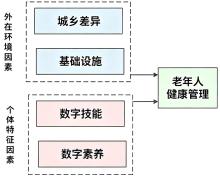
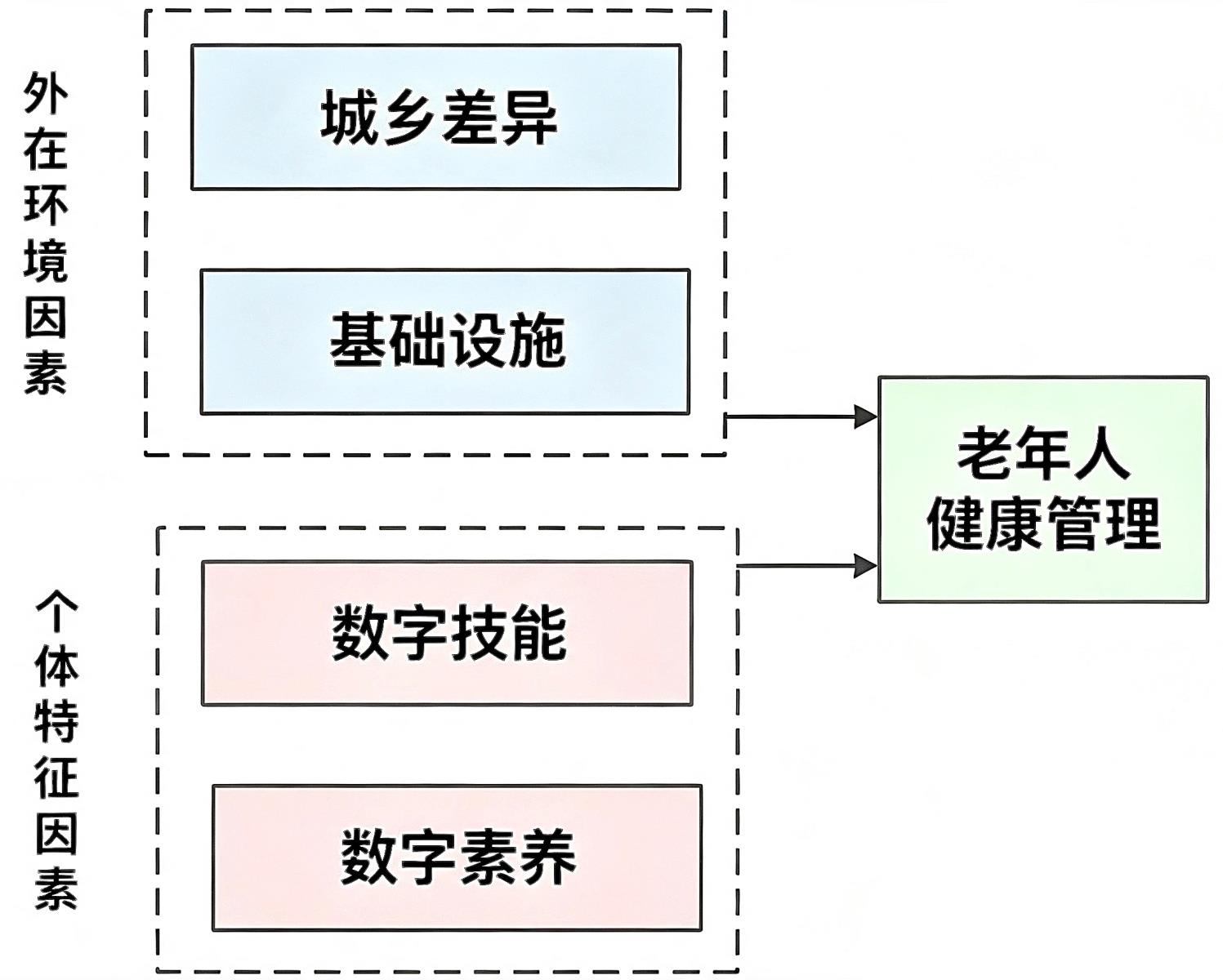
Fig.1

Framework of the influence mechanism of older adults' exposure to online health information on health management"

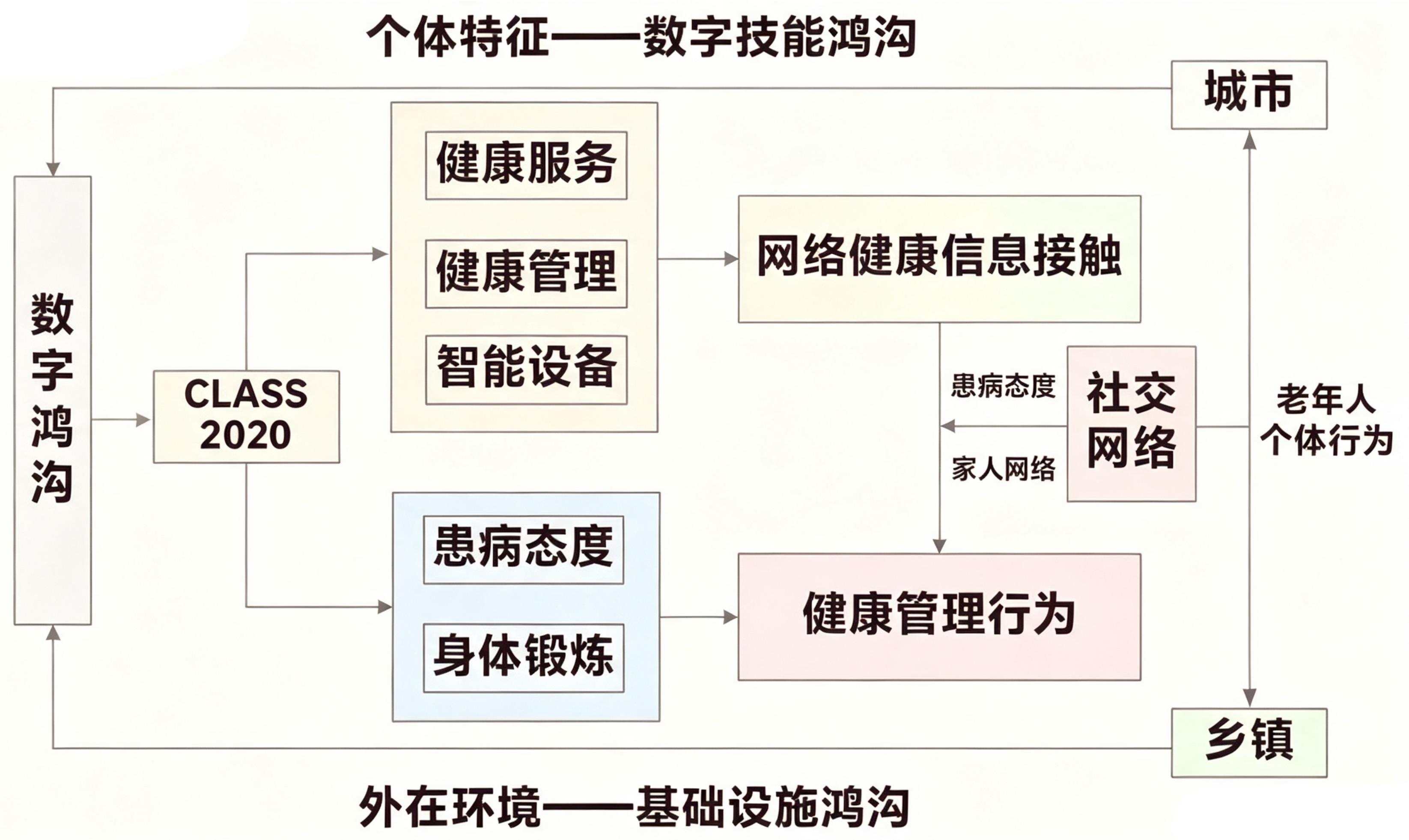
Fig.2

Research model on the mechanism of action of older adults' exposure to online health information on health management"

Table 1

Selection and explanation of variables"

变量类别 变量编号 变量名称 变量解释 赋值说明 平均值 标准差
被解释变量 B11 ill 受访者生小病如何处理 主动选择就诊就医赋值为1;不主动选择就医赋值为0 0.817 0.387
G2 frequence 受访者体育锻炼的频率 每周4~9次赋值为1;每周1~3次赋值为0 0.500 0.500
解释变量 D16-6 Convenience 互联网获取健康服务的便捷程度 问卷中便利1;不便利2;无影响3;说不上来4。本研究将便利赋值1;其他赋值0 0.357 0.479
D18-4-09 Management 上网是否会管理健康 是赋值1;否赋值0 0.073 0.260
D21-2-4 Watch 是否拥有智能手环/手表 是赋值1;否赋值0 0.195 0.396
控制变量 A1 gender 性别 男赋值1;女赋值2 1.478 0.500
A2 year 年龄 2020年调查的年龄结果 67.838 4.544
A10 hukou 户口类型 农业户口1;非农业户口2 1.702 0.542
A3 edu 文化程度 不识字赋值1;私塾赋值2;小学赋值3;初中赋值4;高中赋值5 3.755 1.211

Table 2

Results of benchmark regression"

变量名称 生小病处理态度影响模型
convenience 0.047 7***
(0.014 6)
Management 0.069 2***
(0.024 0)
watch -0.080 7***
(0.019 3)
gender 0.007 45
(0.013 9)
hukou -0.000 919 4
(0.012 5)
year 0.003 04**
(0.001 50)
Constant 0.595***
(0.110)
Observations 3 118
R-squared 0.011

Table 3

Results of robustness test incorporating education level"

变量名称 生小病处理态度影响模型
convenience 0.045 6***
(0.014 5)
Management 0.061 0**
(0.024 3)
watch -0.083 5***
(0.019 4)
gender 0.011 7
(0.013 9)
hukou -0.012 0
(0.012 8)
year 0.003 79**
(0.001 52)
edu 0.016 4***
(0.006 28)
Constant 0.497***
(0.115)
Observations 3 118
R-squared 0.013

Table 4

Test results after replacing the explained variable with frequency of physical exercise"

变量名称 生小病处理态度影响模型
convenience 0.036 9**
(0.018 6)
Management 0.235***
(0.028 9)
watch 0.074 9***
(0.022 4)
gender 0.014 7
(0.017 3)
hukou 0.143***
(0.017 4)
year -0.011 3***
(0.001 88)
Constant 0.958***
(0.137)
Observations 3 118
R-squared 0.076

Table 5

Heterogeneity analysis of proficiency in using smartphones"

变量名称 一般 熟练
生小病处理态度影响模型 生小病处理态度影响模型
convenience 0.032 3* 0.048 9**
(0.017 8) (0.024 6)
Management 0.037 7 0.123*
(0.025 7) (0.064 3)
watch -0.033 1 -0.218***
(0.021 2) (0.041 6)
gender -0.009 27 0.028 6
(0.017 8) (0.022 0)
hukou -0.003 21 -0.008 40
(0.016 8) (0.019 0)
year 0.000 861 0.007 03***
(0.001 87) (0.002 54)
Constant 0.787*** 0.293
(0.135) (0.184)
Observations 1 772 1 346
R-squared 0.004 0.039

Table 6

Results of mediating effect in rural group"

类型 中介效应 Observed coefficient

Bootstrap

Std.err.

z P>|z|

Normal-based

[95%conf.interval]

家庭网络 间接效应 0.215 3 0.006 5 3.29 0.001 0.008 7 0.343 6
直接效应 0.263 9 0.025 9 -10.18 0.000 -0.314 8 -0.213 1
朋友网络 间接效应 0.003 1 0.001 4 2.11 0.035 0.000 2 0.005 9
直接效应 0.024 2 0.007 2 3.37 0.001 0.010 1 0.038 2

Table 7

Results of mediating effect in urban group"

类型 中介效应 Observed coefficient

Bootstrap

Std.err.

z P>|z|

Normal-based

[95%conf.interval]

家庭网络 间接效应 0.000 8 0.003 7 0.21 0.083 -0.006 6 0.008 2
直接效应 0.275 6 0.017 8 -15.46 0.000 -0.310 6 -0.240 7
朋友网络 间接效应 -0.000 0 0.003 1 -0.42 0.678 -0.000 7 0.004 8
直接效应 0.017 1 0.007 4 2.31 0.021 0.002 6 0.031 7
[1]
邓鹏鸿, 陈鸣声. 我国慢性病患者卫生服务利用研究现状及热点分析[J]. 医学与社会, 2023, 36(12): 73-78.
Deng Penghong, Chen Mingsheng. Analysis of the current status and hotspots of research on healthcare utilization among patients with chronic diseases in China[J]. Medicine and Society, 2023, 36(12): 73-78.
[2]
刘德寰, 王袁欣. 移动互联网时代健康信息获取行为的族群研究[J]. 现代传播(中国传媒大学学报), 2020, 42(11): 141-147.
Liu Dehuan, Wang Yuanxin. Group study of health information seeking behavior in mobile Internet age[J]. Modern Communication (Journal of Communication University of China), 2020, 42(11): 141-147.
[3]
蒋文晶, 周明军, 王仁威, 等. 长三角居民网络饮食健康信息利用与传播行为调查研究[J]. 医学信息学杂志, 2024, 45(9): 69-74.
Jiang Wenjing, Zhou Mingjun, Wang Renwei, et al. Investigation on the utilization and dissemination behavior of online dietary health information of residents in Yangtze River Delta[J]. Journal of Medical Informatics, 2024, 45(9): 69-74.
[4]
宁逸帆, 罗遐, 单成彪. 互联网使用、老化态度与老年人认知健康——来自2018CLASS数据的实证分析[J]. 景德镇学院学报, 2024, 39(1): 91-97.
Ning Yifan, Luo Xia, Shan Chengbiao. Internet use, attitudes toward aging and cognitive health: An empirical analysis based on 2018 CLASS data[J]. Jingdezhen Comprehensive College Journal, 2024, 39(1): 91-97.
[5]
步相艳, 莫蓓蓉, 王鑫, 等. 老年人在线健康信息寻求行为的范围综述[J]. 中华护理杂志, 2024, 59(21): 2586-2594.
Bu Xiangyan, Mo Beirong, Wang Xin, et al. Online health information seeking behavior intervention for older adults: A scoping review[J]. Chinese Journal of Nursing, 2024, 59(21): 2586-2594.
[6]
黄建始. 什么是健康管理 [J]. 中国健康教育, 2007, 23(4): 298-300.
Huang Jianshi. What is health management [J]. Chinese Journal of Health Education, 2007, 23(4): 298-300.
[7]
徐婷, 董恩宏, 郭丽君, 等. 老年慢性病患者延续性健康管理需求及影响因素研究[J]. 中国全科医学, 2021, 24(13): 1665-1670.
Xu Ting, Dong Enhong, Guo Lijun, et al. Demands and influencing factors of transitional health management among elderly patients with chronic diseases[J]. Chinese General Practice, 2021, 24(13): 1665-1670.
[8]
段云, 何景波, 曹浩林, 等. 四川省农村老年人健康管理认知及需求研究[J]. 华南预防医学, 2024, 50(3): 211-215.
Duan Yun, He Jingbo, Cao Haolin, et al. Study on the cognition and needs of health management among rural elderly in Sichuan Province[J]. South China Journal of Preventive Medicine, 2024, 50(3): 211-215.
[9]
王雪辉, 彭聪. 老年人社会经济地位对健康的影响机制研究——兼论生活方式、公共服务和社会心理的中介效应[J]. 中国卫生政策研究, 2020, 13(3): 21-30.
Wang Xuehui, Peng Cong. Study on the impact mechanism of elderly socioeconomic status on health: The mediating effects of lifestyle, public service and social psychology[J]. Chinese Journal of Health Policy, 2020, 13(3): 21-30.
[10]
Park G E, Park Y H, Kim K G, et al. Mobile application for digital health coaching in the self-management of older adults with multiple chronic conditions: A development and usability study[J]. Healthcare Informatics Research, 2024, 30(4): 344-354.
[11]
吕合凯, 邓姗姗, 范颜颜, 等. 老年人数字健康技术应用障碍影响因素分析[J]. 医学信息学杂志, 2024, 45(4): 38-44.
Hekai Lyu, Deng Shanshan, Fan Yanyan, et al. Analysis of influencing factors of digital health technology application obstacles in the elderly[J]. Journal of Medical Informatics, 2024, 45(4): 38-44.
[12]
Chen Y, Xu Q. The willingness to use mobile health and its influencing factors among elderly patients with chronic heart failure in Shanghai, China[J]. International Journal of Medical Informatics, 2022, 158: 104656.
[13]
Kim H, Mahmood A, Goldsmith J V, et al. Access to broadband Internet and its utilization for health information seeking and health communication among informal caregivers in the United States[J]. Journal of Medical Systems, 2021, 45(2): 24.
[14]
沈默. 大学生网络健康信息搜寻行为及其影响因素研究[D]. 杭州: 浙江大学, 2018.
Shen Mo. Study on Internet health information seeking behavior of college students and its influencing factors[D]. Hangzhou: Zhejiang University, 2018.
[15]
Lustria M L A, Smith S A, Hinnant C C. Exploring digital divides: An examination of eHealth technology use in health information seeking, communication and personal health information management in the USA[J]. Health Informatics Journal, 2011, 17(3): 224-243.
[16]
王甫勤. 健康数字鸿沟: 互联网如何改变健康不平等 [J]. 社会学评论, 2025, 13(2): 5-28.
Wang Fuqin. Health digital divide: How does the Internet change health inequalities [J]. Sociological Review of China, 2025, 13(2): 5-28.
[17]
吴迪, 向菲, 彭咏杰. 代际支持视角下农村老年人网络健康信息利用行为研究[J]. 数字图书馆论坛, 2024, 20(2): 34-43.
Wu Di, Xiang Fei, Peng Yongjie. Utilization behavior of online health information among rural elderly people from the perspective of intergenerational support[J]. Digital Library Forum, 2024, 20(2): 34-43.
[18]
李志明. 数字时代老年人多重数字困境治理——基于元素养视角的分析[J]. 甘肃社会科学, 2025(1): 164-172.
Li Zhiming. Governance of multiple digital dilemmas for older adults in the digital era: An analysis from a meta-literacy perspective[J]. Gansu Social Sciences, 2025(1): 164-172.
[19]
殷融. 论班杜拉三元交互决定论中蕴含的先锋思想[J]. 心理研究, 2022, 15(2): 115-120.
Yin Rong. On the pioneer thought contained in Bandura's triadic reciprocality determinism[J]. Psychological Research, 2022, 15(2): 115-120.
[20]
蒋承, 李笑秋. 政策感知与大学生基层就业——基于“三元交互理论”的视角[J]. 北京大学教育评论, 2015, 13(2): 47-56, 188-189.
Jiang Cheng, Li Xiaoqiu. Policy's perception and the college graduates' grass-root employment: Based on the bandura's reciprocal determinism[J]. Peking University Education Review, 2015, 13(2): 47-56, 188-189.
[21]
初彦伯, 王萍. 数据连续性视角下网络健康信息可信性提升策略研究[J]. 数字图书馆论坛, 2023, 19(5): 35-41.
Chu Yanbo, Wang Ping. Research on strategies for improving credibility of network health information from perspective of data continuity[J]. Digital Library Forum, 2023, 19(5): 35-41.
[22]
张坤. 网络健康信息搜寻行为影响因素的整合理论模型研究[J]. 情报科学, 2023, 41(3): 33-44.
Zhang Kun. Integrated theoretical model for the influencing factors of online health information seeking behavior[J]. Information Science, 2023, 41(3): 33-44.
[23]
Xie Haojie, Wu Dongxu, Zhou Yuqiu, et al. Use of new-media health information among the elderly and its effect on their health and health management[J]. BMC Public Health, 2024, 24(1): 2078.
[24]
García-Méndez C, García-Padilla F M, Romero-Martín M, et al. Social networks: A quality tool for health dissemination [J]. Journal of Education and Health Promotion, 2022, 26(11):355.
[25]
吴丹, 李一喆. 不同情境下老年人网络健康信息检索行为与认知研究[J]. 图书馆论坛, 2015, 35(2): 38-43.
Wu Dan, Li Yizhe. Older adults' online health information searching behavior and cognition under different contexts[J]. Library Tribune, 2015, 35(2): 38-43.
[26]
陈佳佳. 老年人对健康信息的认知获取和利用现状研究[D]. 贵阳: 贵州财经大学, 2022.
Chen Jiajia. A study on the current status of cognitive access and use of health information in the elderly[D]. Guiyang: Guizhou University of Finance and Economics, 2022.
[27]
方霁, 潘威旭, 林徐勋, 等. 移动健康信息服务的个性化运动目标决策研究[J]. 管理工程学报, 2024, 38(1): 253-265.
Fang Ji, Pan Weixu, Lin Xuxun, et al. Optimal goal setting in a personalized mobile health information service[J]. Journal of Industrial Engineering and Engineering Management, 2024, 38(1): 253-265.
[28]
李菲, 张研. “互联网+医疗”影响居民健康服务利用的作用路径探析[J]. 医学与社会, 2021, 34(3): 23-28, 44.
Li Fei, Zhang Yan. Analysis of the influence mechanism of “Internet+Healthcare” treatment on residents' health service needs[J]. Medicine and Society, 2021, 34(3): 23-28, 44.
[29]
廖庆方, 潘广利, 范平. “互联网1+4”服务模式在老年群体健康管理中的应用价值[J]. 智慧健康, 2024, 10(31): 161-164, 168.
Liao Qingfang, Pan Guangli, Fan Ping. Application research of constructing the "Internet 1+4" service mode in health management of the elderly[J]. Smart Healthcare, 2024, 10(31): 161-164, 168.
[30]
宋小康, 赵宇翔, 朱庆华. 在线健康信息替代搜寻影响因素研究: 基于健康信念模型和社会支持理论[J]. 图书情报工作, 2022, 66(2): 45-56.
Song Xiaokang, Zhao Yuxiang, Zhu Qinghua. Research on influencing factors of online surrogate health information seeking: Based on the health belief model and social support theory[J]. Library and Information Service, 2022, 66(2): 45-56.
[31]
杨晓冬, 宋冰, 杨文倩. 健康信念模型视角下健康信息搜寻对不同心理健康促进行为的影响[J]. 新闻大学, 2023(12): 88-103.
Yang Xiaodong, Song Bing, Yang Wenqian. Extending the health belief model to examine the influence of health information seeking on mental health promotion behavior[J]. Journalism University, 2023(12): 88-103.
[1] ZHANG Ning, HE Boyun. Digital Capital for the Elderly: Conceptual Connotation, Structural Dimensions and Scale Development [J]. Journal of library and information science in agriculture, 2026, 38(2): 16-29.
[2] MA Liying. The Logic, Challenges, and Responses of Digital Supply and Acquisition of Public Cultural Goods [J]. Journal of library and information science in agriculture, 2024, 36(12): 64-73.
[3] Xiong Xue, Nie Fengying, Bi Jieying, Cao Shenshen. Poverty Alleviation from the Perspective of Precision Poverty Alleviation: A case study of We County [J]. Journal of library and information science in agriculture, 2017, 29(5): 5-8.
[4] ZHANG Xiang-ning. The Strategies and Relative Effects of Reducing Digital Divide In Taiwan [J]. Journal of library and information science in agriculture, 2014, 26(9): 142-145.
[5] YAO Yin. Services Ageing Readers to Build a Harmonious Society [J]. Journal of library and information science in agriculture, 2014, 26(1): 164-166.
Viewed
Full text


Abstract

Cited

  Shared   
  Discussed   
No Suggested Reading articles found!