中文    English

Journal of library and information science in agriculture


Relief Pathway of Information Anxiety Among Elderly Users through Metaverse Immersive Reading

GAO Mian, FENG Li(), WANG Peng   

  1. Hohai University Library, Nanjing 210098
  • Received:2026-03-05 Online:2026-06-10
  • Contact: FENG Li

Abstract:

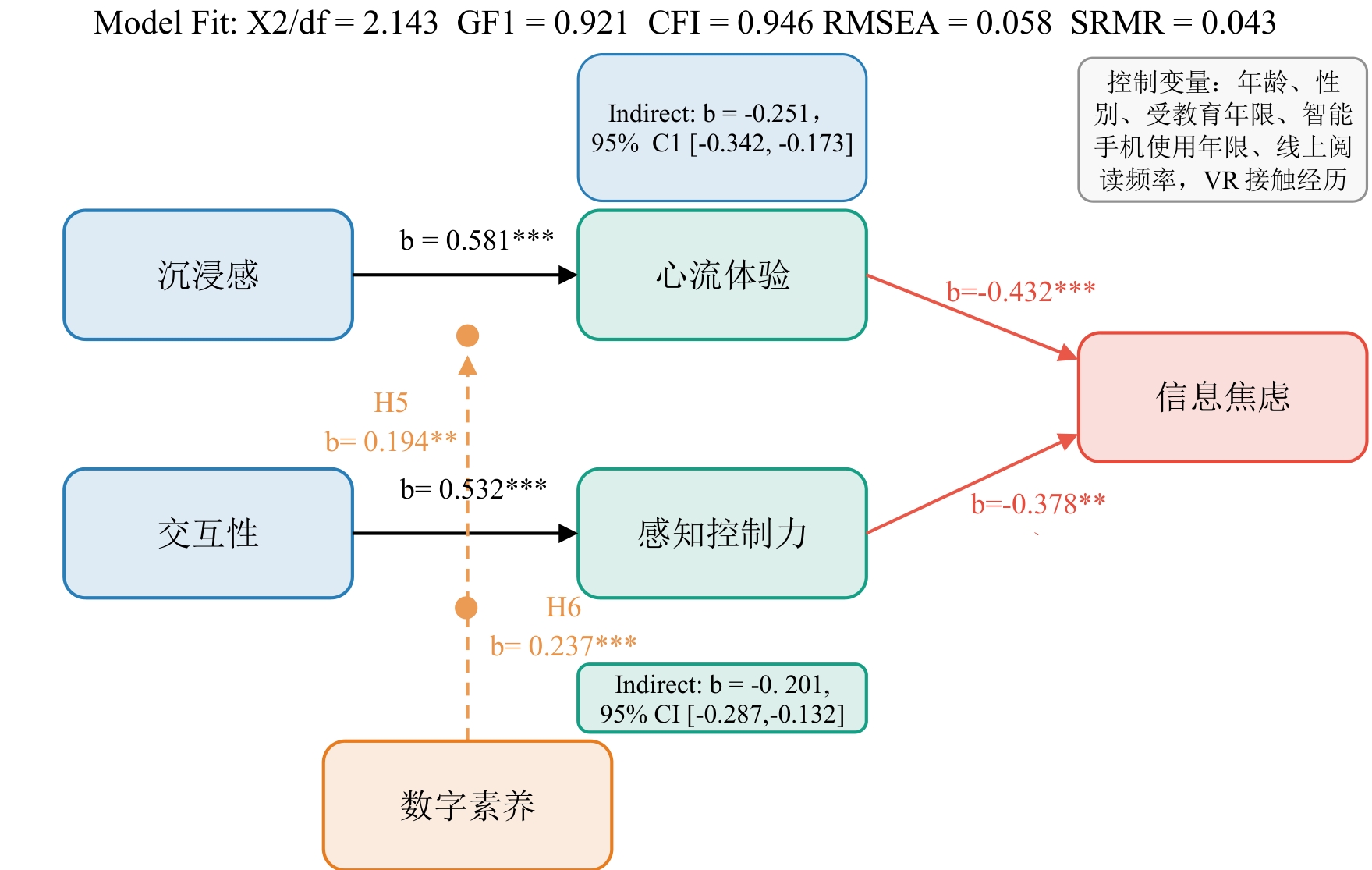
[Purpose/Significance] As the information society continues to evolve, elderly populations increasingly experience information anxiety when confronted with overwhelming volumes of digital content. This anxiety, characterized by feelings of tension, helplessness, and frustration during information-seeking tasks, represents a significant barrier to older adults' engagement with digital reading and public cultural services. While emerging metaverse and virtual reality (VR) technologies have shown promise in enhancing user experience across various domains, the specific mechanisms through which immersive reading environments might alleviate information anxiety among elderly users remain insufficiently understood. This study addresses this critical gap by investigating whether and how VR-based immersive reading technology, as a representative implementation of metaverse technology in reading services, can effectively reduce information anxiety among elderly users. [Method/Process] Grounded in the Stimulus-Organism-Response (S-O-R) theoretical framework, this study employed a quasi-experimental design combined with survey methodology. Immersion and interactivity serve as the stimulus variables (S), flow experience and perceived control constitute the organism variables (O), and changes in information anxiety represent the response variable (R). A total of 247 adults aged 60 and above were recruited from community senior activity centers across four major Chinese cities (Beijing, Shanghai, Guangzhou, and Chengdu), yielding 235 valid responses. Participants were assigned to either an experimental group (n=118), which completed thematic reading tasks in a VR immersive reading environment using Meta Quest 3 headsets, or a control group (n=117), which completed identical reading tasks on tablet devices. Three reading themes were designed: traditional Chinese festival culture, home health and wellness knowledge, and local scenic and historical stories. Pre-test and post-test measures of information anxiety were collected, along with post-task assessments of immersion, interactivity, flow experience, perceived control, and digital literacy. Semi-structured interviews with 40 participants supplemented the quantitative findings. Structural equation modeling was used to test path relationships, Bootstrap methods for mediation effects, and hierarchical regression for moderation analysis. [Results/Conclusions] The empirical results reveal several key findings. First, no significant difference in baseline information anxiety was observed between groups (t=0.347, p=0.729). Following the reading task, the experimental group exhibited significantly lower information anxiety (t=-6.827, p<0.001, Cohen's d=-1.342). Second, SEM analysis confirmed two parallel mediation pathways: immersion positively influenced flow experience (β=0.581, p<0.001), which negatively influenced information anxiety (β=-0.432, p<0.001); interactivity positively influenced perceived control (β=0.532, p<0.001), which negatively influenced information anxiety (β=-0.378, p<0.001). Third, digital literacy positively moderated both pathways: the immersion-flow relationship was stronger for users with higher digital literacy (interaction β=0.194, p<0.01), and the interactivity-perceived control relationship was similarly strengthened (interaction β=0.237, p<0.001). Fourth, multi-group analysis revealed that perceived control's effect on anxiety reduction was significantly stronger among older elderly adults (aged above 70). Qualitative interviews further supported these findings, describing how spatial information presentation reduced cognitive burden and natural interaction reduced operational uncertainty. The study concludes that metaverse immersive reading technology can effectively reduce elderly users' information anxiety through cognitive and operational pathways, but the effect is moderated by digital literacy and age. Practical implications include embedding immersive reading within structured programs, designing control-enhancing features as foundational infrastructure, and providing targeted support for elderly users with lower digital literacy. Future research should employ longitudinal designs to assess durability, factorial designs to separate immersion and interactivity contributions, and more inclusive sampling strategies.

Key words: metaverse, immersive reading, elderly users, information anxiety, flow experience, digital literacy

CLC Number: 

  • G250.7

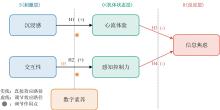
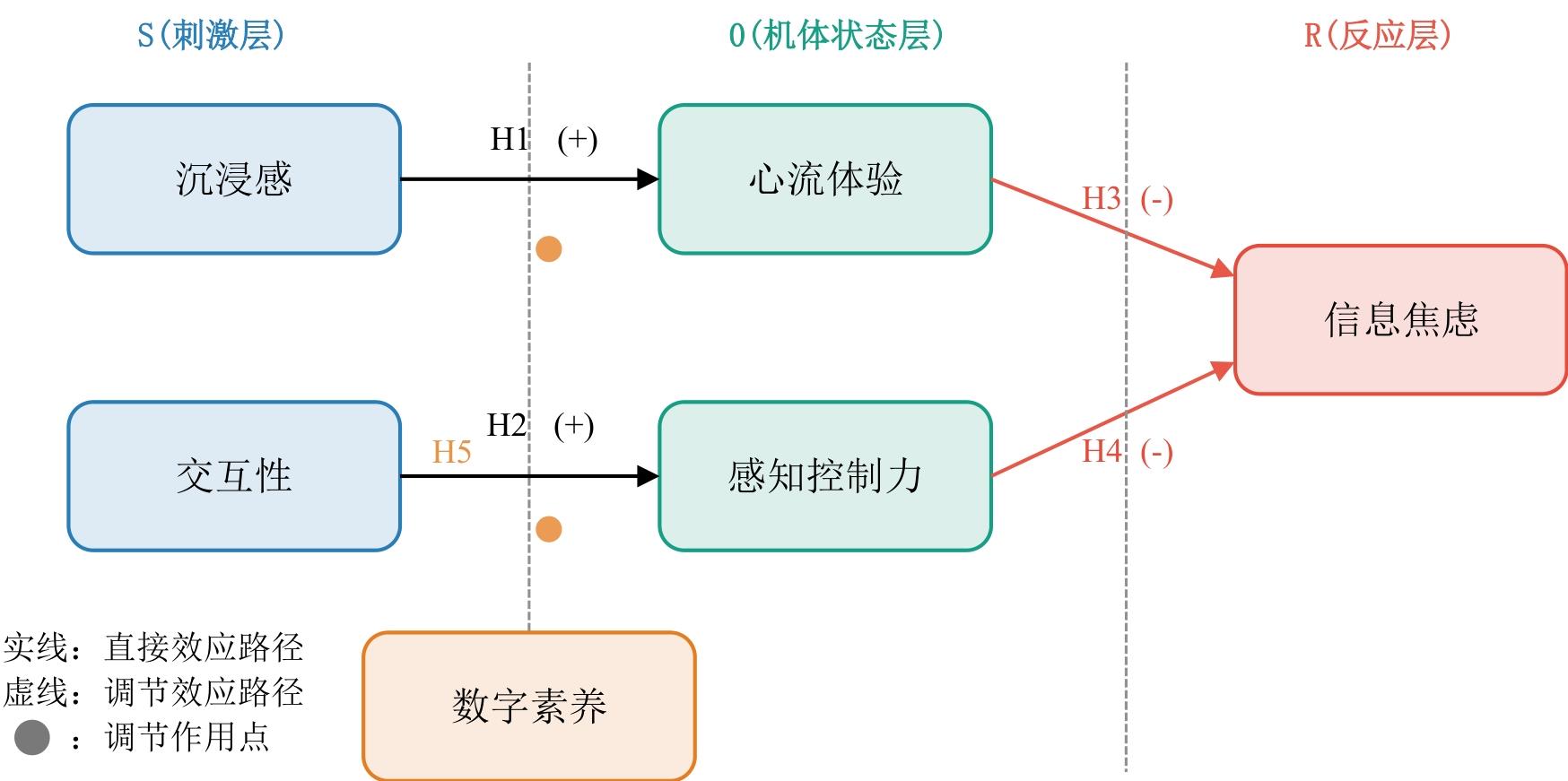
Fig.1

Theoretical model of metaverse immersive reading technology for alleviating information anxiety among elderly users"

Table 1

Summary of research variables"

变量类型 S-O-R层级 变量名称 子维度 测量来源
自变量 - 阅读范式 VR沉浸式/平板二维 实验操纵
刺激变量(S) 刺激 沉浸感 空间临场感、感官丰富度、环境连贯性 PQ简化版[18]
刺激变量(S) 刺激 交互性 操控自由度、反馈即时性、导航可逆性 LIU量表[19]修订
中介变量(O) 机体 心流体验 注意聚焦、过程愉悦、时间扭曲 FSS简化版[20]
中介变量(O) 机体 感知控制力 操作可预测性、错误可恢复性、路径可选择性 KOUFARIS量表[21]
因变量(R) 反应 信息焦虑 信息理解困难、技术操作焦虑、信息超载感 WURMAN框架[22]编制
调节变量 边界条件 数字素养 设备操作、信息检索、数字安全 YU等[4]

Table 2

Demographic characteristics of the sample (n=235)"

特征 类别 人数/个 百分比/%
性别 108 46.0
127 54.0
年龄 60~65岁 96 40.9
66~70岁 78 33.2
71~75岁 43 18.3
>75岁 18 7.6
教育水平 小学及以下 21 8.9
初中 54 23.0
高中/中专 83 35.3
大专/本科 67 28.5
研究生及以上 10 4.3
居住状态 独居 42 17.9
与配偶同住 136 57.9
与子女同住 48 20.4
其他 9 3.8

Table 3

Construct measurement and scale information"

构念 题项数/个 量表来源/依据 子维度(新增) Cronbach's α
沉浸感 16 PQ简化版,基于WITMER和SINGER[18]修订 空间临场感(6)、感官丰富度(5)、环境连贯性(5) 0.913
交互性 7 交互性感知量表,基于LIU[19]修订 操控自由度(3)、反馈即时性(2)、导航可逆性(2) 0.872
心流体验 9 FSS简化版,基于JACKSON和Marsh[20]修订 注意聚焦(3)、过程愉悦(3)、时间扭曲(3) 0.896
感知控制力 5 感知控制力量表,基于KOUFARIS[21]修订 操作可预测性(2)、错误可恢复性(2)、路径可选择性(1) 0.865
信息焦虑 15 基于WURMAN信息焦虑理论框架[22]编制 信息理解困难(6)、技术操作焦虑(5)、信息超载感(4) 0.908
数字素养 12 老年数字素养量表,基于YU等[4] 设备操作(4)、信息检索(4)、数字安全(4) 0.883

Table 4

Reliability and validity test of main constructs"

构念 题项数/个 Cronbach's α CR AVE KMO值
沉浸感 16 0.913 0.926 0.584 0.887
交互性 7 0.872 0.894 0.627 0.842
心流体验 9 0.896 0.911 0.561 0.873
感知控制力 5 0.865 0.883 0.654 0.836
信息焦虑 15 0.908 0.917 0.539 0.892
数字素养 12 0.883 0.901 0.568 0.854

Table 5

Comparison of main variables between experimental and control groups"

变量 实验组(n=118)均值±标准差 对照组(n=117)均值±标准差 t p Cohen's d
前测信息焦虑 4.83±0.92 4.79±0.88 0.347 0.729 0.045
后测信息焦虑 3.26±0.78 4.35±0.85 -6.827 <0.001 -1.342
沉浸感 5.67±0.83 3.52±0.91 13.251 <0.001 2.457
交互性 5.43±0.79 4.11±0.88 9.536 <0.001 1.578
心流体验 5.28±0.91 3.85±0.94 10.217 <0.001 1.543
感知控制力 5.02±0.87 4.13±0.92 6.134 <0.001 0.997

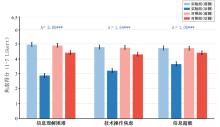
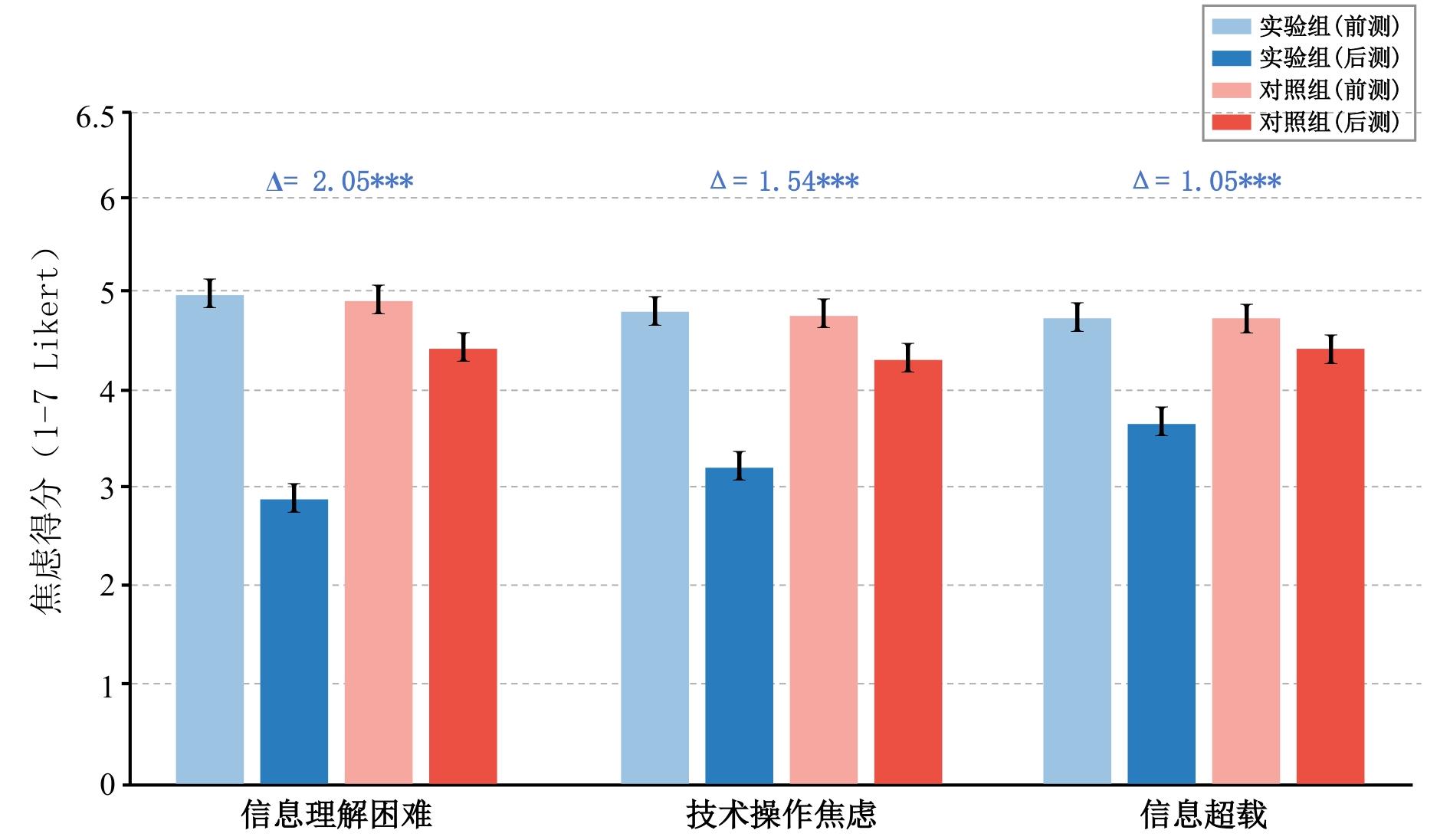
Fig.2

Pre-test and post-test changes in information anxiety dimensions between groups"

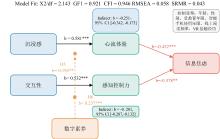
Fig.3

Structural equation model analysis results"

Table 6

Path coefficients and hypothesis testing results"

假设 路径关系 标准化路径系数 t p 假设验证
H1 沉浸感→心流体验 0.581 7.839 <0.001 支持
H2 交互性→感知控制力 0.532 6.943 <0.001 支持
H3 心流体验→信息焦虑 -0.432 -5.647 <0.001 支持
H4 感知控制力→信息焦虑 -0.378 -4.892 <0.001 支持

Table 7

Bootstrap test results of mediation effects"

中介路径 点估计值 95%CI下限 95%CI上限 是否显著
沉浸感→心流体验→信息焦虑 -0.251 -0.342 -0.173
交互性→感知控制力→信息焦虑 -0.201 -0.287 -0.132

Table 8

Moderation analysis of digital literacy (DV: flow experience)"

变量 模型1 模型2 模型3
控制变量
年龄 -0.127* -0.083 -0.079
性别 0.042 0.025 0.021
教育水平 0.156* 0.076 0.074
自变量
沉浸感(A) 0.584*** 0.562***
数字素养(B) 0.137* 0.125*
交互项
A×B 0.194**
0.065 0.413 0.447
ΔR² 0.065 0.348 0.034
F变化量 5.316** 59.743*** 12.175**

Fig.4

Moderating the effect of digital literacy on the relationship between immersion and flow experience"

Table 9

Path difference comparison by age group"

路径 低龄老年组(60~70岁) 高龄老年组(>70岁) 路径差异Z p
沉浸感→心流体验 0.603*** 0.517*** 0.942 0.346
交互性→感知控制力 0.564*** 0.431*** 1.327 0.185
心流体验→信息焦虑 -0.416*** -0.487*** 0.733 0.464
感知控制力→信息焦虑 -0.345*** -0.532*** 2.147* 0.032

Table 10

Summary of grounded theory coding results (n=40)"

主范畴 范畴

初始概念

(开放编码)

代表性证据

(节选)

频次

(提及/组别)

访谈指向
认知负担变化 多感官参与与线索增强 注意更集中;信息“立体化”;理解更直观;记忆线索更明确;疲劳感降低 “传统阅读时…眼睛疲劳,注意力难以集中…在虚拟环境中…感觉信息是立体的,记忆起来也更容易。”(女,73岁)

16/20

(实验组)

主要对应“信息理解困难”下降,解释实验组在理解维度上缓解更显著
操作不确定性变化 控制感与可预测性提升 不怕点错;操作更自然;知道下一步做什么;敢探索;自信增强 “用手机或电脑时…担心点错地方…在虚拟博物馆里…像在真实世界中一样自然,不再担心操作错误。”(男,68岁)

15/20

(实验组)

主要对应“技术操作焦虑”下降,与感知控制力的中介作用相吻合
情绪沉浸与注意迁移 焦虑注意被替代 被环境吸引;不再刻意“学习/记忆”;压力感减弱;情绪放松 “完全被环境吸引,像是真的在参观…信息自然而然地被接收,没有平时阅读时的那种压力。”(67岁)

12/20

(实验组)

解释心流体验与焦虑缓解的关联,支持“沉浸感→心流→焦虑降低”路径
使用门槛与成本 学习曲线与身体负担 头显重量不适;操作适应期;需要引导;希望设备更轻便 “刚开始不适应头显设备的重量和操作方式…需要一段时间去适应…如果有更轻便的设备会更好。”(76岁)

8/20

(实验组)

指出边界条件:数字素养较低者的获益可能受学习成本限制,为调节效应与实践建议提供依据
[1]
国务院办公厅. 关于切实解决老年人运用智能技术困难的实施方案[Z]. 国办发〔2020〕45号, 2020-11-15.
[2]
中共中央办公厅, 国务院办公厅. “十四五”文化发展规划[Z]. 2022-08-16.
[3]
郭佳. 元宇宙图书馆的具身智能场景构建研究[J]. 图书情报导刊, 2025, 10(9): 9-15.
Guo Jia. Research on the construction of embodied intelligent scenarios for metaverse libraries[J]. Journal of Library and Information Science, 2025, 10(9): 9-15.
[4]
郭亚军, 袁一鸣, 张腾飞. 元宇宙场域下用户信息交互生态机制研究[J]. 农业图书情报学报, 2022, 34(6): 4-13.
Guo Yajun, Yuan Yiming, Zhang Tengfei. Ecological mechanism of user information interaction in the metaverse environment[J]. Journal of Library and Information Science in Agriculture, 2022, 34(6): 4-13.
[5]
Su Jingjing, Chan C K, Batalik L, et al. Immersive virtual reality-based intervention for psychological wellbeing among older adults: A systematic review and meta-analysis[J]. PLoS Digital Health, 2026, 5(1): e0001110.
[6]
López del Hoyo Y, Elices M, Garcia-Campayo J. Mental health in the virtual world: Challenges and opportunities in the metaverse era[J]. World Journal of Clinical Cases, 2024, 12(17): 2939-2945.
[7]
蒋曙光. 从物理空间到虚拟空间: 元宇宙背景下图书馆服务延展性研究[J]. 大学图书情报学刊, 2025, 43(4): 96-102.
Jiang Shuguang. From physical space to virtual space: The extensibility of library services in the context of the metaverse[J]. Journal of Academic Library and Information Science, 2025, 43(4): 96-102.
[8]
赵瑞雪, 李甜, 关陟昊, 等. 知识服务与新质生产力: 双向赋能机制与实践路径[J]. 农业图书情报学报, 2024, 36(2): 4-14.
Zhao Ruixue, Li Tian, Guan Zhihao, et al. Bidirectional empowerment between knowledge service and new quality productive forces theoretical interpretation and practical path[J]. Journal of Library and Information Science in Agriculture, 2024, 36(2): 4-14.
[9]
Mystakidis S. Metaverse[J]. Encyclopedia, 2022, 2(1): 486-497.
[10]
Ning H, Wang H, Lin Y, et al. A Survey on the metaverse[J]. IEEE Internet of Things Journal, 2023, 11(10): 1-1.
[11]
Wang Yuntao, Su Zhou, Zhang Ning, et al. A survey on metaverse: Fundamentals, security, and privacy[J]. IEEE Communications Surveys & Tutorials, 2023, 25(1): 319-352.
[12]
司莉, 马小景. 元宇宙视角下虚拟数字人赋能图书馆用户服务研究[J]. 图书馆建设, 2023(6): 62-68.
Si Li, Ma Xiaojing. Research on virtual digital human empowering library user services from the perspective of metaverse[J]. Library Development, 2023(6): 62-68.
[13]
Dwivedi Y K, Hughes L, Baabdullah A M, et al. Metaverse beyond the hype[J]. International Journal of Information Management, 2022, 66: 102542.
[14]
Tlili A, Huang Ronghuai, Shehata B, et al. Is Metaverse in education a blessing or a curse: A combined content and bibliometric analysis[J]. Smart Learning Environments, 2022, 9: 24.
[15]
Jia Weiwei, Li Han, Jiang Meimei, et al. Melting the psychological boundary: How interactive and sensory affordance influence users' adoption of digital heritage service[J]. Sustainability, 2023, 15(5): 4117.
[16]
Rios Rincon A M, Miguel Cruz A, Daum C, et al. Digital storytelling in older adults with typical aging, and with mild cognitive impairment or dementia: A systematic literature review[J]. Journal of Applied Gerontology, 2022, 41(3): 867-880.
[17]
Park S M, Kim Y G. A metaverse: Taxonomy, components, applications, and open challenges[J]. IEEE Access, 2022, 10: 4209-4251.
[18]
Witmer B G, Singer M J. Measuring presence in virtual environments: A presence questionnaire[J]. Presence, 1998, 7(3): 225-240.
[19]
Liu Yuping. Developing a scale to measure the interactivity of websites[J]. Journal of Advertising Research, 2003, 43(2): 207-216.
[20]
Jackson S A, Marsh H. Development and validation of a scale to measure optimal experience: The Flow State Scale[J]. Journal of Sport & Exercise Psychology, 1996, 18(1): 17-35.
[21]
Koufaris M. Applying the technology acceptance model and flow theory to online consumer behavior[J]. Information Systems Research, 2002, 13(2): 205-223.
[22]
Wurman R S. Information Anxiety[M]. New York: Doubleday, 1989.
[1] GUO Jinbo. Effects of AIGC on Reader Trust in Library Information [J]. Journal of library and information science in agriculture, 2026, 38(4): 84-98.
[2] CUI Shaojie, LIU Yanping. Impact of Digital Literacy on Rural Governance Effectiveness: Based on the Survey of 306 Rural Residents in Xia County, Shanxi Province [J]. Journal of library and information science in agriculture, 2025, 37(4): 39-50.
[3] WANG Xiaokun. Comparative Research on International Online Open Digital Literacy Assessment Tools [J]. Journal of library and information science in agriculture, 2025, 37(3): 53-65.
[4] SUN Zhimei, LIU Yan, LIU Wenyun, LI Ruiqin. Perception and Utilization of Digital Literacy Knowledge by University Library Users from Representational Pers Perspective [J]. Journal of library and information science in agriculture, 2025, 37(2): 23-36.
[5] LUO Guofeng, YI Tong, YAN Zhouzhou. Critical Information Literacy Education in University Libraries from the Perspective of AIGC Application [J]. Journal of library and information science in agriculture, 2025, 37(1): 47-58.
[6] Xuemei LUO, Yuzhe LIN. Graduate Student Digital Literacy Promotion Pathway Driven by AIGC [J]. Journal of library and information science in agriculture, 2024, 36(9): 70-77.
[7] Jiaxin HUANG, Xiaofang ZHANG. Application Models and Innovative Approaches of Smart Libraries from the Perspective of MR Technology [J]. Journal of library and information science in agriculture, 2024, 36(9): 78-88.
[8] Baiyang LI, Rong SUN. Construction of an AI Literacy General Education Curriculum Based on "Knowledge-Skills" Navigation [J]. Journal of library and information science in agriculture, 2024, 36(8): 34-42.
[9] Chen MA, Jin LI, Zexin LI, Beibei FAN, Xian FENG. Evaluation and Influencing Factors of Farmers' Digital Literacy Levels in the Context of the Digital Countryside [J]. Journal of library and information science in agriculture, 2024, 36(7): 19-33.
[10] YANG Xing. Practice and Enlightenment of Developing Librarians' Digital Scholarship Service Skills at the University of Florida Library [J]. Journal of library and information science in agriculture, 2024, 36(5): 93-101.
[11] WANG Xiaoyu, ZHANG Suluo. Farmers' Digital Literacy under the Background of Digital Rural Construction: Concept and Framework Construction [J]. Journal of library and information science in agriculture, 2024, 36(5): 52-64.
[12] YI Tong, LUO Guofeng. Improving Digital Literacy of University Librarians Using Educational Technology [J]. Journal of library and information science in agriculture, 2024, 36(2): 61-70.
[13] WANG Weizheng, QIAO Hong, LI Xiaojun, WANG Jingjing. User Willingness to Use Generative Artificial Intelligence Based on AIDUA Framework [J]. Journal of library and information science in agriculture, 2024, 36(2): 36-50.
[14] Xiaoyu WANG, Shuo LI, Suluo ZHANG. Constructing and Researching the Collaborative Cultivation Model of Farmers' Digital Literacy from the Perspective of Activity Theory [J]. Journal of library and information science in agriculture, 2024, 36(10): 63-75.
[15] CUI Kai. Analysis of Farmers' Information Acquisition Behavior for Digital Inclusion: Group Focus and Practical Concerns [J]. Journal of library and information science in agriculture, 2024, 36(1): 33-45.
Viewed
Full text


Abstract

Cited

  Shared   
  Discussed   
No Suggested Reading articles found!