中文    English

Journal of library and information science in agriculture


Transformation Logic and Practical Pathways for University Libraries Integrating into the Trusted Data Space Construction

CHENG Cheng1, ZHOU Jie2, WANG Han2   

  1. 1. Hainan Medical University Library and Archives, Haikou 571199
    2. Guizhou University Library, Guiyang 550025
  • Received:2026-02-11 Online:2026-05-06

Abstract:

[Purpose/Significance] The release of the Trusted Data Space Development Action Plan (2024-2028) marks the strategic shift of data governance in China, and the trusted data space is positioned as the key infrastructure for the safe circulation and value realization of data elements. For university libraries, this national strategic deployment is not only an important opportunity to expand the service boundary, but also an inevitable requirement for their transformation from traditional document-based institutions to data-driven knowledge service institutions. At present, the research on trusted data space mostly focuses on the field of public libraries or pan-library, and research on university libraries with unique resource endowments, service traditions and institutional constraints is still scarce. This study aims to address a research gap by systematically exploring the integration of university libraries into trusted data space. It seeks to provide theoretical guidance and practical solutions for their transformation and development in the data age. [Method/Process] This study is guided by the action plan and adopts a multi-stage research approach. First, the trusted data space is systematically analyzed in four dimensions, core features, technical architecture, business activities, and governance mechanisms. Secondly, based on the public information on the official website of the library, the policy documents of the institutional repository and the publicly published literature, five representative university libraries in China and two international cases were selected for comparative analysis, and a four-dimensional analysis framework covering data resource construction, technology platform deployment, data governance mechanism and knowledge service innovation was constructed to evaluate their existing data capabilities. Thirdly, combined with the identified shortcomings, the transformation logic framework was constructed from the four dimensions of function, service, governance and value. Finally, the design includes three stages of start-up, construction and expansion, and refines seven practical paths: strategic guidance, data center governance, technology base construction, talent cultivation, service innovation, ecological coordination and value balance. [Results/Conclusions] The study found that university libraries have natural advantages in integrating into the trusted data space, including large-scale data resource aggregation capabilities, independent technology platform upgrade capabilities, scenario-based expansion of knowledge service capabilities, and institutional credibility. However, systematic ability still has four shortcomings. First, ownership of the data is unclear as it involves multiple right holders, such as authors, sponsors, libraries and database providers. Second, the standard connection is insufficient, and traditional metadata standards such as MARC and DC are difficult to adapt to data space standards such as DCAT and Schema.org. Third, the security mechanism is weak, and there is a lack of data classification, dynamic access control and the whole process audit. Fourth, the service model is limited, and the service is still mainly within the campus, lacking cross-domain expansion. In view of the above problems, this study proposed that university libraries should undergo a fundamental transformation in four areas. 1) A shift in focus from collecting resources to becoming a data hub. 2) A shift in services, from provding information to co-creating knowledge. 3) A shift in governance, from self-management to ecological synergy. 4) In terms of value orientation, realizing the dynamic balance between openness and security. The seven practical paths and the three-stage roadmap can provide operational implementation guidance for university libraries to break through the traditional service boundary, activate the potential of data elements, and deeply participate in the national data infrastructure and innovative ecological construction. Future research can empirically test and optimize the proposed framework through action research or pilot projects, and further explore the quantitative evaluation mechanism and value return model of data contribution.

Key words: the trusted data space, high-quality datasets, university library, transformation logic, practical pathway

CLC Number: 

  • G255

Table 1

Current status of data competency development in representative university libraries in China"

图书馆 数据资源建设 技术平台部署 数据治理机制 知识服务创新
北京大学图书馆 开放研究数据平台汇聚了一批国内具有极高影响力的精品调查数据,包括中国家庭追踪调查(CFPS)、中国老年健康影响因素跟踪调查(CLHLS)、北京社会经济发展年度调查(BAS)等 基于哈佛大学开源软件Dataverse搭建测试数据平台,正式加入Datacite数据中心获取正式DOI 为数据分配DOI永久标识符;灵活的访问控制、请求审核与版权保护机制;规范的版权保护、实名学术社区;数据在线分析和可视化、数字指纹等 国内外学者均可注册并进行数据下载,平台为研究者提供研究数据的管理、发布和存储服务,促进研究数据的传播、重用和规范引用。平台还加入针对性的数据支持功能,包括数据可视化展示、数据变量搜索、数据关联出版物链接等功能
清华大学图书馆 OpenSign公益性学术资源服务平台整合超1 000万篇OA论文 AI导航助手升级为AI-Agent,采用DeepSeek-R1与ChatGLM4混用模式 Web of Science数据服务实施严格用途管控与使用报告制度 为合作机构提供OA发文数据分析、学科分析、机构合著网络分析等深度数据服务
上海交通大学图书馆 机构知识库整合科研项目数据、实验数据、学者画像等多源信息 机构知识库以中国科学院兰州情报中心开发的CSpace系统为基础进行构建 通过API向校内院系提供数据服务 图书馆智能服务系统AI馆员“交小圕”,提供前沿趋势分析、研究热点探测等知识服务
武汉大学图书馆 机构知识库整合1928年以来70余万条成果数据,覆盖SCIE、SSCI、EI、CSSCI、CSCD等,元数据字段100余项 多源异构数据融合平台 以MARC、DC为元数据标准;学科服务体系覆盖全校院系 《数据素养与数据利用》课程教学;社科基金项目分析
南京大学图书馆 NLSP新一代图书馆服务平台,以全球知识库代替分散本地资源库 面向服务的体系框架;支持CNMARC、USMARC、RDA、DC、RDF等多种元数据标准 作为CADAL(大学数字图书馆国际合作计划)江苏地区中心推动省内高校资源共建共享 联合超星集团推出的“南雍闻道”科学导航平台,以AI为引擎提供深度理解(AI科学家助手)、前沿洞察(7×24小时学术情报官)与知识创造(科研全周期赋能)三大核心功能,贯穿科研全周期

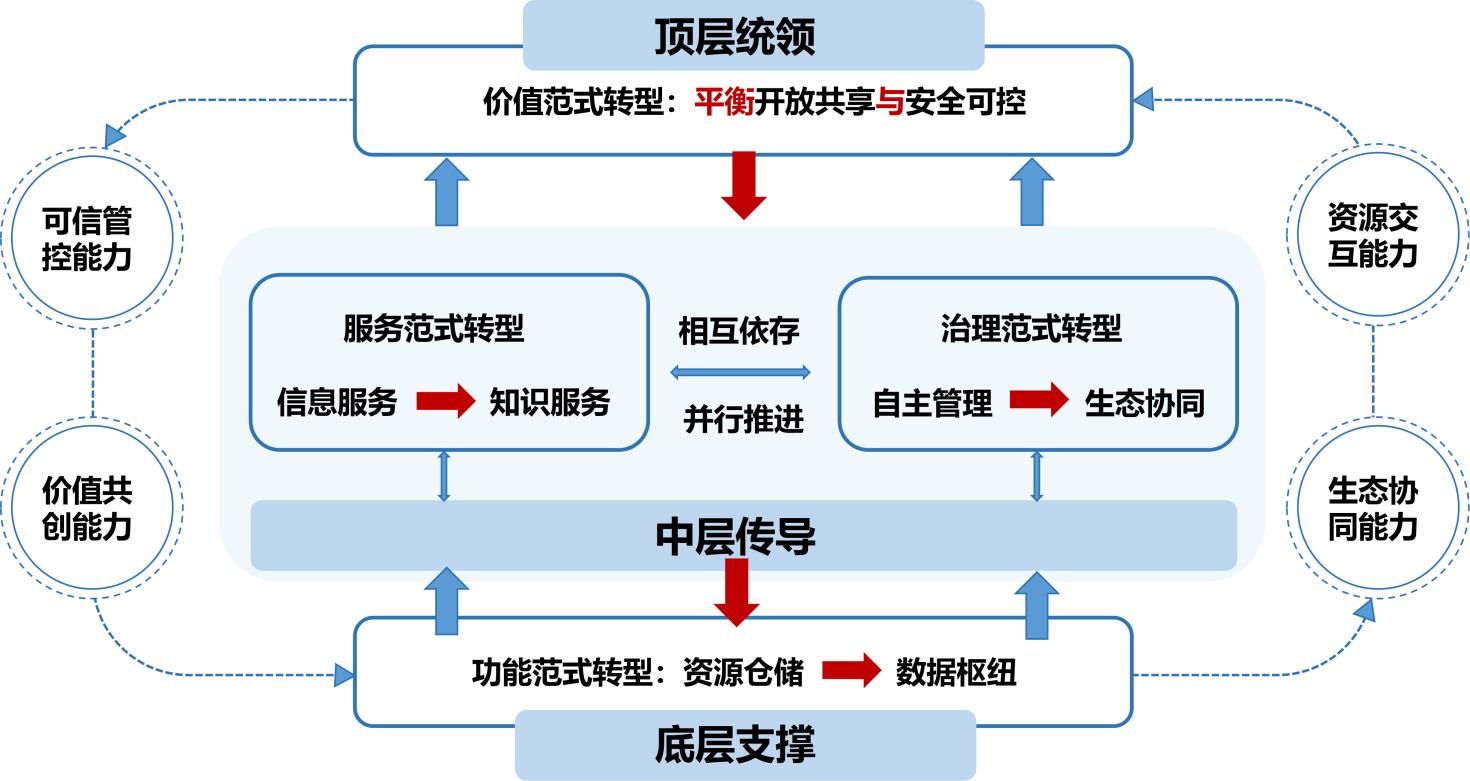
Fig.1

A four-dimensional transformation logic framework for integrating university libraries into the trusted data space construction"

Table 2

Correspondence between practical pathways and transformation logic"

实践路径 对应转型维度 回应的核心问题
战略引领 治理转型 如何确立转型的合法性与统筹机制
技术筑基 功能转型 如何构建数据流通的技术底座
数据为本 功能转型 如何将资源转化为可信数据资产
人才驱动 服务转型 谁来执行转型任务
服务升级 服务转型 如何创造可感知的服务价值
生态协同 治理转型 如何突破组织边界实现跨域协作
价值平衡 价值转型 如何在开放与安全之间取得平衡

Table 3

An integrated advancement pathway for university libraries incorporating trusted data space construction"

阶段 战略引领 数据为本 技术筑基 人才驱动 服务升级 生态协同 价值平衡
启动阶段 编制《校级可信数据空间建设分阶段实施方案》,推动成立可信数据治理委员会 完成校内数据资源盘点与权属梳理,形成《数据资源目录》 根据资源盘点结果完成数据连接器选型与基础平台规划,启动存量系统接口改造评估 制定数据馆员岗位能力框架,设立内部数据学堂启动首批培训 选取1~2个重点学科科研团队开展嵌入式服务试点 建立校内跨部门协同机制,明确各方权责边界 制定《数据分类分级实施细则》《数据共享协议模板》
建设阶段 推动可信数据空间建设纳入学校发展规划,建立评估监测体系 建立元数据标准映射方案,完成核心数据资产化与质量管控平台部署 完成数据枢纽核心平台部署,实现隐私计算技术的场景化应用 推动项目驱动的实战能力培养,引进关键岗位复合型人才 开发3~5个标准化知识产品,升级数据素养教育课程体系 实现与1~2个外部数据空间的标准对接,探索区域馆际协同 部署动态评估与访问控制技术平台,建立全流程审计机制
拓展阶段 形成“规划-执行-监测-改进”的闭环管理体系 实现全生命周期自动化质量监管,建立数据价值动态评估机制 建成安全可信、互联智能的全流程技术体系 建成结构合理、能力完备的数据人才梯队 建成覆盖科研全周期的嵌入式知识服务体系 建成跨域互通、价值共创的服务网络,深度融入国家数据基础设施 建成安全与开放动态平衡的成熟治理体系,形成可推广的制度经验

Table 4

Ownership attributes and licensing conditions of university library collection data"

数据类别 典型示例 权利主体 能否纳入可信数据空间 授权条件与限制
商业数据库 CNKI、Web of Science 数据库商(拥有版权) 否(授权条款限定校内IP) 仅限校内访问,不可跨机构共享
自建特色库 古籍数字化、学位论文库 图书馆+作者(依协议) 可(需作者授权) 需签署数据共享协议,明确使用范围
机构知识库 教师已发表论文PDF 出版社+作者+图书馆 部分可(仅元数据) 全文受版权保护,元数据可开放
业务数据 读者借阅记录、检索日志 图书馆+读者(隐私权) 可(需脱敏处理) 必须匿名化,且仅用于统计分析
科研数据 实验数据、观测数据 科研项目组+资助方 可(需项目组同意) 需签订数据共享协议,明确引用规范
[1]
国家数据局关于印发《可信数据空间发展行动计划(2024-2028年)》的通知[EB/OL]. [2025-06-10].
[2]
程诚, 周杰, 王瀚. 可信数据空间建设中的红色文化资源数字化: 价值阐释、建设导向与实施路径[J]. 农业图书情报学报, 2025, 37(3): 18-31.
Cheng Cheng, Zhou Jie, Wang Han. Digitalization of red cultural resources in the construction of the trusted data space: Value interpretation, construction orientation and implementation path[J]. Journal of Library and Information Science in Agriculture, 2025, 37(3): 18-31.
[3]
包晓丽. 可信数据空间: 技术与制度二元共治[J]. 浙江学刊, 2024(1): 89-100.
Bao Xiaoli. Trusted data space: A co-governance framework of technology and legal rules[J]. Zhejiang Academic Journal, 2024(1): 89-100.
[4]
敦帅, 柳恒超. 可信数据空间建设: 制度、技术与治理[J/OL]. 科学学研究, 1-11[2025-10-21].
Shuai Dun, Liu Hengchao. Construction of trusted data spaces: Institutions, technology, and governance[J/OL]. Studies in Science of Science, 1-11[2025-10-21].
[5]
孔晔晗, 张潇月, 李宜展. 美国高校图书馆促进数据重用的服务实践及启示[J]. 图书与情报, 2023(4): 78-89.
Kong Yehan, Zhang Xiaoyue, Li Yizhan. The practice and enlightenment of data reuse services in American University libraries[J]. Library & Information, 2023(4): 78-89.
[6]
赵一鸣, 黄丹迪. 我国可信数据空间的建设原则与发展路径[J]. 现代情报, 2025, 45(6): 126-139.
Zhao Yiming, Huang Dandi. The construction principles and development paths of trusted data spaces in China[J]. Journal of Modern Information, 2025, 45(6): 126-139.
[7]
张妍, 赵宇翔. 面向数据要素价值共创的可信数据空间: 挑战、行动路径、学科实践[J]. 图书馆建设, 2025(2): 43-48.
Zhang Yan, Zhao Yuxiang. Trusted dataspace for data element value co-creation: Challenges, action pathways and disciplinary practices[J]. Library Development, 2025(2): 43-48.
[8]
胡峰. 流动的丰盈: 面向可信数据空间建设的理论观照与实践观察[J]. 图书情报知识, 2025, 42(5): 6-18, 65.
Hu Feng. Flowing abundance: Theoretical reflection and practical observation on trusted data space construction[J]. Document, Information & Knowledge, 2025, 42(5): 6-18, 65.
[9]
胡峰. 从数据可供到空间可信: 数据空间的逻辑生成、实践塑成与机理证成[J]. 图书馆学研究, 2025(8): 57-67.
Hu Feng. From data availability to trusted data space: Logic generation, practice shaping and mechanism realization of data space[J]. Research on Library Science, 2025(8): 57-67.
[10]
夏义堃, 程铄, 王雪, 等. 数据空间建设的实践进展与运营模式分析——基于Data Spaces Radar的案例[J]. 图书与情报, 2024(2): 18-32.
Xia Yikun, Cheng Shuo, Wang Xue, et al. Research on practical progress and operation mode of data spaces - Based on cases of data spaces radar[J]. Library & Information, 2024(2): 18-32.
[11]
陈依萌, 支凤稳. 面向数据空间建设的档案机构数字转型行动——基于国外典型案例的分析与启示[J]. 浙江档案, 2025(10): 41-44.
Chen Yimeng, Zhi Fengwen. Digital transformation of archival institutions for the construction of data space - Analysis and enlightenment based on foreign typical cases[J]. Zhejiang Archives, 2025(10): 41-44.
[12]
胡志伟, 张楚辉, 刘江峰, 等. 面向新型智慧城市建设的可信数据空间规划: 欧盟经验与启示[J/OL]. 图书馆建设, 1-15[2025-10-21].
Hu Zhiwei, Zhang Chuhui, Liu Jiangfeng, et al. Trusted data space planning for new-type smart city construction: EU experiences and implications[J/OL]. Library Development, 1-15[2025-10-21].
[13]
王雪, 夏义堃. 健康医疗数据利用中数据权益保障的现实困境与完善对策——以欧盟健康数据空间为例[J]. 图书与情报, 2024(2): 55-68.
Wang Xue, Xia Yikun. On the practical dilemma and perfecting improvement of data rights and interests protection in the utilization of health and medical data - Take the European health data space as an example[J]. Library & Information, 2024(2): 55-68.
[14]
孙润康, 李金, 任宇飞, 等. 大型医院临床科研可信数据空间的技术路径研究[J]. 中国医院管理, 2025, 45(4): 70-72.
Sun Runkang, Li Jin, Ren Yufei, et al. Research on technical pathways for trusted data space in clinical research of large-scale hospitals[J]. Chinese Hospital Management, 2025, 45(4): 70-72.
[15]
刘晨, 王蓉. 我国金融行业可信数据空间建设的思考[J]. 金融发展研究, 2025(9): 53-60.
Liu Chen, Wang Rong. Reflections on building a trusted data space for China's financial industry[J]. Journal of Financial Development Research, 2025(9): 53-60.
[16]
王涛, 曾颖洁, 刘清堂, 等. 基于可信数据空间的教育数据要素流通治理体系与实践路径[J]. 电化教育研究, 2025, 46(10): 39-46.
Wang Tao, Zeng Yingjie, Liu Qingtang, et al. Governance framework and practical pathways for the circulation of educational data elements based on trustworthy data spaces[J]. E-education Research, 2025, 46(10): 39-46.
[17]
蒋冬英. 图书馆可信数据空间建设的价值与模式研究[J]. 图书与情报, 2025(1): 130-136.
Jiang Dongying. Research on the value and model of library trusted data space construction[J]. Library and Information, 2025(1): 130-136.
[18]
韩洁. 基于服务生态系统视角的智慧图书馆可信数据空间建设研究[J]. 科技视界, 2025, 15(23): 96-100.
Han Jie. Research on the construction of trusted data space of smart library from the perspective of service ecosystem[J]. Science & Technology Vision, 2025, 15(23): 96-100.
[19]
吴玉浩, 周志红, 刘伟, 等. 价值链协同视角下智慧图书馆可信数据空间体系研究[J]. 农业图书情报学报, 2025, 37(11): 30-46.
Wu Yuhao, Zhou Zhihong, Liu Wei, et al. Trusted data space system of smart libraries from the perspective of value chain synergy[J]. Journal of Library and Information Science in Agriculture, 2025, 37(11): 30-46.
[20]
唐凤, 方向明, 王仪欣. 试论图书馆数字特藏可信数据空间建设的现实需求、理论框架和实施策略[J]. 农业图书情报学报, 2025, 37(11): 47-61.
Tang Feng, Fang Xiangming, Wang Yixin. On the practical needs, theoretical framework, and implementation strategies for constructing a trusted data space for library digital special collections[J]. Journal of Library and Information Science in Agriculture, 2025, 37(11): 47-61.
[21]
任妍, 段涛, 付玉, 等. AIGC时代信息资源管理领域可信数据空间的构建路径: 主体比较与策略研究[J]. 情报资料工作, 2026, 47(2): 62-68.
Ren Yan, Duan Tao, Fu Yu, et al. The construction path of trusted data space in the field of information resources management in the AIGC era: A comparative study of subjects and strategy research[J]. Information and Documentation Services, 2026, 47(2): 62-68.
[22]
王强, 陈鹏玮. 图书馆可信数据空间建设: 场景观察、风险透视与治理演进[J]. 图书馆, 2026(2): 31-39.
Wang Qiang, Chen Pengwei. Building trustworthy data spaces in libraries: Scenario observation, risk exploration and governance evolution[J]. Library, 2026(2): 31-39.
[23]
张琦, 耿锐, 马腾飞, 等. 互联网版本典藏资源的可持续利用——基于数字文明记忆保存与传承视角[J]. 山西档案, 2025(10): 39-47, 56.
Zhang Qi, Geng Rui, Ma Tengfei, et al. Sustainable utilization of Internet version archive resources: Based on the perspective of preservation and inheritance of digital civilization memory[J]. Shanxi Archives, 2025(10): 39-47, 56.
[24]
张宝辉, 张益嘉, 郭海强, 等. 基于我国开放研究数据的论文国际影响力研究——以北京大学开放研究数据平台的中国健康与养老追踪调查数据为例[J]. 中国科技期刊研究, 2024, 35(11): 1571-1579.
Zhang Baohui, Zhang Yijia, Guo Haiqiang, et al. International influence of papers based on Chinese open research data: China health and retirement longitudinal study data from Peking University Open Research Data as an example[J]. Chinese Journal of Scientific and Technical Periodicals, 2024, 35(11): 1571-1579.
[25]
北京大学图书馆.北京大学开放研究数据平台简介[EB/OL] .[2026-04-13].
[26]
清华大学图书馆. 图书馆面向我校师生提供学术数据支持服务[EB/OL]. [2026-04-13].
[27]
清华大学图书馆. “Science Open for All” OpenSign公益性学术资源服务平台正式上线[EB/OL]. [2026-04-13].
[28]
清华大学图书馆.图书馆AI导航助手升级通知[EB/OL]. [2026-04-13].
[29]
上海交通大学图书馆.上海交通大学机构知识管理服务系统[EB/OL]. [2026-04-13].
[30]
上海交通大学图书馆. [交圕・迎新季]你的学习搭子已就位! “AI馆员” 24小时陪伴式服务[EB/OL]. [2026-04-13].
[31]
董有明, 马浩琴. 数据驱动的高校图书馆学科情报服务创新——武汉大学图书馆的实践探索[J]. 大学图书馆学报, 2025, 43(3): 15-23.
Dong Youming, Ma Haoqin. Data-driven innovation in subject intelligence services of university libraries - Practice of Wuhan University library[J]. Journal of Academic Libraries, 2025, 43(3): 15-23.
[32]
武汉大学图书馆. 武汉大学机构知识库[EB/OL]. [2026-04-13].
[33]
武汉大学图书馆. 数据素养与数据利用[EB/OL]. [2026-04-13].
[34]
南京大学图书馆. CADAL管理中心[EB/OL]. [2026-04-13].
[35]
南京大学图书馆. NLSP下一代图书馆管理系统[EB/OL]. [2026-04-13].
[36]
南京大学图书馆. “南雍闻道”智能科学服务平台[EB/OL]. [2026-04-13].
[37]
宋娟. 斯坦福大学图书馆数据服务模式研究: 基于全要素整合的案例研究[J]. 图书馆, 2026(1): 24-31.
Song Juan. Research on the data service model of stanford university library: A case study based on all elements integration[J]. Library, 2026(1): 24-31.
[38]
吴予晨, 许春漫. 美国Civic Switchboard项目获奖图书馆开放数据服务实践及启示[J]. 数字图书馆论坛, 2021, 17(11): 50-56.
Wu Yuchen, Xu Chunman. Practice and enlightenment of field project awards won by American libraries in civic switchboard open data service project[J]. Digital Library Forum, 2021, 17(11): 50-56.
[39]
朱瑞. 图书馆衍生数据的权利确证、保护困境及路径选择[J]. 图书馆建设, 2024(4): 47-57.
Zhu Rui. Right confirmation, protection dilemma, and path selection of library derived data[J]. Library Development, 2024(4): 47-57.
[40]
王世伟. 人工智能时代图书馆员应当如何发展[J]. 图书馆, 2025(6): 1-5.
Wang Shiwei. How should librarians develop in the era of artificial intelligence[J]. Library, 2025(6): 1-5.
[41]
王飒, 杨静. “双一流”建设背景下数智赋能高校图书馆学科情报服务实践——以北京理工大学图书馆为例[J]. 大学图书馆学报, 2025, 43(3): 24-33.
Wang Sa, Yang Jing. Practice of digital and intelligent empowerment for subject intelligence services in university libraries under the background of Double First-Class construction - A case study of the library of Beijing institute of technology[J]. Journal of Academic Libraries, 2025, 43(3): 24-33.
[42]
蔺文爱. 基于岗位职责的高校图书馆数据馆员能力培养策略[J]. 图书馆, 2024(12): 46-52.
Lin Wenai. Ability training strategy of data librarians in university libraries based on job responsibilities[J]. Library, 2024(12): 46-52.
[43]
北京大学图书馆. 融入科研团队的学科情报服务[EB/OL]. [2026-04-13].
[44]
深圳大学图书馆. 学科及成果数据服务[EB/OL]. [2026-04-13].
[45]
Europeana. About[EB/OL]. [2025-12-27].
[46]
哈尔滨工业大学图书馆荣获“CADAL项目2025年度共建共享先进集体”称号[EB/OL]. [2026-04-13].
[1] JIANG Jingze, ZHOU Tianmin, LI Mei, CHENG Cheng, CHEN Haiyan. A study of the Core Competence Model of Compound AI Librarians in the Intelligent Transformation of University Libraries [J]. Journal of library and information science in agriculture, 2025, 37(9): 97-109.
[2] JIANG Yumeng. An Investigation and Enlightenment on the Current Status of AI Literacy Education in Nordic University Libraries [J]. Journal of library and information science in agriculture, 2025, 37(7): 19-34.
[3] CHENG Cheng, ZHOU Jie, WANG Han. Digitalization of Red Cultural Resources in the Construction of the Trusted Data Space: Value Interpretation, Construction Orientation and Implementation Path [J]. Journal of library and information science in agriculture, 2025, 37(3): 18-31.
[4] SUN Zhimei, LIU Yan, LIU Wenyun, LI Ruiqin. Perception and Utilization of Digital Literacy Knowledge by University Library Users from Representational Pers Perspective [J]. Journal of library and information science in agriculture, 2025, 37(2): 23-36.
[5] HE Cong, YANG Jing, XIAO Xiong, SUN Wenwen, LI Chenggang. Construction of Efficiency Evaluation System for University Library Resource Construction under the Background of AI Era: Practical Exploration of Beijing Institute of Technology Library [J]. Journal of library and information science in agriculture, 2025, 37(10): 96-111.
[6] Ru WU, Ruhan ZHANG, Chenxing DAI, cheng LU. Intellectual Property Literacy Education in University Libraries Based on Innovative Talent Cultivation [J]. Journal of library and information science in agriculture, 2024, 36(6): 79-87.
[7] Feiyan HUANG. Practices for New Research University's Collaborative Collection Development of Print and Electronic Books: A Case Study of SUSTech Library [J]. Journal of library and information science in agriculture, 2024, 36(11): 92-103.
[8] Xiao SHI. Analysis of Strategic Planning Content and Development Trends of American University Libraries [J]. Journal of library and information science in agriculture, 2024, 36(10): 38-52.
[9] YANG Lingmei. Discussion on Knowledge and Information Transfer Model for University Libraries Serving Rural Revitalization [J]. Journal of library and information science in agriculture, 2024, 36(1): 71-82.
[10] ZHANG Jingbei, XU Yaping, ZHOU Qiong, CAI Yingchun. Future Learning Centers: A Study on Libraries' Role Reorientation, Function Reconstruction, and Practical Innovations [J]. Journal of library and information science in agriculture, 2023, 35(6): 43-50.
[11] XU Zhao, PENG Juyuan, DUAN Juanjuan. Model of Cooperation between University Libraries and Social Organizations for the Integration of Culture and Tourism Development [J]. Journal of library and information science in agriculture, 2023, 35(12): 71-83.
[12] ZHANG Hongping. Promotion Mechanism of User Demand to Library Literature Resource Construction, Management and Service: Based on Grounded Theory [J]. Journal of library and information science in agriculture, 2022, 34(9): 95-103.
[13] XING Wenming, LIU Wo. An Investigation on University Libraries' Service in Promoting the Implementation of FAIR Data Management Principles [J]. Journal of library and information science in agriculture, 2022, 34(7): 65-75.
[14] LI Bo, LI Honglian, GUAN Qing, LIU Yang. Fine-grained Sentiment Analysis of Social Network Platform of University Libraries Based on CNN-BiLSTM-HAN Hybrid Neural Network [J]. Journal of library and information science in agriculture, 2022, 34(4): 63-73.
[15] DU Yu, WANG Hongye, HU Zhixun. Co-Construction and Sharing of Literature and Information Resources in Regional Colleges and Universities Based on Block Chain Incentive Mechanism [J]. Journal of library and information science in agriculture, 2022, 34(4): 74-83.
Viewed
Full text


Abstract

Cited

  Shared   
  Discussed   
No Suggested Reading articles found!