中文    English

Journal of library and information science in agriculture


Empirical Analysis of Supply and Demand in the Employment Market for Doctoral Graduates in Information Resource Management: A Perspective on Disciplinary Transformation

LIU Pubin1,3, ZHANG Dandan2,3, WANG Penglong1,3()   

  1. 1. Northwest Institute of Eco-Environment and Resources, Chinese Academy of Sciences, Lanzhou 730000
    2. Wuhan Documentation and Information Center, Chinese Academy of Sciences, Wuhan 430071
    3. Department of Information Resource Management, School of Economics and Management, University of Chinese Academy of Sciences, Beijing 100049
  • Received:2025-09-28 Online:2026-07-13
  • Contact: WANG Penglong

Abstract:

[Purpose/Significance] Against the backdrop of China's vigorous promotion of the digital economy and and transformation of digital governance, the discipline of information resource management, which is crucial to national information strategy and intelligent industry development, is in high demand for innovative, high-level talent. Doctoral talent, as the core of disciplinary frontier research and professional practice innovation in disciplines, is currently facing severe challenges in labor market supply and demand matching. The overall scale of doctoral training in this field is relatively small, and graduates tend to be homogeneous in terms of their training orientation, knowledge structure and research direction, which is difficult for them to adapt to the diverse, hierarchical and practical needs of the expanding job market. However, the existing academic research pays insufficient attention to the systematic analysis of the supply-demand relationship in the doctoral employment market, and lacks in-depth empirical investigation on the structural characteristics and dynamic evolution of supply and demand. Therefore, this study uses an analytical framework of supply and demand, to conduct an in-depth exploration of the employment structure, market demand trends and degree of supply-demand matching degree of doctoral talent in information resource management. This study aims to provide solid empirical support and practical guidance for optimizing the doctoral training system, adjusting the training direction and formulating scientific and effective talent policies. [Method/Process] This study constructs a comprehensive and multi-dimensional database for analyzing the supply and demand of doctoral talent. On the supply side, it systematically collected the data of doctoral program distribution, enrollment scale and graduation status from 2016 to 2024; on the demand side, it collected a large number of recruitment information from 2016 to January 2025, covering universities, research institutes, military-civilian integration positions, university libraries and high-tech enterprises. Meanwhile, a questionnaire survey was conducted from October 2024 to January 2025 to obtain the micro-level employment characteristics of graduates. All data were unified and calibrated to January 2025 to ensure the consistency and comparability of the research data. Based on descriptive statistics, structural analysis and supply-demand comparative analysis, this study systematically examined the dynamic changes of doctoral training scale, the diversification process of job types and the evolution trend of market demand. [Results/Conclusions] The results show that the overall supply of doctoral talent in information resource management in China is insufficient, the regional distribution is extremely imbalanced, and there is a serious shortage of talent in emerging interdisciplinary fields. On the demand side, the market demand shows a continuous expansion trend, universities are still the main employers, and the recruitment demand from military-civilian positions, university libraries and research institutes has increased significantly, and the types of positions are increasingly diversified. Although the overall scale of supply and demand is gradually balanced, structural mismatches are still prominent in regional distribution, job hierarchy and competency requirements. Therefore, this study suggests that we should optimize the doctoral training structure, strengthen the cultivation of practical and interdisciplinary abilities, promote the rational flow of talented people among regions, and expand diversified employment channels, so as to effectively alleviate the contradiction between supply and demand and improve the allocation efficiency and matching quality of the doctoral talent market.

Key words: information resource management, doctoral education, employment market, supply-demand analysis, talent structure

CLC Number: 

  • G203.4

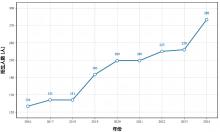
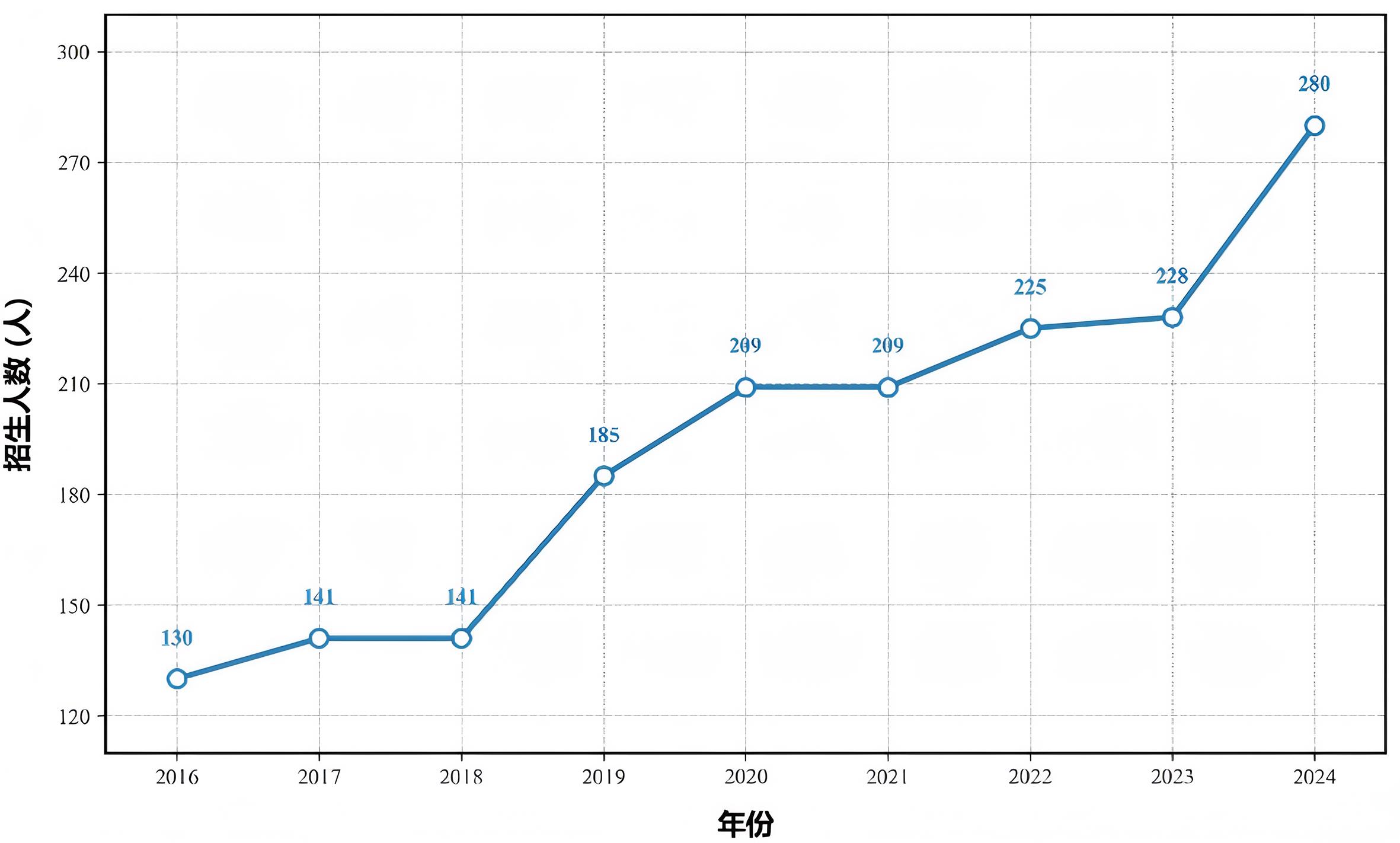
Fig.1

Doctoral admissions data from 2016 to 2024"

Table 1

Regional breakdown of doctoral enrollment in 2024"

地区 院校数/所 招生人数/人 校均招生数/人 招生最大/人 招生最小值/人
全国 21 280(100.0%) 13.3 58 0
华中 4 87(31.1%) 21.75 58 6
华北 8 86(31.0%) 10.75 34 0
华东 4 80(28.5%) 16 56 6
华南 1 12(4.2%) 12 12 12
东北 2 8(2.8%) 4 8 0
西南 1 4(1.4%) 4 4 4
西北 1 3(1.0%) 3 3 3

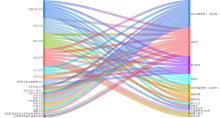
Fig.2

Configuration of Sub-disciplines in information resources management"

Table 2

Enrollment in IRM doctoral programs by sub-discipline from 2016 to 2024"

类别 二级学科 招生人数/人 招生院校/所 校均招生/人
第一类 信息资源管理 846 11 76.9
第二类 情报学 419 11 38.1
图书馆学 199 7 28.4
档案学 75 5 15.0
出版发行学 77 1 77.0
数据科学 47 1 47.0
信管二级学科 44 3 14.7
信息分析 16 2 8.0
编辑出版学 12 1 12.0
文献学 7 1 7.0
数据管理 4 2 2.0
大数据管理与应用 4 1 4.0
数字人文 2 1 2.0

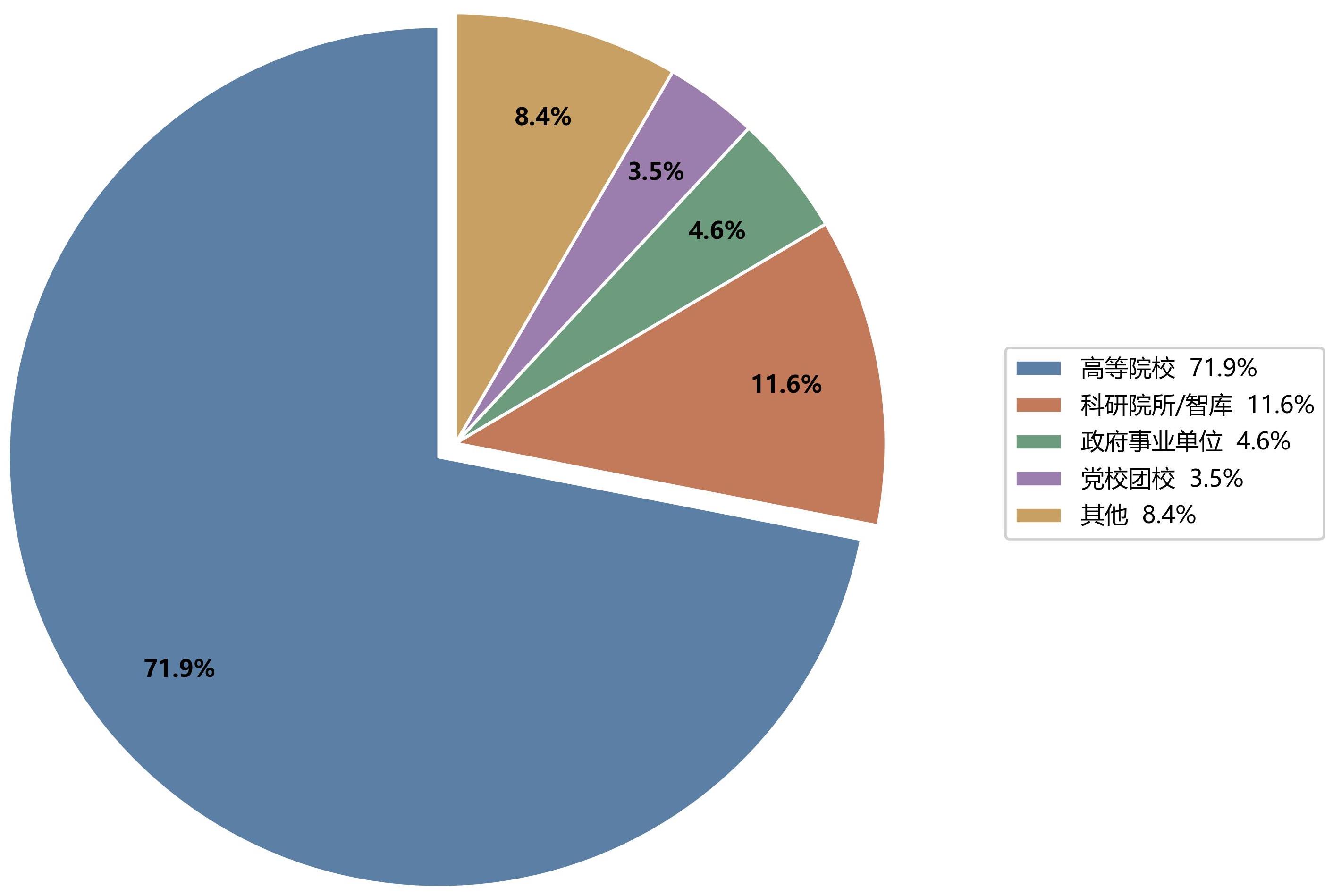
Fig.3

Employment of IRM doctorates by institution type"

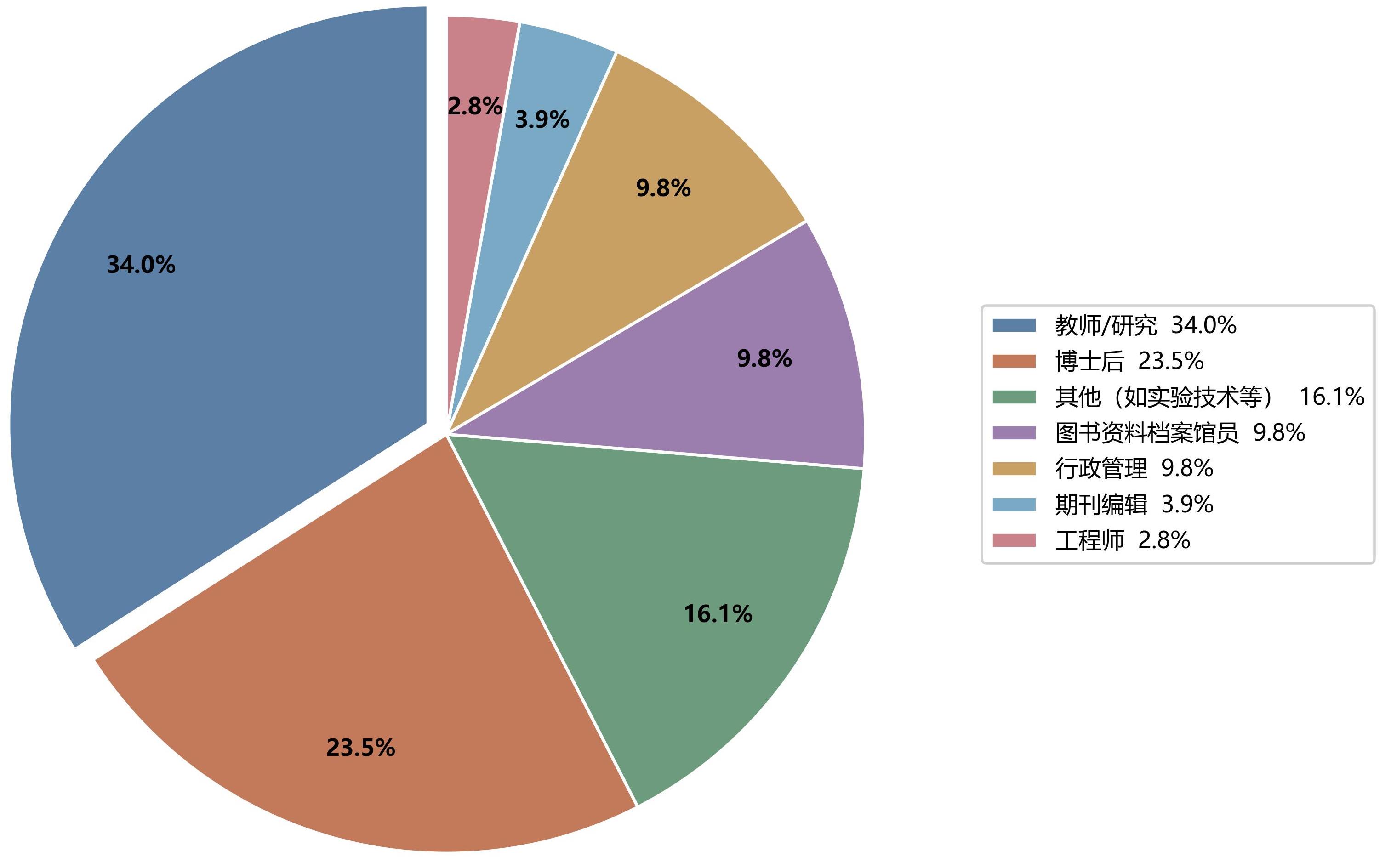
Fig.4

Employment of IRM doctorates by position type"

Table 3

Cross-tabulation of overseas study experience and employment sector type"

留学经历类别 高等院校 科研院所/智库 党校团校 公务员 政府事业单位 军队文职/武警院校 文化机构 医疗卫生机构 各类企业 其他
海外学位 36(75%) 8(16.67%) 0 0 2(4.17%) 0 1(2.08%) 1(2.08%) 0 0
公派联合培养 18(66.67%) 1(3.70%) 4(14.81%) 1(3.70%) 3(11.11%) 0 0 0 0 0
普通访学 23(63.89%) 4(11.11%) 1(2.78%) 2(5.56%) 1(2.78%) 1(2.78%) 0 1(2.78%) 3(8.33%) 0
128(73.56%) 20(11.49%) 5(2.87%) 5(2.87%) 7(4.02%) 1(0.57%) 3(1.72%) 1(0.57%) 3(1.72%) 1(0.57%)

Table 4

Cross-tabulation of research output quantity and employment sector type"

发文量/篇 高等院校 科研院所/智库 党校团校 公务员 政府事业单位 军队文职/武警院校 文化机构 医疗卫生机构 各类企业 其他
0 69(82.14%)

7

(8.33%)

3

(3.57%)

1

(1.19%)

3

(3.57%)

0 0

1

(1.19%)

0 0
1 39(72.22%)

6

(11.11%)

1

(1.85%)

3

(5.56%)

2

(3.70%)

0

1

(1.85%)

1

(1.85%)

1

(1.85%)

0
2 32(51.61%)

11

(17.74%)

3

(4.84%)

3

(4.84%)

4

(6.45%)

1

(1.61%)

2

(3.23%)

0

5

(8.06%)

1

(1.61%)

3 30(75%) 5(12.5%)

1

(2.5%)

0

3

(7.5%)

0 0

1

(2.5%)

0 0
4 30(78.95%) 4(10.53%)

2

(5.26%)

1

(2.63%)

1

(2.63%)

0 0 0 0 0
5及以上 5(71.43%) 0 0 0 0

1

(14.29%)

1

(14.29%)

0 0 0

Table 5

Cross-tabulation of job category and job acquisition channel"

岗位类型

网络公开

招聘信息

专场招聘会或学术会议 院系内部提供 导师推荐 亲友推荐 其他
教师/研究人员 37(38.14%) 36(37.11%) 5(5.15%) 17(17.53%) 0(0.00%) 2(2.06%)
博士后 44(65.67%) 12(17.91%) 0(0.00%) 10(14.93%) 1(1.49%) 0(0.00%)
图书资料档案馆员 21(75%) 4(14.29%) 1(3.57%) 1(3.57%) 1(3.57%) 0(0.00%)
期刊编辑 4(36.36%) 3(27.27%) 2(18.18%) 1(9.09%) 1(9.09%) 0(0.00%)
工程师 3(37.5%) 5(62.5%) 0(0.00%) 0(0.00%) 0(0.00%) 0(0.00%)
其他(如实验技术等) 26(56.52%) 11(23.91%) 2(4.35%) 5(10.87%) 1(2.17%) 1(2.17%)

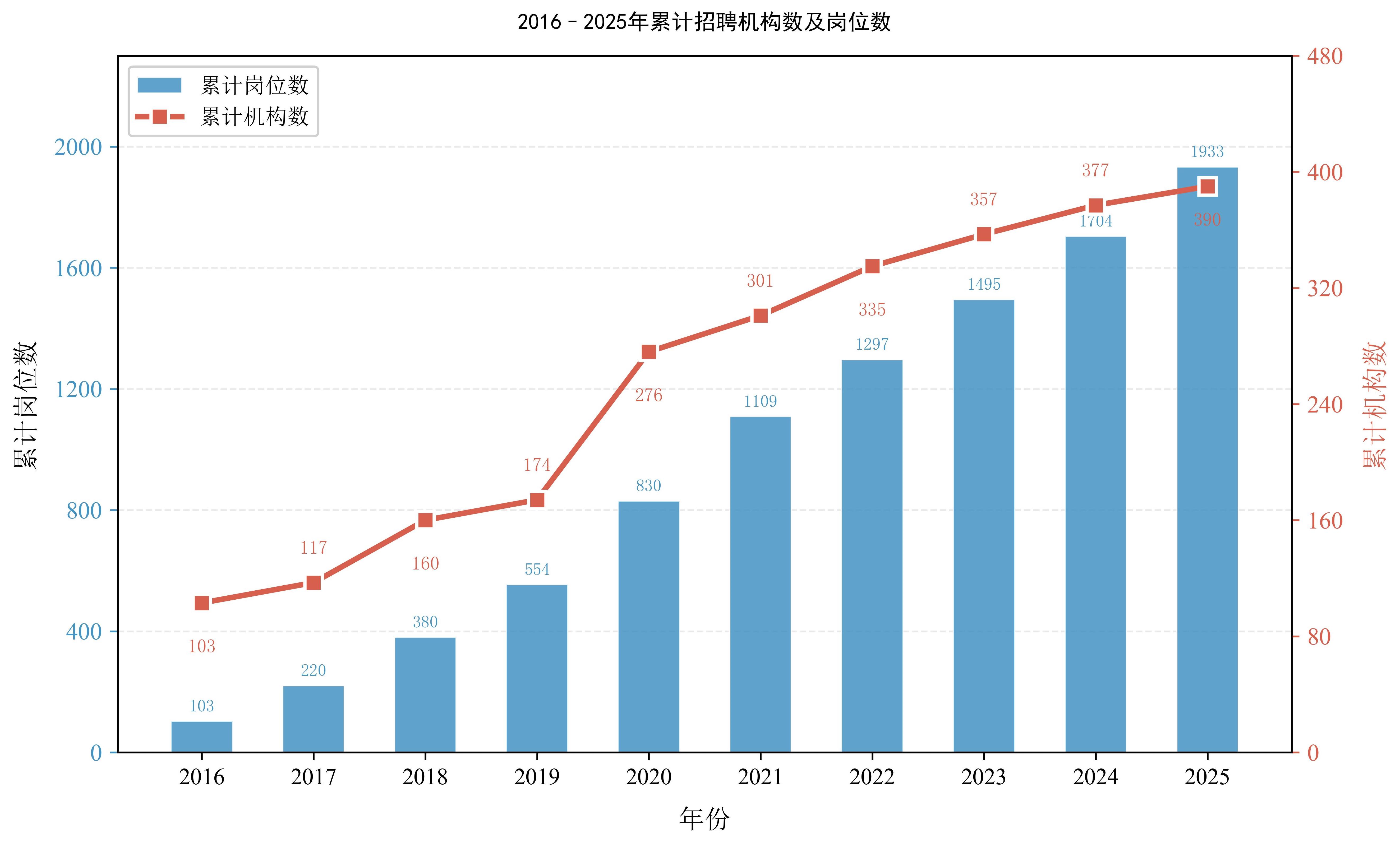
Fig. 5

The number of recruitment agencies and the number of people recruited from 2016 to 2025"

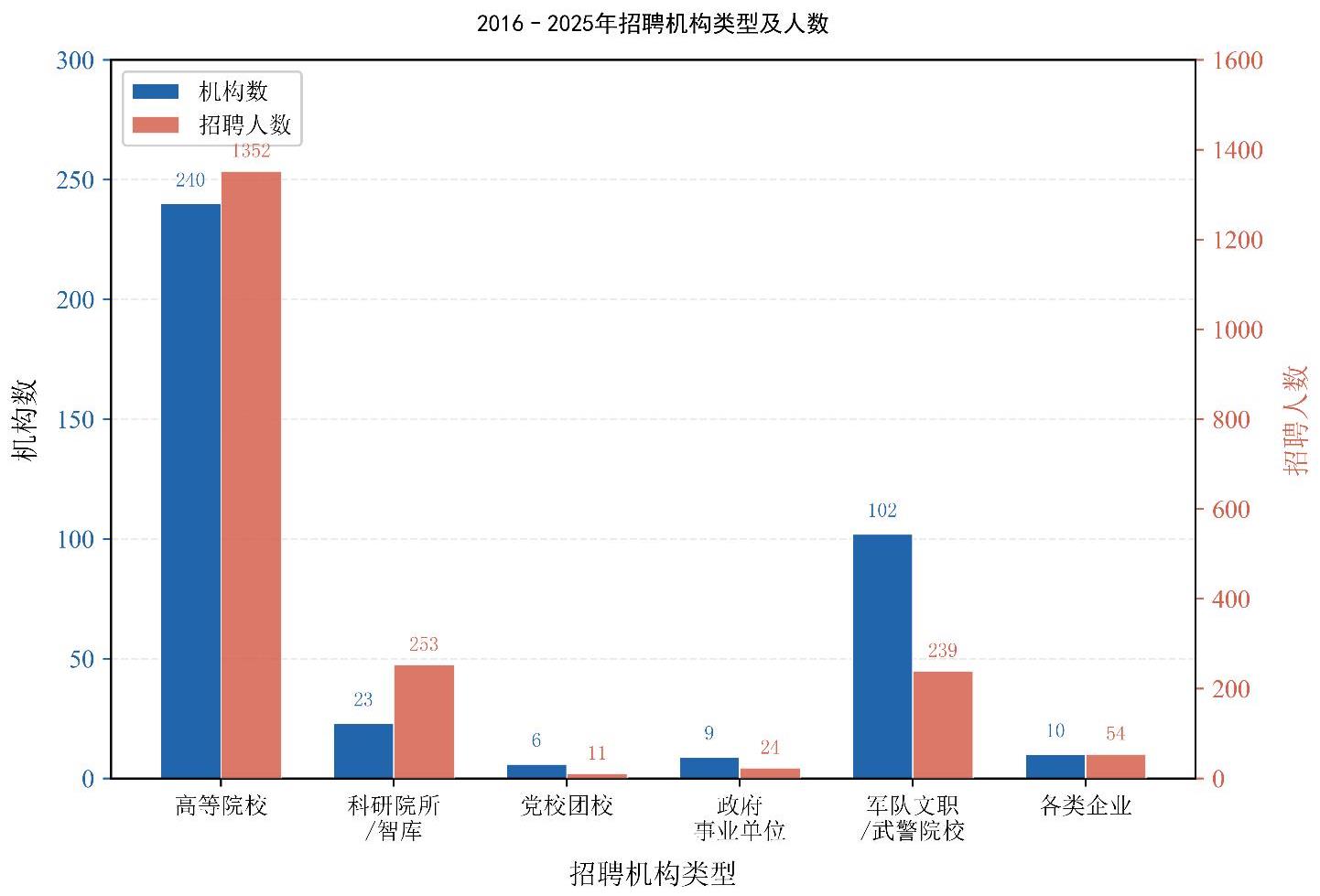
Fig.6

Types and numbers of recruitment agencies and the number of recruits from 2016 to 2025"

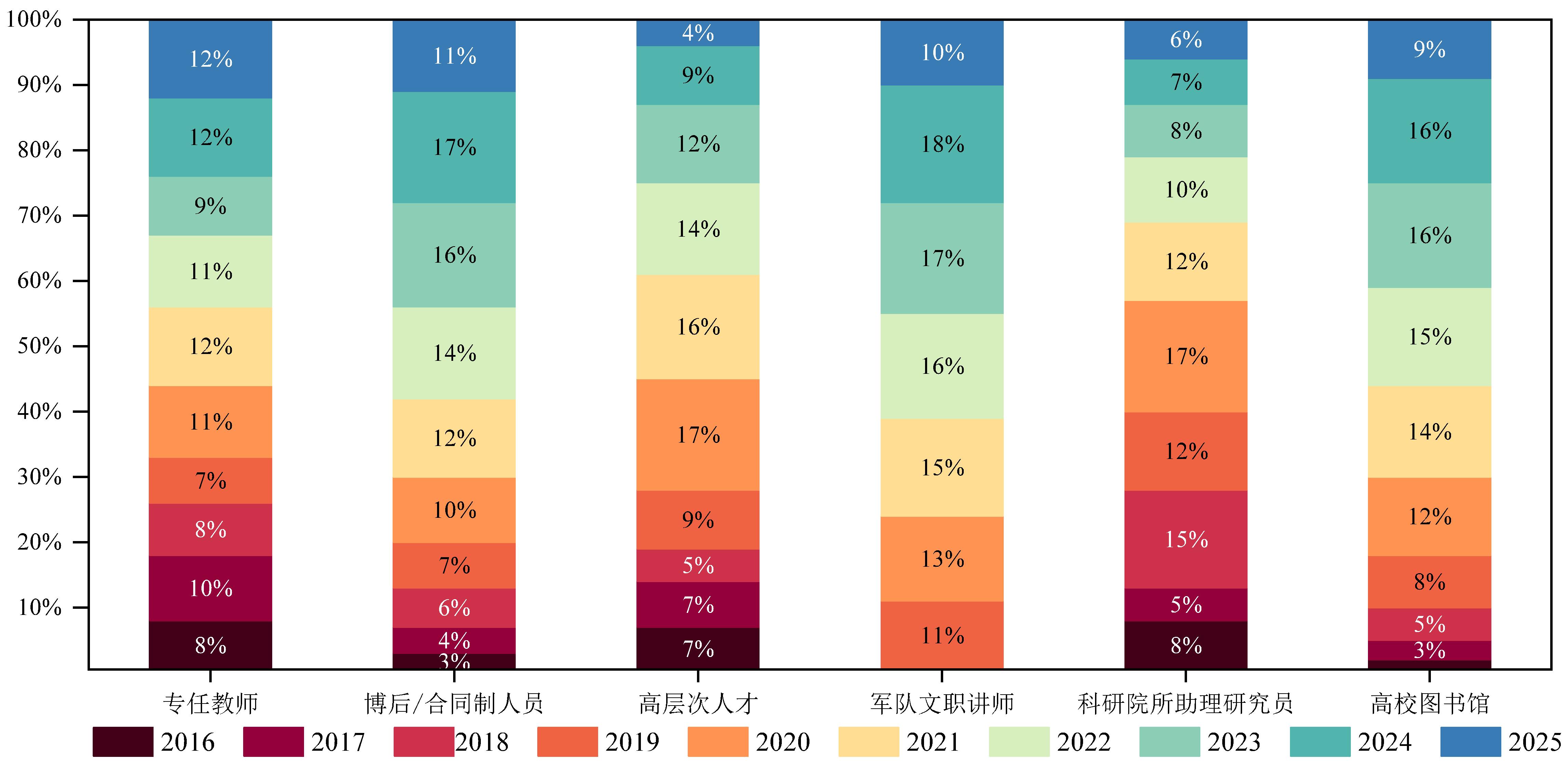
Fig.7

Recruitment position types from 2016 to 2025"

[1]
国务院学位委员会. 教育部关于印发《研究生教育学科专业目录(2022年)》《研究生教育学科专业目录管理办法》的通知[EB/OL]. [2024-10-15].
[2]
王欣. 信息资源管理一级学科新发展理念下图情档资源的融合建设[J]. 档案管理, 2024(5): 100-104.
Wang Xin. The new development concept of the first-level discipline of information resource management: The fusion construction of library resources[J]. Archives Management, 2024(5): 100-104.
[3]
张洋, 吴婷婷, 高云芸, 等. 我国信息资源管理学科布局特征分析及启示[J]. 图书馆理论与实践, 2024(5): 1-8.
Zhang Yang, Wu Tingting, Gao Yunyun, et al. Analysis and implications of the layout characteristics of China's information resource management discipline[J]. Library Theory and Practice, 2024(5): 1-8.
[4]
李阳, 白冰, 程璐, 等. 新时代信息资源管理的学科建设和人才培养——“首届全国信息资源管理年会暨博士生学术论坛”综述[J]. 图书馆论坛, 2024, 44(11): 23-28.
Li Yang, Bai Bing, Cheng Lu, et al. Discipline construction and talent cultivation of information resource management in the new era - An overview of the first national annual conference on information resource management and doctoral academic forum[J]. Library Tribune, 2024, 44(11): 23-28.
[5]
刘冰, 刘禹宏, 李响. 基于数智教育生态的信息资源管理研究生培养模式构建[J]. 情报科学, 2025, 43(3): 10-16.
Liu Bing, Liu Yuhong, Li Xiang. Construction of graduate training model for information resource management based on digital intelligence education ecology[J]. Information Science, 2025, 43(3): 10-16.
[6]
颜丽蓉, 储节旺, 李振延, 等. 生成式人工智能融入信息资源管理学科专业课程教学的路径探索研究[J]. 图书馆杂志, 2025, 44(1): 128-138, 157.
Yan Lirong, Chu Jiewang, Li Zhenyan, et al. Exploring the integration of GAI into the curriculum teaching of information resource management discipline[J]. Library Journal, 2025, 44(1): 128-138, 157.
[7]
李广建, 潘佳立. 加强信息资源管理,助力新质生产力[J]. 图书情报知识, 2024, 41(6): 14-27.
Li Guangjian, Pan Jiali. Strengthening information resources management to empower new quality productive forces[J]. Documentation, Information Knowledge, 2024, 41(6): 14-27.
[8]
张洋, 吴婷婷, 李晶. 交叉学科视角下的信息资源管理创新人才培养[J]. 信息资源管理学报, 2024, 14(3): 21-29, 55.
Zhang Yang, Wu Tingting, Li Jing. Cultivation of innovative talents in information resource management under interdisciplinary perspective[J]. Journal of Information Resources Management, 2024, 14(3): 21-29, 55.
[9]
王喜明, 杨新明. “图情档”一级学科更名的历史回顾与未来展望[J]. 图书馆论坛, 2022, 42(6): 11-19.
Wang Ximing, Yang Xinming. Renaming the first-level discipline of LIS archives management: Historical review and prospects[J]. Library Tribune, 2022, 42(6): 11-19.
[10]
郑荣, 高志豪, 魏明珠, 等. 数字中国背景下信息资源管理研究生教育:时代要务、逻辑转向与赋能场景[J]. 图书情报工作, 2023, 67(4): 3-10.
Zheng Rong, Gao Zhihao, Wei Mingzhu, et al. Graduate education in information resources management in the context of digital China: Times imperatives, logical turn and enabling scenarios[J]. Library and Information Service, 2023, 67(4): 3-10.
[11]
武利红, 李铮, 王思佳. 我国图书情报硕士专业学位培养单位招生方向设置研究[J]. 大学图书馆学报, 2024, 42(5): 95-107.
Wu Lihong, Li Zheng, Wang Sijia. Research on the enrollment direction of master's degree training units in library and information science in China[J]. Journal of Academic Libraries, 2024, 42(5): 95-107.
[12]
任红娟. 我国情报学博士教育研究[J]. 情报科学, 2007, 25(4): 624-627, 640.
Ren Hongjuan. Research on the doctoral education in the field of information science in China[J]. Information Science, 2007, 25(4): 624-627, 640.
[13]
夏立新, 郭致怡. 推动信息资源管理学科高质量发展的思考[J]. 图书情报工作, 2023, 67(1): 9-15.
Xia Lixin, Guo Zhiyi. Reflections on promoting high-quality development of information resources management discipline[J]. Library and Information Service, 2023, 67(1): 9-15.
[14]
秦春秀, 马续补, 张雪, 等. 信息资源管理学科的区域战略支撑与协同发展——2023年第一届西北高校信息资源管理学科建设联盟工作会议暨2023年学术年会纪要[J]. 现代情报, 2024, 44(8): 171-177.
Qin Chunxiu, Ma Xubu, Zhang Xue, et al. The regional strategic support and collaborative development of information resource management discipline - Minutes of the first northwest university information resource management discipline construction alliance work conference academic annual meeting(2023)[J]. Journal of Modern Information, 2024, 44(8): 171-177.
[15]
赵峥. 塑造“人工智能+”信息资源管理人才培养新生态[J]. 图书馆建设, 2024(3): 24-26.
Zhao Zheng. Creating a new ecosystem for cultivating "artificial intelligence+" information resource management talents[J]. Library Development, 2024(3): 24-26.
[16]
吴慰慈. “双一流”背景下“图情档”研究生教育的思考——在“2019年第十三届全国图书馆学博士生学术论坛”上的讲话[J]. 图书馆杂志, 2020, 39(5): 4-5.
Wu Weici. Thinking on graduate education of the subject of library, information and archive science under the background of "double first-rate": Speech at the 13th national academic forum for doctoral students in library science in 2019[J]. Library Journal, 2020, 39(5): 4-5.
[17]
肖希明, 石庆功. 新中国70年我国图书馆学教育本土化探索与思考[J]. 图书与情报, 2019(5): 13-20.
Xiao Ximing, Shi Qinggong. On the indigenization of library science education in new China[J]. Library and Information, 2019(5): 13-20.
[18]
刘涵. 中美两国图书情报学研究生培养比较研究——以武汉大学和美国伊利诺伊大学厄巴纳-香槟分校为例[J]. 图书馆工作与研究, 2020(5): 30-37.
Liu Han. Comparative study of postgraduate education of library and information science between China and America - A case study of Wuhan University and university of Illinois Urbana-Champaign[J]. Library Work and Study, 2020(5): 30-37.
[19]
初景利, 张冬荣. 中国科学院图情档研究生教育的十点特质[J]. 图书情报工作, 2019, 63(19): 25-28.
Chu Jingli, Zhang Dongrong. Ten characteristics of postgraduate education in library and information archives of China academy of sciences[J]. Library and Information Service, 2019, 63(19): 25-28.
[20]
张洋, 朱嘉麒, 罗婷予, 等. 从目标到过程: 我国图情档博士人才培养分析[J]. 图书馆论坛, 2022, 42(7): 74-83.
Zhang Yang, Zhu Jiaqi, Luo Tingyu, et al. From goal to process: Analysis of the cultivation of doctoral talents in library and information science and archives management in China[J]. Library Tribune, 2022, 42(7): 74-83.
[21]
邱均平, 徐中阳, 王琳. 论信息资源管理学的体系结构[J]. 图书情报工作, 2024, 68(20): 3-13.
Qiu Junping, Xu Zhongyang, Wang Lin. On the system structure of information resource management science[J]. Library and Information Service, 2024, 68(20): 3-13.
[22]
杨佳怿, 贾迪雅. 数字人文就业岗位调查分析——基于图情档相关学科专业[J]. 档案管理, 2022(6): 100-104.
Yang Jiayi, Jia Diya. Survey and analysis of digital humanities employment positions - Based on disciplines related to library and information and archives management[J]. Archives Management, 2022(6): 100-104.
[23]
刘惠, 张冬荣. 新时期图书情报档案管理学生就业能力提升路径研究——基于CMES-LIS的模型[J]. 图书馆工作与研究, 2021(9): 111-119.
Liu Hui, Zhang Dongrong. Research on promotion path of the employability of students in library, information and archival management in the new period - Based on CMES-LIS model[J]. Library Work and Study, 2021(9): 111-119.
[1] FAN Zhenjia, ZHANG Yunong, LIU Tingxiao, JI Xiangfei. Connotations and Innovative Path of Data Element Discipline Construction under the Background of New Liberal Arts [J]. Journal of library and information science in agriculture, 2026, 38(6): 17-27.
[2] NIU Chunhua, WANG Yaqi, SHA Yongzhong. Scenario-Adaptive Intelligent Knowledge Services in the Construction of China's Independent Knowledge System: Supporting Capabilities and Talent Cultivation in the Discipline of Information Resource Management [J]. Journal of library and information science in agriculture, 2026, 38(5): 82-93.
[3] WU Dan, XU Hao. From Human-Computer Interaction to Human-AI Collaboration: A Frontier Perspective on Constructing an Independent Knowledge System for Information Resource Management in China [J]. Journal of library and information science in agriculture, 2026, 38(5): 55-64.
[4] ZHOU Wenjie. On the Theoretical Field of Information Resource Management in the Context of Autonomous Knowledge System Construction: A Systematic Inquiry into Indigenous Chinese Academic Discourse [J]. Journal of library and information science in agriculture, 2026, 38(5): 65-81.
[5] XIA Yikun, JIANG Jie, ZHANG Xiaheng, WANG Jiandong, ZHOU Wenjie, YANG Xinya, LI Yang. Developing the New Quality Productivity: Responses and Reflections on the Discipline of Information Resource Management [J]. Journal of library and information science in agriculture, 2024, 36(1): 4-32.
[6] WANG Wenting. Research Status and Hotspot Analysis of China's Information Policy [J]. Journal of library and information science in agriculture, 2018, 30(9): 75-80.
[7] ZHANG Chuanzhen, WANG Huanjing. Research on Domestic Information Resource Management Based on Co-word Cluster Analysis [J]. Journal of library and information science in agriculture, 2018, 30(3): 48-52.
[8] GUAN Fang, LU Lin, YIN Jin, GAO Long. Research Progress about Education Information Resource Management in College [J]. Journal of library and information science in agriculture, 2015, 27(9): 28-32.
[9] SUN Hui,BAI Yang,LI Cheng-long. The Research of Recommendation of Library Resources Based on the Orientation of Employment Market [J]. Journal of library and information science in agriculture, 2014, 26(11): 14-18.
Viewed
Full text


Abstract

Cited

  Shared   
  Discussed   
No Suggested Reading articles found!