中文    English

Journal of library and information science in agriculture


Construction and Application of a Maturity Model for Digital Public Cultural Services in Rural Areas Empowered by Digital Intelligence Technology

WU Yunming, WANG Junxia   

  1. College of Communication, Qufu Normal University, Rizhao 276826
  • Received:2026-04-22 Online:2026-07-01

Abstract:

[Purpose/Significance] Advancements in digital and intelligent technologies, coupled with the implementation of the rural revitalization strategy, have made public digital cultural services in rural areas have become vital means of promoting cultural equity and bridging the urban-rural digital divide. Previous research has largely focused on other aspects, resulting in a fragmented body of work that pays little attention to the maturity level of rural public digital cultural services. Unlike prior studies, this research aims to develop a maturity model for rural public digital cultural services and create an evaluation indicator system based on that model. The innovation of this study lies in three aspects. First, transferring the capability maturity model originally developed in software engineering into this field to explore the maturity of rural public digital cultural services. Second, constructing a multidimensional evaluation framework encompassing institutions, resources, management, services, and ecosystem. Third, applying the model and indicators through empirical research reveals regional differences and common bottlenecks. This study builds on previous research regarding rural public digital cultural services. It provides a replicable assessment framework for practical applications and future studies, and offers local cultural departments a practical tool for self-diagnosis and targeted improvement. [Method/Process] This study employs a mixed-methods approach combining theoretical modeling, expert consultation, and empirical validation. In the first phase, drawing on the capability maturity model and public service theory, we constructed a maturity model and identified key process areas and critical practices at each level. In the second phase, core elements were extracted from national policies, evaluation studies, and practical research, categorized, and mapped onto the maturity framework to form an initial set of evaluation indicators. Using the Delphi method, we collected expert opinions via questionnaires to finalize the evaluation indicators for rural public digital cultural services. Then, using the Analytic Hierarchy Process (AHP) model, we analyzed the weights of each indicator and established specific evaluation methods. In the third phase, we conducted empirical validation in two representative cities - one coastal and developed (City A) and one inland and underdeveloped (City B) - in Shandong Province, inviting 20 professionals to rate the maturity levels across dimensions. [Results/Conclusions] The rural public digital cultural service maturity model consists of five levels, each containing key process areas and critical practices. Based on this framework, the evaluation indicator system comprises five dimensions, eight primary indicators, and 25 secondary indicators. Empirical validation has demonstrated its strong applicability, providing a practical tool for assessing the maturity of rural public digital cultural services. The study offers significant value and contribution in the following aspects. The model and evaluation indicators can serve as self-diagnostic tools for relevant departments to implement targeted improvements, while also supplying necessary data for management. It expands the application scope of maturity models and enables more comprehensive evaluations of rural public digital cultural services through its indicator system. The empirical research further provides reference for comparative analysis and guidance across different regions. However, the study faces limitations such as relatively high subjectivity in methodology and limited practical scope. Future research could incorporate more objective data sources and extend the application of the maturity model and evaluation indicators to broader regional contexts, including provincial or national levels.

Key words: digital intelligence technology, rural public digital cultural services, maturity model, evaluation indicators

CLC Number: 

  • G249.2

Table 1

Repeatability levels of rural public digital cultural services"

关键过程域 关键实践描述
制度框架 对公共文化服务具备初步的认知和理念,制定公共文化服务的章程以及年度工作计划
完善组织管理制度,设立专门的管理岗位
提供资金支持,并对基础资金采取相应制度进行管理
设施与资源 建设专门的乡村公共数字文化服务物理场所
配备基础的数智设备,为服务提供帮助
利用数智技术,促进本地文化资源的数智化转型

Table 2

Defined levels of rural public digital cultural services"

关键过程域 关键实践描述
协同管理 制定专门的乡村公共数字文化服务操作规范,明确规定和要求
加强与其他机构部门的协作,提高乡村公共数字文化服务的管理能力
标准化管理服务所需要的资金,实施服务资金专项审计
资源体系 建立专门的数智文化资源库,提供多样性、全面性和准确性的数智文化资源
拥有基本的乡村公共数字文化服务平台,在该平台提供服务资源
借助相关数智技术和资源对村民定期开展数智素养培训

Table 3

Managed levels of rural public digital cultural services"

关键过程域 关键实践描述
智慧服务 开发APP、小程序等作为数智化的乡村公共数字文化服务平台
利用大数据分析、AI个性推荐等数智技术推荐个性化的文化内容
线上线下相融合提供高质量的乡村公共数字文化服务
质量保障 利用数智技术,确定专门的监控指标对服务数据进行数智化监测
完善版权问题配套服务保护版权,建立合理的资源更新机制
对一些可能影响服务质量的风险制定针对性的预案,化解风险

Table 4

Optimization levels of rural public digital cultural services"

关键过程域 关键实践描述
生态创新 由被动接受乡村公共数字文化服务转变为村民自主创作服务项目
因地制宜,创建具有地方特征的区域文化品牌彰显地方特色
与文旅、电商等产业深度融合,建立“文化+”融合模式
反馈优化 利用各种数智技术收集服务对象的反馈,改进服务模式和内容
根据反馈对服务人员进行培训,提升其服务水平和服务效率

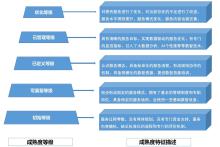
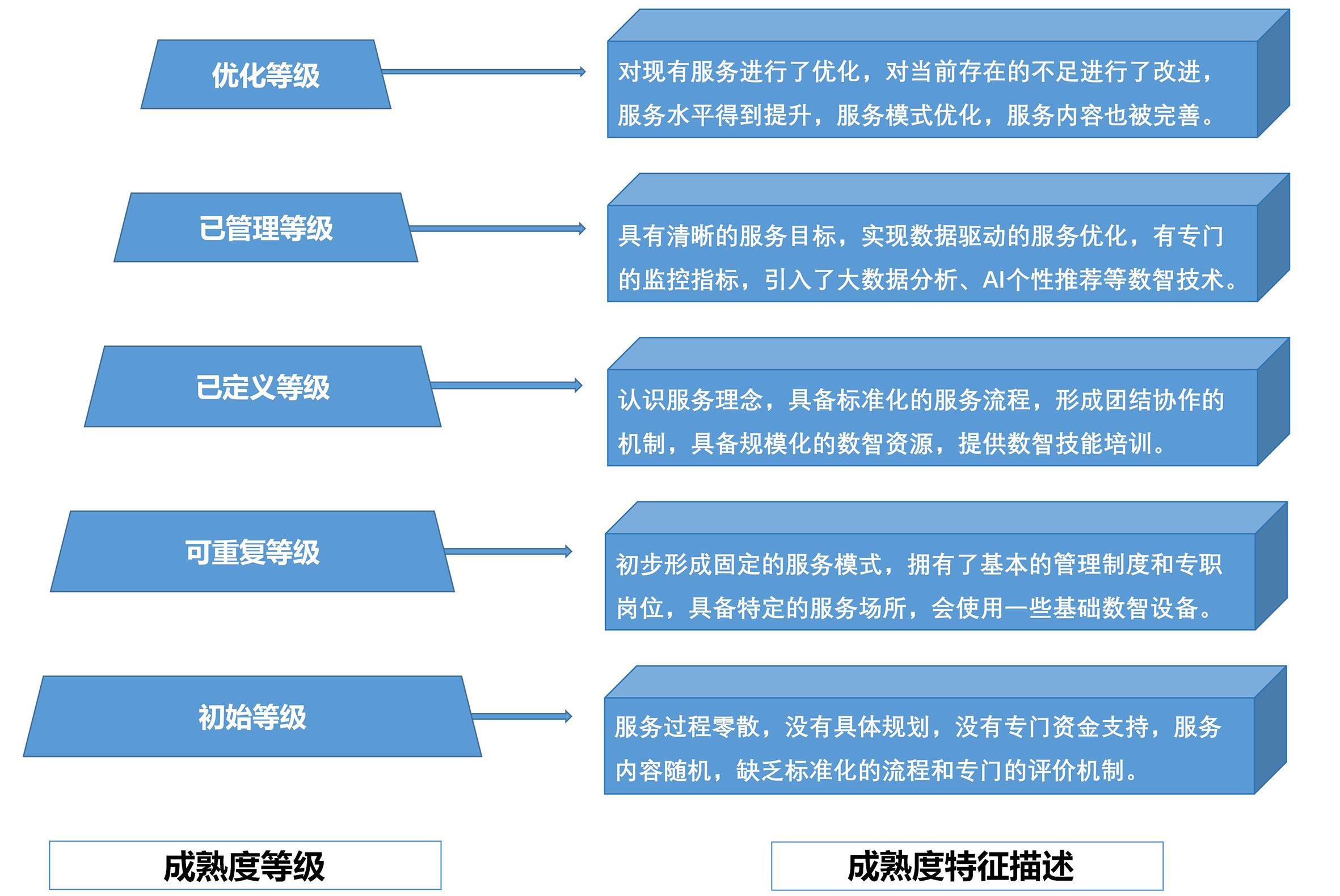
Fig.1

Model of the maturity of rural public digital cultural services"

Table 5

Core elements of the policy standard report"

来源 政策/标准/报告名称(年份) 核心要素

政策

(标准)

关于推动公共文化服务高质量发展的意见(2021年) 标准化建设、基层公共文化服务网络、城乡公共文化空间、服务数字化、社会参与、文化治理、组织领导、法制和财政保障、人才队伍
“十四五”公共文化服务体系建设规划(2021年) 服务体系、社会化发展、智能化建设、组织领导、经费保障、队伍建设、组织管理
数字乡村发展行动规划(2022年) 数智基础设施、数字治理、网络文化、数字乡村
公共图书馆服务规范(2011年) 人力资源、经费保障、设施设备、自动化管理系统、活动组织、新媒体服务、服务时间、硬件设施、人员配置、数字服务
报告 中华人民共和国文化和旅游部2024年文化和旅游发展统计公报(2025年) 创作生产、服务体系、服务规范、科技水平、交流合作、资金投入、财政投入
中国公共文化服务发展报告(2023年) 数智化转型、社会化发展、主体参与、设施运营、活动举办、内容生产、乡村文化振兴、机制改革

Table 6

Core elements in existing relevant evaluation studies"

文献来源 核心要素
曾粤亮等[14] 公共数字文化服务、公共数字文化资源、数字化、高质量发展、资源整合
王勇[15] 数字系统、公共文化空间、物理空间、泛在服务、精准供给、智慧决策
杨彪等[2] 政策环境、供给质量、服务效果、管理评估、需求识别、明确目标、规范流程、客观反馈
邹凯等[16] 基础设施、服务平台、技术培训、制度标准、人才培育、资源建设
尹召凯和孟衍旭[17] 基础设施、公共文化空间、供需矛盾、服务效能、数字动能
冯献和李瑾[18] 技术赋能(数字基础、技术应用能力、核心技术、供需对接)、组织规制(资源汇聚、服务流程、政府治理、村集体、村民参与)、环境优化(经济社会基础、多元化服务、数字素养、媒体融合)
潘颖和郑建明[19] 服务设施、资源建设、服务均等化、服务利用(信息行为、服务效能、服务满意度)、服务项目
罗娟[20] 智能分析、主体偏好、供需接轨、智慧平台、服务资源、客观评价、数智反馈、动态调试
冯献等[21] 基础设施、供给渠道、大数据、供需机制、乡村居民、数字素养
戴艳清和孙英姿[22] 文化服务水平、参与服务、主体地位、多元需求、获得感

Table 7

Core elements in existing relevant practice studies"

文献来源 核心要素
洪闯和文沙[23] 文化氛围、群体规范、数字素养、网络环境、平台质量、数字设备水平、服务质量
付少雄等[24] 基础设施(数字阅览设施、数字服务设备、网络设备)、资源供给(数字功能分区、平台连接、文化推广)、服务供给(文化活动、服务时间、服务团队、服务管理)
孔高敏[25] 文化数字化、媒介融合、新媒体、整合机制、激励机制、控制机制、保障机制、沟通机制
项松林和杨彪[4] 个体赋能(数字意识、自我效能感)、社会赋能(技能素养、数字反哺、文化反授)、环境赋能(顶层制度建设、数智基础设施、数字应用)
潘颖[3] 设施利用、资源利用、服务利用、资源赋权、交流赋权、认知赋权、访问能力、使用能力、数字能力
陶成煦等[26] 服务一体化、国家标准、地方标准、财政帮扶、资金管理、服务设施、管理水平、服务人员、专业能力
唐志远等[27] 技能、知识、获得感、农民数字素养、参与体验、社会支持、发展环境
刘文艳等[28] 宣传推广、文化品牌、数字设施、服务平台、文化资源、人才队伍、体验服务、供需互动
戴艳清和李梅梅[29] 服务可及性、文化获得感、社会心态、公众参与、创新服务、宣传方式、参与兴趣、参与实践
张力文和张富博[30] 资源包容、发展综合、优势特色、服务公平、投入均衡、服务政策、内容匹配、结构互动、社会价值

Table 8

Evaluation index system for the maturity of rural public digital cultural services (preliminary)"

成熟度等级(维度) 关键过程域(一级指标) 关键实践(二级指标)
初始等级
可重复等级 制度框架A1 认知赋权B1
服务流程B2
组织管理B3
资金建设B4
设施与资源A2 物理空间B5
数智基础设施B6
数智化转型B7
已定义等级 协同管理A3 服务规范B8
交流合作B9
资金管理B10
资源体系A4 公共数字文化资源B11
服务平台B12
数智素养培训B13
已管理等级 智慧服务A5 智慧平台B14
智能分析B15
媒体融合B16
智慧监测B17
质量保障A6 版权保障B18
服务质量B19
优化等级 生态创新A7 村民主体参与B20
文化品牌B21
媒介融合B22
反馈优化A8 数智反馈B23
动态调试B24

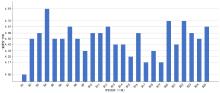
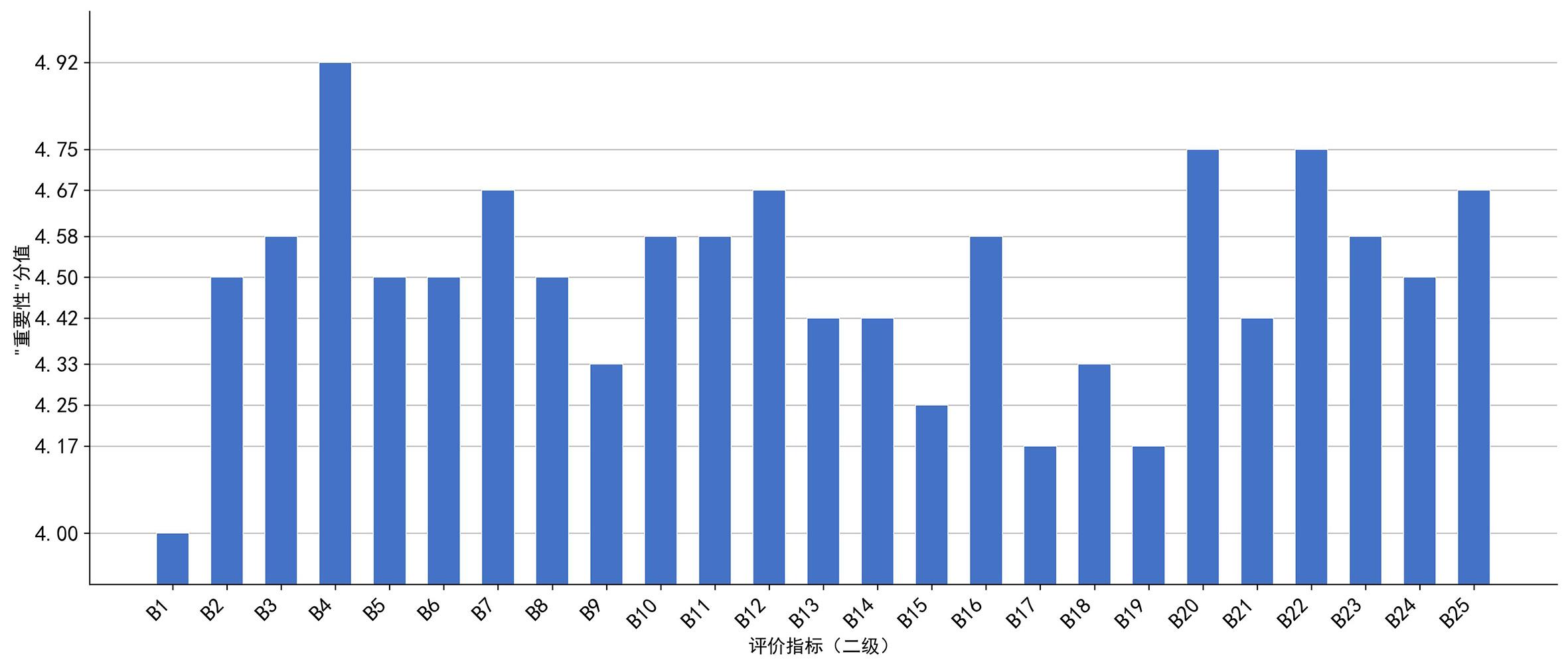
Fig.2

Mean value of "Importance" for the evaluation indicators of rural public digital cultural services (secondary level)"

Table 9

Matrix elements' importance evaluation based on analytic hierarchy process"

量化值 因素i/因素j
1 具有相同重要性
3 前者比后者稍重要
5 前者比后者明显重要
7 前者比后者强烈重要
9 前者比后者极端重要
上述数字的倒数 表示相应两指标交换次序比较的重要性

Table 10

Matrix elements' importance evaluation for analytic hierarchy process"

成熟度等级(维度) 关键过程域(一级指标) 权重 关键实践(二级指标) 权重
初始等级
可重复等级 制度框架A1 0.67 认知赋权B1 0.09
服务流程B2 0.15
组织管理B3 0.30
资金建设B4 0.46
设施与资源A2 0.33 物理空间B5 0.52
数智基础设施B6 0.32
数智化转型B7 0.16
已定义等级 协同管理A3 0.31 服务规范B8 0.29
交流合作B9 0.35
资金管理B10 0.35
资源体系A4 0.69 公共数字文化资源B11 0.56
服务平台B12 0.22
数智素养培训B13 0.22
已管理等级 智慧服务A5 0.60 智慧平台B14 0.18
智能分析B15 0.16
数智建设B16 0.31
智慧监测B17 0.13
智慧服务功能B18 0.22
质量保障A6 0.40 版权保障B19 0.33
服务质量B20 0.67
优化等级 生态创新A7 0.78 村民主体参与B21 0.35
文化品牌B22 0.38
媒介融合B23 0.27
反馈优化A8 0.22 数智反馈B24 0.15
动态调试B25 0.85

Table 11

Design of thresholds for degree of maturity"

一级指标 成熟度等级(维度)
初始等级 可重复等级 已定义等级 已管理等级 优化等级
制度框架、设施与资源 D<30 30≤D<50 50≤D<70 70≤D<85 D≥85
协同管理、资源体系 D<35 35≤D<60 60≤D<80 D≥80
智慧服务、质量保障 D<40 40≤D<75 D≥75
生态创新、反馈优化 D<70 D≥70

Table 12

Scores of primary indicators for rural public digital cultural services in Shandong province"

一级指标 A市评分 B市评分
制度框架 77.8 74.4
设施与资源 80.9 58.6
协同管理 75.0 71.3
资源体系 69.3 57.8
智慧服务 42.4 36.6
质量保障 70.0 65.0
生态创新 76.4 59.4
反馈优化 79.2 64.3
[1]
邸娟, 李亮, 韩佩松. 结构功能主义视角下基层公共文化服务高质量发展的类型学分析——基于文化和旅游部51个典型案例[J]. 图书馆理论与实践, 2025(4): 12-22.
Di Juan, Li Liang, Han Peisong. A typological analysis of the high-quality development of grassroots public cultural services from the perspective of structural functionalism: Based on 51 typical case analyses of the ministry of culture and tourism[J]. Library Theory and Practice, 2025(4): 12-22.
[2]
杨彪, 项松林, 张志鹏. 中国式现代化背景下乡村公共数字文化服务可及性: 内涵、评价维度与实践向度[J]. 图书馆工作与研究, 2024(8): 5-12, 20.
Yang Biao, Xiang Songlin, Zhang Zhipeng. Accessibility of rural public digital cultural services in context of Chinese modernization: Connotation, evaluation dimension and practice orientation[J]. Library Work and Study, 2024(8): 5-12, 20.
[3]
潘颖. 乡村公共数字文化服务对数字包容的作用机理研究——基于乡村用户群体的田野调查[J]. 图书馆建设, 2024(4): 83-95.
Pan Ying. Research on the mechanism of rural public digital cultural services in promoting digital inclusion: Based on field investigation of rural user groups[J]. Library Construction, 2024(4): 83-95.
[4]
项松林, 杨彪. 从数字鸿沟到数字包容: 老年人参与乡村公共数字文化服务的推进路径[J]. 图书馆, 2024(5): 21-27, 34.
Xiang Songlin, Yang Biao. From digital divide to digital inclusion: Ways to promote the participation of the elderly in rural public digital cultural services[J]. Library, 2024(5): 21-27, 34.
[5]
Werang N P L, Florentin Werang M L, Rizki M. Digital transformation in rural areas of Indonesia: Inspecting trust or hesitation[J]. Critical Issue of Sustainable Future, 2026, 3(1): 1-14.
[6]
Maneesh P, Vinu N. Digital technology and livelihood transformation: Why are rural areas left behind[J]. Vigyan Varta, 2025, 6(6): 174-182.
[7]
Wang M, Hua Y W, Sun H L, et al. Bridging the rural digital divide: Avoiding the user churn of rural public digital cultural services[J]. Aslib Journal of Information Management, 2023, 75(4): 730-751.
[8]
Sara I M, Saputra K A K. Easy access to public services through digital village[J]. Russian Journal of Agricultural and Socio-Economic Sciences, 2021, 119(11): 109-118.
[9]
王双. 数智技术赋能公共图书馆参考咨询服务探析[J]. 图书馆工作与研究, 2025(8): 106-112.
Wang Shuang. Analysis of digital and intelligent technology enabling reference consultation services in public libraries[J]. Library Work and Research, 2025(8): 106-112.
[10]
王克平, 傅华玉. 数智赋能非遗博物馆智慧化转型理论思考与路径研究[J/OL]. 图书情报工作, 1-14[2026-06-11].
Wang Keping, Fu Huayu. Theoretical reflection on digital and intelligent empowerment of intangible cultural heritage museums for smart transformation[J/OL]. Library and Information Work, 1-14[2026-06-11].
[11]
代佳欣, 黄靖. 公共数字文化服务可及性的用户评价与形成机理[J]. 图书情报工作, 2025, 69(5): 81-93.
Dai Jiaxin, Huang Jing. Users' evaluation and formation of the accessibility of public digital culture services[J]. Library and Information Service, 2025, 69(5): 81-93.
[12]
杨晓璇, 杨奇松. 政府风险投资、财政治理与中小企业创新持续性——新公共服务理论解读视角[J]. 现代财经(天津财经大学学报), 2024, 44(12): 68-86.
Yang Xiaoxuan, Yang Qisong. Government venture capital, fiscal governance and SMEs' innovation sustainability: Interpretation perspective of new public service theory[J]. Modern Finance and Economics-Journal of Tianjin University of Finance and Economics, 2024, 44(12): 68-86.
[13]
张矛, 郑思怡, 宛玲. 高校图书馆数字学术服务能力成熟度评价指标体系构建[J]. 图书情报工作, 2023, 67(14): 12-20.
Zhang Mao, Zheng Siyi, Wan Ling. Construction of evaluation index system of digital scholarship service capability maturity in university libraries[J]. Library and Information Service, 2023, 67(14): 12-20.
[14]
曾粤亮, 明冉, 吕晓龙, 等. 我国公共数字文化服务研究: 主题、特点与展望[J]. 国家图书馆学刊, 2025, 34(1): 100-112, 封3.
Zeng Yueliang, Ming Ran, Lv Xiaolong, et al. Research on public digital cultural services in China: Topics, characteristics, and prospects[J]. Journal of the National Library of China, 2025, 34(1): 100-112, 封3.
[15]
王勇. 数字技术赋能乡村公共文化服务: 作用机理、现实困境与优化路径[J]. 图书馆工作与研究, 2024(10): 15-22, 32.
Wang Yong. Digital technology empowering rural public cultural services: Role mechanisms, reality dilemmas and optimization paths[J]. Library Work and Research, 2024(10): 15-22, 32.
[16]
邹凯, 李雨欣, 刘耀飞, 等. 基于PMC指数模型的数字乡村公共文化服务政策量化评价[J]. 情报科学, 2024, 42(7): 105-115.
Zou Kai, Li Yuxin, Liu Yaofei, et al. Quantitative evaluation of digital rural public cultural service policy based on PMC index model[J]. Information Science, 2024, 42(7): 105-115.
[17]
尹召凯, 孟衍旭. 乡村振兴视域下公共文化空间的数字化重塑[J]. 出版广角, 2025(4): 97-103.
Yin Zhaokai, Meng Yanxu. Digital reconstruction of public cultural space from the perspective of rural revitalization[J]. View on Publishing, 2025(4): 97-103.
[18]
冯献, 李瑾. 乡村公共数字文化服务可及性: 理论框架与提升路径[J]. 图书馆工作与研究, 2023(11): 12-19.
Feng Xian, Li Jin. Accessibility of rural public digital cultural services: Theoretical framework and improving paths[J]. Library Work and Study, 2023(11): 12-19.
[19]
潘颖, 郑建明. 近十年乡村公共数字文化服务研究进展与展望[J]. 图书情报知识, 2023, 40(3): 38-51.
Pan Ying, Zheng Jianming. Research progress and prospect of rural public digital cultural services in recent decade[J]. Document, Information & Knowledge, 2023, 40(3): 38-51.
[20]
罗娟. 过程型逻辑: 数字乡村建设背景下农村公共文化服务可及性的实现机制[J]. 农村经济, 2022(10): 82-90.
Luo Juan. Process logic: The realization mechanism of accessibility of rural public cultural services under the background of digital village construction[J]. Rural Economy, 2022(10): 82-90.
[21]
冯献, 李瑾, 崔凯. 移动互联视域下乡村公共文化服务可及性框架与评价——以10个数字乡村试点县为例[J]. 图书馆, 2022(10): 84-90.
Feng Xian, Li Jin, Cui Kai. Framework and evaluation of accessibility of rural public cultural services in the context of mobile Internet: Taking 10 pilot counties of digital villages as an example[J]. Library, 2022(10): 84-90.
[22]
戴艳清, 孙英姿. 农村居民公共数字文化服务参与的演变规律与发展逻辑[J]. 图书馆论坛, 2023, 43(10): 55-65.
Dai Yanqing, Sun Yingzi. Evolution law and development logic of rural residents' participation in public digital cultural services[J]. Library Tribune, 2023, 43(10): 55-65.
[23]
洪闯, 文沙. 农村公共数字文化服务可及性影响因素与关联路径研究[J]. 图书馆学研究, 2025(3): 21-34, 41.
Hong Chuang, Wen Sha. Research on influencing factors and related paths of accessibility of rural public digital cultural services[J]. Researches in Library Science, 2025(3): 21-34, 41.
[24]
付少雄, 高一超, 成琦, 等. 数字技术赋能乡村公共文化服务的现状及路径研究——基于需求分析与指标构建的视角[J]. 图书馆理论与实践, 2025(2): 14-24.
Fu Shaoxiong, Gao Yichao, Cheng Qi, et al. Research on the current situation and path of rural public cultural services em-powered by digital technology: From the perspective of demand analysis and in-dicator construction[J]. Library Theory and Practice, 2025(2): 14-24.
[25]
孔高敏. 我国基层公共数字文化服务新媒体联动机制研究[J]. 图书馆, 2024(7): 47-55.
Kong Gaomin. Research on the linkage mechanism of new media in grassroots public digital cultural service in China[J]. Library, 2024(7): 47-55.
[26]
陶成煦, 完颜邓邓, 李佳雯. 城乡公共数字文化服务一体化建设的实践进展、关键问题与推进策略[J]. 图书馆, 2023(12): 8-15.
Tao Chengxu, Dengdeng Wanyan, Li Jiawen. Practice progress, key issues and promotion strategies of the integration construction of urban and rural public digital cultural service[J]. Library, 2023(12): 8-15.
[27]
唐志远, 蔡依婷, 邓江爱. 农民数字素养对公共数字文化服务获得感的影响及其作用机理——基于Y市N县的调查分析[J]. 数字图书馆论坛, 2023, 19(7): 40-51.
Tang Zhiyuan, Cai Yiting, Deng Jiang'ai. Impact and mechanism of farmers' digital literacy on their sense of access to public digital cultural services: Based on survey and analysis in Y city and N county[J]. Digital Library Forum, 2023, 19(7): 40-51.
[28]
刘文艳, 完颜邓邓, 戴艳清. 我国公共数字文化服务可及性现状调查研究[J]. 国家图书馆学刊, 2023, 32(2): 70-80.
Liu Wenyan, Dengdeng Wanyan, Dai Yanqing. Investigation and research on the accessibility of public digital cultural services in China[J]. Journal of the National Library of China, 2023, 32(2): 70-80.
[29]
戴艳清, 李梅梅. 公共数字文化服务可及性对公众文化获得感的影响及作用机理[J]. 图书情报工作, 2022, 66(21): 3-13.
Dai Yanqing, Li Meimei. The impact and mechanism of accessibility of public digital cultural services on public cultural satisfaction[J]. Library and Information Work, 2022, 66(21): 3-13.
[30]
张力文, 张富博. 公共数字文化服务可及性对乡村居民文化获得感的影响及作用研究——以宁夏村民样本为例[J]. 新世纪图书馆, 2023(9): 19-26.
[1] Yinggang WENG. Technical Alienation and Promotion of Rural Public Digital Cultural Services: Based on the "Value-Institution-Behavior" Analytical Framework [J]. Journal of library and information science in agriculture, 2024, 36(8): 56-68.
[2] SU Yunmei, WU Jianguang. The Model Construction and Empirical Research on the Influencing Factors of Library Electronic Resources Performance Evaluation [J]. Journal of library and information science in agriculture, 2021, 33(10): 98-107.
[3] GUO Jing. Construction and Analysis on the Knowledge Management Maturity Model of University Library [J]. Journal of library and information science in agriculture, 2016, 28(6): 173-175.
[4] ZHANG Dong-dong. Academic Influence Analysis of 16 core Journals on Marine Science [J]. Journal of library and information science in agriculture, 2015, 27(1): 39-43.
Viewed
Full text


Abstract

Cited

  Shared   
  Discussed   
No Suggested Reading articles found!