

• •
马晨1,2, 李瑾1,2( )
)
收稿日期:2025-12-21
出版日期:2026-08-20
通讯作者:
李瑾
作者简介:马晨(1985- ),女,博士,副研究员,研究方向为智慧农业、数字乡村、农民数字素养
基金资助:
MA Chen1,2, LI Jin1,2()
Received:2025-12-21
Online:2026-08-20
Contact:
LI Jin
摘要:
[目的/意义] 在数字技术发展纵深推进的背景下,数字素养已从新兴技能演变为城乡居民的生存性能力,数字素养与城乡居民获得感的关联机制逐步成为透视数字中国建设成效的关键切口。 [方法/过程] 构建了数字素养和城乡居民获得感指标体系,运用PLS-SEM模型深入分析数字素养对城乡居民获得感的影响机制,验证了数字社会参与的中介效应,并开展多群组分析,揭示了数字素养对城乡居民获得感的作用边界与强度差异。 [结果/结论] 研究发现,数字素养对城乡居民的精神获得感、政治获得感、经济获得感和民生获得感均存在正向影响,且存在梯度效应;数字素养对获得感影响的21%~30%的效应通过激活城乡居民的数字社会参与实现,且不同中介作用间存在差异,对政治获得感的中介效应占比最高(30.1%);城乡、年龄、学历等人口学特征在数字素养影响获得感路径中的作用效果存在差异化调节,其中城乡群体和学历群体在精神、政治、民生等关键维度的差异更突出,年龄群体的影响相对有限。
中图分类号: F328,S-9
马晨, 李瑾. 数字素养对城乡居民获得感的影响效应与作用机制研究——以北京市为例[J/OL]. 农业图书情报学报. https://doi.org/10.13998/j.cnki.issn1002-1248.25-0736.
MA Chen, LI Jin. Impact Effect and Mechanism of Digital Literacy on the Sense of Gain of Urban and Rural Residents: A Case Study of Beijing[J/OL]. Journal of library and information science in agriculture. https://doi.org/10.13998/j.cnki.issn1002-1248.25-0736.
表1
数字素养指标体系与权重"
| 一级指标 | 二级指标 | 三级指标 | 测量题项 | 权重 |
|---|---|---|---|---|
| 数字素养水平 | 数字概念意识 | 数字化概念意识 | 能否区分数字化与机械化、工业化等概念的差异? | 0.048 9 |
| 数字化基础意识 | 数字信息在生产、治理、服务等场景中的价值与重要性如何? | 0.028 9 | ||
| 数字化应用意识 | 运用数字化手段工作、生产、学习的意愿如何? | 0.026 8 | ||
| 数字通用素养 | 基本硬件使用 | 能否掌握智能手机、电脑等智能终端的基本操作流程? | 0.028 0 | |
| 基本硬件维护 | 能否完成智能终端设备清洁、软件更新等日常维护任务? | 0.031 1 | ||
| 基本软件下载 | 是否具备常规软件、APP的下载与安装能力? | 0.028 9 | ||
| 基本软件使用 | 是否具备常规软件基础功能模块的操作技能? | 0.030 2 | ||
| 数字技术素养 | 数字信息获取能力 | 能否掌握通过互联网获取有用信息的技能? | 0.050 7 | |
| 数字理解与分析能力 | 掌握简单分析数字信息的能力? | 0.049 8 | ||
| 数字化生产场景应用能力 | 是否掌握运用数字化软件设备开展办公、生产、经营等的能力? | 0.056 7 | ||
| 数字化生活场景应用能力 | 是否掌握运用数字化软件设备处理吃穿住行等日常生活事务的能力? | 0.054 1 | ||
| 数字化学习场景应用能力 | 是否掌握运用数字化软件设备在线学习专业技能、专业知识的能力? | 0.053 9 | ||
| 数字化金融场景应用能力 | 是否掌握运用数字化软件设备进行支付及获取金融服务等的能力 | 0.052 1 | ||
| 数字化娱乐场景应用能力 | 是否掌握运用数字化软件设备进行娱乐休闲等的能力? | 0.051 8 | ||
| 数字创新素养 | 数字化文本创新 | 是否具备运用数字化资源撰写文案、博客、产品介绍等开展数字化文本创作的能力? | 0.057 1 | |
| 数字化图像创新 | 是否具备基于数字化图片制作电子相册、简易海报等开展数字化图像创作的能力? | 0.059 6 | ||
| 数字化视频创新 | 是否具备基于数字化视频在网上制作短视频、VLOG等数字化音视频创作的能力? | 0.061 9 | ||
| 数字媒体内容创新 | 是否具备提出数字化创意、想法、模式、提案、方案设计,参与开放创新活动的能力? | 0.054 0 | ||
| 数字社交素养 | 亲人社交数字化 | 是否具备运用视频通话等数字工具强化家庭、亲朋情感连接的能力? | 0.027 7 | |
| 熟人社交数字化 | 是否具备运用电子邮件等数字工具开展熟人、社群数字化关系运营的能力? | 0.031 4 | ||
| 陌生人社交数字化 | 是否具备运用数字工具参与公共事务讨论、提升社会影响力的能力? | 0.033 1 | ||
| 数字安全素养 | 网络安全意识 | 是否具备根据敏感与重要程度对个人隐私信息进行保护与隐私设置的能力? | 0.026 4 | |
| 安全鉴别意识 | 是否具备识别网络谣言、防范钓鱼链接等能力? | 0.029 0 | ||
| 网络法治观念 | 是否具备不传播违法违规信息、维护网络生态健康的能力? | 0.028 0 |
表2
数字素养与居民获得感变量的描述性统计"
| 变量名称 | 测量维度 | 测量题项 | 平均值 | 标准差 |
|---|---|---|---|---|
| 数字素养水平 | 数字概念意识-数字通用素养-数字技术素养-数字创新素养-数字社交素养-数字安全素养 | 根据熵值法计算得出 | 75.000 | 7.593 |
| 城乡居民获得感 | 精神获得感 | 您对个人认知升级与思想深化的满意度如何 | 5.057 | 0.940 |
| 您是否认为通过微信、QQ等线上交流方式增进了您与家人朋友的感情 | ||||
| 政治获得感 | 您对智慧城市、数字乡村的公平性满意度如何 | 4.659 | 1.000 | |
| 您是否认为通过互联网能够使政府工作人员直接地关心大众的想法 | ||||
| 经济获得感 | 您是否认为通过互联网能够获得更多的商业信息 | 5.036 | 1.121 | |
| 您是否认为通过互联网能够获得更多的就业渠道资源 | ||||
| 民生获得感 | 您对智慧政务的“一网通办”惠民服务获得感如何 | 5.037 | 0.938 | |
| 您对智慧城市、数字乡村运行管理服务的一网通管服务获得感如何 | ||||
| 您对智慧城市、数字乡村一网慧治理服务的获得感如何 | ||||
| 数字社会参与 | 基本公共服务的数字参与 | 您近一年是否经常通过互联网、智能手机等享受教育、医疗、社保、税务缴纳等基本公共服务 | 5.269 | 1.043 |
| 政治活动的数字参与 | 您近一年是否经常通过互联网、智能手机等参与过在线投票、网上选举、社会调查等活动 | 5.255 | 1.028 | |
| 经济活动的数字参与 | 您近一年是否经常通过互联网、智能手机等参与线上购物、线上商务讲座、线上会议等活动 | 5.276 | 1.022 | |
| 社群关系活动的数字参与 | 您近一年是否经常通过QQ、微信、朋友圈、微博、抖音、小红书等平台展示、分享、交流自己的生活 | 5.289 | 1.033 | |
| 年龄差异 | 中青年/中老年 | 将年龄小于等于45岁的界定为“中青年”,赋值为1;将年龄大于45岁的界定为“中老年”,赋值为2 | 1.381 | 0.486 |
| 受教育程度差异 | 高学历/低学历差异 | 将大专以下的学历水平界定为“低学历”,赋值为1;将大专及以上的学历水平界定为“高学历”,赋值为2 | 1.285 | 0.452 |
| 城乡差异 | 城市居民、农村居民 | 将户口类型为农业户口的界定为农村居民,赋值为1;将户口类型为非农业户口的界定为城市居民,赋值为2 | 1.416 | 0.493 |
表3
变量信效度检测结果"
| 题项 | t值 | P值 | Cronbach's α系数 | CR | AVE | |
|---|---|---|---|---|---|---|
| 精神获得感 | YA1 | 87.359 | 0.000 | 0.744 | 0.886 | 0.796 |
| YA2 | 89.159 | 0.000 | ||||
| 政治获得感 | YB1 | 61.788 | 0.000 | 0.723 | 0.878 | 0.783 |
| YB2 | 52.531 | 0.000 | ||||
| 经济获得感 | YC1 | 52.431 | 0.000 | 0.726 | 0.879 | 0.785 |
| YC2 | 74.720 | 0.000 | ||||
| 民生获得感 | YD1 | 48.254 | 0.000 | 0.727 | 0.846 | 0.647 |
| YD2 | 46.995 | 0.000 | ||||
| YD3 | 32.934 | 0.000 | ||||
| 数字社会参与 | M1 | 43.571 | 0.000 | 0.800 | 0.870 | 0.625 |
| M2 | 44.433 | 0.000 | ||||
| M3 | 41.533 | 0.000 | ||||
| M4 | 45.500 | 0.000 | ||||
表4
基于Fornell-Larcker准则的区分效度"
| 题项 | 数字素养 | 数字社会参与 | 精神获得感 | 政治获得感 | 经济获得感 | 民生获得感 |
|---|---|---|---|---|---|---|
| 数字素养 | - | |||||
| 数字社会参与 | 0.416 | 0.791 | ||||
| 精神获得感 | 0.444 | 0.375 | 0.892 | |||
| 政治获得感 | 0.324 | 0.284 | 0.28 | 0.885 | ||
| 经济获得感 | 0.351 | 0.289 | 0.223 | 0.234 | 0.886 | |
| 民生获得感 | 0.402 | 0.311 | 0.252 | 0.261 | 0.192 | 0.804 |
表5
结构方程模型估计结果"
| 路径 | 标准化系数 | 标准误 | t值 | P值 | 95%置信区间 | f 2 | VIF | |
|---|---|---|---|---|---|---|---|---|
| 2.50% | 97.50% | |||||||
| 数字素养->精神获得感 | 0.348 | 0.042 | 8.386 | 0.000 | 0.258 | 0.421 | 0.132 | 1.209 |
| 数字素养->政治获得感 | 0.249 | 0.039 | 6.370 | 0.000 | 0.170 | 0.322 | 0.059 | 1.209 |
| 数字素养->经济获得感 | 0.279 | 0.042 | 6.684 | 0.000 | 0.194 | 0.359 | 0.075 | 1.209 |
| 数字素养->民生获得感 | 0.330 | 0.041 | 8.080 | 0.000 | 0.247 | 0.406 | 0.111 | 1.209 |
| 数字素养->数字社会参与 | 0.416 | 0.035 | 11.803 | 0.000 | 0.343 | 0.481 | 0.209 | 1.000 |
| 数字社会参与->精神获得感 | 0.230 | 0.038 | 5.987 | 0.000 | 0.153 | 0.303 | 0.058 | 1.209 |
| 数字社会参与->政治获得感 | 0.181 | 0.041 | 4.408 | 0.000 | 0.099 | 0.258 | 0.031 | 1.209 |
| 数字社会参与->经济获得感 | 0.173 | 0.038 | 4.554 | 0.000 | 0.097 | 0.248 | 0.029 | 1.209 |
| 数字社会参与->民生获得感 | 0.174 | 0.042 | 4.168 | 0.000 | 0.087 | 0.254 | 0.031 | 1.209 |
表6
PLS predict结果"
| 题项 | Q²预测值 | PLS-SEM模型 | 线性模型 | PLS-LM | |||
|---|---|---|---|---|---|---|---|
| RMSE | MAE | RMSE | MAE | ΔRMSE | ΔMAE | ||
| PLS Predict LV Summary | |||||||
| 数字社会参与 | 0.171 | 0.914 | 0.696 | ||||
| 精神获得感 | 0.193 | 0.900 | 0.723 | ||||
| 政治获得感 | 0.101 | 0.951 | 0.773 | ||||
| 经济获得感 | 0.119 | 0.940 | 0.748 | ||||
| 民生获得感 | 0.159 | 0.919 | 0.722 | ||||
| PLS Predict MV Summary | |||||||
| M1 | 0.104 | 0.988 | 0.787 | 0.988 | 0.787 | 0.000 | 0.000 |
| M2 | 0.113 | 0.969 | 0.780 | 0.969 | 0.780 | 0.000 | 0.000 |
| M3 | 0.105 | 0.968 | 0.791 | 0.968 | 0.791 | 0.000 | 0.000 |
| M4 | 0.106 | 0.978 | 0.789 | 0.978 | 0.790 | 0.000 | -0.001 |
| YA1 | 0.154 | 0.794 | 0.646 | 0.794 | 0.647 | 0.000 | -0.001 |
| YA2 | 0.153 | 1.138 | 0.923 | 1.138 | 0.923 | 0.000 | 0.000 |
| YB1 | 0.086 | 0.986 | 0.824 | 0.987 | 0.823 | -0.001 | 0.001 |
| YB2 | 0.072 | 1.184 | 0.964 | 1.184 | 0.965 | 0.000 | -0.001 |
| YC1 | 0.082 | 1.217 | 0.996 | 1.217 | 0.996 | 0.000 | 0.000 |
| YC2 | 0.105 | 1.195 | 0.963 | 1.195 | 0.963 | 0.000 | 0.000 |
| YD1 | 0.110 | 1.182 | 0.956 | 1.182 | 0.956 | 0.000 | 0.000 |
| YD2 | 0.105 | 1.168 | 0.946 | 1.168 | 0.946 | 0.000 | 0.000 |
| YD3 | 0.094 | 0.965 | 0.787 | 0.965 | 0.788 | 0.000 | -0.001 |
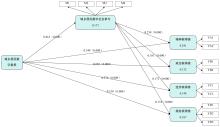
图1
数字素养对城乡居民获得感的影响机制"
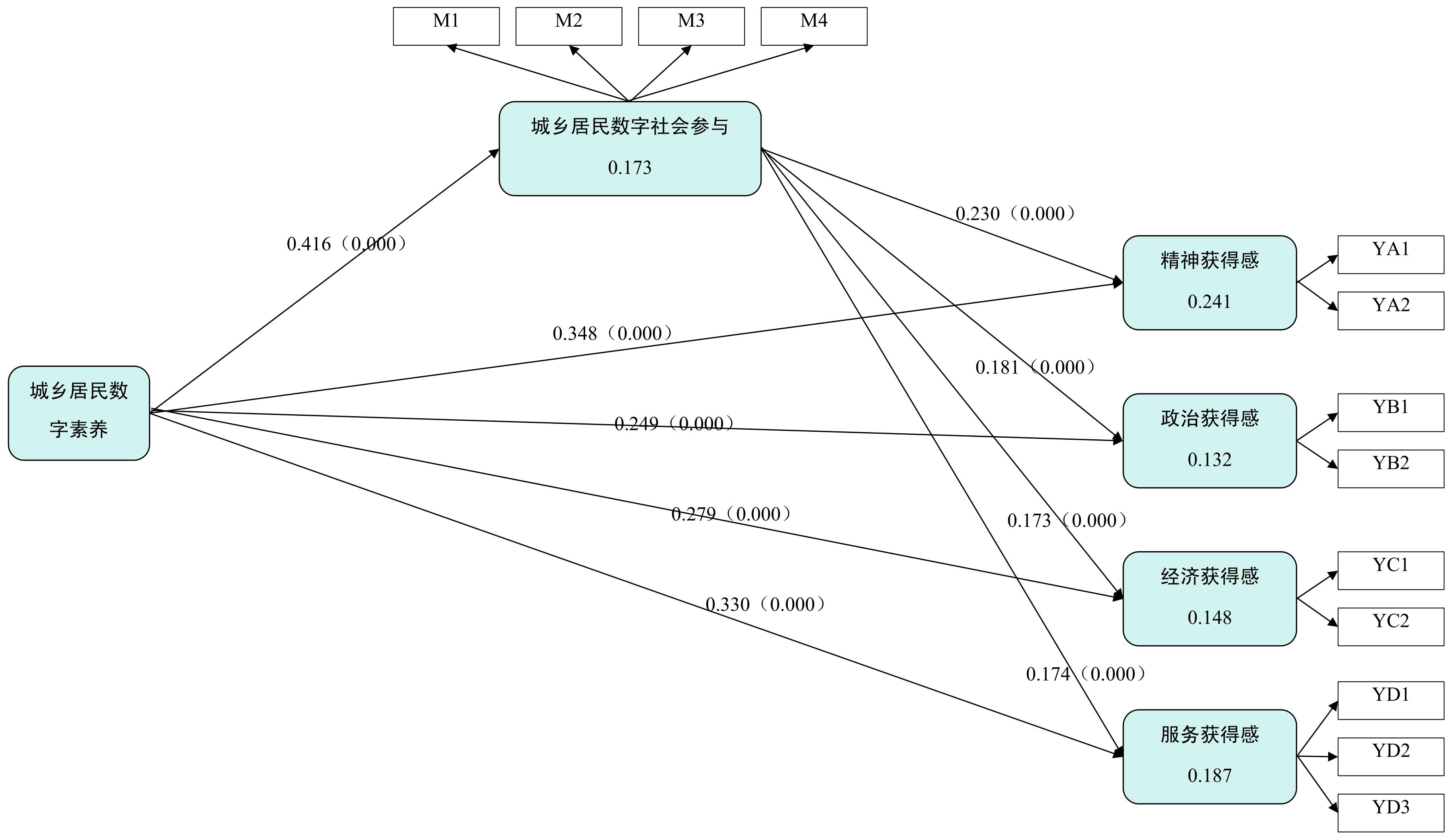
表7
数字社会参与的中介效应显著性检验"
| 总效应路径 | 标准化系数 | 标准误 | 95%置信区间 | ||
|---|---|---|---|---|---|
| 2.50% | 97.50% | ||||
| 数字素养->精神获得感 | Total Effect | 0.444 | 0.037 | 0.366 | 0.510 |
| Direct Effect | 0.348 | 0.042 | 0.258 | 0.421 | |
| Indirect Effect | 0.096 | 0.017 | 0.065 | 0.131 | |
| 数字素养->政治获得感 | Total Effect | 0.324 | 0.034 | 0.256 | 0.388 |
| Direct Effect | 0.249 | 0.039 | 0.170 | 0.322 | |
| Indirect Effect | 0.075 | 0.018 | 0.041 | 0.112 | |
| 数字素养->经济获得感 | Total Effect | 0.351 | 0.036 | 0.277 | 0.418 |
| Direct Effect | 0.279 | 0.042 | 0.194 | 0.359 | |
| Indirect Effect | 0.072 | 0.018 | 0.040 | 0.109 | |
| 数字素养->民生获得感 | Total Effect | 0.402 | 0.036 | 0.328 | 0.467 |
| Direct Effect | 0.330 | 0.041 | 0.247 | 0.406 | |
| Indirect Effect | 0.072 | 0.018 | 0.038 | 0.109 | |
表8
多群组分析结果"
| 路径 | 城乡差异 | 年龄差异 | 学历差异 | ||||||
|---|---|---|---|---|---|---|---|---|---|
| 农村(I) | 城市(J) | Δ(I-J) | 中青年(I) | 中老年(J) | Δ(I-J) | 低学历(I) | 高学历(J) | Δ(I-J) | |
| 数字素养→精神获得感 | 0.241*** | 0.52*** | -0.279*** | 0.382*** | 0.306*** | 0.076 | 0.317*** | 0.440*** | -0.123 |
| 数字素养→政治获得感 | 0.198*** | 0.300*** | -0.102 | 0.276*** | 0.196** | 0.08 | 0.236*** | 0.262*** | -0.026 |
| 数字素养→经济获得感 | 0.262*** | 0.288*** | -0.026 | 0.268*** | 0.279*** | -0.011 | 0.266*** | 0.299*** | -0.032 |
| 数字素养→民生获得感 | 0.296*** | 0.365*** | -0.068 | 0.311*** | 0.340*** | -0.029 | 0.276*** | 0.481*** | -0.204* |
| 数字素养→数字社会参与 | 0.344*** | 0.492*** | -0.149* | 0.441*** | 0.354*** | 0.087 | 0.375*** | 0.493*** | -0.118 |
| 数字社会参与→精神获得感 | 0.265*** | 0.137* | 0.128 | 0.190*** | 0.279*** | -0.089 | 0.241*** | 0.165* | 0.076 |
| 数字社会参与→政治获得感 | 0.096 | 0.301*** | -0.205* | 0.145** | 0.210** | -0.065 | 0.104* | 0.324*** | -0.220* |
| 数字社会参与→经济获得感 | 0.120** | 0.251*** | -0.131 | 0.150** | 0.187** | -0.037 | 0.138** | 0.221** | -0.083 |
| 数字社会参与→民生获得感 | 0.156** | 0.185** | -0.029 | 0.279*** | 0.019 | 0.260** | 0.162** | 0.170* | -0.008 |
| [1] |
光明日报. 科学统筹突出重点对准焦距, 让人民群众对改革有更多获得感[EB/OL]. (2015-02-28)[2025-04-28].
|
| [2] |
新华社. 习近平: 决胜全面建成小康社会 夺取新时代中国特色社会主义伟大胜利——在中国共产党第十九次全国代表大会上的报告[EB/OL]. (2017-10-2)[2025-04-28].
|
| [3] |
文宏, 林彬. 人民获得感: 美好生活期待与国民经济绩效间的机理阐释——主客观数据的时序比较分析[J]. 学术研究, 2021(1): 66-73.
|
|
|
|
| [4] |
李丹. 数字社会的“权利鸿沟”及其弥合[J]. 河北法学, 2024, 42(6): 127-143.
|
|
|
|
| [5] |
单志广. 什么是智慧城市 [J]. 供用电, 2014, 31(10): 14-15, 22, 4.
|
|
|
|
| [6] |
王也. 数字鸿沟与数字弱势群体的国家保护[J]. 比较法研究, 2023(5): 121-137.
|
|
|
|
| [7] |
湛礼珠, 张延龙, 马晓蕾. 悬浮推进、工具理性与数字乡村建设转型[J]. 农村经济, 2023(6): 1-10.
|
|
|
|
| [8] |
陈文旭, 聂嘉琪. 21世纪全球数字鸿沟审视与中国方案[J]. 新疆社会科学(汉文版), 2023(6): 147-155.
|
|
|
|
| [9] |
焦豪, 朱永麒, 李宛蓉. 数字素养对流动人口社会融入影响机制研究[J]. 商业经济与管理, 2025(2): 62-73.
|
|
|
|
| [10] |
苏红键. 数字城乡建设: 通往城乡融合与共同富裕之路[J]. 电子政务, 2022(10): 88-98.
|
|
|
|
| [11] |
李静. 全民数字素养何以筑基智慧城市建设 [J]. 中国建设信息化, 2024(13): 62-65.
|
|
|
|
| [12] |
杨仲山, 初放. 数字素养对老年人主观福利的影响——基于新人力资本理论的研究视角[J]. 山西财经大学学报, 2025, 47(1): 31-47.
|
|
|
|
| [13] |
单志广. 新型智慧城市与智慧社会建设[J]. 中国建设信息化, 2018(5): 12-15.
|
|
|
|
| [14] |
丛雅静, 蔡宁. 北京智慧城市评价研究——基于3263位市民的电话调查[J]. 电子政务, 2014(12): 86-92.
|
|
|
|
| [15] |
北京市统计局. 北京统计年鉴2024[EB/OL]. (2025-03-20)[2025-04-28].
|
| [16] |
|
| [17] |
|
| [18] |
|
| [19] |
|
| [20] |
马晨, 李瑾, 李泽欣, 等. 数字乡村背景下的农民数字素养水平评价与影响因素研究[J]. 农业图书情报学报, 2024, 36(7): 19-33.
|
|
|
|
| [21] |
中共中央网络安全和信息化委员会办公室. 提升全民数字素养与技能行动纲要[EB/OL]. [2021-11-05].
|
| [22] |
兰国帅, 郭倩, 张怡, 等. 欧盟教育者数字素养框架:要点解读与启示[J]. 现代远程教育研究, 2020, 32(6): 23-32.
|
|
|
|
| [23] |
高欣峰, 陈丽. 信息素养、数字素养与网络素养使用语境分析——基于国内政府文件与国际组织报告的内容分析[J]. 现代远距离教育, 2021(2): 70-80.
|
|
|
|
| [24] |
中国社会科学院信息化研究中心. 乡村振兴战略背景下中国乡村数字素养调查分析报告[EB/OL]. [2023-03-23].
|
| [25] |
曹现强, 李烁. 获得感的时代内涵与国外经验借鉴[J]. 人民论坛·学术前沿, 2017(2): 18-28.
|
|
|
|
| [26] |
陈海玉, 郭学静, 刘庚常. 基于结构方程模型的劳动者主观获得感研究[J]. 西北人口, 2018, 39(6): 85-95.
|
|
|
|
| [27] |
郑风田, 陈思宇. 获得感是社会发展最优衡量标准——兼评其与幸福感、包容性发展的区别与联系[J]. 人民论坛·学术前沿, 2017(2): 6-17.
|
|
Zheng Fengtian, Chen Siyu "Sense of gain" is the best measure of social development - Also on its differences and connections with happiness and inclusive development[J]. Frontiers, 2017(2): 6-17.
|
|
| [28] |
王艳丽, 陈红. 城市社区居民获得感量表的编制[J]. 心理与行为研究, 2021, 19(5): 665-670.
|
|
|
|
| [29] |
赵卫华. 消费视角下城乡居民获得感研究[J]. 北京工业大学学报(社会科学版), 2018, 18(4): 1-7.
|
|
|
|
| [30] |
文宏. 政治获得感评价指标体系与地区比较实证研究——基于因子分析和聚类分析[J]. 经济社会体制比较, 2020(3): 96-106.
|
|
|
|
| [31] |
姚迎春, 杨业华. 论思想政治理论课获得感的内涵[J]. 湖北社会科学, 2018(4): 183-187.
|
|
|
|
| [32] |
董瑛. 增进人民群众对反腐倡廉的“获得感”研究——新形势下反腐倡廉建设新理念新布局[J]. 理论与改革, 2017(1): 99-103.
|
|
|
|
| [33] |
吕小康, 黄妍. 如何测量“获得感” ——以中国社会状况综合调查(CSS)数据为例[J]. 西北师大学报(社会科学版), 2018, 55(5): 46-52.
|
|
|
|
| [34] |
阳义南. 民生公共服务的国民“获得感”: 测量与解析——基于MIMIC模型的经验证据[J]. 公共行政评论, 2018, 11(5): 117-137, 189.
|
|
|
|
| [35] |
董洪杰, 谭旭运, 豆雪姣, 等. 中国人获得感的结构研究[J]. 心理学探新, 2019, 39(5): 468-473.
|
|
|
|
| [36] |
邵雅利. 新时代人民主观获得感的指标构建与影响因素分析[J]. 新疆社会科学, 2019(4): 139-147.
|
|
|
|
| [37] |
徐延辉, 李志滨. 社会质量与城市居民的获得感研究[J]. 南开学报(哲学社会科学版), 2021(4): 169-181.
|
|
|
|
| [38] |
汤峰, 苏毓淞. “内外有别”: 政治参与何以影响公众的获得感 [J]. 公共行政评论, 2022, 15(2): 22-41, 195-196.
|
|
|
|
| [39] |
凌珑. 就业质量与居民主观福利——基于中国劳动力动态调查的实证研究[J]. 统计研究, 2022, 39(10): 149-160.
|
|
|
|
| [40] |
郑建君, 马璇, 刘丝嘉. 公共服务参与会增加个体的获得感吗 ——基于政府透明度与信任的调节作用分析[J]. 公共行政评论, 2022, 15(2): 42-59.
|
|
|
|
| [41] |
王恬, 谭远发, 付晓珊. 我国居民获得感的测量及其影响因素[J]. 财经科学, 2018(9): 120-132.
|
|
|
|
| [42] |
谭旭运, 张若玉, 董洪杰, 等. 青年人获得感现状及其影响因素[J]. 中国青年研究, 2018(10): 49-57.
|
|
|
|
| [43] |
张玫, 霍增辉. 农户主观获得感测度及影响因素研究——以浙江省16个村为例[J]. 地域研究与开发, 2022, 41(6): 136-141.
|
|
|
|
| [44] |
张连刚. 基于多群组结构方程模型视角的绿色购买行为影响因素分析——来自东部、中部、西部的数据[J]. 中国农村经济, 2010(2): 44-56.
|
|
|
|
| [45] |
崔登峰, 黎淑美. 特色农产品顾客感知价值对顾客购买行为倾向的影响研究——基于多群组结构方程模型[J]. 农业技术经济, 2018(12): 119-129.
|
|
|
|
| [46] |
郭秀荣, 王娟. 熵权法和灰色分析的一个教学案例设计及软件实现[J]. 统计与管理, 2014, 29(2): 175-176.
|
|
|
|
| [47] |
|
| [48] |
朱宏城, 田甜. 微观视角下居民消费碳排放结构及影响因素研究——基于PLS-SEM模型的实证分析[J]. 干旱区资源与环境, 2022, 36(1): 59-65.
|
|
|
|
| [49] |
郑彩华. 联合国教科文组织《数字素养全球框架》: 背景、内容及启示[J]. 外国中小学教育, 2019(9): 1-9.
|
|
|
|
| [50] |
文宏, 刘志鹏. 人民获得感的时序比较——基于中国城乡社会治理数据的实证分析[J]. 社会科学, 2018(3): 3-20.
|
|
|
|
| [51] |
张正, 金丽馥. 获得感研究述评与展望——基于2015-2020年文献CiteSpace可视化分析[J]. 江苏大学学报(社会科学版), 2021, 23(5): 91-101.
|
|
|
|
| [52] |
罗强强, 郑莉娟, 郭文山, 等. “银发族”的数字化生存:数字素养对老年人数字获得感的影响机制[J]. 图书馆论坛, 2023, 43(5): 130-139.
|
|
|
|
| [53] |
马晨, 李瑾, 冯献. 农民数字素养对其数字乡村参与的影响机制研究[J]. 西南农业大学学报, 2024, 37(9): 1937-1949.
|
|
|
|
| [54] |
林龙飞, 祝仲坤. 频繁换工: 数字技术助推农民工 “短工化” 现象吗 [J]. 南京农业大学学报(社会科学版), 2023, 23(3): 141-154.
|
|
|
|
| [55] |
田鸽, 张勋. 数字经济、非农就业与社会分工[J]. 管理世界, 2022, 38(5): 72-84.
|
|
|
|
| [56] |
石宝峰, 田锦萱, 孙梦遥. “低学历”抑或“高学历”: 谁带来了更高的违约率[J]. 农业技术经济, 2024(3): 4-19.
|
|
|
|
| [57] |
徐彩瑶, 钱晨, 孔凡斌. 数字乡村建设能否缩小城乡收入差距——基于农业科技进步中介和门槛效应的实证检验[J]. 农业技术经济, 2024(12): 4-24.
|
|
|
|
| [58] |
杨怡, 陶文清, 王亚飞. 数字普惠金融对城乡居民收入差距的影响[J]. 改革, 2022(5): 64-78.
|
|
|
|
| [59] |
|
| [60] |
|
| [61] |
周欣, 王耀斌, 贺相春. 教师数字化教学能力影响因素实证研究——基于PLS-SEM和fsQCA方法[J]. 现代教育技术, 2025, 35(3): 66-76.
|
|
|
|
| [62] |
|
| [63] |
|
| [64] |
|
| [1] | 吴艳艳, 张金玲. 数字素养、新质生产力感知与绿色生产意愿——来自中国西北规模农户的证据[J]. 农业图书情报学报, 2026, 38(6): 115-130. |
| [2] | 郭金博. 图书馆使用AIGC对读者信息信任的效应研究[J]. 农业图书情报学报, 2026, 38(4): 84-98. |
| [3] | 崔少杰, 刘艳萍. 数字素养对乡村治理效能的影响研究——基于山西省夏县306户农村居民的调研数据[J]. 农业图书情报学报, 2025, 37(4): 39-50. |
| [4] | 王小琨. 国外在线开放数字素养评估工具比较研究[J]. 农业图书情报学报, 2025, 37(3): 53-65. |
| [5] | 孙志梅, 刘艳, 刘文云, 李瑞芹. 表征视角下高校图书馆用户数字素养知识的感知与利用研究[J]. 农业图书情报学报, 2025, 37(2): 23-36. |
| [6] | 罗国锋, 易童, 闫舟舟. 面向AIGC应用的高校图书馆批判性信息素养教育研究[J]. 农业图书情报学报, 2025, 37(1): 47-58. |
| [7] | 罗学妹, 林予哲. AIGC驱动下研究生数字素养教育提升路径探索[J]. 农业图书情报学报, 2024, 36(9): 70-77. |
| [8] | 李白杨, 孙榕. 基于“知识-技能”导航的人工智能素养通识教育课程构建[J]. 农业图书情报学报, 2024, 36(8): 34-42. |
| [9] | 马晨, 李瑾, 李泽欣, 范贝贝, 冯献. 数字乡村背景下的农民数字素养水平评价与影响因素研究[J]. 农业图书情报学报, 2024, 36(7): 19-33. |
| [10] | 王小雨, 张素罗. 数字乡村建设背景下的农民数字素养:概念界定与框架构建[J]. 农业图书情报学报, 2024, 36(5): 52-64. |
| [11] | 杨行. 美国佛罗里达大学图书馆提升馆员数字学术服务能力的实践与启示[J]. 农业图书情报学报, 2024, 36(5): 93-101. |
| [12] | 易童, 罗国锋. 教育技术应用下高校图书馆馆员数字素养提升路径研究[J]. 农业图书情报学报, 2024, 36(2): 61-70. |
| [13] | 王伟正, 乔鸿, 李肖俊, 王静静. 基于AIDUA框架的生成式人工智能使用意愿研究[J]. 农业图书情报学报, 2024, 36(2): 36-50. |
| [14] | 王小雨, 李朔, 张素罗. 活动理论视阈下农民数字素养协同培育模型构建与路径研究[J]. 农业图书情报学报, 2024, 36(10): 63-75. |
| [15] | 崔凯. 面向数字包容的农民信息获取行为分析:群体聚焦与现实关切[J]. 农业图书情报学报, 2024, 36(1): 33-45. |
|
||