

农业图书情报学报 ›› 2026, Vol. 38 ›› Issue (7): 32-45.doi: 10.13998/j.cnki.issn1002-1248.26-0174
李佳薇, 孙竹墨, 姜婷婷( )
)
收稿日期:2026-04-03
出版日期:2026-07-05
发布日期:2026-07-13
通讯作者:
姜婷婷
E-mail:tij@whu.edu.cn
作者简介:李佳薇(2003- ),女,硕士研究生,研究方向为人智交互基金资助:
LI Jiawei, SUN Zhumo, JIANG Tingting()
Received:2026-04-03
Online:2026-07-05
Published:2026-07-13
Contact:
JIANG Tingting
E-mail:tij@whu.edu.cn
摘要:
[目的/意义] AI披露是避免技术滥用引发道德与伦理风险的规范手段,但当前普遍采用的披露标签过于简化,未能满足用户对技术透明度的深层需求,削弱了对AI生成短视频的参与意愿,现有研究也尚未明确更详细的披露标签应该如何设计。 [方法/过程] 针对这一问题,研究开展了一项2(AI披露详尽程度:简单披露/详细披露)×2(短视频类型:实用型/享乐型)的组间实验以对比不同详尽程度AI披露的影响,招募188名参与者完成短视频观看任务并填写结构化问卷。 [结果/结论] 结果表明,详细的AI披露能够通过用户感知内容质量的提升,对AI生成短视频参与意愿产生积极作用,这种影响在不同类型的短视频之间没有显著差异。研究深化了对AI透明度机制的理解,为内容创作者合理设计披露标签、平台有效实施监管提供了可操作的理论依据和实践指导。
中图分类号: G203
李佳薇, 孙竹墨, 姜婷婷. 增强AI生成短视频用户参与意愿:AI披露的作用[J]. 农业图书情报学报, 2026, 38(7): 32-45.
LI Jiawei, SUN Zhumo, JIANG Tingting. Enhancing User Engagement Intention in AI-Generated Short Videos: The Role of AI Disclosure[J]. Journal of library and information science in agriculture, 2026, 38(7): 32-45.
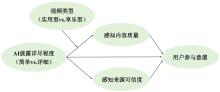
图1
研究模型"
表1
参与者特征"
| 特征 | 分组 | 数量/个 | 占比/% |
|---|---|---|---|
| 性别 | 男 | 71 | 37.8 |
| 女 | 117 | 62.2 | |
| 年龄/岁 | ≤20 | 37 | 19.7 |
| 21~30 | 100 | 53.2 | |
| 31~40 | 36 | 19.1 | |
| 41~50 | 10 | 5.3 | |
| 51~60 | 5 | 2.7 | |
| 最高学历 | 高中生及以下 | 6 | 3.2 |
| 大专 | 31 | 16.5 | |
| 本科 | 125 | 66.5 | |
| 研究生 | 26 | 13.8 |

图2
实验材料设计"
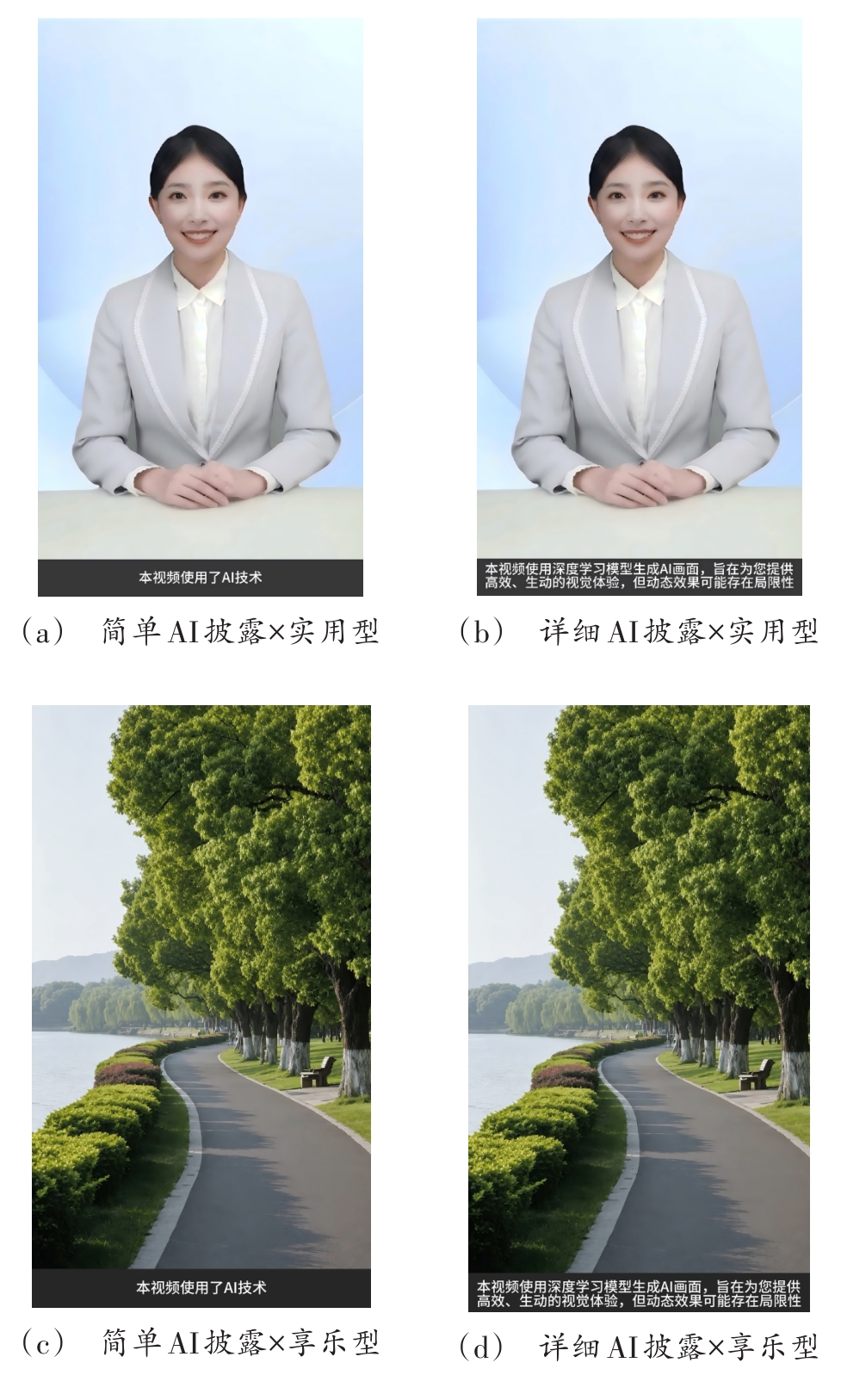
表2
操纵检验测量量表"
| 变量 | 测度项 | 引用 |
|---|---|---|
| 兴趣 | 我对该视频很感兴趣 | O'Brien等[ |
| 实用性 | 我可以通过此类视频获取客观、高质量的信息 | 田晓旭等[ |
| 此类视频为我提供了信息和功能效能 | ||
| 我可以通过此类视频实现资源获取、知识学习目标 | ||
| 娱乐性 | 我可以通过此类视频获取主观、有趣的信息 | |
| 此类视频为我提供了享乐效能 | ||
| 我可以通过此类视频实现审美、愉悦及体验需求 | ||
| 披露透明度 | 我认为该标签披露了该视频使用AI技术的类型 | Wang和Qiu[ |
| 我认为该标签披露了该视频使用AI技术的目的 | ||
| 我认为该标签披露了该视频使用AI技术的局限性 |
表3
实验情境描述"
| 现实情境 | 描述 |
|---|---|
| 信息获取 | 请想象以下场景——清晨醒来,你打开手机上的短视频应用,这时一段天气播报视频自动播放,画面中主播正用温和的声音播报今日早间天气,贴心地给出穿衣建议,你觉得这段视频信息正好能帮助你规划今天的行程,你可能会多看几秒,记住关键信息。同时请注意视频中关于使用AI技术的声明提示 |
| 娱乐放松 | 请想象以下场景——晚上休息时,你正在刷短视频放松,突然划到一段某地的风景视频,视频展现了该地的自然风光和人文景观,你被这些美丽的风景画面吸引,认为该视频很有趣,让你心情愉悦。同时请注意视频中关于使用AI技术的声明提示 |
表4
变量及测量"
| 变量 | 测度项 | 引用 |
|---|---|---|
| 感知来源可信度 | 我认为该视频来源是可靠的 | Appelman和Sundar[ |
| 我认为该视频来源是可信的 | ||
| 我认为该视频来源是权威的 | ||
| 感知内容质量 | 我认为该视频上显示的内容准确无误 | Dabbous和Barakat[ |
| 我认为该视频显示的内容很有趣 | ||
| 我认为该视频显示的内容很有价值 | ||
| 用户参与意愿 | 我想再次观看视频 | Li和Tu[ |
| 我想“赞”视频 | ||
| 我想为视频提供评论 | ||
| 我会把视频分享给我的朋友 |
表5
数据分析方法"
| 编号 | 假设 | 检验方法 | 结果 |
|---|---|---|---|
| H1 | 相比于简单的AI披露,详细的AI披露会带来更高的用户参与意愿 | 单因素方差分析 | 支持 |
| H2a | 感知来源可信度在AI披露详尽程度和用户参与意愿之间起到中介作用 | 中介作用分析 (PROCESS MODEL 4) | 不支持 |
| H2b | 感知内容质量在AI披露详尽程度和用户参与意愿之间起到中介作用 | 中介作用分析 (PROCESS MODEL 4) | 支持 |
| H3 | 视频类型在AI披露详尽程度和感知内容质量之间起到调节作用 | 调节作用分析 (PROCESS MODEL 1) | 不支持 |
表6
描述性统计"
| 条件 | 感知来源可信度(均值±标准差) | 感知内容质量(均值±标准差) | 参与意愿(均值±标准差) |
|---|---|---|---|
| 简单AI披露×实用型 | 4.86±1.35 | 4.70±1.23 | 4.21±1.62 |
| 详细AI披露×实用型 | 5.22±1.15 | 5.05±1.04 | 4.53±1.67 |
| 简单AI披露×享乐型 | 4.30±1.43 | 4.53±1.23 | 4.17±1.63 |
| 详细AI披露×享乐型 | 5.00±1.19 | 4.95±1.16 | 4.93±1.41 |
表7
相关性分析"
| 变量 | 均值 | 标准差 | 感知来源可信度 | 感知内容质量 | 参与意愿 |
|---|---|---|---|---|---|
| 感知来源可信度 | 4.85 | 1.32 | |||
| 感知内容质量 | 4.81 | 1.77 | .700** | ||
| 参与意愿 | 4.46 | 1.61 | .564** | .728** |
| [1] | 喻国明, 滕文强. 生成式AI对短视频的生态赋能与价值迭代[J]. 学术探索, 2023(7): 43-48. |
| Yu Guoming, Teng Wenqiang. Ecological empowerment and value iteration of short video by generative AI[J]. Academic Exploration, 2023(7): 43-48. | |
| [2] | 国家广播电视总局发展研究中心, 国家广播电视总局监管中心, 中广联合会短视频短片委员会. 中国短视频发展研究报告(2024)[R]. 北京, 2024-12-30. |
| [3] | 张晓华. AI“魔改”经典影视剧现象须警惕[N]. 河北日报, 2024-12-13(006). |
| [4] | 黄哲. AI“魔改”泛滥引热议广电总局出手止“妖风”[N]. 中国计算机报, 2024-12-16(016). |
| [5] | Wittenberg C, Epstein Z, et al. Labeling AI-generated media online[J]. PNAS Nexus, 2025, 4(6): pgaf170. |
| [6] | 国家互联网信息办公室, 工业和信息化部, 公安部, 等. 关于印发《人工智能生成合成内容标识办法》的通知[EB/OL]. (2025-03-14)[2026-05-08]. . |
| [7] | 抖音. 抖音关于人工智能生成内容标识的水印与元数据规范[EB/OL]. (2025-07-11)[2026-05-08]. . |
| [8] | Jung Y, Hua Peixin, Bao J A, et al. AI-generated or AI-modified? User reactions to labeling AI use in social media posts[C]//Proceedings of the Extended Abstracts of the CHI Conference on Human Factors in Computing Systems. New York: ACM, 2025: 1-7. |
| [9] | Gamage D, Sewwandi D, Zhang Min, et al. Labeling synthetic content: User perceptions of label designs for AI-generated content on social media[C]//Proceedings of the 2025 CHI Conference on Human Factors in Computing Systems. New York: ACM, 2025: 1-29. |
| [10] | Baek T H, Kim J, Kim J H. Effect of disclosing AI-generated content on prosocial advertising evaluation[J]. International Journal of Advertising, 2026, 45(1): 171-192. |
| [11] | Grigsby J L, Michelsen M, Zamudio C. Service ads in the era of generative AI: Disclosures, trust, and intangibility[J]. Journal of Retailing and Consumer Services, 2025, 84: 104231. |
| [12] | Köbis N, Mossink L D. Artificial intelligence versus Maya Angelou: Experimental evidence that people cannot differentiate AI-generated from human-written poetry[J]. Computers in Human Behavior, 2021, 114: 106553. |
| [13] | 龚艳萍, 曹玉, 李见. 短视频应用的特性对用户参与行为的影响: 心理参与的中介作用[J]. 情报科学, 2020, 38(7): 77-84. |
| Gong Yanping, Cao Yu, Li Jian. The impact of short-video application characteristics on user engagement behavior: The mediating role of psychological engagement[J]. Information Science, 2020, 38(7): 77-84. | |
| [14] | Wang Xiaoyi, Qiu Xingyi. The positive effect of artificial intelligence technology transparency on digital endorsers: Based on the theory of mind perception[J]. Journal of Retailing and Consumer Services, 2024, 78: 103777. |
| [15] | Haresamudram K, Larsson S, Heintz F. Three levels of AI transparency[J]. Computer, 2023, 56(2): 93-100. |
| [16] | 张玥, 姜冠岐, 李璐含. 人工智能生成内容(AIGC)信息回避影响机制研究——AI身份威胁的调节作用[J]. 现代情报, 2025, 45(4): 60-73. |
| Zhang Yue, Jiang Guanqi, Li Luhan. Research on the influencing mechanism of users' avoidance intention towards AIGC information - The moderating role of AI identity threat[J]. Journal of Modern Information, 2025, 45(4): 60-73. | |
| [17] | Hein I, Diefenbach S. Towards a comprehensive view on technology transparency: A cross-technology investigation of psychological and design factors around users' transparency need and perception[J]. International Journal of Human–Computer Interaction, 2025, 41(24): 15862-15879. |
| [18] | Springer A, Whittaker S. Progressive disclosure: When, why, and how do users want algorithmic transparency information?[J]. ACM Transactions on Interactive Intelligent Systems, 2020, 10(4): 1-32. |
| [19] | Suen H Y, Hung K E. Building trust in automatic video interviews using various AI interfaces: Tangibility, immediacy, and transparency[J]. Computers in Human Behavior, 2023, 143: 107713. |
| [20] | Frik A, Bernd J, Egelman S. A model of contextual factors affecting older adults' information-sharing decisions in the U.S[J]. ACM Transactions on Computer-Human Interaction, 2023, 30(1): 1-48. |
| [21] | Cheng Xusen, Bao Ying, Zarifis A, et al. Exploring consumers' response to text-based chatbots in e-commerce: The moderating role of task complexity and chatbot disclosure[J]. Internet Research, 2022, 32(2): 496-517. |
| [22] | 黄世威. 生成式AI嵌入短视频: 生产变革、文本再造与审美偏移[J]. 电视研究, 2024(4): 78-81. |
| Huang Shiwei. Generative AI embedded short video: Production transformation, text reconstruction and aesthetic deviation[J]. TV Research, 2024(4): 78-81. | |
| [23] | 郭婉君, 王晴川. 当生成式AI嵌入短视频: 应用场景、效用危机与实践路径[J]. 青年记者, 2025(5): 46-52. |
| Guo Wanjun, Wang Qingchuan. When generative AI embeds short video: Application scenario, utility crisis and practice path[J]. Youth Journalist, 2025(5): 46-52. | |
| [24] | Duong H L, Vo T K O. How do young users perceive and respond to AI-generated short-form videos? An exploration of Generation Z's perceptions, emotional responses, and trust in AI-created video on social media platforms[J]. International Journal of Human-Computer Studies, 2025, 206: 103660. |
| [25] | 刘忆寒,褚煜霞,翟羽佳.基于多模态机器学习的非遗短视频传播效果影响因素研究[J].农业图书情报学报,2025,37(12):20-35. |
| Liu Yihan, Chu Yuxia, Zhai Yujia. Factors influencing the communication effectiveness of intangible cultural heritage short videos: A multimodal machine learning approach[J]. Journal of library and information science in agriculture, 2025, 37(12): 20-35. | |
| [26] | Cao Wang, Liu Yipeng, Li Shengli, et al. What drives users to tip? The impact of contributor experience, content length, and content type on online video sharing platforms[J]. Information Management, 2024, 61(8): 104054. |
| [27] | 王影, 黄利瑶. 移动短视频感知价值对消费者购买意愿影响研究——基于用户参与和态度的中介效应[J]. 经济与管理, 2019, 33(5): 68-74. |
| Wang Ying, Huang Liyao. Research on the impact of mobile short video perceived value on consumers' purchase intention[J]. Economy and Management, 2019, 33(5): 68-74. | |
| [28] | Qu Fei, Wang Nian, Zhang Xianyan, et al. Exploring the effect of use contexts on user engagement toward tourism short video platforms[J]. Frontiers in Psychology, 2022, 13: 1050214. |
| [29] | Ma Long, Ou Wei, Sian Lee C. Investigating consumers' cognitive, emotional, and behavioral engagement in social media brand pages: A natural language processing approach[J]. Electronic Commerce Research and Applications, 2022, 54: 101179. |
| [30] | 陈爱辉, 鲁耀斌. SNS用户活跃行为研究: 集成承诺、社会支持、沉没成本和社会影响理论的观点[J]. 南开管理评论, 2014(3): 30-39. |
| Chen Aihui, Lu Yaobin. Users' active behavior in SNSs: Integrating commitment, social support, sunk cost and social influence perspective[J]. Nankai Business Review, 2014(3): 30-39. | |
| [31] | Li Hui, Tu Xinxin. Who generates your video ads? The matching effect of short-form video sources and destination types on visit intention[J]. Asia Pacific Journal of Marketing and Logistics, 2024, 36(3): 660-677. |
| [32] | Seo I T, Liu Hongbo, Li Hengyun, et al. AI-infused video marketing: Exploring the influence of AI-generated tourism videos on tourist decision-making[J]. Tourism Management, 2025, 110: 105182. |
| [33] | Pellas N. The influence of sociodemographic factors on students' attitudes toward AI-generated video content creation[J]. Smart Learning Environments, 2023, 10(1): 57. |
| [34] | 汪佳雨. 艺术类受众对人工智能生成绘画作品接受意愿的影响因素研究[D]. 合肥: 中国科学技术大学, 2023. |
| Wang Jiayu. Research on Influencing Factors of "Artificial Intelligence Painting" Acceptance Intention of Art Audience[D]. Hefei: University of Science and Technology of China, 2023. | |
| [35] | Brzezinska M. The appeal, efficacy, and ethics of using text- and video-generating AI in the learning process of college students: Predictive insights and student perceptions[C]//Social Computing and Social Media. Cham: Springer, 2024: 23-42. |
| [36] | Gu Chenyu, Li Xiaoxia, et al. The infinite monkey theorem in AIGC advertising: Matching effects between AI disclosure and advertising appeals on consumer advertising avoidance intention[J]. Journal of Research in Interactive Marketing, 2025: 1-20. |
| [37] | Li Fan, Yang Ya. Impact of artificial intelligence–generated content labels on perceived accuracy, message credibility, and sharing intentions for misinformation: Web-based, randomized, controlled experiment[J]. JMIR Formative Research, 2024, 8: e60024. |
| [38] | Morrow G, Swire-Thompson B, Polny J M, et al. The emerging science of content labeling: Contextualizing social media content moderation[J]. Journal of the Association for Information Science and Technology, 2022, 73(10): 1365-1386. |
| [39] | Chen Hao, Wang Pingping, Hao Shuaikang. AI in the spotlight: The impact of artificial intelligence disclosure on user engagement in short-form videos[J]. Computers in Human Behavior, 2025, 162: 108448. |
| [40] | Ray E C, Merle P F, Lane K. Generating credibility in crisis: Will an AI-scripted response be accepted?[J]. International Journal of Strategic Communication, 2025, 19(2): 158-175. |
| [41] | Rossner A, Cassel M, Huschens M. Do users really care? Evaluating the user perception of disclosing AI-generated content on credibility in (sports) journalism[C]//Proceedings of Mensch und Computer 2024. New York: ACM, 2024: 413-418. |
| [42] | Shin D. How do people judge the credibility of algorithmic sources?[J]. AI Society, 2022, 37(1): 81-96. |
| [43] | Blom J N, Heiselberg L, van Dalen A, et al. "I think it's exciting and frightening at the same time": Audience sentiments toward the use and labeling of generative AI in journalism[J]. Journalism Mass Communication Quarterly, 2025: 10776990251385943. |
| [44] | Chaiken S. Heuristic versus systematic information processing and the use of source versus message cues in persuasion[J]. Journal of Personality and Social Psychology, 1980, 39(5): 752-766. |
| [45] | Shin D, Koerber A, Lim J S. Impact of misinformation from generative AI on user information processing: How people understand misinformation from generative AI[J]. New Media Society, 2025, 27(7): 4017-4047. |
| [46] | Liu Yin, Zhang Zaozao, Wu Yingkai. What drives Chinese university students’ long-term use of GenAI? Evidence from the heuristic-systematic model[J]. Education and Information Technologies, 2025, 30(11): 14967-15000. |
| [47] | Hong Y, Lee N, Kirkpatrick C E, et al. "Trust me, I'm a doctor." How TikTok videos from different sources influence clinical trial participation[J]. Health Communication, 2025, 40(3): 417-428. |
| [48] | Yang Qin, Lee Y C. Ethical AI in financial inclusion: The role of algorithmic fairness on user satisfaction and recommendation[J]. Big Data and Cognitive Computing, 2024, 8(9): 105. |
| [49] | Sardar S, Tata S V, Sarkar S. Examining the influence of source factors and content characteristics of influencers' post on consumer engagement and purchase intention: A moderated analysis[J]. Journal of Retailing and Consumer Services, 2024, 79: 103888. |
| [50] | 王妍. 科普互动视频信息传播效果影响因素的实证研究——以B站为例[J]. 科普研究, 2022, 17(3): 26-37, 106. |
| Wang Yan. Empirical research on influencing factors of communication effect of science popularization interactive videos: Taking bilibili as an example[J]. Studies on Science Popularization, 2022, 17(3): 26-37, 106. | |
| [51] | Yhee Y, Koo C. Seeing AI as human or machine? Effects of transparency, valence, and readability on review summary helpfulness[J]. Tourism Management, 2026, 113: 105305. |
| [52] | Liu Yongmei, Wang Zichun, Peng Bo. Understanding the impact of AI doctors' information quality on patients' intentions to adopt AI for independent diagnosis: Scenario-based experimental study[J]. Journal of Medical Internet Research, 2025, 27: e62885. |
| [53] | Gong Xiuyuan, Sun Pengkai. How to liberate human labor? Understanding the interplay of virtual streamer type and interaction style in livestreaming e-commerce[J]. Journal of Business Research, 2026, 205: 115875. |
| [54] | Belanche D, Casaló L V, Flavián M. Human versus virtual influences, a comparative study[J]. Journal of Business Research, 2024, 173: 114493. |
| [55] | Jiang Zixiao, Wang Bo, Cheng Dawei, et al. The effects of source credibility and content objectivity on pro-environmental post engagement on social media: A case study of Chinese TikTok (Douyin)[J]. Asian Journal of Social Psychology, 2025, 28(1): e70002. |
| [56] | Bigras É, Léger P M, Sénécal S. Recommendation agent adoption: How recommendation presentation influences employees' perceptions, behaviors, and decision quality[J]. Applied Sciences, 2019, 9(20): 4244. |
| [57] | Wang Yanzi, Wang Min, Zhu Zhen, et al. Uncovering how information quality shapes diverse user engagement on content community platforms: Harnessing deep learning for feature extraction[J]. Journal of Theoretical and Applied Electronic Commerce Research, 2024, 19(4): 2673-2693. |
| [58] | Dabbous A, Barakat K A. Bridging the online offline gap: Assessing the impact of brands' social network content quality on brand awareness and purchase intention[J]. Journal of Retailing and Consumer Services, 2020, 53: 101966. |
| [59] | Carlson J, Rahman M, Voola R, et al. Customer engagement behaviours in social media: Capturing innovation opportunities[J]. Journal of Services Marketing, 2018, 32(1): 83-94. |
| [60] | 贾博. 知识类短视频质量对成人学习者持续使用意愿的影响研究——以抖音短视频平台为例[D]. 上海: 上海外国语大学, 2024. |
| Jia Bo. Research on the impact of knowledge based short videos quality on adult learners' continuous use intention - Taking tiktok platform as an example[D]. Shanghai: Shanghai International Studies University, 2024. | |
| [61] | Mohammad J, Quoquab F, Thurasamy R, et al. The effect of user-generated content quality on brand engagement: The mediating role of functional and emotional values[J]. Journal of Electronic Commerce Research, 2020, 21(1): 39-55. |
| [62] | Xu J D, Benbasat I, Cenfetelli R T. The nature and consequences of trade-off transparency in the context of recommendation Agents1[J]. MIS Quarterly, 2014, 38(2): 379-406. |
| [63] | de Fine Licht K, de Fine Licht J. Artificial intelligence, transparency, and public decision-making: Why explanations are key when trying to produce perceived legitimacy[J]. AI Society, 2020, 35(4): 917-926. |
| [64] | O'Brien H L, Arguello J, Capra R. An empirical study of interest, task complexity, and search behaviour on user engagement[J]. Information Processing Management, 2020, 57(3): 102226. |
| [65] | Appelman A, Sundar S S. Measuring message credibility: Construction and validation of an exclusive scale[J]. Journalism Mass Communication Quarterly, 2016, 93(1): 59-79. |
| [66] | Salles J. Affect and prediction in short-video social media recommendation algorithm: TikTok and the missing half-second[J]. New Media Society, 2025: 14614448251385086. |
| [67] | Liu Yuhan, Wang Shuining, Yu Guoming. The nudging effect of AIGC labeling on users' perceptions of automated news: Evidence from EEG[J]. Frontiers in Psychology, 2023, 14: 1277829. |
| [68] | Li Sirui, Zhao Shufang, Wang Xi, et al. A study on the dissemination effectiveness and influencing factors of short videos in scientific journals: An empirical analysis based on the ELM model[J]. PLoS One, 2026, 21(1): e0341716. |
| [69] | Dabran-Zivan S, Klein-Avraham I, Baram-Tsabari A. Correction: When the source is a bot: How people adapt their evaluation strategies to assess AI-generated content[J]. PLoS One, 2026, 21(4): e0348712. |
| [70] | Dagtekin U, Kabakus A K. Human-technology interaction in generative AI: A theoretical review of technology acceptance and cognitive response[J]. International Journal of Advanced Computer Science and Applications, 2025, 16(12): 194-206. |
| [71] | Bennett B L, Lamere A, Kopan A, et al. Filtering trust: Disclosing the role of artificial intelligence decreases trust in technology, but does not prevent harm to body image after viewing AI-generated content[J]. International Journal of Eating Disorders, 2026, 59(6): 1304-1312. |
| [72] | Alruwaili R F. Scroll immersion and short-form video use: Predictors of attention, memory, and fatigue among Saudi social media users[J]. Acta Psychologica, 2025, 260: 105674. |
| [73] | Dai Xinran, Wang Jing. Effect of online video infotainment on audience attention[J]. Humanities and Social Sciences Communications, 2023, 10: 421. |
| [74] | Anggraini C N, Rachmadania N, Nugroho C, et al. How students make sense of ChatGPT in digital literacy education: Reflections on ethics, dependency, emotion, and evaluation[J]. Frontiers in Political Science, 2026, 8: 1784691. |
| [75] | Choi W, Bak H, An Jiaxin, et al. College students' credibility assessments of GenAI-generated information for academic tasks: An interview study[J]. Journal of the Association for Information Science and Technology, 2025, 76(6): 867-883. |
| [1] | 李晓, 曲建升. 证据合成众包的用户参与意愿影响因素研究[J]. 农业图书情报学报, 2025, 37(3): 92-105. |
| [2] | 马宁, 张孝义, 刘启轩. 信息素养对农民参与电子商务的影响——感知收益与感知风险的中介作用及政府支持的调节作用[J]. 农业图书情报学报, 2025, 37(2): 88-99. |
|
||