中文    English

Journal of library and information science in agriculture


Factors Influencing Academic Researchers,Academic Resilience Based on Information Ecology Theory

CUI Xiaoxu   

  1. Peking University School of International Studies Library, Beijing 100871
  • Received:2026-07-09

Abstract:

[Purpose/Significance] As higher education and scientific research scale continue to expand globally, competition among universities in these fields has become increasingly intense and complex. Throughout their research careers, contemporary university researchers are confronted with a series of pervasive academic dilemmas, including persistent research bottlenecks in project exploration, rigorous and standardized academic assessment systems, insufficient scientific research resources, and overlapping academic work pressure. These adverse factors can easily trigger academic anxiety, research burnout, and passive research attitudes, which greatly hinder the sustainable development of individual academic careers and restrict the high-quality progress of university scientific research projects. Academic resilience, as a core psychological and behavioral ability that enables researchers to cope with academic setbacks, resist academic risks and recover from academic predicaments, has become a key variable to solve the above practical problems. Nevertheless, existing domestic and foreign studies mostly focus on the influencing factors of academic burnout, academic pressure and research performance of university researchers, while systematic research on the formation mechanism and driving path of academic resilience is relatively scarce and fragmented. Most previous studies lack a holistic theoretical framework and ignore the interactive influence of multiple environmental and individual factors on academic resilience, failing to fully explain how external academic environments transform into internal resilience motivation of researchers. [Method/Process] Against this background, this study takes university researchers as the research object, and systematically explores the formative mechanism of their academic resilience based on information ecology theory. This research fills the theoretical gap in the interdisciplinary research of information ecology and academic psychology, improves the theoretical system of academic resilience research in the field of higher education, and provides a new analytical perspective for understanding the adaptive behavior of scientific researchers under complex academic environments. In practice, the research conclusions can effectively alleviate the problem of academic burnout among university researchers, help resolve practical academic predicaments, promote the construction of a positive, healthy and sustainable academic ecology, and provide important practical support for stabilizing the team of university scientific researchers and improving the overall efficiency of university scientific research. [Results/Conclusions] The empirical test results effectively verify the core research hypotheses of this study and draw valuable research conclusions. Firstly, individual subjective factors are the core driving factors of academic resilience of university researchers. Specifically, positive academic emotions and scientific academic cognition can significantly and positively predict the level of academic resilience, which means researchers with positive research emotions and clear academic cognition are more capable of coping with academic setbacks. Secondly, different from traditional cognitive views, external environmental factors such as academic evaluation mechanism and academic pressure do not have a direct significant impact on academic resilience. However, these two factors play a positive indirect role in improving academic resilience through complete mediation effects. A standardized and reasonable academic evaluation mechanism can optimize researchers' academic cognition level, while moderate academic pressure can stimulate positive academic emotions of researchers, and ultimately jointly promote the improvement of academic resilience. Based on the above conclusions, this study puts forward targeted and operable practical optimization suggestions for university scientific research management and talent training, including strengthening humanistic care for scientific researchers, establishing a long-term mechanism to resolve negative academic emotions, optimizing the scientific and standardized academic evaluation system, and guiding the rational regulation of academic pressure. In terms of research limitations, this study only adopts cross-sectional questionnaire data, which cannot reflect the dynamic evolution process of academic resilience of researchers in different career stages. In addition, this study does not discuss the heterogeneity of research disciplines and academic titles, and the regulatory effect of other potential variables is not included in the model. Future research can adopt longitudinal tracking research methods to explore the dynamic development law of academic resilience, and introduce regulatory variables such as disciplinary differences and research experience to refine the research model, so as to form a more comprehensive and in-depth theoretical system of academic resilience of university researchers.

Key words: academic resilience, university researchers, influencing factors Academic sentiment, information ecology theory

CLC Number: 

  • G251

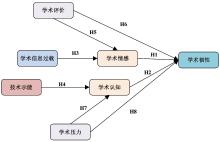
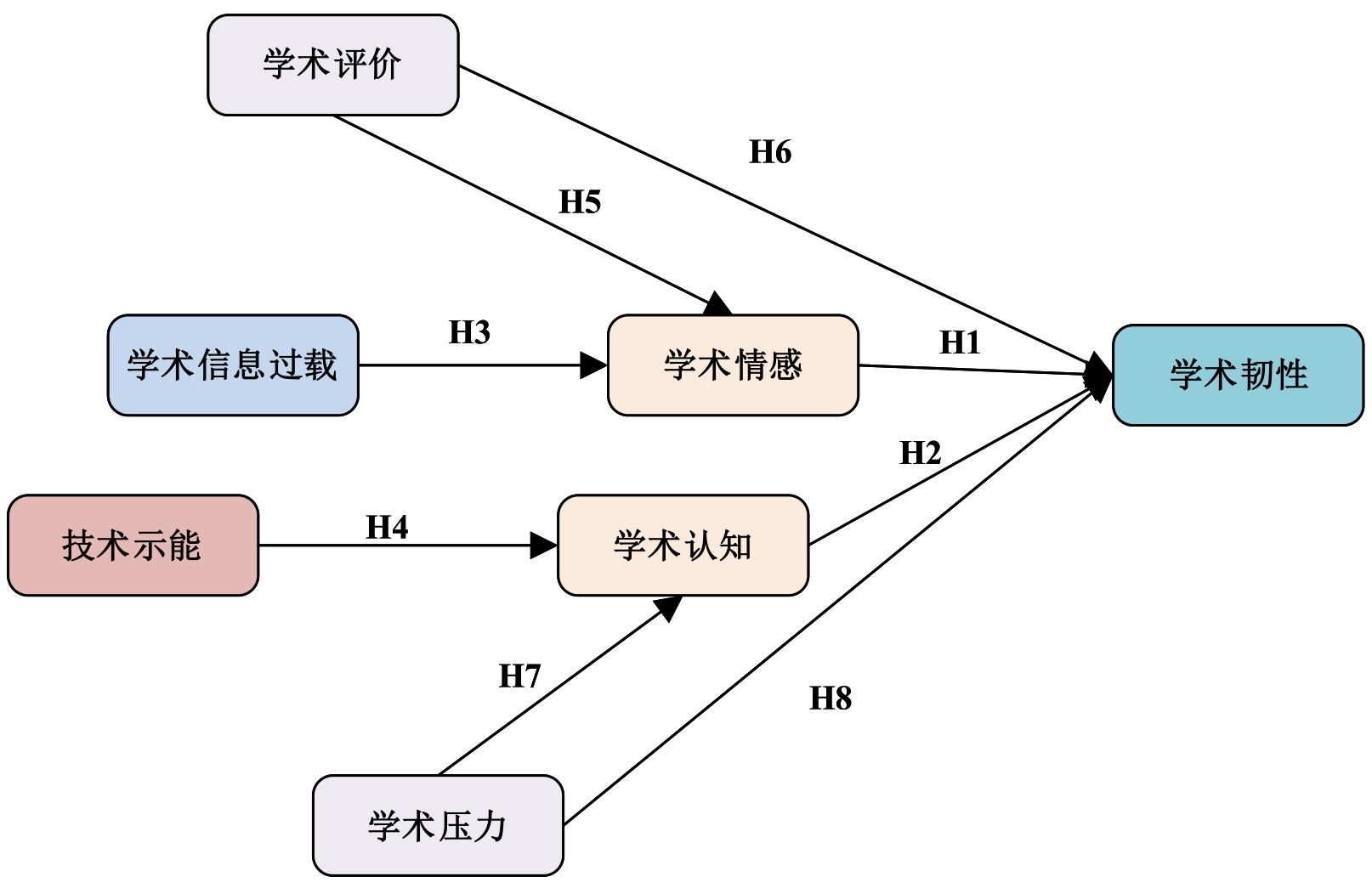
Fig.1

Research model of influencing factors of academic resilience among university researchers"

Table 1

Descriptive statistics of survey samples"

属性 指标 人数/人 比例/% 属性 指标 人数/人 比例/%
性别 男 203 51.39 学历 本科及以下 11 2.78
女 192 48.61 硕士 138 34.94
年龄 25~35岁 120 30.37 博士 246 62.28
36~45岁 189 47.85 职称 无 12 3.03
46~60岁 86 21.78 初级 34 8.61
学科 人文学科 92 23.29 中级 86 21.77
社会学科 187 47.34 副高级 197 49.87
自然学科 116 29.37 正高级 78 19.75

Table 2

Reliability analysis results of the scales"

变量 Cronbach's α 测度项 因子载荷 CR AVE
学术情感 0.824 ACE_1 0.832 0.868 0.688
ACE_2 0.813
ACE_3 0.844
学术认知 0.851 ACC_1 0.853 0.817 0.694
ACC_2 0.842
ACC_3 0.803
学术信息过载 0.864 AIO_1 0.848 0.877 0.704
AIO_2 0.857
AIO_3 0.811
技术示能 0.803 TAE_1 0.863 0.879 0.709
TAE_2 0.824
TAE_3 0.839
学术评价 0.822 AET_1 0.847 0.857 0.667
AET_2 0.816
AET_3 0.785
学术压力 0.842 APS_1 0.852 0.872 0.695
APS_2 0.836
APS_3 0.812
学术韧性 0.912 ARE_1 0.874 0.887 0.726
ARE_2 0.852
ARE_3 0.829

Table 3

Discriminant validity of measurement scales"

变量 ACE ACC AIO TAE AET APS ARE
ACE 0.829
ACC 0.578 0.833
AIO 0.270 0.476 0.839
TAE 0.532 0.335 0.211 0.842
AET 0.414 0.600 0.123 0.233 0.817
APS 0.655 0.338 0.215 0.252 0.215 0.837
ARE 0.467 0.378 0.583 0.287 0.316 0.438 0.852

Table 4

Model fit indices"

指标 CMIN/DF(<3) CFI(>0.9) GFI(>0.9) TLI(>0.9) RMSEA(<0.08)
数据结果 1.684 0.965 0.953 0.951 0.047

Table 5

Path coefficients and hypothesis testing results"

假设 路径关系 标准化系数 S.E. C.R. p值 验证结果
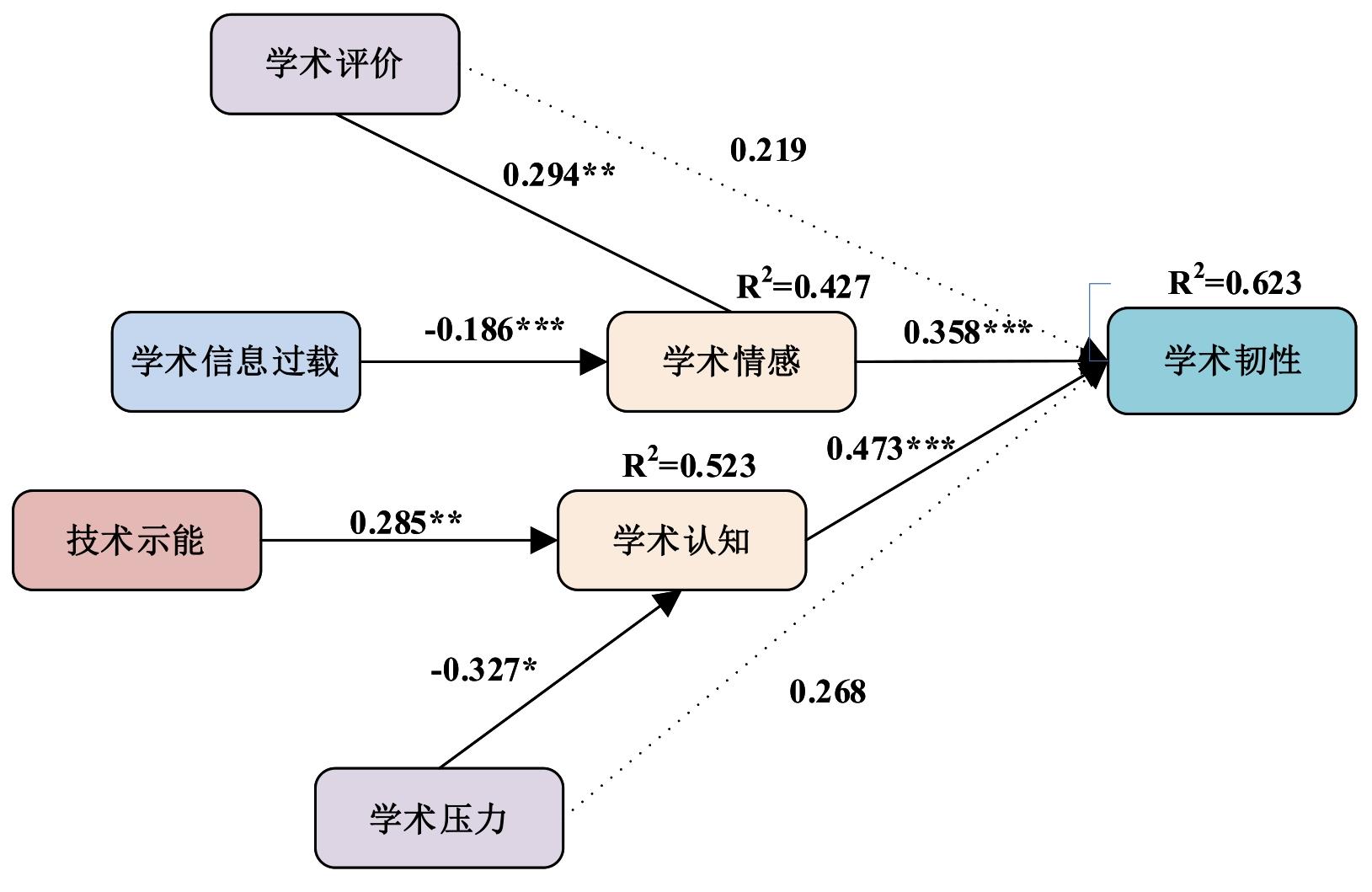
H1 ACE→ARE 0.358 0.075 3.128 *** 支持
H2 ACC→ARE 0.473 0.070 3.628 *** 支持
H3 AIO→ACE -0.186 0.071 3.144 *** 支持
H4 TAE→ACC 0.285 0.060 2.712 ** 支持
H5 AET→ACE 0.294 0.064 2.922 ** 支持
H6 AET→ARE 0.219 0.061 3.270 0.165 不支持
H7 APS→ACC -0.327 0.061 3.660 *** 支持
H8 APS→ARE 0.268 0.051 2.887 0.127 不支持

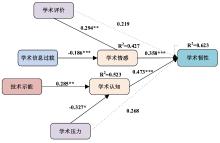
Fig.2

Empirical results of the research model for academic resilience influencing factors of university researchers"

[1]
中共中央关于进一步全面深化改革 推进中国式现代化的决定[N]. 人民日报, 2024-07-22(1).
[2]
马治国, 白冰. 有组织科研机制助推教育科技人才一体化发展研究[J]. 西南民族大学学报(人文社会科学版), 2026, 47(4): 209-219.
Ma Zhiguo, Bai Bing. A study on state-organized research mechanisms boosting the integrated development of education, science and technology, and human resources[J]. Journal of Southwest Minzu University (Humanities and Social Sciences Edition), 2026, 47(4): 209-219.
[3]
张海, 张浩, 方海涛. 生成式人工智能情境下科研人员数字韧性层次结构及影响因素研究[J]. 情报理论与实践, 2026, 49(2): 61-69.
Zhang Hai, Zhang Hao, Fang Haitao. Research on hierarchical structure and influencing factors of researchers' digital resilience based on generative artificial intelligence[J]. Information Studies (Theory & Application), 2026, 49(2): 61-69.
[4]
张海. 大语言模型情境下科研人员数字韧性概念框架与影响机理研究[J/OL]. 图书情报工作, 1-9[2026-05-19].
Zhang Hai. Research on conceptual framework and influence mechanism of digital resilience of researchers in the context of big language model[J/OL]. China Industrial Economics, 1-9[2026-05-19].
[5]
Ramadhani D P, Sagita D D. Academic resilience of students in the limited face to face learning period (PTM-T)[J]. Journal of Innovation in Educational and Cultural Research, 2022, 3(4): 519-527.
[6]
Martin A J, Marsh H W. Academic resilience and its psychological and educational correlates: A construct validity approach[J]. Psychology in the Schools, 2006, 43(3): 267-281.
[7]
Meneghel I, Martínez I M, Salanova M, et al. Promoting academic satisfaction and performance: Building academic resilience through coping strategies[J]. Psychology in the Schools, 2019, 56(6): 875-890.
[8]
Kalaivani D. Academic resilience among students: A review of literature[J]. International Journal of Research and Review, 2021, 8(6): 360-369.
[9]
Deb A, Arora M. Resilience and academic achievement among adolescents[J]. Journal of the Indian Academy of Applied Psychology, 2012, 38(1): 93-101.
[10]
Zhang Yanjun, Zhu Gewei, Luo Chunying, et al. Factors influencing academic resilience of master students in China[J]. Asia Pacific Journal of Education, 2026, 46(3): 625-643.
[11]
杨雨娇, 袁勤俭. 信息生态理论其在信息系统研究领域的应用及展望[J]. 现代情报, 2022, 42(5): 140-148.
Yang Yujiao, Yuan Qinjian. Information ecology and its application and prospect in the field of information system research[J]. Journal of Modern Information, 2022, 42(5): 140-148.
[12]
甄宓, 刘彦辉, 裴月莹, 等. 信息生态视角下高校大学生学术信息搜寻行为的影响因素与组态路径研究[J]. 情报科学, 2024, 42(10): 155-162.
Zhen Mi, Liu Yanhui, Pei Yueying, et al. Influencing factors and configuration paths of university students' academic information searching behavior from the perspective of information ecology[J]. Information Science, 2024, 42(10): 155-162.
[13]
袁顺波. 网络环境下科研人员信息茧房的成因要素研究[J]. 情报理论与实践, 2022, 45(2): 43-48.
Yuan Shunbo. Causative factors of information cocoon towards researchers under the Internet environment[J]. Information Studies (Theory & Application), 2022, 45(2): 43-48.
[14]
毛进, 汪奕辰, 白云. 学术文献出版后评价情感与学术影响力关系研究[J]. 情报理论与实践, 2025, 48(10): 28-36, 27.
Mao Jin, Wang Yichen, Bai Yun. Research on the relationship between post-publication evaluation sentiment and influence of academic paper[J]. Information Studies (Theory & Application), 2025, 48(10): 28-36, 27.
[15]
叶映华. 社交媒体使用如何影响博士生的学术创新能力——社会情感能力与注意失败的中介作用[J]. 中国高教研究, 2024(8): 79-86.
Ye Yinghua. How does the use of social media affect the academic innovation ability of doctoral students: The mediating role of social-emotional competence and attention failure[J]. China Higher Education Research, 2024(8): 79-86.
[16]
肖鹏, 衣春波. 万华镜里的自画像: 关于中国人文学者数字学术认知与需求的质性研究[J]. 图书情报工作, 2021, 65(7): 4-14.
Xiao Peng, Yi Chunbo. Self portrait in the mirror: A qualitative study of the digital scholarship cognition and needs of Chinese humanists scholars[J]. Library and Information Service, 2021, 65(7): 4-14.
[17]
Li Huan, Zhu Sha, Wu Di, et al. Impact of information literacy, self-directed learning skills, and academic emotions on high school students' online learning engagement: A structural equation modeling analysis[J]. Education and Information Technologies, 2023, 28(10): 13485-13504.
[18]
Ekornes S. The impact of perceived psychosocial environment and academic emotions on higher education students' intentions to drop out[J]. Higher Education Research & Development, 2022, 41(4): 1044-1059.
[19]
赵磊磊, 姜蓓佳. 导师支持对学术型博士生学术适应的影响——基于江浙沪皖16所高校的调查研究[J]. 中国高教研究, 2020(8): 56-61.
Zhao Leilei, Jiang Beijia. The influence of tutor support on academic adaptation of academic doctoral students: Based on the investigation of 16 universities in Jiangsu, Zhejiang, Shanghai and Anhui[J]. China Higher Education Research, 2020(8): 56-61.
[20]
Kashlot S M, Ruthven I, Moshfeghi Y. Strategies for managing information overload: A systematic review[J]. Journal of Documentation, 2026, 82(2): 249-265.
[1] Long HAN, Jincheng GUO, Yiting LU, Qun ZHOU. Factors Influencing User Information Adoption in Virtual Communities of Interest: A Study Based on SEM and fsQCA [J]. Journal of library and information science in agriculture, 2024, 36(8): 82-95.
[2] WU Qiyun. Research on the Optimal Allocation of Digital Library Collection Resource from the Perspective of Information Ecology Theory [J]. Journal of library and information science in agriculture, 2018, 30(9): 38-41.
[3] Liu Liping. Research on Collaborative Innovation Service Model of Library Consortia based on Information Ecology Theory [J]. Journal of library and information science in agriculture, 2017, 29(8): 201-204.
Viewed
Full text


Abstract

Cited

  Shared   
  Discussed   
No Suggested Reading articles found!