中文    English

Journal of library and information science in agriculture


A Multimodal-Driven Semantic Interconnection Framework for Digital Resources of Library Collections

WANG Xiaomeng   

  1. Acquisition and Cataloging Center, Guangzhou Library, Guangzhou 510623
  • Received:2026-09-07 Online:2026-10-22

Abstract:

[Purpose/Significance] Library collections have expanded from printed books to manuscripts, letters, photographs, rubbings, audio-visual materials and born-digital files. This expansion creates a structural difficulty at the level of description. MARC, the Chinese MARC format specified in GB/T 33286-2016, is designed around physical carriers: its fields record physical form, publication data and access points, but offer no designated position for the technical attributes of digital objects, such as image resolution, page count, the presence of a text layer, sampling rate or encoding parameters. Frameworks oriented to digital environments, such as BIBFRAME and IFLA LRM, provide modelling ideas, yet adopting them requires reorganizing existing fields and workflows, and their use in union cataloguing and interlibrary data exchange faces constraints of local adaptation. Most collections are in a transitional state in which physical carriers and digital objects coexist. This paper asks whether two descriptions can run in parallel, so that resources of different carriers and origins each obtain an appropriate position within one system and can check each other. [Method/Process] The paper proposed dual-track information organization, in which tracks are divided by the object of description rather than by the source of resources. The carrier track continues to use MARC, retaining compatibility with union cataloguing and with existing bibliographic records. The digital object track adopts a customized metadata scheme, because the description of a digital object must begin from the digital file itself rather than from a bibliographic conversion. The scheme organizes fields into three tiers: a core set holding identity and access information, a form set recording the structure and technical attributes of the digital object and supplying parameters to image services and processing modules, and a domain set carrying content-related information specific to a resource type; fields are further grouped into ten categories that determine storage location and the destination of mapping to external formats. A field registry is the single authoritative source of field definitions, so that adding a resource type extends mounting relations rather than redefining fields. The two tracks are mapped at the level of MARC subfields rather than whole fields, which prevents information carried in repeated subfields from being lost: of the 115 fields examined, 74 are mapped to MARC and 41 technical and system management fields are stored independently. The tracks are linked by resource identifiers and bibliographic record numbers, and the mapping relation is checked continuously during processing. Two complementary scenarios are then defined-Scenario A, in which a standard MARC record already exists for the physical carrier, and Scenario B, in which it does not- and the framework is carried through in data production on three resource types held by a public library: manuscripts, rare books and photographs. Multimodal recognition is positioned inside the framework as a means of field production: pages with regular text are processed by local optical character recognition, pages with artistic lettering or mixed layouts are read by a vision-language model, images are cropped into semantic regions before being submitted for recognition, and recognition output is written into designated fields and confirmed by cataloguers. [Results/Conclusions] In Scenario A, existing MARC fields supplied values to the digital object track through the mapping table, form parameters collected during digitization were written back, and information recorded in bibliographic notes-colophons, dedicatory inscriptions, ownership stamps and biographical notes- was registered in independent domain set fields corresponding to the relevant MARC note fields instead of being crowded into the note area. In Scenario B, a digital object without a bibliographic record generated a MARC draft with fields for standard number, title and statement of responsibility, publication, physical description, summary and electronic location, which entered the formal bibliographic database after review under tiered admission rules, with corrections written back to the digital object track. Field-by-field comparison found no conflicting values for the same field in the three cases, because values are maintained at a single point and referenced elsewhere. Three conclusions follow: the tiered organization of fields makes extension rule-based; field-level mapping and identifier correspondence make the two tracks mutually verifiable, since the digital object track fills the gap left by MARC in describing digital features while MARC supplies authoritative values in return; and the complementarity of the two scenarios lowers the threshold for adoption, because existing holdings can be digitized incrementally under Scenario A while new resources can be digitized before cataloguing under Scenario B. The study has several limitations. First, verification covers one case for each of three resource types and does not report an overall accuracy rate for the complementarity of the two tracks. Second, the domain set vocabulary and the mapping table need to be extended to more fields and resource types. Third, further work should test the framework on larger samples and on audio-visual materials.

Key words: multimodality, digital collection resources, semantic interconnection, dual-track information organization, MARC, metadata repository, field mapping

CLC Number: 

  • G254

Table 1

Correspondence between resource types and dual-track description paths"

场景 存在形态 实物载体轨道 数字资源轨道 两轨对应方式
A 实物载体,有数字对象 已完成MARC著录 无 资源标识对应完成MARC到元数据的映射
B 实物载体,有数字对象 暂无 采用自定义元数据方案完成著录 资源标识对应;利用自定义方案中的映射规则,反补MARC数据
C 原生数字资源,无实物载体 不适用 采用自定义元数据方案完成著录 无

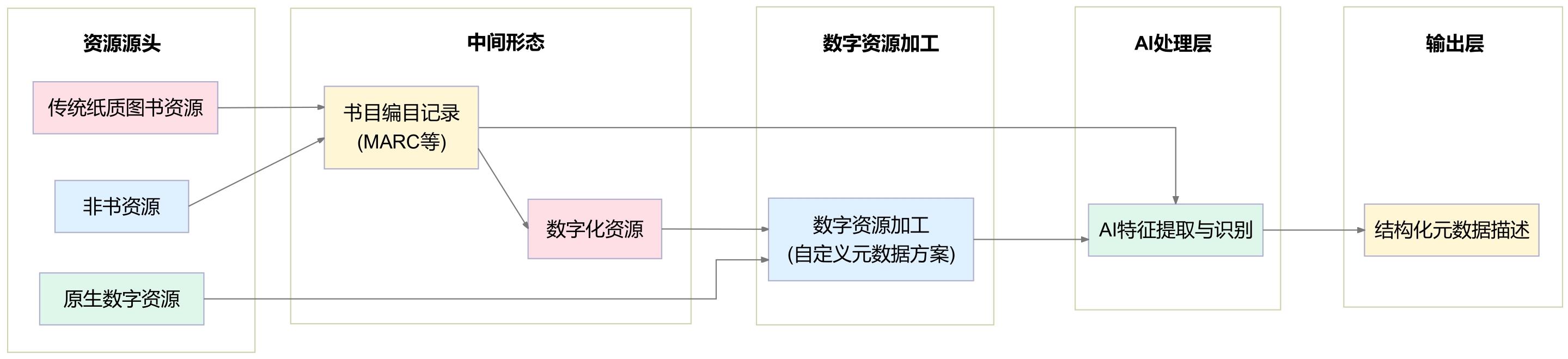
Fig.1

Dual-track processing path of library resources"

Table 2

An excerpt from the metadata field table"

字段名称 必备性 可重复性 所属类 所属集 MARC字段与子字段
UID 必备 否 标识类 核心集 无对应(系统分配)
题名 必备 可重复 题名类 核心集 200$a/200$c
主要责任者 有则必备 可重复 责任者类 核心集 700$a/701$a/710$a/711$a
责任方式 有则必备 可重复 责任者类 核心集 700$4/701$4/710$4/711$4
创作时间 有则必备 否 日期类 核心集 210$d(手稿、书画)
摘要/简介 有则必备 可重复 描述类 核心集 330$a
资源类型 必备 可重复 主题类 核心集 336$a
关键词 必备 可重复 主题类 核心集 600~616(各主题字段)
语种 必备 可重复 形态类 核心集 101(作品语种)
索书号 有则必备 否 标识类 领域集 馆藏信息(由馆藏系统提供)
出版日期 有则必备 否 日期类 领域集 210$d
出版者 有则必备 可重复 出版者类 领域集 210$c
出版地 有则必备 可重复 出版者类 领域集 210$a
分类 有则必备 可重复 主题类 领域集 675/676/680/686/690/696
版本 有则必备 否 描述类 领域集 205$a(含210$a等版本信息)
密级 必备 否 管理类 领域集 无对应(随元数据记录存储)
实体尺寸 有则必备 否 形态类 形态集 215$d
装订方式 有则必备 否 形态类 形态集 010$b/011$b
时长 有则必备 否 形态类 形态集 115$a(1~3字符位)/127$a
声道语种 有则必备 可重复 形态类 形态集 101$a
字幕语种 有则必备 可重复 形态类 形态集 101$j
图像分辨率 有则必备 否 形态类 形态集 无对应(随元数据记录存储)

Fig.2

Metadata and MARC complementary mechanism flowchart"

Table 4

Processing flows of Scenario A and Scenario B"

对照项 场景A(实物已有MARC记录) 场景B(实物尚无MARC记录)
判定条件 实物已有规范书目记录 实物尚无规范书目记录
流程发起点 实物载体轨道(MARC记录) 数字资源轨道(数字化件)
字段流向 MARC字段按映射表向数字资源轨道供值,如200→题名、701→责任者、215→实体尺寸 数字资源轨道按映射表反向生成MARC草案,含010、200、210、215、330、856等字段
数字对象的登记 形态集登记数字化过程中采集的形态参数与文件信息 形态集与领域集字段在加工过程中先行填写
标识对应 数字对象的资源标识回填至MARC的856字段 沿用同一套资源标识与书目记录号规则,入库后继续维护
产出 两轨描述相互对应的完整记录 经编目员审核、按分级准入进入正式书目库的MARC记录
适用对象 已回溯编目的馆藏图书与古籍 新到馆的非书资源、待编手稿与原生数字资源

Table 5

Data production and verification results for the three resource types"

验证项 结果 依据
字段整理规模 115个字段,其中核心集17个、形态集26个、领域集72个 表3
两轨映射覆盖 74个字段与MARC建立映射,41个字段独立存储、不写入书目记录 2.3.2节、表2
场景A路径 手稿、古籍2例走通:既有MARC字段按映射表供值,形态参数回补登记 4.2节示例1、示例3
场景B路径 照片1例走通:反向生成含010、200、210、215、330、856的MARC草案,经审核进入正式书目库 4.2节示例2
附注信息的登记 题跋、赠言、藏书印记与生平信息在领域集独立登记,与305、314、317字段对应 4.2节示例1、示例3
两轨一致性 逐字段核对,两轨取值同源,未出现同一字段两处取值冲突 4.2节、4.3节
人工维护量 同一信息只需维护一处,另一轨按映射规则取值 4.2节
[1]
全国人民代表大会常务委员会. 中华人民共和国公共图书馆法: 中华人民共和国主席令第79号[Z]. 2017‑11‑04.
[2]
董沛文, 贾君枝, 崔西燕. BIBFRAME词表及应用发展思考[J]. 图书馆杂志, 2022, 41(11): 40-48, 69.
Dong Peiwen, Jia Junzhi, Cui Xiyan. The development of BIBFRAME vocabulary and its application[J]. Library Journal, 2022, 41(11): 40-48, 69.
[3]
李杰, 魏瑞斌. VOSviewer应用现状及其知识基础研究[J]. 农业图书情报学报, 2022(6): 61-71.
Li Jie, Wei Ruibin. VOSviewer application status and its knowledge base[J]. Journal of Library and Information Science in Agriculture, 2022(6): 61-71.
[4]
张安琪, 刘可嘉, 丁建勤. 新一代编目元数据编辑器的开发和实践探索——以上海图书馆演出单实体关系编目审校平台为例[J/OL]. 图书馆杂志, 1-17[2026-06-10].
Liu Kejia, Ding Jianqin. Development and practical exploration of a next-generation cataloging metadata editor: Taking the Shanghai library's playbill entity-relationship cataloging review platform as an example[J/OL]. Library Journal, 1-17[2026-06-10].
[5]
欧石燕. 面向关联数据的语义数字图书馆资源描述与组织框架设计与实现[J]. 中国图书馆学报, 2012, 38(6): 58-71.
Ou Shiyan. Design and implementation of a linked data-oriented framework for resource description and organization in semantic digital libraries[J]. Journal of Library Science in China, 2012, 38(6): 58-71.
[6]
张月茹. 对比分析G8国家的开放数据政策及对中国的启示[J]. 农业图书情报学刊, 2018, 30(4): 13-17.
Zhang Yueru. Comparative analysis of G8' open data policy and its enlightenment to China[J]. Journal of Library and Information Sciences in Agriculture, 2018, 30(4): 13-17.
[7]
陆趣, 李哲, 张世乐. 多模态大模型驱动的全媒体媒资系统建设实践[J]. 广播与电视技术, 2025, 52(9): 35-38.
Lu Qu, Li Zhe, Zhang Shile. Practice of building an all-media media asset management system driven by multimodal large models[J]. Radio & TV Broadcast Engineering, 2025, 52(9): 35-38.
[8]
OpenAI. GPT-4V(ision) system card[R]. San Francisco: OpenAI, 2023-09-25.
[9]
Bai Jinze, Bai Shuai, Yang Shusheng, et al. Qwen-VL: A versatile vision-language model for understanding, localization, text reading, and beyond[PP/OL]. V3. arXiv (2023-10-13)[2026-06-10].
[10]
Chen Zhe, Wu Jiannan, Wang Wenhai, et al. Intern VL: Scaling up vision foundation models and aligning for generic visual-linguistic tasks[C]//2024 IEEE/CVF Conference on Computer Vision and Pattern Recognition (CVPR). Piscataway, New Jersey: IEEE, 2024: 24185-24198.
[11]
钱国富, 张智东, 李贵. 基于多模态大模型的多媒体资源编目系统探索[J]. 图书情报工作, 2026, 70(9): 105-113.
Qian Guofu, Zhang Zhidong, Li Gui. The exploration of multimedia resource cataloging system based on multimodal large models[J]. Library and Information Service, 2026, 70(9): 105-113.
[12]
赵美花. 人工智能在图书采分编领域的实践与展望——以广东省立中山图书馆“采编图灵”为例[J]. 图书馆论坛, 2025, 45(8): 126-132.
Zhao Meihua. Practice and prospect of artificial intelligence in the field of book acquisition, classification, and cataloging - Taking "library turing" as an example[J]. Library Tribune, 2025, 45(8): 126-132.
[13]
刘炜, 金家琴, 张宁, 等. 从分类主题到语义空间: 人工智能驱动下图书馆知识组织体系的转型与发展[J/OL]. 中国图书馆学报, 1-20[2026-06-10].
Liu Wei, Jin Jiaqin, Zhang Ning, et al. From classification and subject to semantic space: transformation and development of library knowledge organization systems driven by artificial intelligence[J/OL]. Journal of Library Science in China, 1-20[2026-06-10].
[14]
刘炜. 关联数据: 概念、技术及应用展望[J]. 大学图书馆学报, 2011, 29(2): 5-12.
Liu Wei. Overview on linked data: Concept, technology and implementation[J]. Journal of Academic Libraries, 2011, 29(2): 5-12.
[15]
孙坦, 张智雄, 周力虹, 等. 人工智能驱动的第五科研范式(AI4S)变革与观察[J]. 农业图书情报学报, 2023, 35(10): 4-32.
Sun Tan, Zhang Zhixiong, Zhou Lihong, et al. The transformation and observations of AI for science(AI4S) driven by artificial intelligence[J]. Journal of Library and Information Science in Agriculture, 2023, 35(10): 4-32.
[16]
贾君枝, 杨鑫, 牛力. AI驱动的图书馆编目:技术演进、适配挑战和优化策略[J]. 中国图书馆学报, 2026, 52(1): 145-165.
Jia Junzhi, Yang Xin, Niu Li. AI-driven library cataloging: Technological evolution, adaptation challenges, and optimization strategies[J]. Journal of Library Science in China, 2026, 52(1): 145-165.
[17]
郭利敏, 刘悦如, 付雅明. 智能元数据视角下图书馆元数据内容变革路径研究[J]. 图书情报工作, 2026, 70(10): 95-107.
Guo Limin, Liu Yueru, Fu Yaming. The content transformation path of library metadata from the perspective of smart metadata[J]. Library and Information Service, 2026, 70(10): 95-107.
[18]
周小萍. 从CNMARC到BIBFRAME: 中文书目数据的富语义化研究[J]. 情报资料工作, 2018, 39(3): 99-104.
Zhou Xiaoping. From CNMARC to BIBFRAME: Study on semantic research of Chinese bibliographic data[J]. Information and Documentation Services, 2018, 39(3): 99-104.
[19]
周小萍. CNMARC与BIBFRAME的映射及转换研究[J]. 图书馆杂志, 2018, 37(8): 21-29.
Zhou Xiaoping. A study on the mapping and conversion between CNMARC and BIBFRAME[J]. Library Journal, 2018, 37(8): 21-29.
[20]
寿建琪. MARC向BIBFRAME转换规范对CNMARC格式转换的启示[J]. 图书馆工作与研究, 2023(8): 65-74.
Shou Jianqi. Enlightenment of conversion specifications from MARC to BIBFRAME on CNMARC format conversion[J]. Library Work and Study, 2023(8): 65-74.
[21]
杨雯霞. ISBDM: 实体关系编目的新探索[J]. 图书馆杂志, 2026, 45(9): 52-60.
Yang Wenxia. ISBDM: A new exploration of entity-relationship cataloging[J]. Library Journal, 2026, 45(9): 52-60.
[22]
刘可嘉. 国外新一代编目元数据平台——实体-关系编辑器比较研究[J/OL]. 图书馆杂志, 1-26[2026-06-10].
Liu Kejia. New-generation cataloging metadata platforms abroad: A comparative study of entity-relationship editors[J/OL]. Library Journal, 1-26[2026-06-10].
[23]
陈若韵, 张倩, 张谙宁, 等. 人工智能驱动的图书馆编目领域新进展[J/OL]. 图书馆杂志, 1-14[2026-06-10].
Chen Ruoyun, Zhang Qian, Zhang Anning, et al. New advances in artificial intelligence-driven library cataloging[J/OL]. Library Journal, 1-14[2026-06-10].
[24]
张雨卉, 刘炜, 张磊, 等. 面向智能化元数据生产的智慧编目框架研究[J]. 信息与管理研究, 2026, 11(1): 38-51.
Zhang Yuhui, Liu Wei, Zhang Lei, et al. Research on a smart cataloging framework for intelligent metadata production[J]. Journal of Information and Management, 2026, 11(1): 38-51.
[25]
江京泽, 周天旻, 李妹, 等. 高校图书馆智能化转型中的复合型AI馆员核心能力模型的探索与研究[J]. 农业图书情报学报, 2025, 37(9): 97-109.
Jiang Jingze, Zhou Tianmin, Li Mei, et al. A study of the core competence model of compound AI librarians in the intelligent transformation of university libraries[J]. Journal of Library and Information Science in Agriculture, 2025, 37(9): 97-109.
[1] WU Beibei. Study on the Localization of BIBFRAME [J]. Journal of library and information science in agriculture, 2017, 29(9): 91-95.
[2] LI Shaomin. New Method of Koreancataloging ——Comparison of KORMARC ,USMARCandCNMARC [J]. Journal of library and information science in agriculture, 2017, 29(9): 111-115.
[3] DONG Jin, ZHOU Li-ying. Discussion on the Standard Cataloguing of Donated Books——Taking University Town Library of Shenzhen as Example [J]. Journal of library and information science in agriculture, 2016, 28(4): 96-99.
[4] XIE Na. The Application and Influence of BIBFRAME in Library Catalogue [J]. Journal of library and information science in agriculture, 2016, 28(10): 41-44.
[5] GUO Xue-juan. Comparative Study on the Format Characteristics of JAPAN/MARC and CNMARC [J]. Journal of library and information science in agriculture, 2015, 27(11): 97-102.
[6] FAN Guo-yin. The Design and Achievement of MARC Metadata Based on the Technology of PL/SQL to Reading [J]. Journal of library and information science in agriculture, 2014, 26(9): 48-50.
[7] SONG Wen-yan. Comparative Analysis of Cataloging Continuing Resource’s Linking Entry Based onCNMARC, ISSN MARC and MARC21 [J]. Journal of library and information science in agriculture, 2014, 26(8): 25-29.
[8] LI Jun-ting. Discussion on Description of Responsibility Authors in CNMARC [J]. Journal of library and information science in agriculture, 2014, 26(8): 101-103.
Viewed
Full text


Abstract

Cited

  Shared   
  Discussed   
No Suggested Reading articles found!