中文    English

Journal of library and information science in agriculture


Mechanism Analysis and Risk Regulation of the Embedding of Emotional-Functional Embodied Intelligence in Social Governance: From the Perspective of "Instrument and Value" Rationality

HAO Yali, LIANG Ying, DING Ruoxi   

  1. School of Public Management, Tianjin University of Commerce, Tianjin 300134
  • Received:2025-10-17 Online:2026-01-06

Abstract:

[Purpose/Significance] With the continuous advancement of national governance modernization and the rapid development of artificial intelligence (AI) technologies, emotional-functional embodied intelligence has become integral to grassroots social governance. This development not only reshapes traditional governance tools but also triggers profound reflections on the balance between instrumental rationality and value rationality. In this context, systematically examining the internal mechanisms and potential risks associated with the integration of emotional-functional embodied intelligence into social governance can provide both theoretical enrichment and practical guidance for technology-enabled governance modernization. [Method/Process] Based on Max Weber's "tool-value" dichotomy, this study focuses on key issues concerning the influence mechanisms, risk boundaries, and regulatory pathways of emotional-functional embodied intelligence in social governance. By situating the analysis within concrete scenarios of its embedding in social governance practices, the research combines theoretical reflection with contextual examination to explore how emotional-functional embodied intelligence reshapes governance structures and processes. [Results/Conclusions] The findings reveal that AI, embodied intelligence, and emotional-functional embodied intelligence differ significantly in terms of technological architecture, functional form, and modes of integration into social governance. While AI optimizes decision-making through data empowerment and embodied intelligence delivers services through physical interaction, emotional-functional embodied intelligence achieves full-process and in-depth integration into social governance by relying on affective linkage. It forms an integrated structural system composed of the demand, intelligence, action, and support layers, thereby enabling coordinated governance operations that combine rational decision-making with emotional interaction. Through three core mechanisms - intelligence embedding, human-machine coupling and feedback-driven iteration, emotional-functional embodied intelligence is able to simultaneously accomplish rational decision-making tasks and emotional interaction objectives. However, the embedding of emotional-functional embodied intelligence in social governance also implies dual structure of risks. On one hand, it may amplify traditional risks inherent in AI technologies, such as algorithmic dependence and blurred responsibility attribution. On the other hand, it may generate new forms of context-specific risks, including emotional-cognitive alienation, value-guidance deviation, and the reconstruction of governance authority. To address these challenges, it is necessary to construct a full-chain regulatory framework for accountability and establish full-process technological safeguards encompassing ex-ante prevention, in-process monitoring, and ex-post traceability. Concurrently,it's essential to articulate value-oriented principles for emotion-informed governance and clarify a human-machine collaborative governance framework in which human actors retain primary authority while intelligent technologies play an auxiliary role. Through these coordinated measures, effective risk regulation and rational balance can be achieved in the application of emotional-functional embodied intelligence in social governance.

Key words: embodied intelligence, social governance, robotics, instrumental and value rationality, human-machine relationship, risk regulation

CLC Number: 

  • D035

Table 1

Connections and differences between artificial intelligence, embodied intelligence, and emotional-functional embodied intelligence"

维度 人工智能 具身智能 情智具身智能
技术架构 “数据-算法-算力”三角支撑 “感知-决策-行动-反馈”四环闭合持续学习 “智能层”与“情感层”双轮驱动
技术层次 总纲框架 分支类型 高阶形态
特点 单向性、信息化 机械化、脚本式 交互式、人性化
治理嵌入方式 以数据赋能决策优化 以物理交互实现服务落地 以人文协同传递治理温度
典型代表

离身智能:ChatGPT

具身智能:机器人

工业:柔性装配机器人

服务:物流配送机器人

科研:仿生机器人如机器狗

医疗护理机器人

养老关照机器人

信访接待、特殊人群关怀

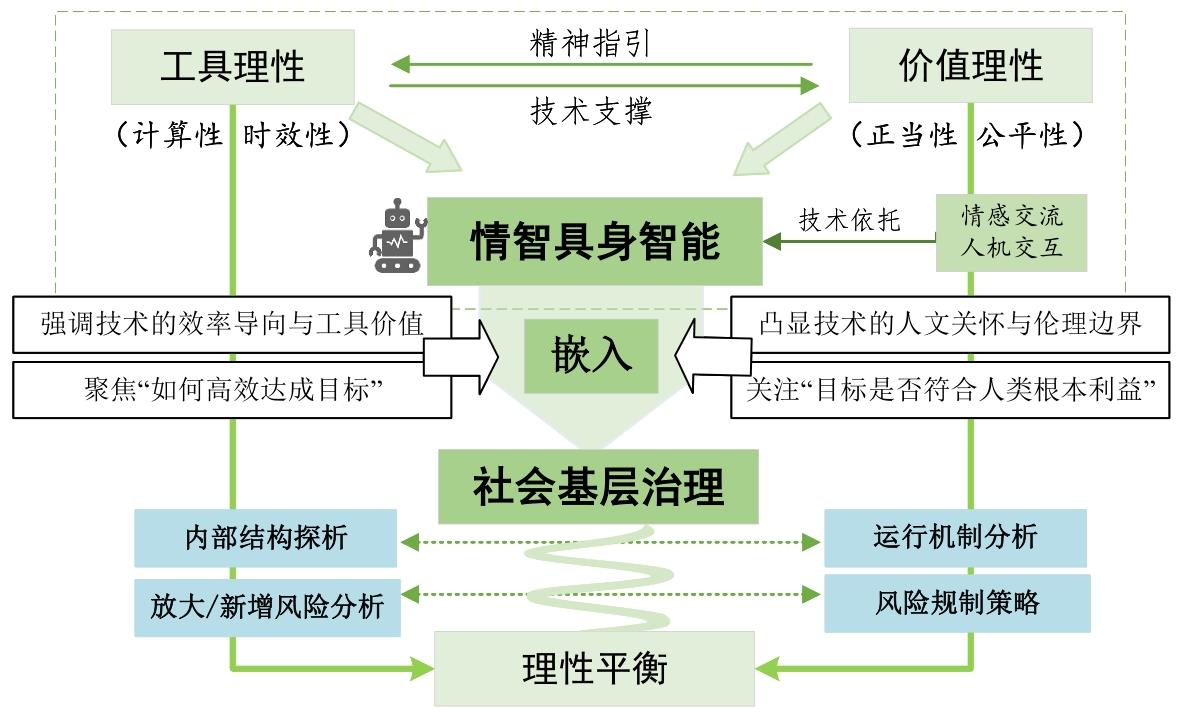
Fig.1

Theoretical analysis framework"

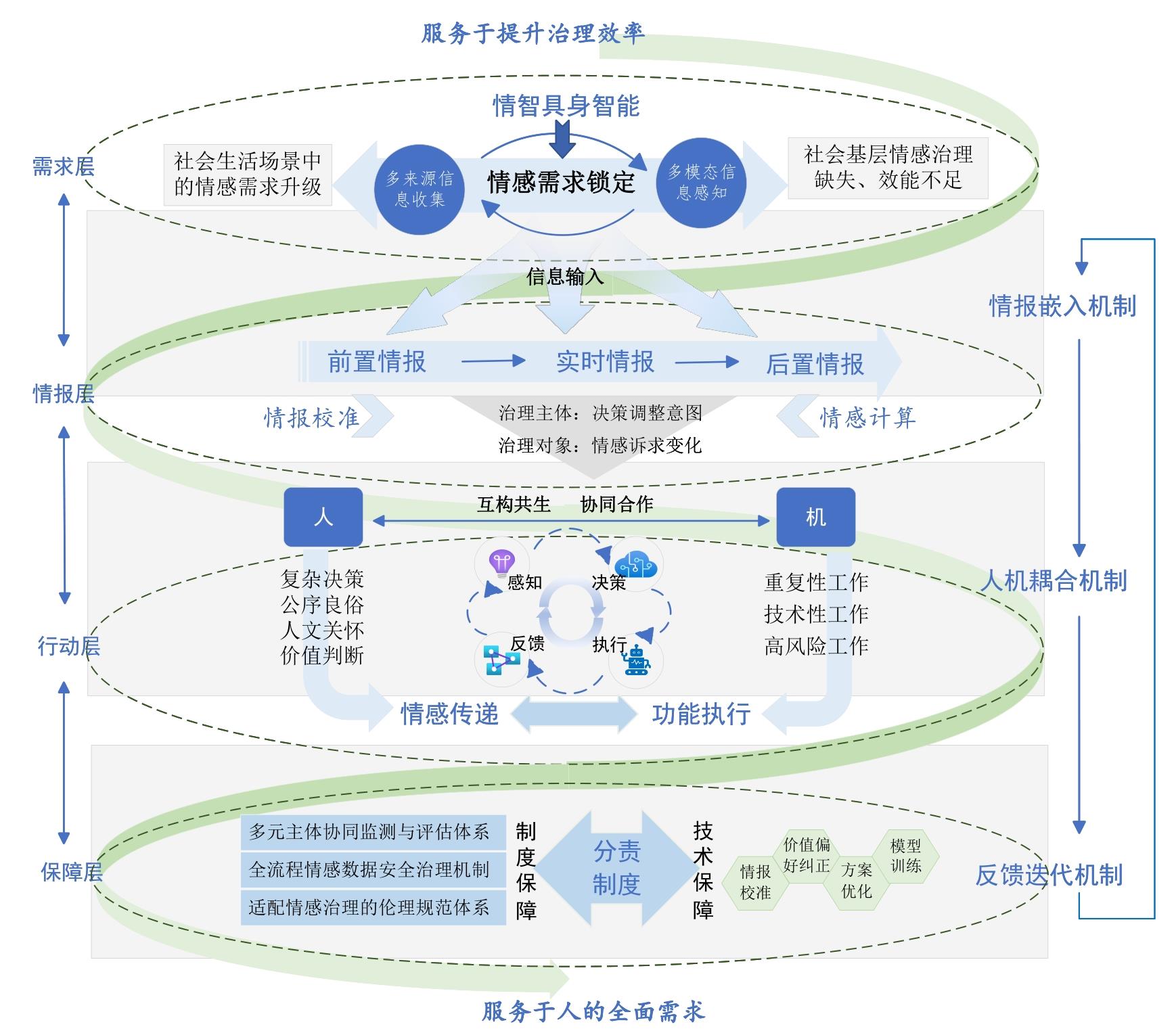
Fig.2

Schematic diagram of the structure and operational mechanism of emotional-functional embodied intelligence in social governance"

[1]
吕鹏, 龚顺, 梅笑, 等. 智能社会的崛起和人工智能的社会影响[J]. 智能社会研究, 2022, 1(1): 61-77.
LYU P, GONG S, MEI X, et al. The rise of intelligence society and the social impacts of artificial intelligence[J]. Journal of intelligent society, 2022, 1(1): 61-77.
[2]
中国网. 中共中央关于制定国民经济和社会发展第十五个五年规划的建议[EB/OL]. [2025-07-24].
[3]
MINSKY M L. The Society of Mind[M]. New York: Simon and Schuster, 1986.
[4]
贾丹萍, 靳健, 耿骞, 等. 感性工学视角下的用户需求挖掘研究[J]. 情报学报, 2020(3): 308-316.
GJIA S D, JIN J, GENG Q,et al. A Sansei engineering integrated approach for customer-needs mining from online product reviews[J]. Journal of the China society for scientific and technical information, 2020(3): 308-316.
[5]
国家自然科学基金委员会重大研究计划“共融机器人基础理论与关键技术研究”[J]. 模式识别与人工智能, 2019, 32(1): 94-95.
Major research plan of the national natural science foundation of China "Research on Basic Theory and Key Technologies of Coexisting-Cooperative-Cognitive"[J]. Pattern recognition and artificial intelligence, 2019, 32(1): 94-95.
[6]
王文晟, 谭宁, 黄凯, 等. 基于大模型的具身智能系统综述[J]. 自动化学报, 2025, 51(1): 1-19.
WANG W S, TAN N, HUANG K, et al. Overview of intelligent system with body based on large model[J]. Acta automatica sinica, 2025, 51(1): 1-19.
[7]
孙宾, 章荣君. 融合工具理性与价值理性: 社会治理数字化的实践省思[J]. 湖湘论坛, 2024, 37(2): 57-69.
SUN B, ZHANG R J. Integrating instrumental rationality and value rationality: Reflections on the practice of digitalizing social governance[J]. Huxiang forum, 2024, 37(2): 57-69.
[8]
高源. 工具理性与价值理性的冲突与调适[J]. 学习月刊, 2025(5): 47-49.
GAO Y. Conflicts and adjustment between instrumental rationality and value rationality[J]. Study monthly, 2025(5): 47-49.
[9]
何萍. 数字治理的“科林格里奇困境”: 风险、发生逻辑与防范之策[J]. 理论导刊, 2023(10): 88-95.
HE P. "Collingridge's Dilemma" of digital governance: Risks, occurrence logic, and preventive measures[J]. Journal of socialist theory guide, 2023(10): 88-95.
[10]
锁利铭, 耿佳皓. 迈向人智协同的超大城市数字政府进化: 基于复杂适应系统理论[J]. 电子政务, 2025(6): 2-15.
SUO L M, GENG J H. Toward human-AI synergy: The evolution of digital government in mega-cities from the perspective of complex adaptive system theory[J]. E-Government, 2025(6): 2-15.
[11]
文军, 方淑敏. 项目栖居: 基层治理社会工作的动态耦合机制研究[J]. 华东师范大学学报(哲学社会科学版), 2025, 57(5): 105-115, 237.
WEN J, FANG S M. Project inhabitation: On the dynamic coupling mechanism in grassroots governance social work[J]. Journal of East China normal university (humanities and social sciences), 2025, 57(5): 105-115, 237.
[12]
崔健, 曹梦圆. 算法亲密: 智能情感的温情幻象与警思[J]. 福建师范大学学报(哲学社会科学版), 2025(5): 136-144, 171, 172.
CUI J, CAO M Y. The intimacy of algorithms: The warm illusion and cautionary reflections on artificial emotion[J]. Journal of Fujian normal university (philosophy and social sciences edition), 2025(5): 136-144, 171, 172.
[13]
石立春. 青年“赛博恋爱”的人机情感交互及其价值引领[J]. 思想理论教育, 2025(11): 91-97.
SHI L C. The human-computer emotional interaction and value guidance of young people's "Cyber-Love"[J]. Ideological & theoretical education, 2025(11): 91-97.
[14]
郝雅立, 宋沂霏, 阿忠萍, 等. 基于情感计算的涉农突发事件网络舆情态势分析与引导策略[J]. 农业图书情报学报, 2025(10): 37-52.
HAO Y L, SONG Y F, A Z P, et al. Analysis of online public opinion situations related to agricultural emergencies based on affective computing and guidance strategy[J]. Journal of library and information science in agriculture, 2025(10): 37-52.
[15]
周付军, 王晟. 数字归责: 数字平台赋能精准问责的内在逻辑——基于C县大数据实验室的案例研究[J/OL]. 电子政务,2025: 1-13.
ZHOU F J, WANG S. Digital accountability: The inherent logic of how digital platforms empower precise accountability - Based on a case study of the big data laboratory in county[J/OL]. E-government, 2025: 1-13.
[16]
师文, 刘亦琛. 陷入与逃脱: “情绪茧房”与平台算法机制间关系的计算实验研究[J]. 新闻与写作, 2025(8): 70-82.
SHI W, LIU Y C. Trapped and escaped: A computational experimental study on the relationship between "Emotional Cocoon" and platform algorithmic mechanisms[J]. News and writing, 2025(8): 70-82.
[17]
陈桂生, 吴合庆. 情感治理何以成为乡村社区治理的新转向: 基于“治理有效”的解释[J]. 求实, 2022(4): 96-108, 112.
CHEN G S, WU H Q. Why does emotional governance become a new turn of rural community governance: Interpretation based on "Effective Governance"[J]. Truth seeking, 2022(4): 96-108, 112.
[1] WAN Demei. Research on Cloud Storage of Digital Feature Library Resource Based on HDFS [J]. Journal of library and information science in agriculture, 2018, 30(4): 36-40.
[2] HAN Wei. Optimization Countermeasures on the Community Extension Service System of Public Library in the Information age [J]. Journal of library and information science in agriculture, 2016, 28(5): 165-167.
[3] YANG Jian-yun. Study on the government records service under the background of information publicity [J]. Journal of library and information science in agriculture, 2014, 26(9): 204-206.
Viewed
Full text


Abstract

Cited

  Shared   
  Discussed   
No Suggested Reading articles found!