中文    English

Journal of library and information science in agriculture


Evolutionary Game Study of the Digital Hoarding Behavior of Social Media Users under Algorithm Recommendations

LI Shuqi1, LI Jian2   

  1. 1. Business College of Southwest University, Chongqing 402460
    2. Archives of Southwest University, Chongqing 400715
  • Received:2025-08-30 Online:2025-12-02

Abstract:

[Purpose/Significance] Digital hoarding has emerged as a significant behavioral phenomenon in the digital age, particularly prevalent among social media users who engage in the excessive acquisition and retention of digital content. This behavior is further amplified by algorithmic recommendation systems that continuously personalize content delivery. Although existing research has examined individual psychological factors or platform characteristics using static approaches, it lacks a dynamic perspective to understand the co-evolutionary relationship between platform strategies and user behaviors. This study addresses this research gap by introducing evolutionary game theory as an innovative analytical framework. Theoretically, the significance lies in modeling the dynamic interactions between platforms' algorithmic adjustments and users' hoarding behaviors. This provides new insights into the adaptive mechanisms within socio-technical systems. From a practical standpoint, this research offers valuable implications for promoting healthier digital environments and developing sustainable governance models for platforms that balance commercial objectives with user well-being. [Method/Process] This study employs evolutionary game theory to model the dynamic interactions between social media platforms and boundedly rational users. This method is well-suited for analyzing how strategies co-evolve over time towards stable states. Based on literature from user behavior and platform economics, a game-theoretic model was developed. Numerical simulations in MATLAB analyzed evolutionary paths across four platform types (Instant Messaging, Public, Short Video, and Vertical Community), with the model calibrated against empirical typologies to investigate how key factors influence long-term outcomes. [Results/Conclusions] The simulation results reveal that the evolutionary path of the platform-user interaction system is highly sensitive to key parameters, ultimately converging to different evolutionarily stable strategies (ESS) under varying conditions. A principal finding is that a unilateral increase in algorithmic recommendation intensity by platforms, while potentially boosting short-term engagement, does not guarantee long-term benefits and may instead drive users towards non-hoarding strategies due to increased cognitive burden. Crucially, the reasonable regulation of recommendation intensity is identified as the key to achieving sustainable, positive interactions. Moderate algorithmic recommendations can effectively alleviate information overload, reduce the negative impacts of hoarding, enhance user experience and satisfaction, and ultimately increase long-term platform benefits, creating a win-win scenario. The study provides significant managerial implications, suggesting that platform operators should incorporate user well-being metrics into algorithm evaluation frameworks, moving beyond purely engagement-driven models. Differentiated governance strategies are recommended for various platform types, such as implementing intelligent filtering on instant messaging apps and content quality incentives on vertical communities. However, this study has limitations, primarily its assumption of user homogeneity, which overlooks the impact of individual differences in preferences and digital literacy. Future research should introduce user heterogeneity, explore multi-platform competition scenarios, and validate the model with empirical data to enhance its practical predictive power and application value.

Key words: algorithm recommendation, digital hoarding behavior, social media platforms, evolutionary game

CLC Number: 

  • G204

Table 1

Cost-benefit table of evolutionary game between social media platforms and users"

社交媒体平台 用户
F:平台固定收益 P:用户在社交媒体平台获取有益信息的基础收益
N:平台固定成本 Q:用户在社交媒体平台使用时间的基础成本
R:强化算法推荐时的额外收益 E:用户选择囤积行为获取有益信息的潜在收益

K:用户囤积行为造成的平台额外收益(K=θC

θ:用户额外使用时间带给平台的单位收益

φ:不同强化算法推荐时用户使用时间强化系数

C:用户选择囤积行为造成的额外使用成本及心理成本

Table 2

Payoff matrix of the platform-user evolutionary game"

博弈主体与决策类型 用户
选择囤积(x 不选择囤积(1-x
社交平台 强化算法推荐(y P-φQ+E-φCF-N+φR+K/φ P-φQF-N+φR
无强化算法推荐(1-y P-Q+E-CF-N+K P-QF-N

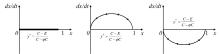
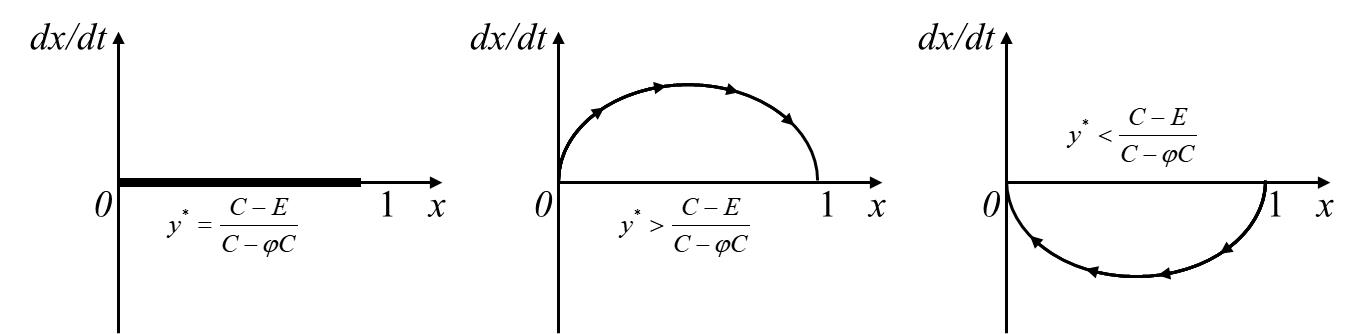
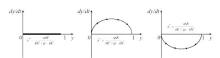
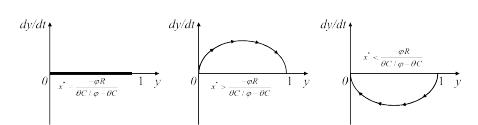
Fig.1

Replicator dynamics phase diagram of the user population"

Fig.2

Replicator dynamics phase diagram of the social media platform"

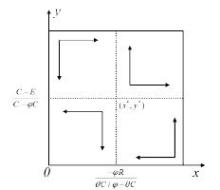
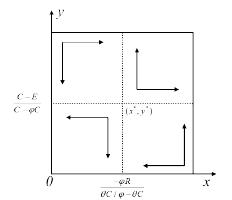
Fig.3

Replicator dynamics and stability of the platform-user evolutionary system"

Table 3

Partial derivatives of the evolutionarily stable strategy for the replicator dynamics equations at equilibrium points"

均衡点 a 11 a 12 a 21 a 22
(0,0) E-C 0 0 φR
(1,0) -(E-C) 0 0 K/φ+φR-K
(0,1) E-φC 0 0 -φR
(1,1) -(E-φC) 0 0 -(K/φ+φR-K)
(x*,y*) 0 a 12(x0,y0) a 21(x0,y0) 0

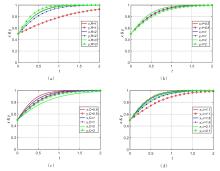
Fig.4

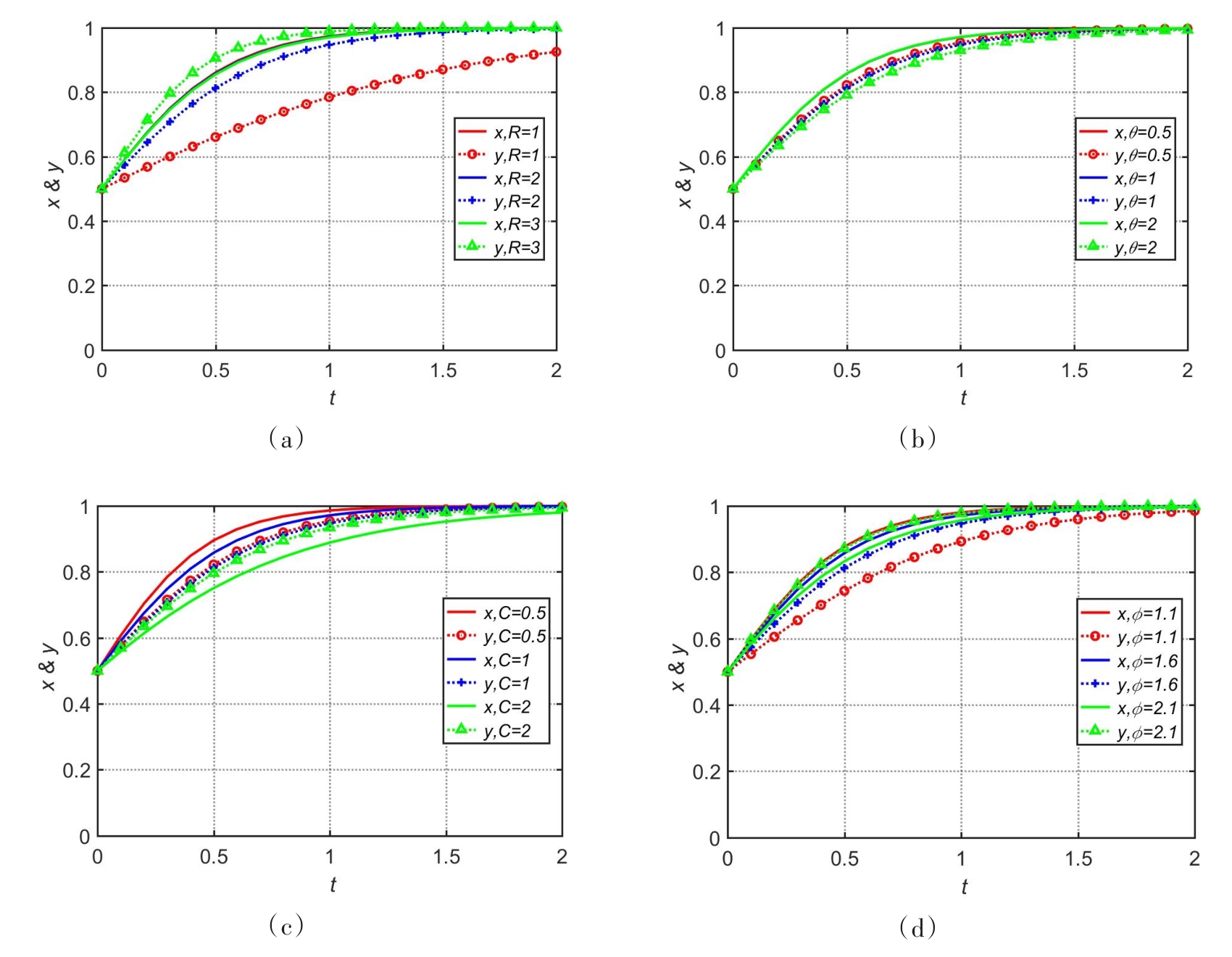
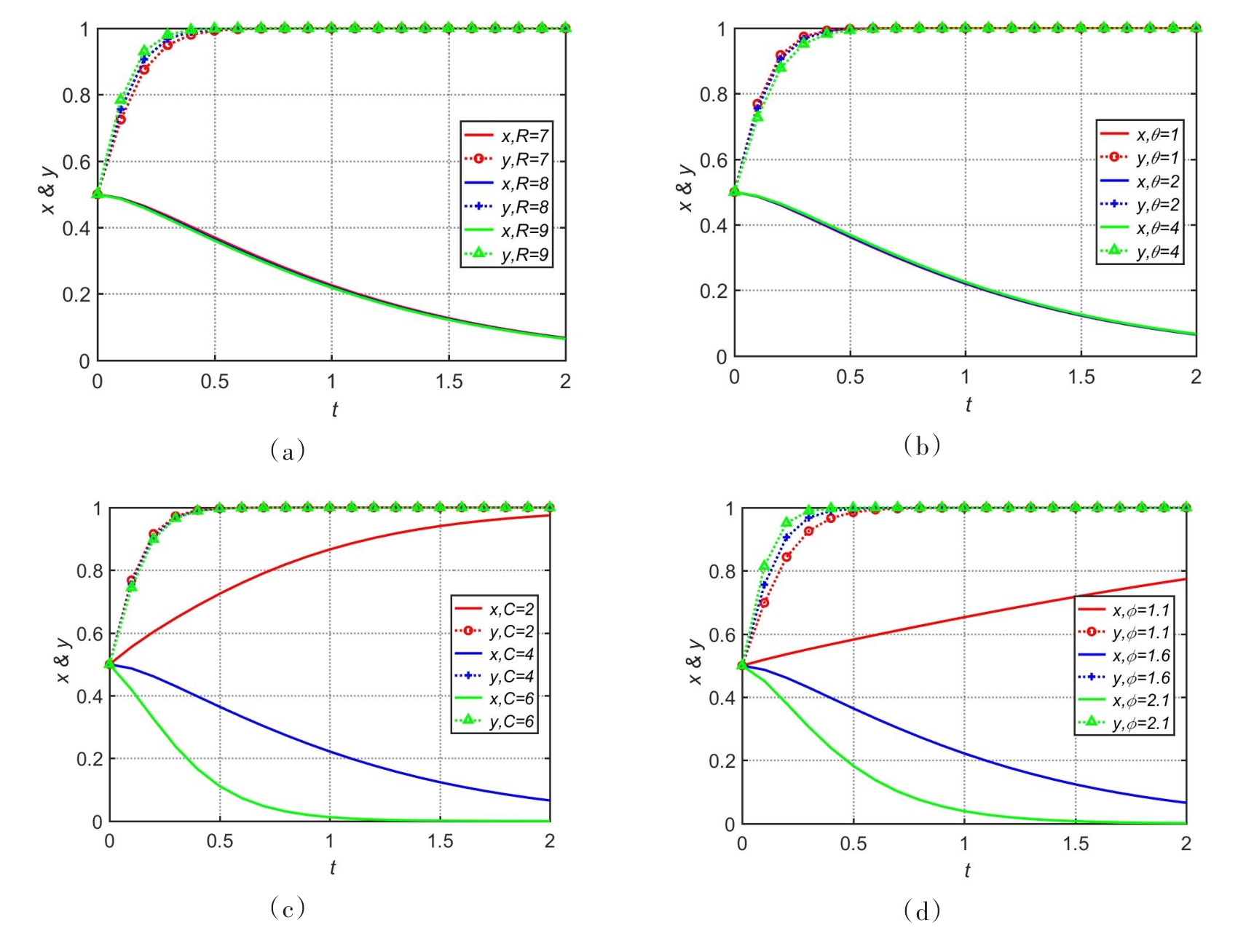
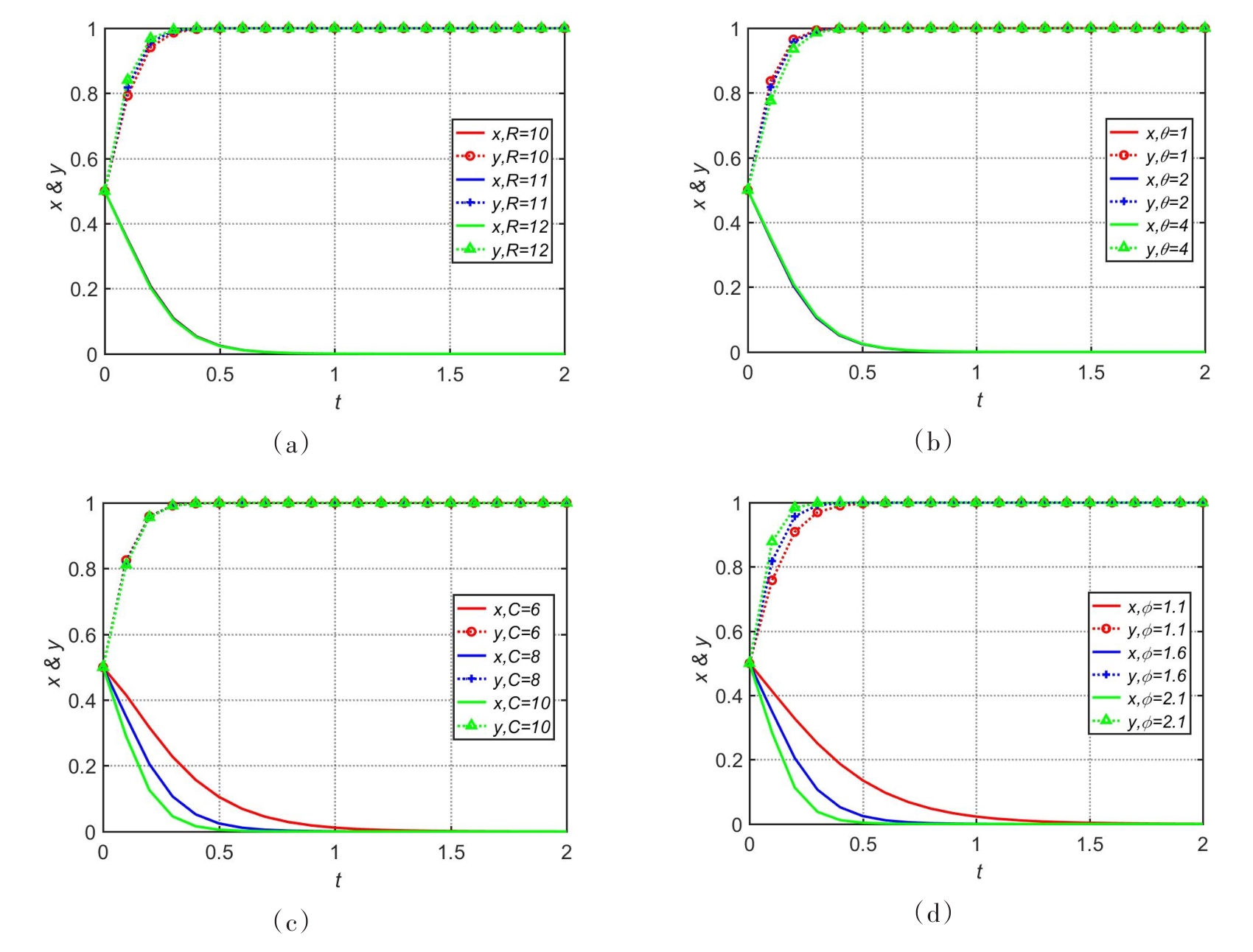
Simulation results of instant messaging platforms"

Fig.5

Simulation results of public social media platforms"

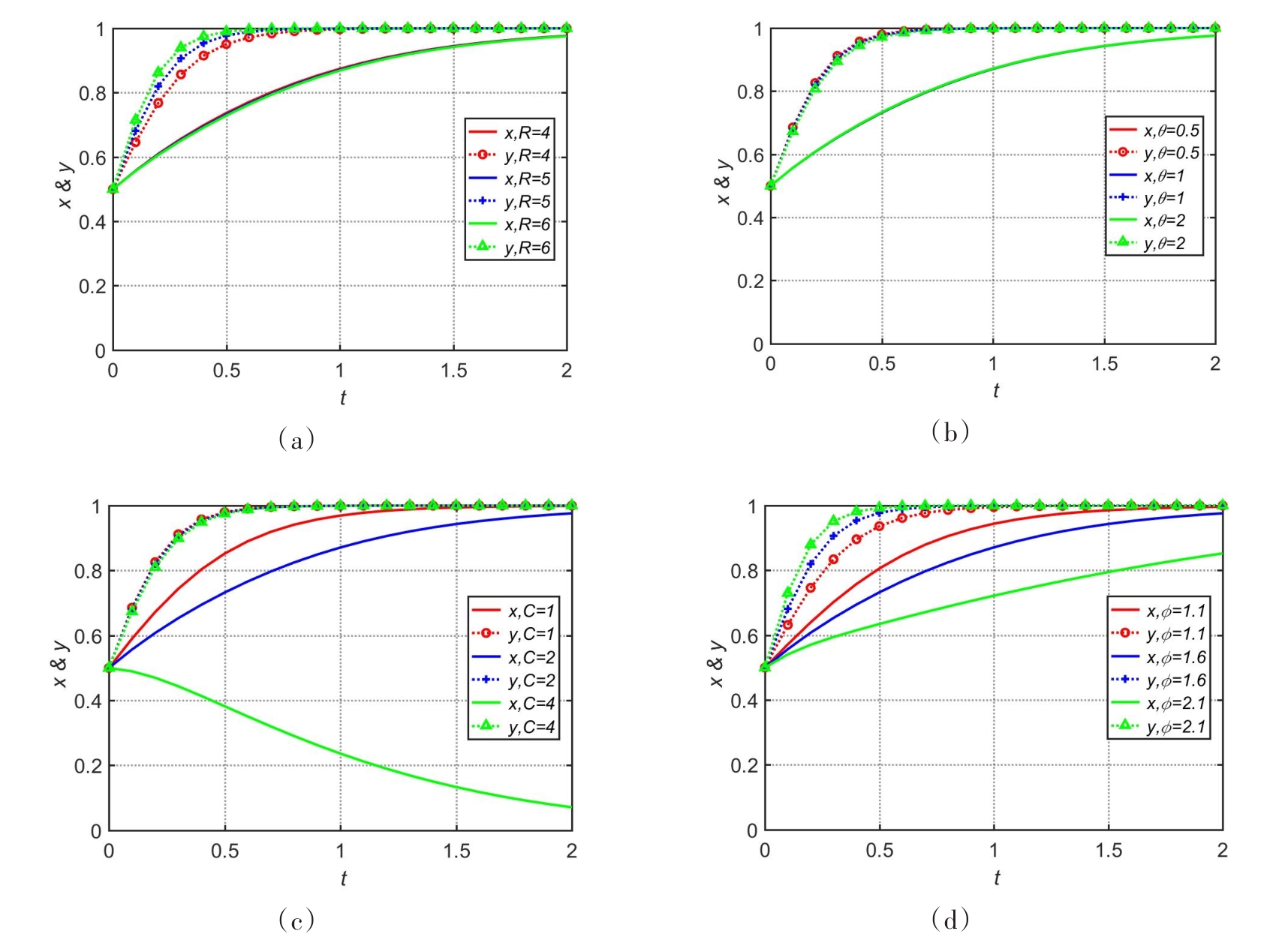
Fig.6

Simulation results of vertical social media platforms"

Fig.7

Simulation results of short-video social media platforms"

[1]
张铮, 刘晨旭. 海量信息下社交媒体用户数字囤积的心理机制初探[J]. 西南民族大学学报(人文社会科学版), 2024, 45(4): 135-142.
ZHANG Z, LIU C X. A preliminary study on the psychological mechanism of digital hoarding by social media users under massive information[J]. Journal of southwest Minzu University (humanities and social sciences edition), 2024, 45(4): 135-142.
[2]
王琳, 杜田羽, 朱华健. 社交媒体环境下大学生数据囤积行为形成机理研究[J]. 情报理论与实践, 2022, 45(1): 22-29.
WANG L, DU T Y, ZHU H J. The formation mechanism of data hoarding behavior in social media context: Taking college students as an example[J]. Information studies: Theory & application, 2022, 45(1): 22-29.
[3]
SEDERA D, LOKUGE S, GROVER V. Modern-day hoarding: A model for understanding and measuring digital hoarding[J]. Information & management, 2022, 59(8): 103700.
[4]
国家互联网信息办公室, 中华人民共和国工业和信息化部, 中华人民共和国公安部, 等. 互联网信息服务算法推荐管理规定[EB/OL]. [2022-03-30].
[5]
PAASONEN S. Affect, data, manipulation and price in social media[J]. Distinktion: Journal of social theory, 2018, 19(2): 214-229.
[6]
汤景泰, 星辰. 作为“武器”的谣言: 基于计算宣传的认知操纵[J]. 新闻大学, 2023(8): 16-30, 116-117.
TANG J T, XING C. Disinformation as "weapon": Cognitive manipulation based on computational propaganda[J]. Journalism research, 2023(8): 16-30, 116-117.
[7]
袁静, 李柯. 移动社交媒体环境下用户信息焦虑行为研究进展[J]. 图书情报工作, 2020, 64(11): 133-144.
YUAN J, LI K. Research progress of user's information anxiety behavior in mobile social media environment[J]. Library and information service, 2020, 64(11): 133-144.
[8]
SHIN D. How do users interact with algorithm recommender systems? The interaction of users, algorithms, and performance[J]. Computers in human behavior, 2020, 109: 106344.
[9]
张晓璐. 可供性视角下青年群体的数字囤积行为研究[D]. 哈尔滨: 黑龙江大学, 2024.
ZHANG X L. Research on digital hoarding behavior of youth groups from the perspective of affordance[D]. Harbin: Helongjiang University, 2024.
[10]
谭春辉, 邹雅婷, 王仪雯, 等. 社交媒体用户的UGC数字囤积行为形成机理[J]. 图书馆论坛, 2025, 45(3): 130-140.
TAN C H, ZOU Y T, WANG Y W, et al. Formation mechanism of UGC digital hoarding behavior of social media users[J]. Library tribune, 2025, 45(3): 130-140.
[11]
张征, 贺伟. 大学生数字囤积行为的影响因素及组态路径研究[J]. 情报理论与实践, 2023, 46(1): 108-114.
ZHANG Z, HE W. Research on the factors influencing digital hoarding behavior of college students and the configuration path[J]. Information studies: Theory & application, 2023, 46(1): 108-114.
[12]
赵栋祥. 个人的数字囤积行为研究进展与展望[J]. 情报杂志, 2022, 41(8): 194-200, 184.
ZHAO D X. Review and outlook of personal digital hoarding behaviors[J]. Journal of intelligence, 2022, 41(8): 194-200, 184.
[13]
贾明霞, 赵宇翔, 朱庆华, 等. 双系统理论视角下用户数字囤积行为的形成机理与演化路径研究[J]. 情报学报, 2024, 43(3): 339-356.
JIA M X, ZHAO Y X, ZHU Q H, et al. Formation and evolution path of user's digital hoarding behavior: A dual-system theory perspective[J]. Journal of the China society for scientific and technical information, 2024, 43(3): 339-356.
[14]
刘亚丽, 范逢春. 社交媒体用户数字囤积行为要素识别与影响路径研究[J]. 情报理论与实践, 2023, 46(7): 87-97.
LIU Y L, FAN F C. Factor identification and influence path of social media users' digital hoarding behavior[J]. Information studies: Theory & application, 2023, 46(7): 87-97.
[15]
李龙飞, 张国良. 算法时代“信息茧房”效应生成机理与治理路径: 基于信息生态理论视角[J]. 电子政务, 2022(9): 51-62.
LI L F, ZHANG G L. Generation mechanism and governance path of "information cocoon room" effect in algorithm era: Based on the perspective of information ecology theory[J]. E-Government, 2022(9): 51-62.
[16]
姜婷婷, 许艳闰. 国外过滤气泡研究: 基础、脉络与展望[J]. 情报学报, 2021, 40(10): 1108-1117.
JIANG T T, XU Y R. Filter bubbles: Induced by personalized recommendation algorithms: A review of related research[J]. Journal of the China society for scientific and technical information, 2021, 40(10): 1108-1117.
[17]
刘强, 赵茜. 算法中选择的同化与异化: 国外回音室效应研究20年述评与展望[J]. 新闻界, 2021(6): 29-38.
LIU Q, ZHAO X. Assimilation and alienation in the algorithm of choice: Review and prospect of the research on echo chamber effect abroad[J]. Journalism and mass communication monthly, 2021(6): 29-38.
[18]
朱丽丽, 姜红莉. 消极绩效主义实践: 基于社交平台青年群体数字囤积行为的研究[J]. 国际新闻界, 2024, 46(6): 154-176.
ZHU L L, JIANG H L. The practice of negative-performancism: A study based on the digital hoarding behavior of young people in social platforms[J]. Chinese journal of journalism & communication, 2024, 46(6): 154-176.
[19]
张艳丰, 刘敏. 移动社交媒体用户数字囤积行为生成机理与引导策略研究[J]. 情报资料工作, 2024, 45(2): 48-56.
ZHANG Y F, LIU M. Research on the formation mechanism and guiding strategies of digital hoarding behavior of mobile social media users[J]. Information and documentation services, 2024, 45(2): 48-56.
[20]
VAN BENNEKOM M J, BLOM R M, VULINK N, et al. A case of digital hoarding[J]. BMJ case reports, 2015, 2015: bcr2015210814.
[21]
NEAVE N, BRIGGS P, MCKELLAR K, et al. Digital hoarding behaviours: Measurement and evaluation[J]. Computers in human behavior, 2019, 96: 72-77.
[22]
邓胜利, 贾哲宇, 夏苏迪, 等. 网络用户算法推荐服务接受意愿与使用行为背离研究[J]. 图书情报工作, 2023, 67(2): 4-13.
DENG S L, JIA Z Y, XIA S D, et al. Research on the deviation between acceptance willingness and usage behavior of online users' algorithmic recommendation service[J]. Library and information service, 2023, 67(2): 4-13.
[23]
KIM T, IM I. Understanding users' AI manipulation intention: An empirical investigation of the antecedents in the context of AI recommendation algorithms[J]. Information & management, 2025, 62(1): 104061.
[24]
FINK L, NEWMAN L, HARAN U. Let me decide: Increasing user autonomy increases recommendation acceptance[J]. Computers in human behavior, 2024, 156: 108244.
[25]
赵栋祥. 在线健康社区信息服务质量优化研究: 基于演化博弈的分析[J]. 情报科学, 2018, 36(8): 149-154.
ZHAO D X. Research on online health community information service quality optimization: Based on evolutionary game theory[J]. Information science, 2018, 36(8): 149-154.
[26]
HIRSHLEIFER J. Evolutionary models in economics and law: Cooperation versus conflict strategies[J]. Research in law & economics, 1982(4): 1-60.
[27]
张瑞, 赵栋祥, 唐旭丽, 等. 社交媒体用户倦怠行为演化博弈及仿真分析[J]. 现代情报, 2019, 39(11): 46-54, 68.
ZHANG R, ZHAO D X, TANG X L, et al. Evolutionary game and simulation analysis of burnout behavior of social media users[J]. Modern information, 2019, 39(11): 46-54, 68.
[28]
彭焕萍, 陈瑶. 短视频推荐中的算法操控及其协同治理[J]. 中国编辑, 2023(3): 86-90.
PENG H P, CHEN Y. Algorithm manipulation and collaborative governance in short video recommendation[J]. Chinese Editors Journal 2023(3): 86-90.
[29]
刘天元, 贾煜. 青年群体数字囤积行为的形成机理及其结果效应: 基于内部动因视角的分析[J]. 中国青年研究, 2023(2): 93-100.
LIU T Y, JIA Y. The formation mechanism and result effect of youth group's digital hoarding behavior: Based on the internal motivation perspective[J]. China youth study, 2023(2): 93-100.
[30]
孙梦阳, 孙琦, 陈隽旎. 社交媒体原创内容如何影响商业内容: 基于微观数据的实证研究[J]. 南开管理评论, 2024, 27(4): 153-163.
SUN M Y, SUN Q, CHEN J N. How does organic content on social media platform affect sponsored content: An empirical study based on micro-level data of influencers[J]. Nankai business review, 2024, 27(4): 153-163.
[31]
WEIBULL J W. Evolutionary Game Theory[M]. Cambridge, Mass. MIT Press, 1995.
[32]
FRIEDMAN D. Evolutionary games in economics[J]. Econometrica, 1991, 59(3): 637-666.
[33]
倪珍妮, 张帅, 姚志臻, 等. 信息过载效应下在线健康社区用户信息规避行为演化博弈分析[J]. 现代情报, 2022, 42(4): 77-87, 133.
NI Z N, ZHANG S, YAO Z Z, et al. Evolutionary game analysis of information avoidance behavior of online health community users under information overload effect[J]. Modern information, 2022, 42(4): 77-87, 133.
[34]
胡媛, 蒋天森, 古淋鑫, 等. 跨平台社交媒体用户生成内容差异研究[J]. 情报科学, 2024, 42(4): 69-78.
HU Y, JIANG T S, GU L X, et al. Research on differences of user-generated content in cross-platform social media[J]. Information science, 2024, 42(4): 69-78.
[35]
中国互联网络信息中心. 第54 次《中国互联网络发展状况统计报告》发布[EB/OL]. [2024-08-29].
[36]
李玥琪. 社交网络舆情多平台主题图谱构建及风险识别研究[D]. 长春: 吉林大学, 2023.
LI Y Q. Research on the construction of multi-platform thematic map of social network public opinion and risk identification[D]. Changchun: Jilin University, 2023.
[37]
李武, 姚婧雅, 梁悦. 问答社区平台与用户策略选择的创新路径演化博弈分析[J]. 图书馆论坛, 2022, 42(5): 140-149.
LI W, YAO J Y, LIANG Y. An evolutionary game analysis of innovation paths of Q & A community platforms and user strategic choices[J]. Library tribune, 2022, 42(5): 140-149.
[38]
莫祖英, 赵悦名, 王垲烁. 突发公共事件下社交媒体虚假信息自净化动态博弈模型演化分析[J]. 情报杂志, 2023, 42(9): 98-108.
MO Z Y, ZHAO Y M, WANG K S. Evolutionary analysis of the dynamic game model for self-purification of social media disinformation under public emergencies[J]. Journal of intelligence, 2023, 42(9): 98-108.
[39]
屈楠伟, 夏志杰, 王诣铭, 等. 基于用户信息行为的社交媒体辟谣效果研究[J]. 情报科学, 2021, 39(1): 111-119.
QU N W, XIA Z J, WANG Y M, et al. Research on the effect of social media's refutation based on users' information behavior[J]. Information science, 2021, 39(1): 111-119.
[40]
陈积银, 胡睿心. 把关与操纵: 中国主流媒体与商业社交媒体推荐算法价值的比较研究[J]. 福建师范大学学报(哲学社会科学版), 2024(2): 105-117, 170, 171.
CHEN J Y, HU R X. Gatekeeping and manipulation: A comparative study of the values of recommendation algorithms in China's mainstream media and commercial social media[J]. Journal of Fujian normal university (philosophy and social sciences edition), 2024(2): 105-117, 170, 171.
[41]
LI D, DENG C Y, WANG X G, et al. Joint inter-word and inter-sentence multi-relation modeling for summary-based recommender system[J]. Information processing & management, 2024, 61(3): 103631.
[1] XIA Sudi, ZHANG Shuai, ZHANG Shumin, XIE Jing. An Evolutionary Game Analysis of Knowledge Sharing in Online Medical Communities in a Service Ecosystem Environment [J]. Journal of library and information science in agriculture, 2025, 37(6): 37-54.
[2] LI Huimiao, NIU Xiaohong, MA Zhuo, GUO Mohan. Evolutionary Game Research on Stakeholder Decision-Making in Preprint Platform [J]. Journal of library and information science in agriculture, 2025, 37(2): 75-87.
[3] BIN Ning, RONG Jianbang, LIANG Chuyin, CHEN Huannv, HU He. Evolution of Public Opinion on Public Emergencies and Government Response under the Influence of Emotional Factors: Based on the Perspective of the Tripartite Game [J]. Journal of library and information science in agriculture, 2024, 36(1): 46-57.
Viewed
Full text


Abstract

Cited

  Shared   
  Discussed   
No Suggested Reading articles found!