
农业图书情报学报

• •    

AI大模型辅助学术研究中数据偏见的形成逻辑、实践图景与治理策略——基于人文社会科学领域的扎根理论研究

孙妍1, 张闪闪2()   

  1. 1.北京服装学院 马克思主义学院,北京 100029
    2.北京服装学院 图书馆,北京 100029
  • 收稿日期:2026-06-03 出版日期:2026-09-24
  • 通讯作者: 张闪闪 E-mail:zss-002@163.com
  • 作者简介:孙妍(1986- ),女,副教授,博士,北京服装学院马克思主义学院,研究方向为人工智能哲学、价值论
  • 基金资助:
    北京市社会科学基金青年项目“生成式人工智能‘价值对齐’的伦理向度及其建构”(25BJ03006);北京服装学院高水平教师队伍建设专项资金(BIFTBJ202702);新时代文化与中国时尚理论研究中心一般项目“中国特色时尚文化的价值逻辑与规范建构研究”(MY2026-ZX-YB-5)

Formation Logic, Practical Manifestations, and Governance Strategies of Data Bias in Large Language Model-Assisted Academic Research: A Grounded Theory Study in the Humanities and Social Sciences

SUN Yan1, ZHANG Shanshan2()   

  1. 1.School of Marxism, Beijing Institute of Fashion Technology, Beijing 100029
    2.Library, Beijing Institute of Fashion Technology, Beijing 100029
  • Received:2026-06-03 Online:2026-09-24
  • Contact: ZHANG Shanshan E-mail:zss-002@163.com

摘要:

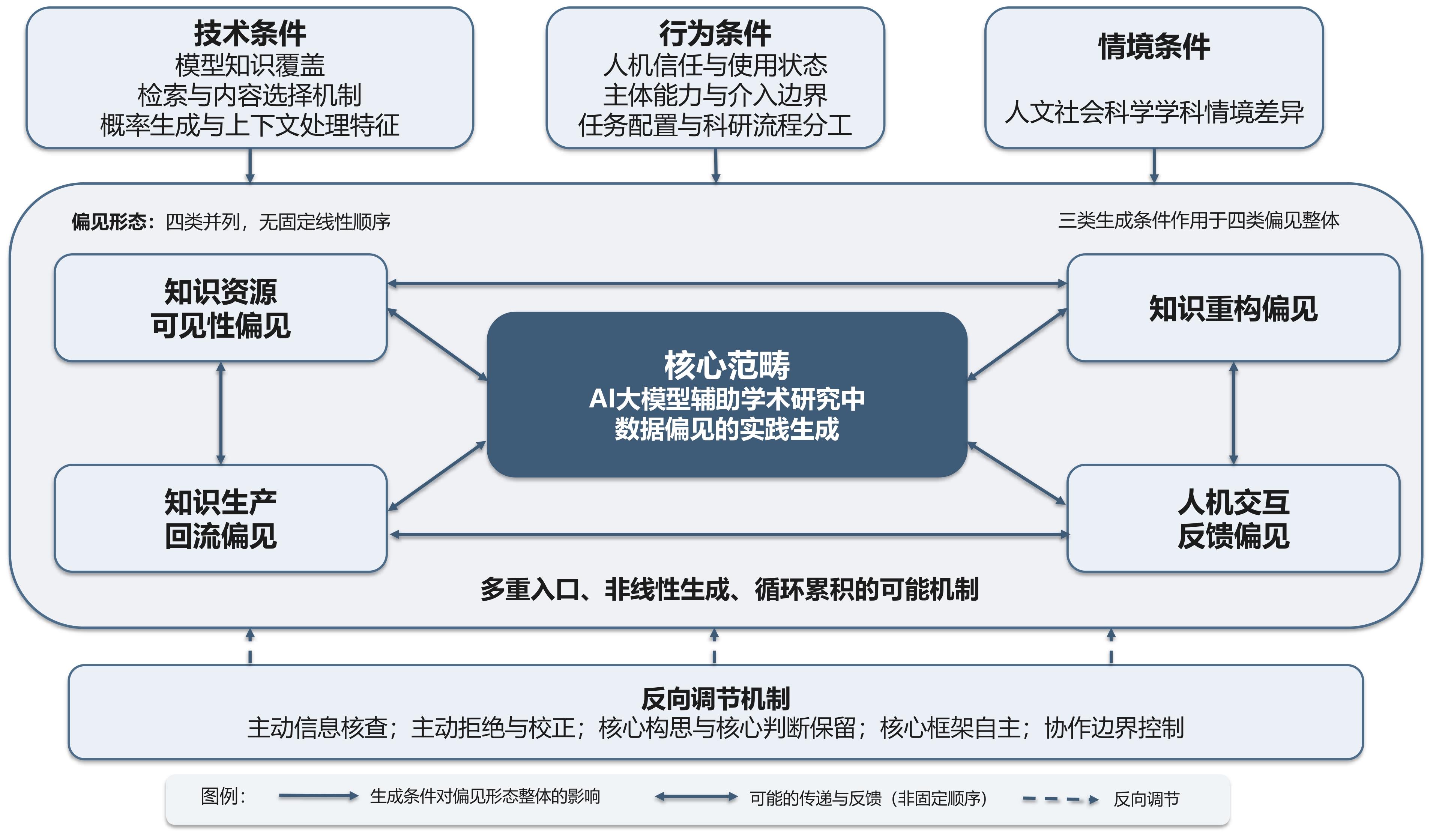
[目的/意义] 现有研究多从训练数据、模型算法和输出结果讨论数据偏见,较少关注大模型进入学术研究后,研究者的任务配置与持续交互如何参与偏见生成。本研究从知识生产过程中的动态数据观出发,界定AI大模型辅助学术研究中的数据偏见,并揭示其生成逻辑。 [方法/过程] 采用扎根理论,分两阶段收集56名人文社会科学领域AI辅助学术研究使用者及相关评价者的访谈资料,并以公开网络讨论材料作为补充比较。第一阶段形成初步概念与范畴,第二阶段围绕尚未充分展开的范畴关系进行理论抽样,并将新增资料与前期编码持续比较,最终形成86个初始概念、12个初始范畴及理论模型。 [结果/结论] 研究发现,AI大模型辅助学术研究中的数据偏见主要表现为知识资源可见性偏见、知识重构偏见、人机交互反馈偏见和知识生产回流偏见,受技术、行为与情境条件共同影响,呈现多重入口与非线性生成特征,并显示循环累积的可能机制。研究者既可能通过任务前置、信任累积和持续交互放大偏见,也可通过主动核查、保留核心判断和控制协作边界发挥反向调节作用。治理应覆盖知识资源供给、模型处理透明度、人机协作边界和学术共同体规范。

关键词: AI大模型, 学术研究, 数据偏见, 知识生产, 人机交互, 扎根理论

Abstract:

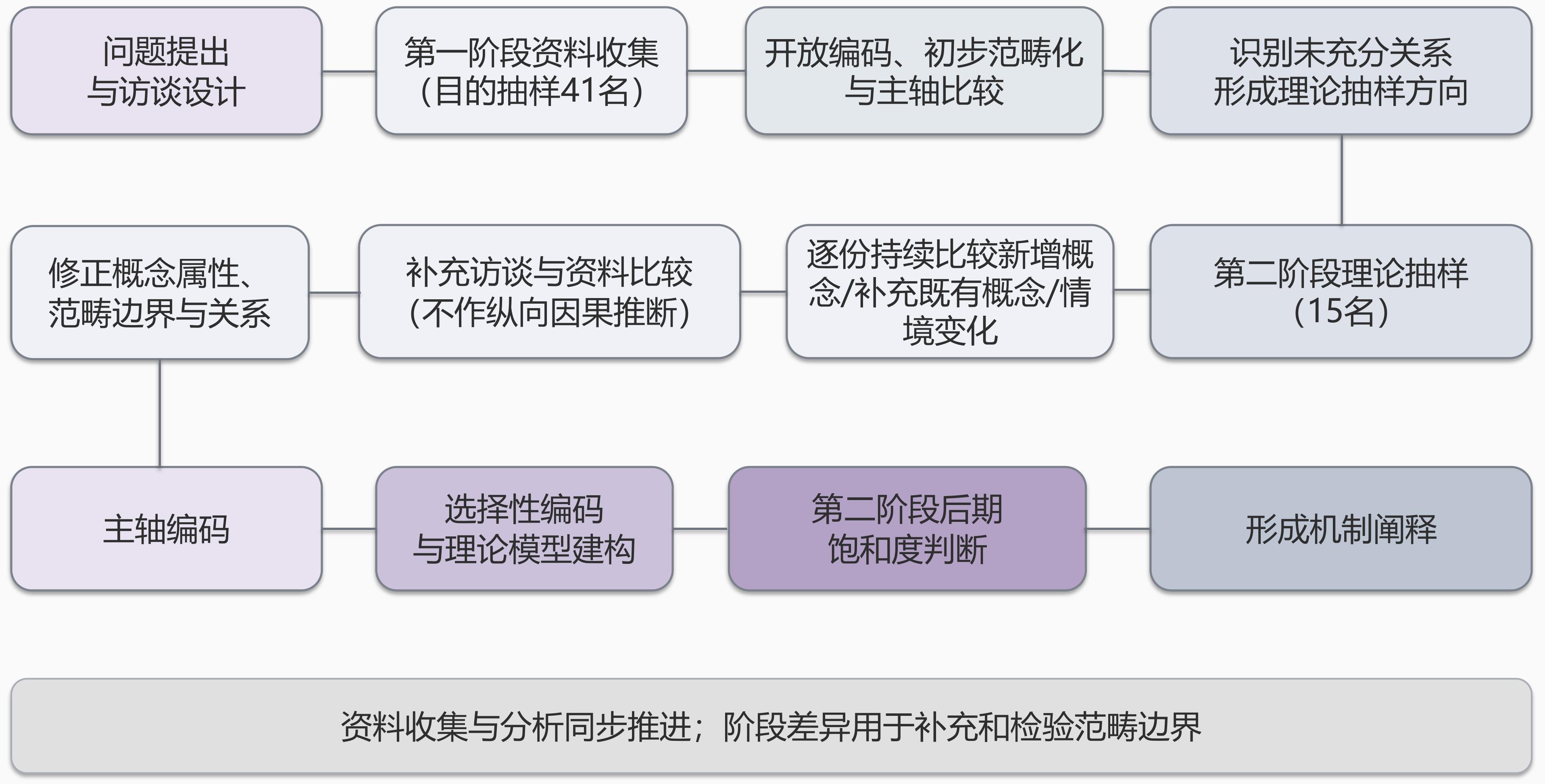
[Purpose/Significance] Existing studies of data bias have primarily examined training data, model algorithms, and output-level errors, with limited attention to how scholarly information is selected, reconstructed, confirmed, and reused after large language models (LLMs) are adopted in research. In LLM-assisted research, literature, search results, dialogue records, summaries, and generated texts are repeatedly processed and reintegrated into knowledge production. Bias may therefore arise not only before or within model generation, but also through human–LLM interaction across research tasks. To address this gap, this study adopts a dynamic view of data in knowledge production and extends the analysis of data bias from training data and model outputs to the socio-technical process of academic research. It examines the practical forms, generative conditions, and governance of data bias in the humanities and social sciences, while distinguishing observable bias forms from the technical, behavioral, and contextual conditions that shape them, and highlighting researchers as both potential amplifiers and active correctors. [Method/Process] Grounded theory was adopted to identify recurring patterns and category relations from actual research practice rather than test a predetermined causal model. Empirical materials were collected in two stages from 56 participants, including 8 undergraduates, 18 master's and doctoral students, 26 university teachers, and 4 journal editors. The first stage, conducted from December 2023 to December 2024, used purposive sampling and generated materials from 41 participants. Open coding and preliminary categorization identified initial concepts and relations requiring further elaboration. The second stage, conducted in July 2026, added 15 theoretically sampled participants and focused on underdeveloped relations involving human-LLM trust and use states, researcher capability and task configuration, AI-text detection, academic-community use norms, and disciplinary differences. Second-stage materials were compared item by item with the concepts, properties, and category relations formed in the first stage. Researcher practice records and public online discussions served as supplementary materials for constant comparison. Open, axial, and selective coding produced 86 initial concepts, 12 initial categories, and a theoretical model. Theoretical saturation was reached when later second-stage materials produced no new concepts, categories, or category relations. No fixed numerical frequency threshold was imposed. Relative stability or repeatability was identified through recurrent experiences within the same participant, convergent accounts across participants undertaking similar tasks, or recurrence across different data sources or research stages. Isolated anomalies, including one-off hallucinations, were retained as risk records unless repeated directional patterns emerged. [Results/Conclusions] Four parallel forms of data bias were identified. Knowledge-resource visibility bias concerns recurring differences in which literature, sources, or information become visible or remain omitted during retrieval and AI-assisted reading. Knowledge-reconstruction bias refers to relatively stable or repeatable shifts in information completeness, conceptual boundaries, argumentative strength, or modes of expression during summarization, explanation, translation, or rewriting. Human-LLM interaction feedback bias develops through sustained dialogue when model tendencies interact with researchers' questioning, trust, fatigue, and acceptance, thereby reinforcing particular viewpoints, problem frames, or judgment paths. Knowledge-production recirculation bias emerges when AI-mediated content, expression patterns, detection practices, and community norms are repeatedly incorporated into writing, evaluation, revision, imitation, circulation, and reuse. The four forms do not constitute a fixed sequence. They may enter at different points, interact with one another, and exhibit a possible mechanism of multiple entry points, non-linear formation, and cyclical accumulation. Technical, behavioral, and contextual conditions shape whether such tendencies are accepted, reinforced, corrected, or rejected. Researchers may amplify bias through early delegation of core tasks, accumulated trust, sustained interaction, and fatigue, while source verification, explicit correction, retention of core questions and judgments, and control of human-LLM collaboration boundaries can weaken or interrupt it. Governance should improve academic knowledge-resource provision and traceability, enhance transparency in model-based knowledge processing, strengthen researcher agency and collaboration boundaries, and develop revisable community norms for disclosure, detection, evaluation, and responsibility. The model remains exploratory: the sample is limited to the humanities and social sciences, much of the evidence is retrospective, and the two data-collection stages span a period of rapid LLM development. Future studies should combine longitudinal tracking, behavioral observation, experiments, and quantitative testing to examine boundary conditions and change over time.

Key words: large language models, academic research, data bias, knowledge production, human - LLM interaction, grounded theory

中图分类号:  G203

引用本文

孙妍, 张闪闪. AI大模型辅助学术研究中数据偏见的形成逻辑、实践图景与治理策略——基于人文社会科学领域的扎根理论研究[J/OL]. 农业图书情报学报. https://doi.org/10.13998/j.cnki.issn1002-1248.26-0371.

SUN Yan, ZHANG Shanshan. Formation Logic, Practical Manifestations, and Governance Strategies of Data Bias in Large Language Model-Assisted Academic Research: A Grounded Theory Study in the Humanities and Social Sciences[J/OL]. Journal of library and information science in agriculture. https://doi.org/10.13998/j.cnki.issn1002-1248.26-0371.