中文    English

Journal of library and information science in agriculture


Construction of a Scientific Data Sharing Policy Analysis Framework from the Perspective of Data Factorisation

ZHENG Haotian1, FAN Xiaofeng2   

  1. 1. Institute of Subtropical Crops, Chinese Academy of Tropical Agricultural Sciences, Zhanjiang 524091
    2. International Business School, Hainan University, Haikou 570228
  • Received:2025-11-05 Online:2026-03-11

Abstract:

[Purpose/Significance] Against the backdrop of data becoming a key factor of production, the sharing and utilization of scientific data face significant challenges, including "market failure" and a fragmented policy landscape. Existing academic efforts often analyze policies from an isolated perspective. These efforts lack a holistic framework to understand how policies interact with multiple stakeholders to create value from data. This study aims to address this gap by constructing an integrated analytical framework for scientific data sharing policies. Its primary significance lies in providing a systematic tool to deconstruct policy architecture, dynamically reveal the internal transmission mechanism from policy intervention to value realization, and offer evidence-based insights for optimizing top-level design. This contributes to building a more efficient data governance ecosystem, ultimately enhancing the allocation efficiency of scientific resources and national innovation capacity. [Methods/Process] The research employs a mixed-method approach combining theoretical construction and empirical text analysis. Firstly, through a synthesis of literature on policy instruments, stakeholder theory, and data factorisation, a three-dimensional analytical framework encompassing "Policy Instruments, Stakeholders, and Factorisation Stages" was constructed. To animate this static structure, the Stimulus-Organism-Response (SOR) model was introduced as an overarching theoretical lens, formulating a "policy stimulus (S) → stakeholder perception/organism (O) → factorisation response (R)" dynamic mechanism. Secondly, to empirically apply and validate the framework, representative policy documents, including the national "Measures for the Management of Scientific Data" and selected local implementation rules, were chosen as cases. Using qualitative data analysis software NVivo 12, 174 relevant policy clauses were extracted. A rigorous coding process based on the three-dimensional framework was conducted independently by two researchers to ensure reliability. The inter-coder consistency was measured with Cohen's Kappa coefficient, yielding a result of 0.82, which indicates almost perfect agreement. Discrepancies were resolved through discussion and expert consultation. Finally, statistical analysis was performed on the coded data to quantify the distribution of policy attention and identify characteristic patterns. [Results/Conclusions] The study yields three sets of core findings. First, it conceptualizes the factorisation of scientific data as a three-stage transition: "Digitization" (transforming raw information into structured data), "Valorization" (enhancing data into valuable assets through processing), and "Sharization" (releasing multiplied value through circulation and reuse). Second, the quantitative analysis reveals a distinct imbalance in current policy attention allocation. Regarding policy instruments, emphasis is heavily skewed towards "Planning & Organization" (35.63%) and "Sharing & Reuse" (21.84%), while the crucial intermediate stage of "Storage & Publication" is under-supported (10.34%). Concerning stakeholders, "Sharers" (e.g., researchers) are the central focus (43.10%), whereas "Intermediators" (e.g., data centers) are relatively marginalized (23.56%). In terms of factorisation goals, policies overwhelmingly prioritize the final "Sharization" stage (71.84%), overlooking the foundational "Digitization" and "Valorization" stages. Third, the research identifies several synergistic and effective policy pathways, such as "Mandatory Submission + Standard Constraints" and "Data Processing + Talent Incentives". Based on these conclusions, the study proposes that future policy optimization should focus on rebalancing attention towards intermediate processes and intermediary actors, strengthening whole-lifecycle governance, and enhancing the synergy of policy tools. Exploring innovative governance models like data trusts is also recommended to foster a sustainable data-sharing ecosystem. A main limitation of this study is its reliance on textual analysis; future research could employ surveys or interviews to empirically validate the SOR mechanism by measuring stakeholders' actual perceptions and behavioral responses, and test the framework's applicability in other specific data domains.

Key words: data factorisation, scientific data sharing, policy analysis framework, SOR theory

CLC Number: 

  • G311

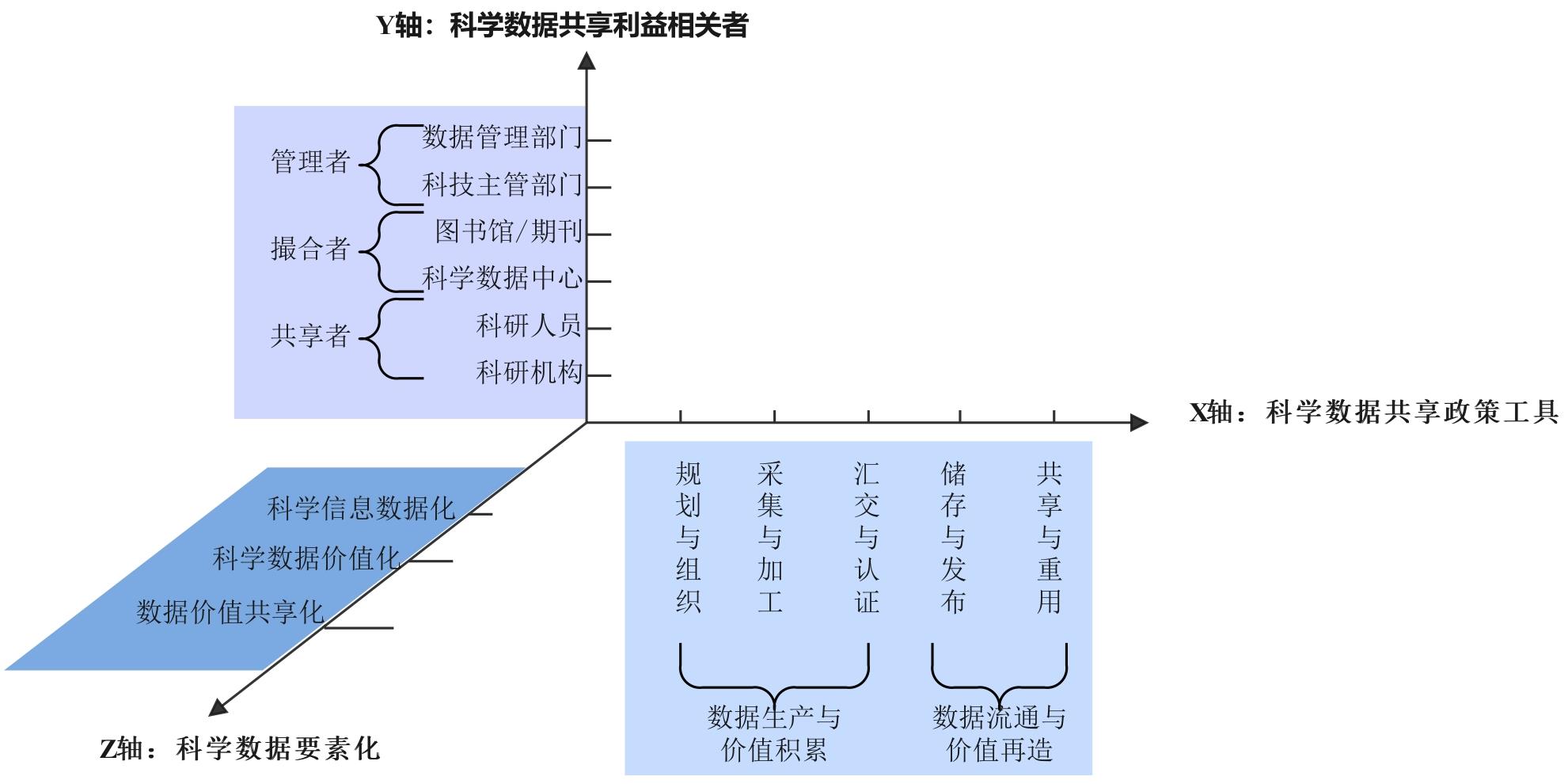
Fig.1

The three-dimensional analytical framework for scientific data sharing policies"

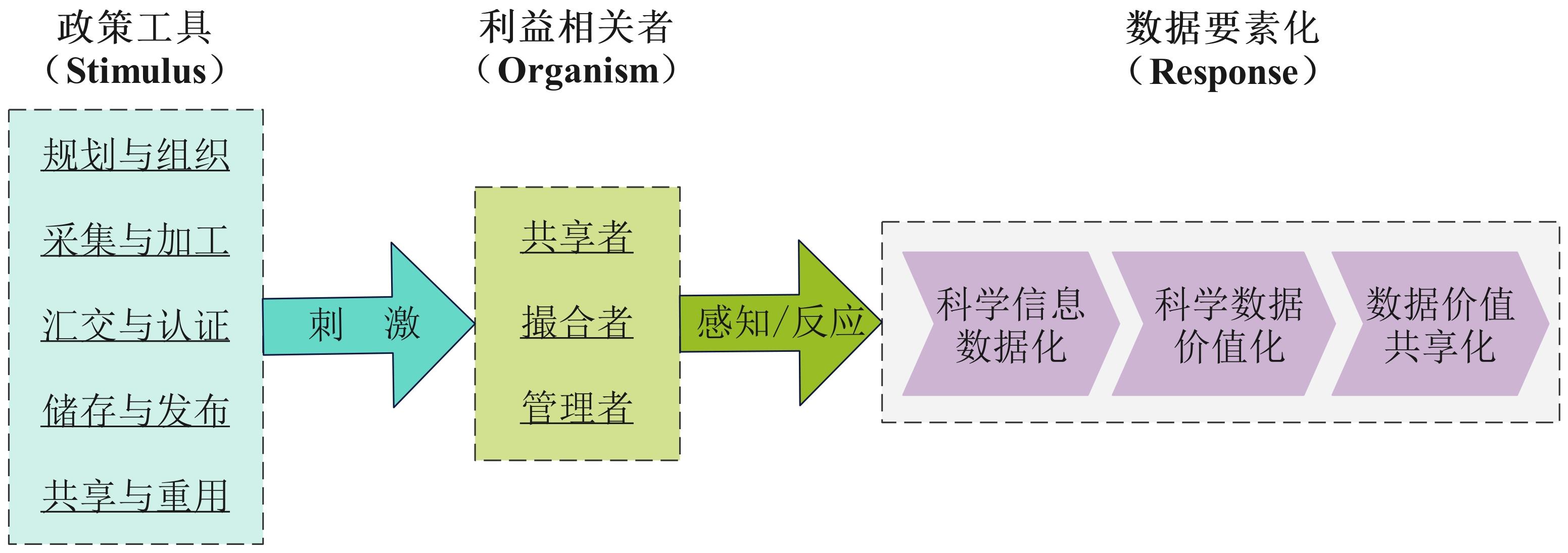
Fig.2

The SOR-driven mechanism for scientific data factorisation via sharing policies"

Table 1

Representative cases of scientific data sharing policies"

政策名称 效力位阶 制定机关 代表性
科学数据管理办法 行政法规 国务院 作为国务院制定的行政法规,是全国科学数据管理的基础性、全局性制度框架,确立了数据汇交、共享与安全的顶层规则
科技基础性工作专项项目科学数据汇交管理办法(试行) 部门规章 科学技术部 科技部针对专项科研项目制定的部门规章,聚焦特定领域数据汇交的流程规范与验收标准,是《科学数据管理办法》在项目层面的细化执行文件
江苏省科学数据管理实施细则 地方政府规章 江苏省政府 江苏省政府依据国家法规制定的地方规章,结合本省科研与产业需求,明确了科学数据管理的地域性实施路径和监督机制
中国科学院科学数据管理与开放共享办法(试行) 机构内部规定 中国科学院 中国科学院作为国家战略科技力量制定的内部规范,体现了科研机构在数据管理中的自主性,强化院内数据管理与开放共享要求

Table 2

Examples of scientific data sharing policy text coding"

维度 文本 编号
政策工具 利益相关者 要素化
采集与加工 共享者 科学信息数据化 法人单位及科学数据生产者要按照相关标准规范组织开展科学数据采集生产和加工整理,形成便于使用的数据库或数据集 2-1-1-(3)
汇交与认证 管理者 数据价值共享化 主管部门应建立科学数据汇交制度,在国家统一政务网络和数据共享交换平台的基础上开展本部门(本地区)的科学数据汇交工作 3-3-3-(1)
规划与组织 撮合者 数据价值共享化 科学数据中心……加强国内外科学数据方面交流与合作 1-2-3-(1)

Table 3

Statistical analysis of policy dimension distribution"

维度 类别 频数 占比/%
政策工具 规划与组织 62 35.63
采集与加工 22 12.64
汇交与认证 34 19.54
储存与发布 18 10.34
共享与重用 38 21.84
合计 174 100.00
利益相关者 共享者 75 43.10
撮合者 41 23.56
管理者 58 33.33
合计 174 100.00
要素化 科学信息数据化 19 10.92
科学数据价值化 30 17.24
数据价值共享化 125 71.84
合计 174 100.00
[1]
刘越男, 代林序, 周文泓, 等. 数据要素化的现实问题与推进策略——基于数据驱动型企业的角度[J]. 中国人民大学学报, 2025, 39(3): 87-101.
Liu Yuenan, Dai Linxu, Zhou Wenhong, et al. Practical issues and strategies of advancement for data factorization: A data-driven enterprise perspective[J]. Journal of Renmin University of China, 2025, 39(3): 87-101.
[2]
杨艳, 王理, 廖祖君. 数据要素: 倍增效应与人均产出影响——基于数据要素流动环境的视角[J]. 经济问题探索, 2021(12): 118-135.
Yang Yan, Wang Li, Liao Zujun. Data elements: Multiplier effect and per capital output - From the perspective of data elements flow environment[J]. Inquiry Into Economic Issues, 2021(12): 118-135.
[3]
国务院办公厅. 关于印发科学数据管理办法的通知[EB/OL]. (2018-03-17)[2025-11-05].
[4]
申其辉. 数据要素化视角下新时期国家科学数据汇交回顾与建议[J]. 农业大数据学报, 2024, 6(3): 363-372.
Shen Qihui. Review and suggestion of national scientific data collection in the New Era from the perspective of data factionalization[J]. Journal of Agricultural Big Data, 2024, 6(3): 363-372.
[5]
刘开强, 李梦柯, 李东, 等. 我国科学数据开放共享生态系统建设实践及其优化对策[J]. 科技管理研究, 2023, 43(16): 125-131.
Liu Kaiqiang, Li Mengke, Li Dong, et al. Practice and optimization countermeasures of scientific data open and sharing ecosystem construction in China[J]. Science and Technology Management Research, 2023, 43(16): 125-131.
[6]
国家数据局. “数据要素×”三年行动计划(2024-2026年)[EB/OL]. (2023-12-31)[2025-11-05].
[7]
迟玉琢, 张冰. 中国开放科学数据政策扩散影响因素与组态研究[J]. 农业图书情报学报, 2025, 37(9): 49-62.
Chi Yuzhuo, Zhang Bing. Determinants and configurations of open scientific data policy diffusion in China[J]. Journal of Library and Information Science in Agriculture, 2025, 37(9): 49-62.
[8]
丁晓芹, 汤怡洁, 徐雯. 我国科学数据汇交管理现状及面临的问题[J]. 科技管理研究, 2023, 43(23): 63-69.
Ding Xiaoqin, Tang Yijie, Xu Wen. The current situation and problems of scientific data collection management in China[J]. Science and Technology Management Research, 2023, 43(23): 63-69.
[9]
郑昊天, 樊孝凤. 供求视域下农业科技成果转化模式探究——以海南为例[J]. 南海学刊, 2025, 11(1): 31-42.
Zheng Haotian, Fan Xiaofeng. Exploration of agricultural technology transformation modes from the perspective of supply and demand: A case study of Hainan[J]. The Journal of South China Sea Studies, 2025, 11(1): 31-42.
[10]
郑坚铭, 张丽娜. 数字规制政策、知识产权保护与技术创新扩散[J]. 科技进步与对策, 2025, 42(4): 100-109.
Zheng Jianming, Zhang Lina. Digital regulation policies, intellectual property protection and technological innovation diffusion[J]. Science & Technology Progress and Policy, 2025, 42(4): 100-109.
[11]
孙俊娜, 胡文涛, 汪三贵. 数字技术赋能农民增收: 作用机理、理论阐释与推进方略[J]. 改革, 2023(6): 73-82.
Sun Junna, Hu Wentao, Wang Sangui. Digital technology empower increasing farmers' income: Mechanism, theoretical explanation and promotion strategies[J]. Reform, 2023(6): 73-82.
[12]
Levitin A V, Redman T C. A model of the data (life) cycles with application to quality[J]. Information and Software Technology, 1993, 35(4): 217-223.
[13]
Tao Fei, Qi Qinglin, Liu Ang, et al. Data-driven smart manufacturing[J]. Journal of Manufacturing Systems, 2018, 48: 157-169.
[14]
Goben A, Raszewski R. The data life cycle applied to our own data[J]. Journal of the Medical Library Association: JMLA, 2015, 103(1): 40-44.
[15]
Rüegg J, Gries C, Bond-Lamberty B, et al. Completing the data life cycle: Using information management in macrosystems ecology research[J]. Frontiers in Ecology and the Environment, 2014, 12(1): 24-30.
[16]
Shah S I H, Peristeras V, Magnisalis I. DaLiF: A data lifecycle framework for data-driven governments[J]. Journal of Big Data, 2021, 8(1): 89.
[17]
甄美荣, 刘蕊. 数字赋能制造企业技术创新的实现机制——基于数据生命周期理论的研究[J]. 技术经济, 2024, 43(3): 64-76.
Zhen Meirong, Liu Rui. A study on the digital empowerment mechanism to technological innovation of manufacturing enterprises: Based on the data life cycle theory[J]. Journal of Technology Economics, 2024, 43(3): 64-76.
[18]
翟运开, 刘冰琳, 王宇, 等. 数据生命周期视角下医疗健康大数据资产化影响因素研究[J]. 情报杂志, 2024, 43(1): 183-190.
Zhai Yunkai, Liu Binglin, Wang Yu, et al. Research on the influencing factors of medical and health big data assetization from the perspective of data life cycle[J]. Journal of Intelligence, 2024, 43(1): 183-190.
[19]
夏义堃, 管茜. 科学研究的数据生态及其模式演进研究[J]. 科学学研究, 2024, 42(4): 673-682.
Xia Yikun, Guan Qian. Research on the data ecology and pattern evolution of scientific research[J]. Studies in Science of Science, 2024, 42(4): 673-682.
[20]
储节旺, 夏莉. 嵌入生命周期理论的科学数据管理体系构建研究——牛津大学为例[J]. 现代情报, 2020, 40(10): 34-42.
Chu Jiewang, Xia Li. Research on scientific data management construction based on life cycle theory[J]. Modern Information, 2020, 40(10): 34-42.
[21]
Spiekermann M. Data marketplaces: Trends and monetisation of data goods[J]. Intereconomics, 2019, 54(4): 208-216.
[22]
Koutroumpis P, Leiponen A, Thomas L D W. Markets for data[J]. Industrial and Corporate Change, 2020, 29(3): 645-660.
[23]
马洪超, 张浩楠. 基于利益相关者视角的数据要素市场培育对策[J]. 理论探讨, 2024(2): 149-155.
Ma Hongchao, Zhang Haonan. Cultivation countermeasures of data factor market based on stakeholder perspective[J]. Theoretical Investigation, 2024(2): 149-155.
[24]
陶卓, 黄卫东, 闻超群. 基于利益相关者视角的数据要素市场培育政策分析框架研究[J]. 电子政务, 2024(11): 27-40.
Tao Zhuo, Huang Weidong, Wen Chaoqun. Research on policy analysis framework of data factor market cultivation based on stakeholder perspective[J]. E-Government, 2024(11): 27-40.
[25]
陈媛媛, 王苑颖. 科研数据开放共享的利益相关者互动关系[J]. 图书馆论坛, 2020, 40(5): 55-63.
Chen Yuanyuan, Wang Yuanying. Research on stakeholder interaction in the open sharing of scientific research data[J]. Library Tribune, 2020, 40(5): 55-63.
[26]
李宜展, 刘细文, 李泽霞, 等. 科学数据安全边界概念模型研究——基于利益相关者视角[J]. 中国科学基金, 2022, 36(2): 339-347.
Li Yizhan, Liu Xiwen, Li Zexia, et al. Study on conceptual analysis model of scientific data security boundary: From the perspective of stakeholders[J]. Bulletin of National Natural Science Foundation of China, 2022, 36(2): 339-347.
[27]
McDonnell L M, Elmore R F. Getting the job done: Alternative policy instruments[J]. Educational Evaluation and Policy Analysis, 1987, 9(2): 133-152.
[28]
Schneider A, Ingram H. Behavioral assumptions of policy tools[J]. The Journal of Politics, 1990, 52(2): 510-529.
[29]
王流芳, 荣注瑶, 贾晓峰, 等. 基于三维框架的我国科学数据政策文本内容分析[J]. 知识管理论坛, 2024, 9(2): 177-194.
Wang Liufang, Rong Zhuyao, Jia Xiaofeng, et al. The text content analysis of Chinese scientific data policy based on three-dimensional framework[J]. Knowledge Management Forum, 2024, 9(2): 177-194.
[30]
洪永淼, 林滔, 史九领. 数据要素的基本属性、价值形成与市场构建[J]. 中国经济问题, 2025(3): 1-16.
Hong Yongmiao, Lin Tao, Shi Jiuling. Basic attributes, value formation, and market construction of data factors[J]. China Economic Studies, 2025(3): 1-16.
[31]
梅宏. 数据如何要素化: 资源化、资产化、资本化[J]. 施工企业管理, 2022(12): 42.
Mei Hong. How to factor data: Resource, asset and capitalization[J]. Construction Enterprise Management, 2022(12): 42.
[32]
Gargano M L, Raggad B G. Data mining - a powerful information creating tool[J]. OCLC Systems & Services: International Digital Library Perspectives, 1999, 15(2): 81-90.
[33]
Mayer-Schönberger V, Ramge T. Reinventing Capitalism in the Age of Big Data[M]. London: John Murray, 2018: 141-142.
[34]
孙静, 张通, 王建冬. 文化遗产数据要素化的五阶段理论模型探索[J]. 信息资源管理学报, 2025, 15(3): 37-48.
Sun Jing, Zhang Tong, Wang Jiandong. Exploration of the five-stage theoretical model of data elementization of cultural heritage[J]. Journal of Information Resources Management, 2025, 15(3): 37-48.
[35]
杜宝贵, 丰佰恒. 科学数据要素交易助力新质生产力实现: 机理、困境与破局[J]. 现代情报, 2024, 44(12): 15-22, 136.
Du Baogui, Feng Baiheng. Scientific data element trading accelerates the realization of new quality productive force: Mechanisms, dilemmas and solutions[J]. Modern Information, 2024, 44(12): 15-22, 136.
[36]
汪洋, 郑晓欢, 班艳, 等. 深化落实数据要素政策,建立健全科学数据生态圈[J]. 中国科学数据, 2023, 8(1): 134-145.
Wang Yang, Zheng Xiaohuan, Ban Yan, et al. Establishing a sound scientific data ecosystem through the implementation of a data element policy[J]. China Scientific Data, 2023, 8(1): 134-145.
[37]
邢文明, 洪程. 开放为常态, 不开放为例外——解读《科学数据管理办法》中的科学数据共享与利用[J]. 图书馆论坛, 2019, 39(1): 117-124.
Xing Wenming, Hong Cheng. Opening is normal - Interpretation of items about scientific data sharing and utilization in the scientific data management rules[J]. Library Tribune, 2019, 39(1): 117-124.
[38]
陆丽娜, 尹居峰, 于啸, 等. 基于联盟链的农业科学数据共享模型构建研究[J]. 图书情报工作, 2022, 66(17): 60-68.
Lu Lina, Yin Jufeng, Yu Xiao, et al. Research on the construction of agricultural science data sharing model based on consortium blockchain[J]. Library and Information Service, 2022, 66(17): 60-68.
[39]
张新凤. 区块链视域下医学图书馆科学数据共享机制研究[J]. 图书馆工作与研究, 2022(9): 13-18, 28.
Zhang Xinfeng. Study on medical science data sharing mechanism of medical libraries in the blockchain perspective[J]. Library Work and Study, 2022(9): 13-18, 28.
[40]
王海辉, 邢文明, 伍丹. 我国地球科学数据共享平台信息构建调研[J]. 图书馆学研究, 2024(4): 87-99.
Wang Haihui, Xing Wenming, Wu Dan. Research on information architecture of earth science data sharing platform in China[J]. Research on Library Science, 2024(4): 87-99.
[41]
党洪莉. 社会科学数据的开放与共享: 发展现状、障碍与出路[J]. 图书馆理论与实践, 2018(5): 70-74.
Dang Hongli. The opening and sharing of social science data: Current situation, obstacles and solutions[J]. Library Theory and Practice, 2018(5): 70-74.
[42]
Mehrabian A, Russell J A. An Approach to Environmental Psychology[M]. Cambridge, Mass.: M.I.T. Press, 1974: 132-135.
[43]
丁煌, 张绍飞. SOR理论视角下地方政府应急预防协同失灵的生成解释——基于X区“城镇燃气整治专项行动”的案例研究[J]. 理论与改革, 2022(6): 106-118, 160.
Ding Huang, Zhang Shaofei. Interpretation of failed collaboration in local government emergency prevention from the perspective of SOR theory: A case study of the "urban gas regulation special action" in district X[J]. Theory and Reform, 2022(6): 106-118, 160.
[44]
程克群, 吴雨晨. 新质生产力驱动乡村旅游产业因地制宜发展的理论逻辑与实现路径[J]. 东北农业大学学报(社会科学版), 2024, 22(6): 46-56.
Cheng Kequn, Wu Yuchen. Research on the logic and realization path of new quality productivity forces driving the development of rural tourism industry according to local conditions[J]. Journal of Northeast Agricultural University (Social Science Edition), 2024, 22(6): 46-56.
[45]
徐君, 朱微笑, 陈圣武. 基于“刺激-机体-反应(SOR)”模型的新质生产力响应机制及提升路径研究[J]. 科技管理研究, 2024, 44(6): 1-10.
Xu Jun, Zhu Weixiao, Chen Shengwu. Response mechanism, enhancement path of new quality productive forces based on stimuli-organism-response(SOR) model[J]. Science and Technology Management Research, 2024, 44(6): 1-10.
[1] HAN Hongjun. Development of Scientific Data Sharing in Europe and Its Enlightenment [J]. Journal of library and information science in agriculture, 2018, 30(4): 118-121.
Viewed
Full text


Abstract

Cited

  Shared   
  Discussed   
No Suggested Reading articles found!