中文    English

Journal of library and information science in agriculture


Design and Transformation Pathways of Library Systems Driven by Generative Agents

GUO Limin1, LIU Yueru2, FU Yaming3   

  1. 1. Shanghai Library / Institute of Scientific and Technical Information of Shanghai, Shanghai 200031
    2. Tongji University Library, Shanghai 200092
    3. School of Cultural Heritage and Information Management Shanghai University, Shanghai 200444
  • Received:2025-10-20 Online:2025-12-02

Abstract:

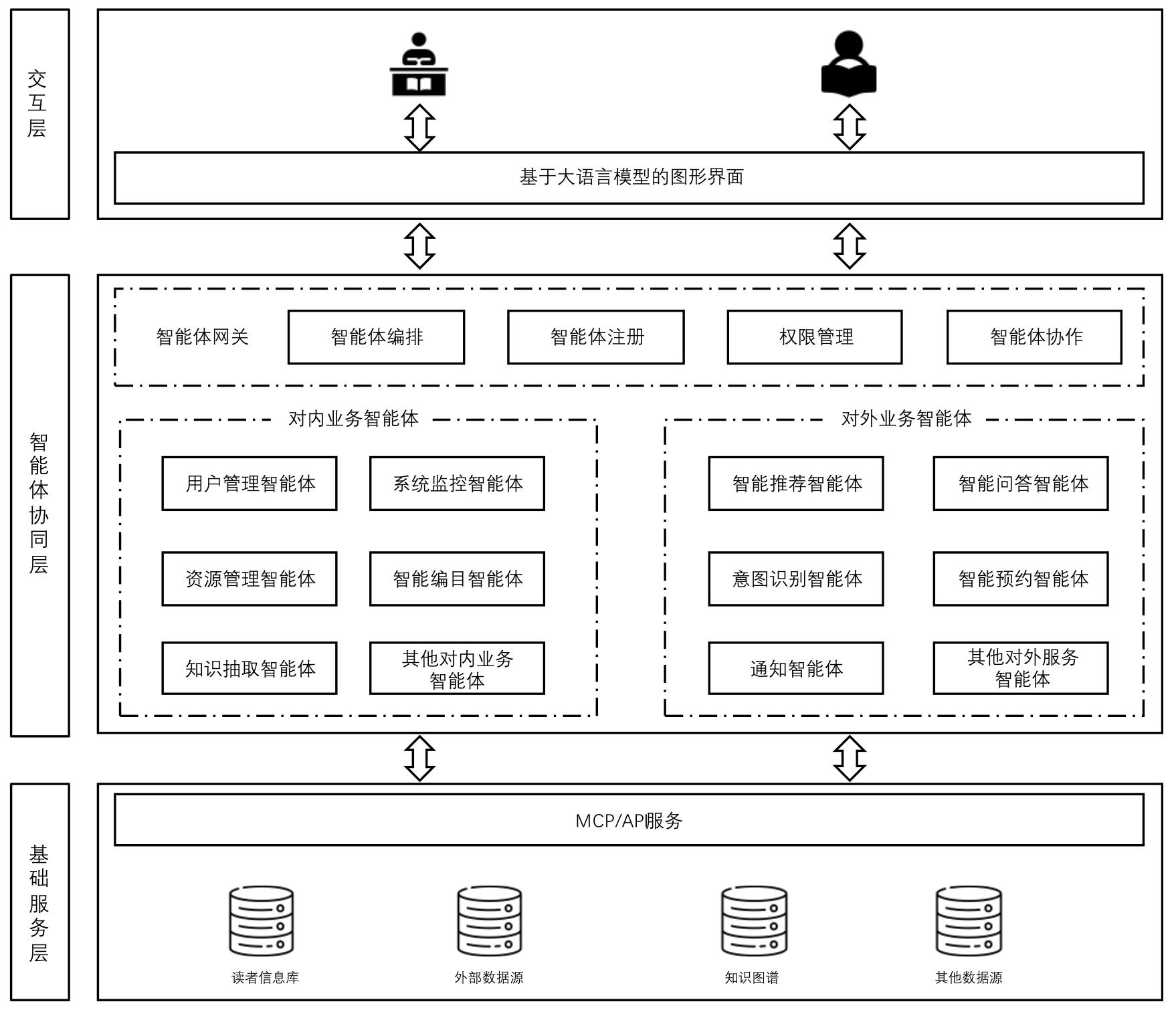
[Purpose/Significance] This paper examines the ongoing transformation of library information systems, shifting from platform-oriented architectures to agent-based ones, in the context of generative artificial intelligence. It argues that, although Integrated Library Systems (ILS) and Library Services Platforms (LSP) have improved workflow automation and resource management, they remain constrained by poor semantic understanding, restricted cross-system orchestration, and insufficient support for proactive, personalized services. Building on these observations, the paper proposes a transformation path in which existing ILS/LSP infrastructures are not discarded, but rather re-positioned as providers of capabilities within a broader ecosystem of generative intelligent agents. This provides libraries facing both legacy constraints and pressures for service innovation with a feasible evolution strategy. [Method/Process] The study first reviews service-level limitations of ILS and LSP through the lenses of interaction patterns, data openness, and intelligent service support, and distills typical pain points encountered in cataloging, circulation, reference services, and subject liaison work. On this basis, it constructs a graded capability model for generative intelligent agents that encompasses semantic perception, context modeling, goal-driven behavior, preference adaptation, and reflective evolution. It also discusses how different types of agents can be aligned with specific library roles and task granularities. The study then proposes a three-layer architecture consisting of a basic service layer, an agent coordination layer, and a semantic interaction layer. The bottom layer exposes atomic capabilities such as search, metadata editing, authentication, and logging; the middle layer orchestrates multiple agents via lightweight protocols and shared task states; and the top layer supports natural-language-driven interaction while maintaining semantic consistency and traceable reasoning paths. Finally, leveraging a "Library Assistant" prototype that integrates these components, the study designs and conducts experimental evaluations in bibliographic follow-up and recommendation scenarios, combining task-based user tests with qualitative feedback from librarians and domain experts. [Results/Conclusions] Experimental results indicate that the proposed architecture outperforms traditional models in terms of answer relevance, interaction fluency, and perceived service intelligence, particularly in multi-step information-seeking and follow-up recommendation tasks. At the same time, the study found that the mechanisms for long-term memory, cross-session user modeling, and explicit feedback loops were underdeveloped. This can lead to inconsistencies in sustained interactions and complex task chains. The paper concludes with a discussion of the design implications for the evolution of library systems, suggesting that future work should focus on trustworthy memory management, transparent agent coordination, and robust evaluation metrics. It also recommends the development of governance frameworks that jointly consider system performance, user experience, professional ethics, and institutional policy requirements together. In this way, the study provides both a conceptual blueprint and empirical evidence to guide the transition from platform-oriented systems to agent-based, generative AI-enabled library architectures.

Key words: generative AI, library information systems, AI agents, MCP, A2A

CLC Number: 

  • G250

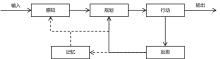
Fig.1

Architecture of a generative intelligent agent"

Table 1

Comparison between library systems and generative AI agent systems"

维度 当前图书馆系统 生成式智能体系统
核心架构 功能模块化(OPAC、编目、流通等) 智能体协同(感知-记忆-规划-生成)
输入方式 结构化输入(字段+关键字) 自然语言对话(自由表达)
响应机制 规则触发→功能调用→静态响应 语义理解→意图构建→动态生成
用户参与方式 用户适应系统逻辑 系统适应用户意图
服务模式 被动检索/查询 主动引导/推荐
可扩展性 模块间低耦合 智能体高度协同、任务动态重组

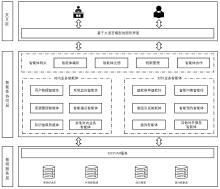
Fig.2

Agent-based library system architecture"

Table 2

Comparison of design features between traditional interfaces and large language model-based interfaces for library services"

维度 传统界面设计 基于大语言模型的界面设计
交互模式 用户执行操作(按钮、表单等) 一种资源描述内容标准
信息流动方向 用户操作→系统反应(单向) 用户↔模型(双向协商,语言驱动)
输入方式 结构化控件(点击、输入框) 自然语言输入(语音/文字),允许模糊表达
响应方式 固定反馈(确认框、结果页) 语义反馈 + 推理路径 + 模型引用/链式调用
功能发现性 依赖导航、菜单、教程等指引 模型引导式提示(“你可以问我…”)主动呈现能力
多轮对话支持 一问一答(状态不保留) 上下文保持,支持追问与任务链状态跟踪
可定制性 依赖前端逻辑开发 大语言模型动态构建任务流程,支持低代码实现
错误处理机制 显式报错提示,用户需手动更正 模型自动尝试澄清、再提问或语义修正

Table 3

Mapping and experimental validation of agent capabilities for library service tasks"

层级能力 用户典型问题 系统行为与表现能力 实验结果摘要
语义感知

“这本书有几页?”

“这本书适合多大的孩子?”

识别“这本书”为当前焦点图书,使用元数据,返回准确页数与适龄范围 系统快速响应问题,语言自然,准确返回193页与“0~12岁”适龄描述
上下文建模 “这本书适合多大的孩子?”→“那3岁能看吗?” 识别语义递进关系与指代一致性,保持上下文语境连贯,生成具体化回答 成功识别“3岁”语义追问指向前问,结合章节内容进行年龄适配分析
目标驱动型 “我想用这本书做亲子阅读活动” 解析用户复杂目标意图,规划任务路径,生成完整的活动流程设计建议(导读+创作+分享等) 自动构建5步活动流程,涵盖家长引导、亲子创作、空间布置与语言激励,建议内容连贯具体
偏好适配型

“3岁孩子能理解吗?”

“有没有更适合小孩子的?”

“提升孩子自信”

结合年龄特征与表达目标,推荐适龄图书(如《我可以很勇敢》),并附使用方式与心理发展说明 推荐内容与年龄段匹配,提供具体书目、阅读方式与亲子活动建议,体现出内容适配能力
[1]
刘炜, 张磊, 嵇婷, 等. 以AI塑形智慧图书馆:基于智能体的下一代图书馆服务平台[J]. 农业图书情报学报, 2025, 37(5): 15-26.
LIU W, ZHANG L, JI T, et al. Shaping the smart libraries with AI: An agent-based, next-generation library service platform[J]. Journal of library and information science in agriculture, 2025, 37(5): 15-26.
[2]
WANKHEDE K A. Smart libraries and AI technologies[J]. International journal of research in library science, 2025, 11(2): 20-27.
[3]
刘柏嵩, 杨春艳, 殷文婷, 等. 智能技术驱动下的图书馆服务现代化: 转型与创新[J]. 大学图书馆学报, 2024, 42(4): 13-19.
LIU B S, YANG C Y, YIN W T, et al. Advancing library services through intelligent technology: Innovations and transformations[J]. Journal of academic libraries, 2024, 42(4): 13-19.
[4]
COX A M, PINFIELD S, RUTTER S. The intelligent library: Thought leaders' views on the likely impact of artificial intelligence on academic libraries[J]. Library hi tech, 2019, 37(3): 418-435.
[5]
PUTNOKI A M, OROSZ T. Artificial intelligence and cognitive information systems: Revolutionizing business with generative artificial intelligence and robotic process automation[C]//Proceedings of International Conference on Recent Innovations in Computing. Singapore: Springer, 2024: 39-70.
[6]
刘炜. 大模型与智能体[J]. 图书情报知识, 2025, 42(2): 1.
LIU W. Large model and agent[J]. Documentation, information & knowledge, 2025, 42(2): 1.
[7]
PARK J S, O’BRIEN J, CAI C J, et al. Generative agents: Interactive simulacra of human behavior[C]//Proceedings of the 36th Annual ACM Symposium on User Interface Software and Technology. 29 October 2023, San Francisco, CA, USA. ACM, 2023: 1-22.
[8]
KRISHNAN N. AI agents: Evolution, architecture, and real-world applications[J/OL]. arXiv: 2503.12687, 2025.
[9]
SINGH A, EHTESHAM A, KUMAR S, et al. Agentic retrieval-augmented generation: A survey on agentic RAG[J/OL]. arXiv: 2501.09136, 2025.
[10]
BREEDING M. Library systems report: Operationalizing innovation[J/OL]. American libraries magazine, 2015.
[11]
SADEH T, ELLINGSEN M. Electronic resource management systems: The need and the realization[J]. New library world, 2005, 106(5/6): 208-218.
[12]
BREEDING M. The future of library resource discovery[R/OL]. Bethesda: National Information Standards Organization (NISO), 2015: 3-4.
[13]
郭利敏, 张磊. FOLIO的技术选型与运营模式研究[J]. 中国图书馆学报, 2020, 46(1): 92-98.
GUO L M, ZHANG L. Research on technical selection and operation mode of FOLIO[J]. Journal of library science in China, 2020, 46(1): 92-98.
[14]
BREEDING M. Library services platforms: A maturing genre of products[R/OL]. Chicago: American Library Association, 2015.
[15]
CHAD K. Rethinking the library services platform[EB/OL]. [2025-09-26].
[16]
RUSSELL S J, NORVIG P, CHANG M W. Artificial Intelligence: A Modern Approach[M]. Hoboken: Pearson, 2021.
[17]
LIU N F, LIN K, HEWITT J, et al. Lost in the middle: How language models use long contexts[J/OL]. arXiv: 2307.03172, 2023.
[18]
WEI J, WANG X Z, SCHUURMANS D, et al. Chain-of-thought prompting elicits reasoning in large language models[C]//Proceedings of the 36th International Conference on Neural Information Processing Systems. New Orleans, LA, USA: ACM, 2022: 24824-24837.
[19]
YAO S Y, ZHAO J, YU D, et al. ReAct: Synergizing reasoning and acting in language models[J/OL]. arXiv: 2210.03629, 2022.
[20]
ZHANG J J, HOU Y P, XIE R B, et al. AgentCF: Collaborative learning with autonomous language agents for recommender systems[C]//Proceedings of the ACM Web Conference 2024. Singapore, Singapore: ACM, 2024: 3679-3689.
[21]
Anthropic. Model context protocol: Introduction[EB/OL]. [2025-06-17].
[22]
Google. Announcing the Agent2Agent Protocol (A2A)[EB/OL]. [2025-06-17].
[23]
LARIBEE D. Best practice - An introduction to domain-driven design[EB/OL]. [2025-06-17].
[1] TAN Miao, DAI Mengfei. Empowered Digital Reading Promotion of Historical Documents with Generative AI [J]. Journal of library and information science in agriculture, 2025, 37(4): 83-93.
[2] ZHANG Tao, LYU Qianhui. Generative AI Governance Practices in Europe and the United States and the Enlightenment for China [J]. Journal of library and information science in agriculture, 2025, 37(4): 12-23.
[3] Fan YUAN, Jia LI. Opportunities, Challenges, and Future Directions for Generative Artificial Intelligence in Library Information Literacy Education: A Scoping Review [J]. Journal of library and information science in agriculture, 2024, 36(9): 44-57.
Viewed
Full text


Abstract

Cited

  Shared   
  Discussed   
No Suggested Reading articles found!